Every data restaurant generates large volumes of operational data every day, but gathering data is just the first step. But the real challenge for restaurant owners and managers is to convert data into insights that help to improve efficiency, control expenses, and increase profitability.
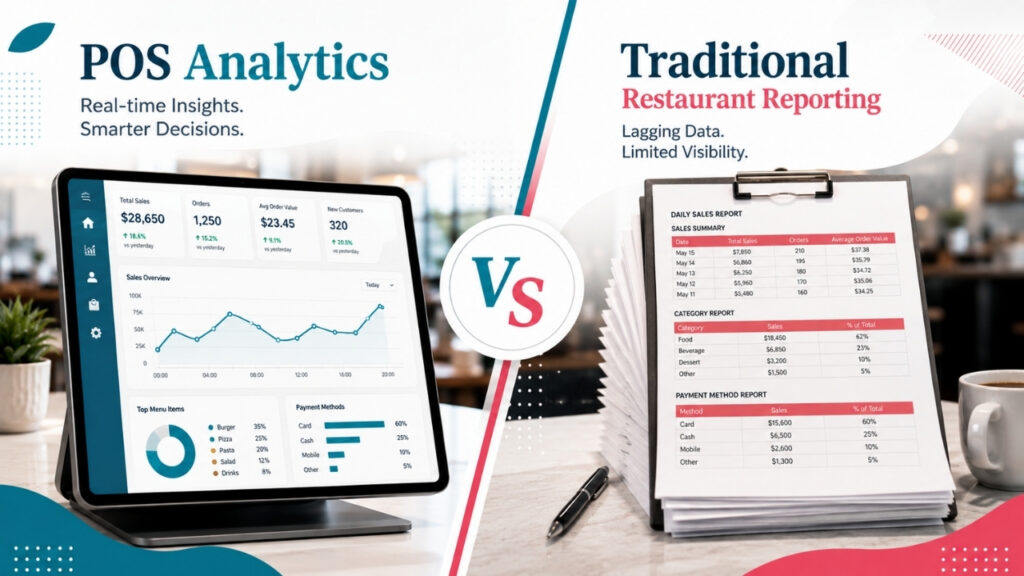
Traditional Restaurant Reporting mainly analyzes past data that helps managers to review completed sales, transactions, labor expenses, inventory, and other performance indicators.
Although these reports are valuable but often require manual analysis and give less visibility into what is happening in real time.
Modern POS Analytics has a wider approach as it connects and analyzes restaurant data to identify customer trends, patterns, and opportunities.
Important areas include Sales Analytics, Menu Performance, Labor Cost Analysis, Inventory Management, Food Cost Analysis, Customer Analytics, Ordering Channel Analytics, Real-Time Analytics, Predictive Analytics, Business Intelligence, and Multi-Location Reporting.
Platforms like Livelytics can help restaurants to convert POS data into actionable insights through advanced analytics and real-time visibility.
The difference becomes especially crucial as restaurants expand to multiple locations, employees, integrate digital ordering channels, and manage more complex daily operations.
Traditional reports explain what happened, while POS analytics can help reveal why performance changed and where action may be needed.
Understanding these differences can help restaurant operators to choose the right approach for improving decision-making, operational efficiency, and long-term profitability.
Also Read: POS Reports Vs Real-Time Analytics
What Is Traditional Restaurant Reporting?
Traditional restaurant reporting involves the process of collecting operational data from a POS system and reviewing it after a specific period, such as a shift, day, week, or month.
These reports help managers understand past performance and maintain accurate business records.
A typical restaurant report may include:
- Total sales and transactions
- Average check size
- Best-selling menu items
- Payment methods
- Discounts, voids, and refunds
- Employee sales
- Table turnover
- Labor costs
These reports provide useful past data for financial reconciliation, accounting, budgeting, compliance, and performance reviews. Managers can compare results across different periods to identify changes in sales, labor costs, and menu performance.
Traditional reporting mainly looks at past performance, offering insights after events have taken place instead of providing real-time visibility into ongoing operations.
For instance, a manager may find that after closing a popular menu time is sold out during peak hours. While the report identifies the missed opportunity, the lost sales cannot be recovered.
Also Read: Types of POS Systems for Restaurants
What Is POS Analytics?
POS analytics involves the process of analyzing data generated by a restaurant’s POS system to identify patterns, trends, performance changes, and opportunities for improvement.
Instead of using the POS only to record transactions, restaurants can use its data as a valuable business intelligence tool for making informed operational decisions.
POS analytics can examine important areas such as:
- Sales performance by hour, location, and daypart
- Average order value and transaction volume
- Menu item performance and category trends
- Employee performance and labor-to-sales ratios
- Food costs and inventory usage
- Discounts, refunds, and payment activity
- Ordering channels and customer purchasing patterns
- Table turnover and operational efficiency
The goal is not just to generate additional reports but to make restaurant data easier to understand and act upon. Analytics can also connect sales information with labor, inventory, and other operational data.
This connected view helps restaurant managers to identify relationships, uncover inefficiencies, track performance, and make more informed decisions about staffing, purchasing, pricing, menus, and profitability.
Also Read: Real-Time Analytics Why Does Your Business Need it
POS Analytics vs. Traditional Reporting: The Key Difference
The main difference between POS analytics and traditional reporting is the way restaurant data is processed and used. Both approaches may depend on the same POS information, but analytics provides faster access, wider connections, and deeper interpretation.
Traditional reporting may show:
- Yesterday’s total sales
- Transaction counts
- Menu performance
- Labor costs
POS analytics can go further by identifying:
- Peak sales periods
- Location-level trends
- Profitable ordering channels
- Labor and sales relationships
- Inventory variances
- Changes in current performance
Traditional reports mainly explain past performance, whereas POS analytics provides deeper insights into the factors driving results and highlights opportunities for restaurant managers to make informed decisions.
This makes POS analytics essential for restaurants that want to take faster, data-driven decisions and improve performance of operations.
Also Read: Benefits of Data-Driven Decision Making
POS Analytics vs. Traditional Reporting: What Restaurants Need to Know
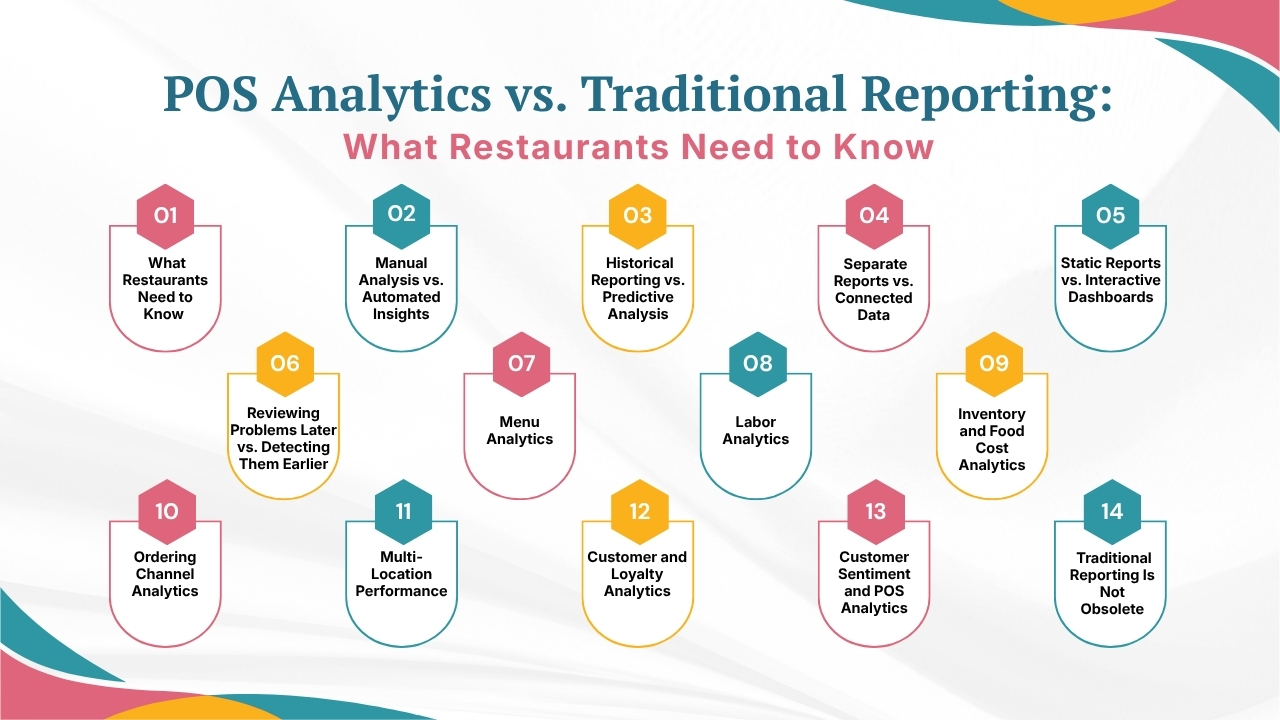
1. Historical Data vs. Real-Time Visibility
Traditional restaurant reporting mainly explains restaurant performance that has already been completed in the past. Such reporting helps managers to review past performance and identify trends in the long-term.
Common reports may include:
- Yesterday’s sales
- Weekly labor costs
- Monthly food costs
- Quarterly revenue
- Previous promotional results
This past data remains essential for budgeting, comparisons, and performance evaluation. However, restaurant operations can change quickly during a shift.
Unexpected customer demand, rising order volumes, staffing changes, or potential inventory shortages may require instant attention. Real-time analytics offers a more current view of restaurant activity.
Real-time analytics provides a more current view of restaurant activity. Depending on the system, managers may monitor:
- Current sales and order volume
- Labor activity
- Inventory movement
- Table activity
- Ordering-channel performance
- Sales compared with targets
Livelytics emphasizes the difference between conventional POS reporting and real-time analytics by highlighting current visibility into areas such as sales, inventory, staff activity, and table performance.
Quicker access to information can help managers to identify issues during a shift and respond before they significantly affect restaurant operations.
Also Read: How Real-Time Dashboard Drive Smart Business Decisions
2. Manual Analysis vs. Automated Insights
Traditional restaurant reporting requires restaurant managers to collect information from different systems and analyze it manually.
A usual manual analysis process may involve exporting POS data, downloading labor reports, reviewing inventory records, updating spreadsheets, calculating percentages, comparing locations, and preparing management summaries.
Although this approach may work for smaller restaurants, but it can become time-consuming when transaction volumes, number of locations, staff, and ordering channels increase.
Common manual tasks include:
- Exporting sales and transaction data
- Reviewing labor and inventory records
- Updating spreadsheets
- Calculating performance ratios
- Comparing locations or time periods
- Identifying unusual changes
- Preparing management reports
Modern POS analytics and AI-based platforms can automate most of the processes by gathering data together from different systems and highlighting crucial patterns.
This allows restaurant managers to analyze through multiple reports, to receive consolidated insights about sales, labor, inventory, and performance in operations.
The practical difference between traditional reporting and automated reporting is simple, traditional reporting presents the numbers, while automated analytics can highlight trends, unusual changes, and areas that require attention of management.
Also Read: Customer Sentiment Analysis Vs Traditional Surveys
3. Historical Reporting vs. Predictive Analysis
Traditional restaurant reporting explains past performance that helps restaurant managers to review completed activities and understand results from past periods.
For instance, a report may show that food expenses increased from 29% to 34% last month. While this identifies a change, managers may need additional analysis to understand its causes.
Advanced analytics can use past and current information to identify patterns that support future planning. Predictive analysis may highlight:
- Increasing weekend demand
- Higher ingredient usage on specific days
- Labor requirements during particular dayparts
- Seasonal changes in menu demand
- Expected increases in delivery orders
- Potential inventory requirements
With these insights restaurants can make better decisions regarding staffing, purchasing, inventory, scheduling, and promotions. But predictive analytics cannot guarantee future outcomes.
If there are any unexpected events, customer behavior, weather, or operational changes can affect results. However, these forecasts should support management decisions instead of replacing them.
The major benefit of POS analytics is offering a more informed basis for making proactive decisions.
Also Read: Predictive Analysis in Restaurants a Game Changer
4. Separate Reports vs. Connected Data
Traditional restaurant reporting often stores important operational data in separate systems. Restaurant managers may be required to review multiple reports and spreadsheets to understand the overall performance of restaurants.
This can make it difficult for restaurants to compare actual revenue, expenses, staffing, and customer activity.
Common data sources include:
- POS: Sales and transaction records
- Inventory systems: Stock levels and ingredient usage
- Labor systems: Employee schedules, hours, and labor expenses
- Ordering platforms: Online and delivery orders
- Customer systems: Loyalty activity and purchasing behavior
POS analytics can bring these sources together to create a more complete view of operations. For instance, a 12% increase in sales may initially appear positive, but further analysis could indicate:
- Labor costs increased by 18%.
- Food costs increased by 10%.
- Discounts increased by 25%.
- Delivery commissions also increased.
- Waste levels became higher.
If restaurants are generating high revenue, it does not mean greater profits. Data that is integrated from different sources helps managers to compare sales with related expenses, that helps them to make informed decisions regarding staffing, inventory, pricing, discounts, and ordering channels.
Also Read: How to Choose the Right Data Analytics Solution
5. Static Reports vs. Interactive Dashboards
Traditional restaurant reports are presented as spreadsheets, PDFs, tables, or downloadable documents. These formats are essential for maintaining records and conducting detailed reviews that allow restaurant managers to analyze large amounts of data to identify essential patterns in the restaurants.
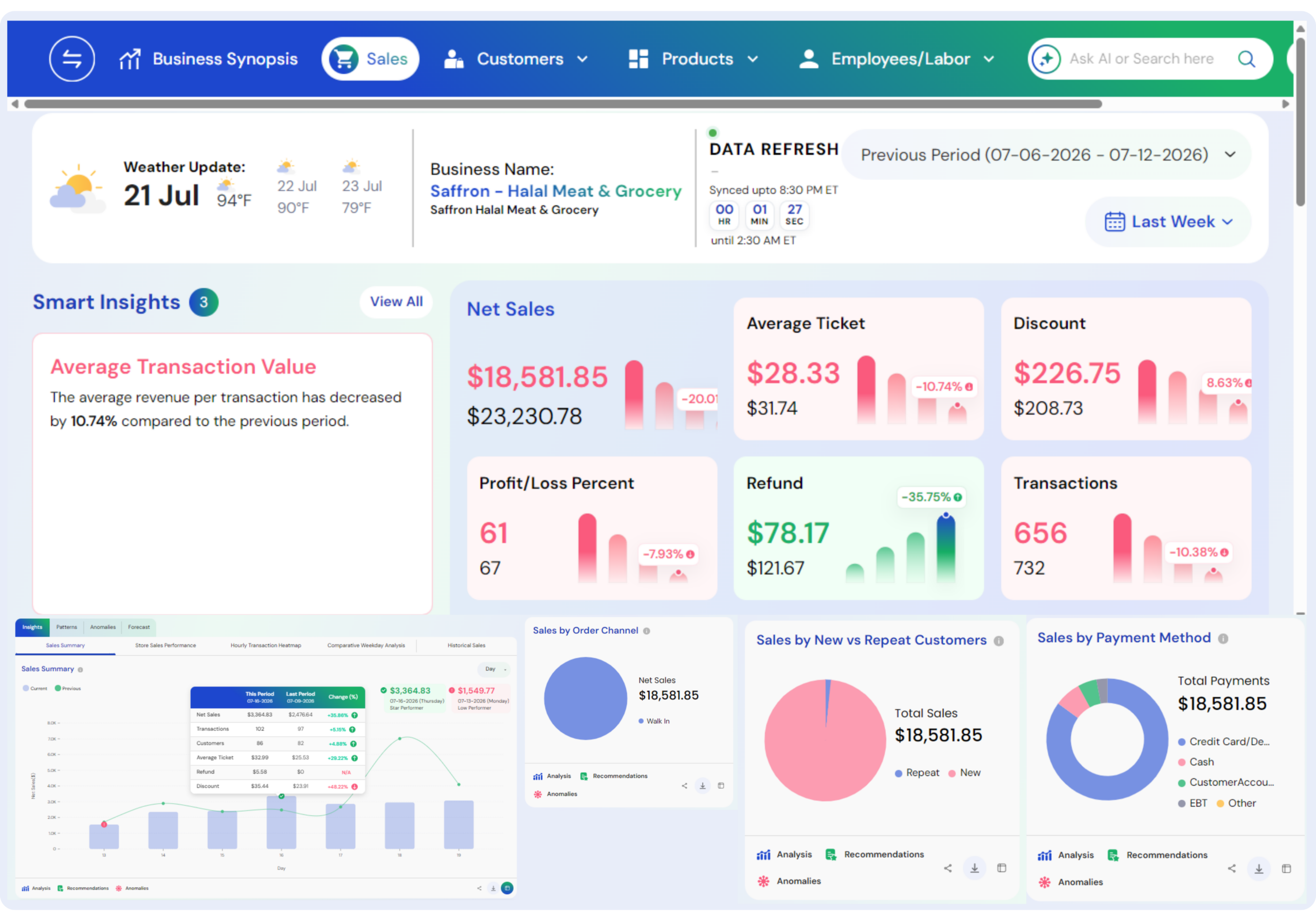
Interactive analytics dashboards can present important performance insights in an accessible format, that includes:
- Charts and graphs
- KPI cards
- Trend lines
- Filters
- Location comparisons
- Daypart analysis
- Drill-down views
- Performance alerts
For instance, rather than reviewing thousands of individual transactions, a manager could instantly see today’s sales, average order value, labor cost percentage, food cost, order volume, and performance against targets.
Dashboard offers a quick overview of operations that allow managers to explore detailed data when necessary.
Livelytics incorporates data visualization and real-time business intelligence to help restaurants interpret operational information more effectively. This can make performance monitoring faster, clearer, and more actionable.
Also Read: Business Intelligence Dashboard for Data Collection
6. Reviewing Problems Later vs. Detecting Them Earlier
Traditional restaurant reports are useful for identifying problems after they have happened. Although a weekly or monthly report may reveal unusual food waste, declining sales, rising labor expenses, excessive discounts, increasing voids, or weak menu performance.
However, by the time these issues appear in a completed report, the restaurant may have already experienced financial losses.
Analytics can provide earlier visibility into operations and help restaurant managers respond during an active shift. For instance, if a restaurant normally sells 80 burgers during Friday dinner but has sold only 30 halfway through the shift, then managers can analyze possible causes.
Potential issues may include:
- Menu item unavailability
- Incorrect pricing
- Display or ordering problems
- Customers choosing alternatives
- Underperforming promotions
Identifying such changes earlier provides managers an opportunity to assess and take corrective action before the problem affects the entire shift. This makes analytics more proactive than conventional reporting.
Also Read: How to Improve Customer Satisfaction in Restaurants
7. Menu Analytics
Menu analytics helps restaurants to understand not about the most-selling items but also know about the products that contribute most to revenue and profitability.
Traditional POS reports may provide basic information like:
- Units sold
- Revenue generated
- Menu rankings
- Average selling price
POS analytics can combine these numbers with ingredient expenses, margins, locations, dayparts, ordering channels, and promotions. For instance, one food item has high sales but also has high ingredient expenses, but the other food items sell less but generate high profit margins.
Restaurants can further evaluate menu performance by:
- Location
- Daypart
- Season
- Ordering channel
- Customer segment
- Employee
- Promotion
- Menu category
Such wider analysis helps restaurant managers to make better decisions regarding prices, menu placement, promotions, recipe changes, and whether certain items should be retained, repositioned, or removed.
Also Read: Optimizing a Restaurant Dashboard With AI Powered Data Analytics
8. Labor Analytics
Labor analytics enables restaurants to understand how staffing levels affect sales, service, and operating expenses. Since labor is an important controllable expense, tracking employee activity along with revenue can help restaurant managers to identify inefficient scheduling and improve workforce planning.
Traditional labor reports generally provide information about hours worked, wages, overtime, labor costs, and employee sales.
POS analytics can connect these figures with actual restaurant activity, allowing managers to compare:
- Labor cost vs. sales
- Employees scheduled vs. order volume
- Labor percentage by daypart
- Sales per labor hour
- Performance across locations
For instance, a restaurant may find that staffing levels are too high during slower periods but insufficient during busy shifts. Reviewing labor and sales together can help managers to adjust schedules as per actual customer demand.
The important consideration is whether staffing levels effectively match customer demand and revenue throughout each shift. This approach can help restaurants to control labor costs while maintaining adequate staffing and service quality during peak hours.
Also Read: How Data Analytics Improve the Measurement of Employee Performance
9. Inventory and Food Cost Analytics
Through inventory and food cost analytics restaurants can understand the way ingredients are purchased, consumed, and converted into food menu sales.
Traditional inventory reports can find levels of stock and usage, but POS analytics provides more deeper insights by comparing expected food consumption with actual ingredient usage.
For instance, if a restaurant purchases 100 units of an ingredient and sales data indicates that 70 units should have been consumed, but actual usage reaches 85 units, the 15-unit difference requires investigation.
Possible causes may include:
- Food waste
- Over-portioning
- Incorrect recipes
- Spoilage
- Theft
- Recording errors
Analytics can also identify whether these variances occur repeatedly across different operational areas, such as:
- Locations
- Employees
- Menu items
- Shifts
- Days
- Suppliers
- Time periods
When restaurants identify recurring patterns, then restaurant owners can analyze the reasons behind unusual ingredient usage, improve food portion control, reduce food waste, and improve managing purchasing decisions.
Also Read: AI for Restaurant Inventory
10. Ordering Channel Analytics
Ordering channel analytics helps restaurants to understand how different sales channels contribute to revenue and profits. Modern restaurants may receive orders through several sources which includes:
- Dine-in
- Takeout
- Restaurant websites
- Mobile apps
- Delivery
- Self-service kiosks
- Catering
- Third-party marketplaces
Traditional POS reports can show the amount of revenue each channel generates, but revenue alone does not offer a complete visibility into profits.
For instance, dine-in and delivery might each generate $20,000 in sales, yet their operating expenses can be very different.
Delivery orders may involve:
- Marketplace commissions
- Packaging expenses
- Additional labor
- Discounts
- Promotional fees
POS analytics can compare channel revenue with related expenses, providing managers a clearer understanding of true profits of each channel.
This data can support better decisions about promotions, pricing, staffing, packaging, and channel strategy that help restaurants to focus on channels that generate sustainable profits.
Also Read: How Livelytics Can Help Restaurants Boost Revenue
11. Multi-Location Performance
Managing performance across multiple restaurant locations becomes increasingly difficult when information is stored in separate reports and spreadsheets.
A growing restaurant group may need to compare many operational and financial metrics across every location to identify differences and improvement opportunities.
Important metrics may include:
- Sales and AOV
- Labor cost percentage
- Food costs
- Menu performance
- Discounts and refunds
- Inventory levels
- Customer activity
- Ordering channels
Centralized POS analytics dashboards can make comparisons of each performance easier by bringing location-level data into a centralized view of dashboards.
For instance, one location may generate higher sales but generate lower profits due to increased labor or food costs. Another location may have lower revenue but high profit margins.
Cross-location restaurant analytics helps restaurant managers to compare locations, identify performance gaps, detect operational challenges, and apply successful strategies across the business.
When restaurant groups increase, this approach supports making consistent decisions that helps to maintain efficiency in operations across multiple locations.
Also Read: Customer Sentiment for Multi-Location Businesses
12. Customer and Loyalty Analytics
Customer and loyalty analytics helps restaurants to understand customer purchasing behavior and build stronger relationships with their customers.
Based on the POS system and available integrations, restaurants can analyze customer information like:
- Visit frequency
- Average spending
- Purchase history
- Ordering preferences
- Loyalty program activity
- Response to promotions
- Customer retention
Traditional reports may show the number of loyalty transactions or total rewards redeemed. Advanced analytics can offer deeper insights by identifying behavioral customer patterns across different customer groups.
For instance, restaurants may discover that frequent visitors have higher average order values or respond more positively to specific promotions.
These insights can help restaurants to develop more targeted loyalty campaigns, personalize offers, improve customer retention, and encourage repeat visits.
Managers can also compare customer behavior across locations and ordering channels to identify valuable segments. However, customer information should be collected, stored, and analyzed responsibly, with appropriate privacy, security, and data-protection practices.
Also Read: Restaurant Profit Margin Analytics Tool to Boost Profits
13. Customer Sentiment and POS Analytics
POS analytics mainly focuses on transaction behavior, while customer sentiment analysis examines how customers perceive their experiences.
Combining both types of information can provide restaurants with a more complete understanding of performance.
POS data may indicate:
- Sales declined by 8%
- Average order value remained stable
- Repeat visits decreased
Customer feedback may identify related concerns such as:
- Longer wait times
- Incorrect orders
- Poor service experiences
- Menu availability problems
When these datasets are analyzed together, then restaurant managers can go beyond simply identify a decline in sales and analyze reasons behind it.
For instance, reducing sales and fewer repeat visits and increasing customer complaints regarding long wait times indicates a service-related issue.
Such a connected approach makes restaurant analytics actionable by helping restaurant managers to identify potential reasons, focus on operational improvements, and understand the way customer experiences can affect customer revenue and attention.
14. Traditional Reporting Is Not Obsolete
The growth of POS analytics does not make traditional restaurant reporting unnecessary. Conventional reports continue to offer a reliable record of financial and operational activity, which makes them essential for documentation, compliance, and past comparisons.
Restaurants should view POS analytics as an enhancement instead of a complete replacement for established reporting processes.
Traditional reports remain useful for:
- Financial reconciliation
- Accounting and auditing
- Tax preparation
- Payroll verification
- Historical performance analysis
- Budgeting and forecasting
- Management reviews
- Performance documentation
Analytics provides deeper insights by helping restaurant managers to understand patterns, track performance trends, and respond to operational changes more quickly and effectively.
A restaurant can therefore use traditional reports to maintain accurate records while using analytics dashboards to understand performance and support faster decisions.
The most effective approach is to combine both methods. Traditional reporting gives the factual details, while POS analytics adds context, visibility, and actionable insights. Together they form a stronger framework for managing restaurant operations, expenses, and profits.
Conclusion
POS analytics and traditional restaurant reporting offer unique approaches that work together to offer a more complete view of business performance.
Traditional reporting remains valuable for maintaining past records, reviewing financial performance, completing reconciliations, and understanding what happened during a specific period.
However, it becomes limited when managers require faster insights, deeper analysis, or information from multiple operational systems.
POS analytics takes restaurant data further by connecting sales, labor, inventory, menu customers, and ordering channel information. This can help managers to identify trends, detect unusual changes, compare locations, evaluate profits, and support more proactive decisions.
Rather than simply revealing that performance of restaurants changed, restaurant analytics can help to uncover the factors contributing to that change.
For restaurants with growing operations, multiple locations, and increasingly complex sales channels, this additional visibility can be especially valuable.
Platforms like Livelytics can support this transition by combining POS reporting with analytics and business intelligence capabilities.
Ultimately, restaurants do not need to abandon traditional reporting. The stronger approach is to use reliable reports as the foundation while applying analytics to convert operational data into actionable insights that helps restaurants to improve efficiency, profits, and long-term growth.
If you still have any query about POS analytics vs traditional restaurant reporting, then you may book a free demo at Livelytics and we are more than happy to assist you.