In today’s highly competitive restaurant industry, it is essential for restaurant owners and staff to know how to improve customer satisfaction in restaurants to attract new diners, increase repeat visits, and build a strong reputation for your brand.
Modern customers don’t just expect delicious food, but they also expect exceptional services, quick response times from customers, personalized experiences, clean dining spaces, and smooth digital interactions.
Restaurants that consistently fulfill these customer expectations are more likely to receive positive reviews, strengthen restaurant customer satisfaction, and create long-term customer loyalty.
For restaurants to deliver an excellent restaurant customer experience requires consistent improvements across every phase of the customer journey.
These small improvements include greeting guests warmly and serving high-quality meals to reduce waiting times and responding professionally to every customer feedback, every such interaction with customers influences customer perceptions.
By investing in restaurant customer service, staff training, menu optimization, and modern restaurant technology can highly improve guest satisfaction while improving operational efficiency.
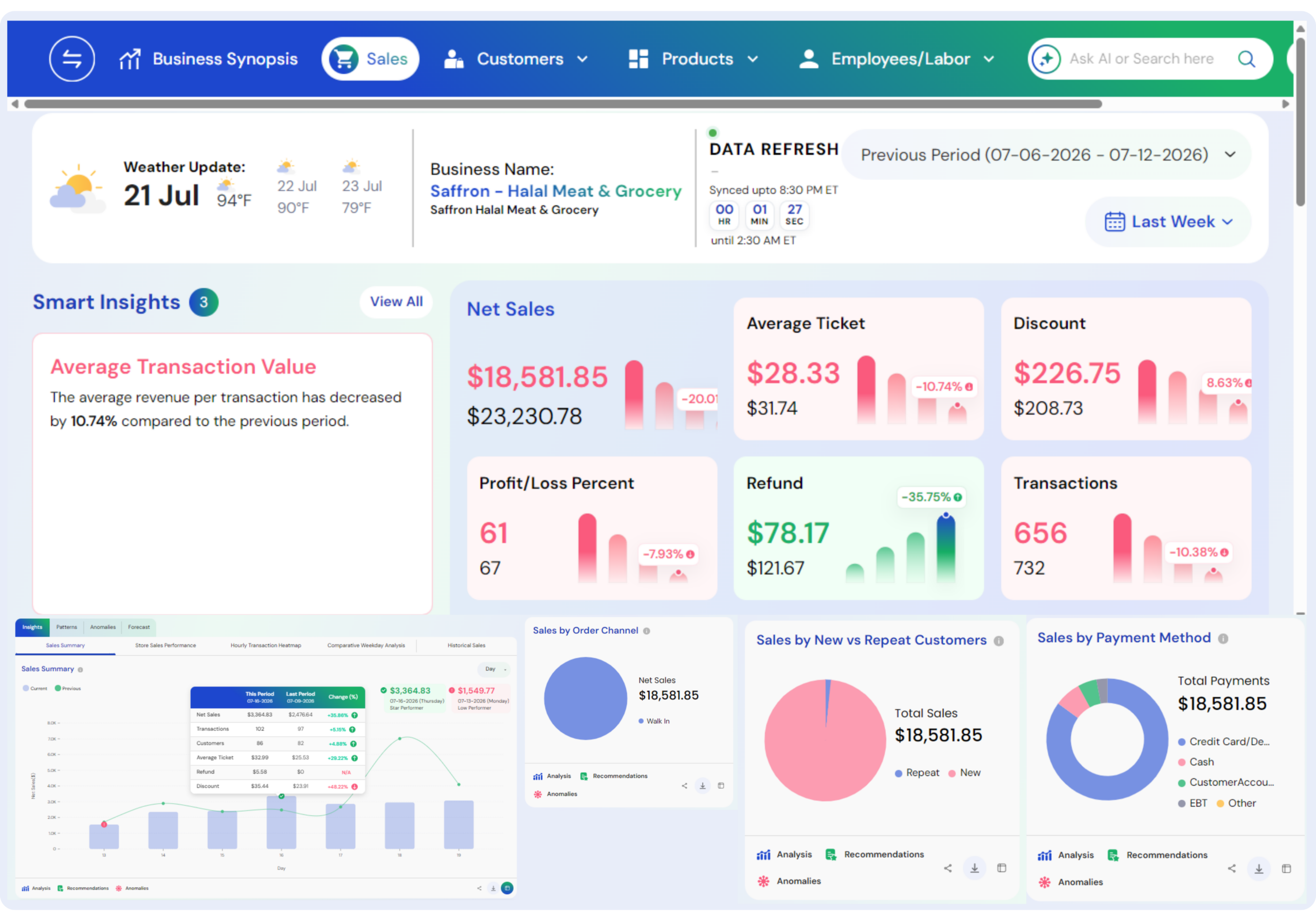
Data is also essential for helping restaurants to understand customer behavior and make informed decisions. Through Advanced restaurant analytics platforms like Livelytics restaurants can gain valuable insights into sales patterns, customer preferences, menu performance, and service efficiency.
By analyzing real-time data, restaurants can identify improvement opportunities, personalize customer experiences, and optimize daily operations.
In this blog, we will walk you through how to improve customer satisfaction in restaurants using practical strategies, proven management techniques, and data-driven insights.
Whether you own a cafe, fine-dining restaurant, quick-service outlet, or multi-location chain, these actionable tips will help you to improve restaurant customer loyalty, increase positive reviews, increase guest satisfaction, improve restaurant customer retention, and create memorable dining experiences that encourage customers to return again and again.
Also Read: How to Use Customer Feedback to Grow Your Business
Why Customer Satisfaction Matters in Restaurants
Maintaining high customer satisfaction levels is essential for restaurants to ensure long-term success of your restaurant. It affects different aspects of restaurants like repeat visits, online reviews, revenue growth, and brand reputation.
Because if restaurants are successful in gaining satisfied customers then they do not leave after enjoying a meal instead develop trust in your restaurant and leave positive reviews about your restaurant.
Restaurants with high customer satisfaction often experience:
- Higher customer retention
- Increased repeat visits
- Better online ratings and reviews
- Higher average order values
- Greater word-of-mouth referrals
- Improved staff morale
- Stronger brand reputation
- Increased profitability
Regular research consistently shows that retaining existing customers costs less than acquiring new customers. Even if restaurants make a small improvement in customer retention can generate substantial long-term revenue.
Satisfied customers are also strong marketers for your restaurants as they will leave positive reviews, and also spread positive word-of-mouth. And when customers find positive recommendations about your restaurant on different platforms like Google Reviews, Facebook, and TripAdvisor, it influences potential diners more than traditional advertising.
Also Read: Customer Satisfaction Metrics
What Influences Customer Satisfaction in Restaurants?
Customer satisfaction is influenced by the experience that customers have with your restaurant. Every aspect like food quality, speed of service, every detail causes an overall positive dining experience.
And restaurants that perform well in different aspects like food quality, exceptional services are more likely to build customer loyalty, encourage repeat visits, and gain positive online reviews.
Some of the key factors that influence customer satisfaction include:
- High food quality and consistently good food taste
- Friendly and attentive staff
- Fast and efficient services
- Clean dining areas and restrooms
- Comfortable ambience and seating
- Transparent pricing
- Attractive food menu options
- Easy ordering and payment processes
- Accurate order fulfilment
- Personalised customer service
- Quick complaint resolution
- Consistent service across every customer visit
Successful restaurants always focus on improving customer satisfaction metrics, and thereby giving memorable experiences to customers encouraging guests to return.
Also Read: Restaurant Review Sentiment Analysis
Effective Tips to Improve Customer Satisfaction in Restaurants
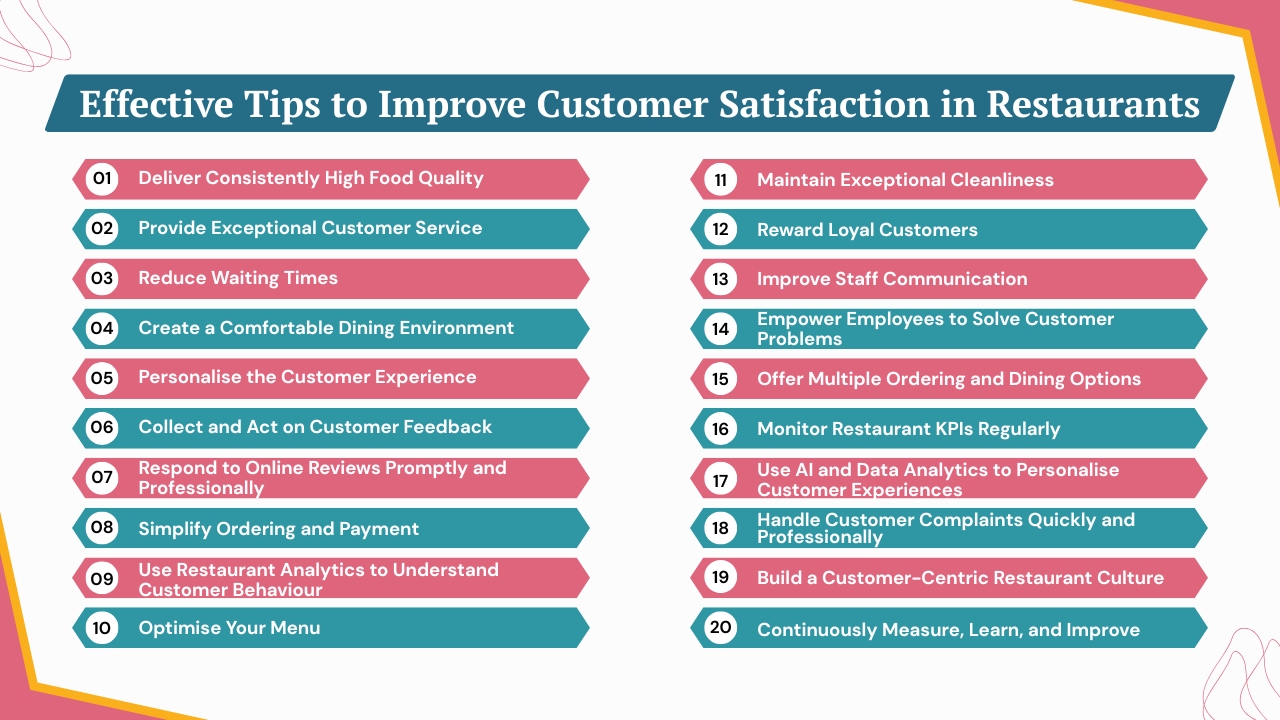
1. Deliver Consistently High Food Quality
Providing high quality food to customers is essential for restaurants to maintain high customer satisfaction levels. Irrespective of the restaurant decor or technology implemented, customers will not return back to your restaurant if your food quality fails to meet customer expectations.
Consistently serving high quality food to customers is essential for restaurants. Guests expect their favorite dishes to taste the same every time they visit. If they find any difference in food taste, portion size, or food presentation can negatively affect customer satisfaction levels.
To maintain high food quality:
- Use fresh ingredients.
- Standardise recipes.
- Train kitchen staff thoroughly.
- Track food preparation
- Maintaining proper food storage
- Conduct regular food quality checks.
Restaurants have to make seasonal updates as it keeps their customers interested while also showcasing fresh food ingredients and meals. Restaurants should regularly review customer feedback to identify dishes that require continuous improvement and menu optimization.
Also Read: How to Respond Negative Customer Reviews
2. Provide Exceptional Customer Service
Restaurants that offer exceptional customer service are most likely to offer memorable dining experiences encouraging guests to visit your restaurants again.
Every interaction between staff and customers affects the way customers perceive your restaurant.
Some of the important exceptional customer service practices to be implemented include greeting guests warmly, answering their queries confidently, and showing genuine enthusiasm for helping customers.
Ensure that every staff member should understand the menu thoroughly so that they can recommend dishes based on customer preferences and dietary preferences.
Professional service also includes:
- Listening carefully to customer requests
- Responding promptly
- Remaining polite during busy periods
- Resolving issues professionally
- Thanking guests before they leave
By offering regular training to staff, improves the way staff communicate with diners, gain customer trust, and problem-solving skills. Empowering staff to resolve small customer problems without waiting for management approval also creates quicker and more satisfying resolutions.
Restaurants known for providing excellent customer service often achieve stronger customer loyalty over competitors with similar food quality.
Also Read: How AI Can Analyze Customer Feedback
3. Reduce Waiting Times
One of the most common reasons customers leave dissatisfied restaurants is because of long waiting times. If they experience food delays at any phase of their dining experience can negatively affect customer perceptions.
Common waiting issues include:
- Waiting for a table
- Waiting to place an order
- Slow food preparation
- Delayed drink service
- Long payment queues
While restaurants can reduce waiting times by improving kitchen efficiency, predicting busy hours, scheduling adequate staff, and using digital ordering systems.
Restaurants must allow customers to book tables online which allows to reduce waiting times and improves the overall dining experience for customers even during busy dining hours.
Kitchen Display Systems(KDS) improves communication between servers and chefs, and thereby helping restaurants to deliver restaurant orders to reach customers instantly.
Using restaurant analytics through Livelytics, managers can identify peak hours, average service times, and operational challenges. With these insights restaurants can improve staffing schedules and improve service speed without compromising the quality of food. Though customers appreciate quick service, they value efficient, accurate service even more.
Also Read: Why Customer Reviews are Important for Business Growth
4. Create a Comfortable Dining Environment
The overall dining environment of a restaurant highly influences customer satisfaction levels. Guests often not just notice food served but also pay attention to cleanliness, decor, seating.
A welcoming dining environment should include:
- Comfortable seating
- Clean tables
- Pleasant lighting
- Suitable background music
- Well-maintained restrooms
- Attractive interior décor
- Comfortable temperature
- Organised table layouts
Restaurants by ensuring regular cleaning schedules and maintenance checks ensures that your restaurants consistently meet customer expectations.
By implementing improvements such as fresh flowers, seasonal decorations, or updated furniture, can make your restaurant feel more welcoming and encourage customers to spend more time enjoying their meals.
Also Read: How Businesses Can Improve Customer Satisfaction
5. Personalise the Customer Experience
Modern customers appreciate restaurants that recognize food preferences of customers and make them feel valued.
Personalization can include:
- Greeting returning customers by name
- Remembering favourite dishes
- Celebrating birthdays
- Offering customised recommendations
- Providing personalised promotions
- Recognising loyalty programme members
With the most advanced technology, implementing personalization becomes easy for customers unlike before. Restaurant CRM systems and platforms like Livelytics analyze customer behavior, visit frequency, purchase history, and ordering preferences, which helps to offer personalized experiences to customers which strengthens relationships with customers. Providing personalized service increases customer satisfaction while encouraging repeat visits.
Also Read: How to Track Customer Feedback in Real Time
6. Collect and Act on Customer Feedback
Customer feedback offers valuable insights about the aspects that your restaurant is offering well and the areas where your restaurant needs improvements.
Encourage guests to share their opinions through:
- Google Reviews
- QR code surveys
- Email surveys
- SMS feedback
- Social media
- Table-side feedback
For restaurants, gathering customer feedback is only the first step. Successful restaurants analyze customer comments, identify recurring problems, and implement meaningful improvements.
For instance, if multiple customers mention that they receive slow service during weekends, managers can adjust staffing schedules or optimize kitchen operations.
Livelytics helps restaurants to combine customer feedback with operational data, which makes it easier to identify trends, track customer satisfaction levels, and make informed business decisions.
Also Read: How to Use Review Monitoring to Manage Your Online Reputation
7. Respond to Online Reviews Promptly and Professionally
Online reviews that customers leave about a restaurant has become an essential factor affecting the reputation of a restaurant. Today most consumers before visiting a restaurant , many customers check reviews on Google, Facebook, and other platforms to understand experiences of past diners.
Positive customer reviews build trust among people, while negative reviews can discourage potential customers if they are ignored.
When restaurants respond to reviews, it shows that restaurants value their customer feedback and are committed to improving your customer service. Restaurant owners and staff must be thankful to customers for positive reviews and acknowledge their support.
And if restaurants receive negative reviews from customers, then restaurant owners and management must be professional, apologize whenever appropriate, address customer problems, and explain the steps to resolve customer problems.
They must avoid using defensive or argumentative responses, as they can damage your reputation further.
Restaurants should also track review patterns to identify recurring customer problems. For instance, if several customers mention slow service or inconsistent food quality, it shows operational problems that require customer attention.
Platforms like Livelytics help businesses to combine customer reviews with operational data, which makes it easier to identify restaurant patterns and improve the overall guest experience.
Also Read: How to Use Customer Feedback to Grow Your Business
8. Simplify Ordering and Payment
Modern diners expect a convenient dining process. So, if the ordering process is complicated or lengthy, payment procedure can negatively impact an otherwise enjoyable dining experience.
Restaurants can improve customer satisfaction by making ordering and payment quick, accurate.
Useful technologies include:
- QR code menus
- Digital ordering systems
- Self-service kiosks
- Contactless payments
- Mobile payment options
- Online ordering
- Split bill functionality
- Digital receipts
These solutions reduce customer waiting times, reduce order mistakes, and allow staff to focus on providing excellent customer service.
Integrating your POS system with Livelytics enables restaurant managers to track ordering patterns, payment patterns, and service efficiency, helping to identify opportunities to smooth operations further.
Also Read: Best Social Media Management Tools for Business
9. Use Restaurant Analytics to Understand Customer Behaviour
Successful restaurants no longer depend on guesswork to improve customer satisfaction. Rather they use data to understand customer preferences, customer purchasing patterns, and operational performance.
Restaurant analytics platforms such as Livelytics provide valuable insights into:
- Peak business hours
- Customer visit frequency
- Average order value
- Best-selling menu items
- Slow-moving products
- Customer retention rates
- Table turnover
- Staff productivity
- Sales performance
- Revenue trends
For instance, analytics may reveal that certain menu items perform exceptionally well during weekends but receive less orders during weekdays. Restaurants can use these insights to create targeted promotions, adjust staffing levels, and optimize inventory.
Restaurants making decisions based on data-driven decisions reduce food waste, improve operational efficiency, and improve the customer experience.
Also Read: How to Add Business to Apple Maps
10. Optimise Your Menu
A well-designed menu does more than display food items, it influences purchasing decisions and improves the dining experience.
Customers should be able to find dishes instantly without feeling overwhelmed by too many choices. With clear descriptions, logical categories, and attractive layouts make menus easier to navigate.
Best practices include:
- Highlight signature dishes
- Use high-quality food descriptions
- Remove poor-performing items
- Include dietary information
- Offer vegetarian and vegan options
- Display allergen details
- Use appealing menu design
- Update seasonal specials
Restaurants should regularly analyze menu performance using Livelytics to determine the dishes that generate the highest profits and customer satisfaction.
Menu engineering helps restaurants to increase profits while offering customers the dishes that they truly enjoy.
Also Read: Optimizing a Restaurant Menu With AI Powered Data Analytics
11. Maintain Exceptional Cleanliness
Maintaining cleanliness directly influences customer trust and customer satisfaction. Serving high-quality good food to customers cannot compensate for dirty tables, unpleasant restrooms, or dirty kitchens.
Restaurants should maintain high hygiene standards by ensuring:
- Dining areas remain spotless
- Tables are cleaned promptly
- Floors are regularly sanitised
- Restrooms are inspected frequently
- Staff maintain professional appearance
- Kitchen equipment is sanitised
- Food storage meets safety standards
When customers witness cleanliness in your restaurants, it ensures customers that food is prepared professionally and safely. Restaurants by conducting routine inspections and staff training helps them to maintain high hygiene standards consistently.
Also Read: Innovative ideas for Food Waste Management in Restaurants
12. Reward Loyal Customers
Restaurants by providing customer loyalty programs encourage customers to repeat visits and improve long-term relationships with customers.
Offering customer loyalty programmes to customers encourages them for repeat visits and strengthens long-term relationships with customers.
For restaurants instead of consistently attracting new customers, successful restaurants invest in retaining their existing customers.
Popular loyalty rewards include:
- Points programmes
- Birthday discounts
- Free desserts
- Exclusive promotions
- Early access to new menu items
- Referral rewards
- VIP memberships
- Personalised offers
Restaurants using customer data collected through platforms like Livelytics, can create targeted rewards based on customer behavior rather than generic promotions. Offering loyalty programs generate higher customer engagement and stronger customer retention levels.
Also Read: How AI Revolutionizes Customer Experience in Restaurant Industry
13. Improve Staff Communication
Improving communication among staff while they handle customers leads to smoother operations and better customer service.
Any form of miscommunication between servers, kitchen staff, and managers often causes:
- Incorrect orders
- Delayed meals
- Customer frustration
- Food waste
- Poor reviews
Restaurants should establish clear communication procedures by:
- Holding daily team briefings
- Using kitchen display systems
- Providing regular staff training
- Sharing customer feedback
- Defining responsibilities clearly
Every staff member by clearly understanding their responsibilities and working together effectively, helps restaurants to deliver faster service, improve order accuracy, reduce mistakes, and create a smoother, more satisfying dining experience for every customer.
Also Read: How Data Analytics Improve the Measurement of Employee Performance
14. Empower Employees to Solve Customer Problems
Restaurants must empower employees to resolve customer problems immediately which can highly improve guest satisfaction levels.
If the employees do not require management approval for every complaint, staff should be trained to handle common situations professionally.
Examples include:
- Replacing incorrect orders
- Offering complimentary desserts
- Providing discount vouchers
- Resolving billing issues
- Apologising sincerely
When staff quick resolutions to customer problems shows that the restaurant values its customers. Managers should encourage staff to focus on finding resolutions rather than focusing on who is responsible for this problem.
Well-trained staff members create memorable customer experiences that turn dissatisfied guests into loyal customers.
Also Read: Customer Sentiment Analysis Vs Traditional Surveys
15. Offer Multiple Ordering and Dining Options
Today’s customers expect restaurants to offer multiple ordering and dining options. Because many guests still enjoy dining in, others prefer takeaway, delivery, or ordering food through a mobile app.
Restaurants by providing multiple ordering options allowing customers to choose the experiences that are suitable for fulfilling customer needs, increasing customer convenience, and increasing overall customer satisfaction.
Consider offering:
- Dine-in service
- Online ordering
- Mobile ordering
- QR code menus
- Self-service kiosks
- Takeaway
- Home delivery
- Click-and-collect
- Contactless payment options
Restaurants should track every ordering channel and are able to provide the same level of quality and service. It means that customers ordering food online should also receive the same food quality and also pay attention to food orders when someone is dining in.
With restaurant analytics platforms like Livelytics, restaurants can track customer preferences across different ordering channels, helping businesses to understand which services are most popular and where improvements are needed.
Also Read: How Restaurant Data Analytics Helps Increase Profit Margin
16. Monitor Restaurant KPIs Regularly
Without tracking KPIs regularly, customers cannot track customer satisfaction levels. Successful restaurant owners by tracking key performance indicators(KPIs) to analyze customer experiences with your restaurants and improve efficiency in operations.
Important restaurant KPIs include:
- Customer Satisfaction Score (CSAT)
- Net Promoter Score (NPS)
- Customer Retention Rate
- Average Order Value
- Table Turnover Rate
- Average Waiting Time
- Online Review Rating
- Complaint Resolution Time
- Food Waste Percentage
- Repeat Customer Rate
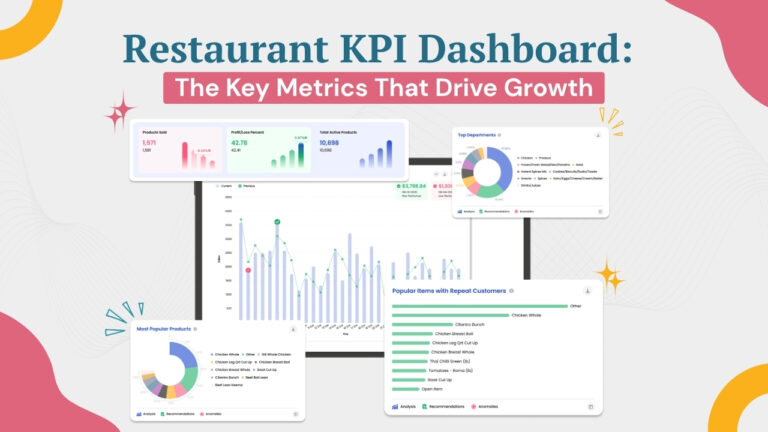
Restaurants instead of manually collecting data from multiple systems, must use platforms like Livelytics to combine POS data, sales reports, customer feedback, and operational metrics into a single dashboard.
Such integration helps managers to make informed decisions instantly and identify opportunities to improve customer satisfaction levels and business performance.
Tracking important restaurant KPIs regularly helps managers to identify patterns before they become serious customer problems and thereby allowing restaurant owners to make proactive improvements rather than being reactive.
Also Read: How to Setup KeyPerformance Indicators KPIs for Your Business
17. Use AI and Data Analytics to Personalise Customer Experiences
Artificial intelligence has completely changed the way the restaurant industry operates by enabling businesses to better understand customer behavior and deliver personalized experiences.
AI tools help restaurants to analyze customer data to recommend menu items, predict food purchasing, understand customer behavior, and create targeted promotions based on past visits.
Instances of AI applications include:
- Personalised menu recommendations
- Predictive demand forecasting
- Smart inventory management
- Automated marketing campaigns
- Customer segmentation
- Dynamic pricing strategies
- Intelligent reservation management
Livelytics helps restaurants to convert large amounts of operational and customer data into practical insights. It lets restaurants identify changes in customer preferences, busy dining hours, and purchasing patterns. Restaurant owners can make smarter decisions to improve guest satisfaction while increasing efficiency of your operations.
Though implementing AI does not replace good hospitality, it improves hospitality by helping staff to deliver more personalized and efficient customer service.
Also Read: Business Intelligence & Data Analytics Services
18. Handle Customer Complaints Quickly and Professionally
At times even the best restaurants receive customer complaints. But the way restaurants handle customer complaints is also essential. Staff members by providing a fast, good response can turn even a dissatisfied customer into a loyal customer.
Follow these steps when handling complaints:
- Listen carefully to customer complaints without interrupting.
- Thank the customer for their feedback
- Apologize sincerely whenever it is appropriate
- Investigate the issue quickly
- Provide a good solution
- Follow up with customers to ensure customer satisfaction
Staff members must avoid arguing with customers or dismissing problems faced by customers. As every complaint from a customer is an opportunity for restaurants to identify weakness and improve their operations.
Also Read: Leveraging AI to Collect Customer Insights
19. Build a Customer-Centric Restaurant Culture
Customer satisfaction should be a part of your restaurant’s culture instead of being the responsibility of only a single employee or department. Every team member, whether chefs and servers, managers, and hosts plays a crucial role in delivering exceptional experiences.
To build a customer-focused culture:
- Train employees regularly.
- Celebrate excellent customer service.
- Encourage teamwork.
- Share customer feedback with staff.
- Reward outstanding performance.
- Empower employees to make decisions.
- Promote continuous improvement.
When staff understand the importance of customer satisfaction, then feel encouraged to deliver exceptional services and the guests may notice the difference.
Strong leadership also plays an important role. Restaurant managers should set an example by consistently showing professionalism, respect, and commitment to customer care.
Also Read: How to Use AI in Restaurant Business
20. Continuously Measure, Learn, and Improve
Customer expectations keep changing, which means restaurants must continuously adapt to changing needs of customers to remain competitive.
Successful restaurants regularly review their performance by analyzing customer feedback, operational data, sales reports, and market trends.
Areas for continuous improvement include:
- Food quality
- Menu performance
- Staff training
- Service speed
- Customer loyalty
- Marketing campaigns
- Pricing strategies
- Technology adoption
Instead of depending only on assumptions, businesses should use restaurant analytics platforms like Livelytics to track performance in real time.
When restaurants have access to accurate insights, restaurant owners can identify opportunities, solve customer problems quickly, and make data-driven decisions that improve customer satisfaction and long-term profits. With continuous improvement in operations ensures your restaurant remains competitive in a highly demanding marketplace.
Conclusion
For restaurants providing outstanding customer satisfaction needs more than serving good food. Diners today expect quick service, friendly staff, clean ambiences, personalized experiences, convenient food ordering options, and consistent food quality every time they visit.
Restaurants that focus on these aspects have high chances to build long-term relationships with customers, gain positive reviews, and increase repeat business.
Technology has also become a crucial driver for high customer satisfaction levels. With many solutions like digital ordering, contactless payments, AI-based tools, and restaurant analytics helps businesses to better understand customer behavior and improve daily operations.
Improving customer satisfaction is not just a one-time task but an ongoing commitment to continuous learning and improvement. By listening to customer feedback, tracking performance, empowering employees, and adopting modern technology, restaurants can create memorable dining experiences that encourage loyalty and long-term growth.
Restaurants that combine exceptional hospitality with data-driven decision-making will be well equipped to flourish in the competitive restaurant industry.
If you still have any query about how to improve customer satisfaction in restaurants then you may Book a Free Demo at Livelytics and we are more than happy to assist you.