Introduction:
In today’s hyper-connected customer-centric world, customers are regularly sharing their experiences whether through online reviews, social media posts, or direct feedback.
For multi-location businesses, this feedback creates a goldmine of insights – but also carries a complex challenge. Then, how do you track, interpret, and act on thousands of customer sentiments across several or even hundreds of locations?
Customer sentiment analysis provides a solution. Implementing AI-powered tools such as Livelytics to analyze text, tone, and emotion in feedback, businesses can interpret what customers are feeling – not just what they are saying.
So, Sentiment analysis tools help brands that operate in multi-locations with different cultures, expectations, and service standards to determine the emotional tone, sentiment expressed for your product or service.
So, the pressure is immense – for every customer interaction can make or break your brand’s reputation. For a single negative experience in one location can easily spread among local communities and damage brand trust. While, a positive trend in any other region may reveal scalable best practices.
Without a unified system to track and compare customer feelings across locations, businesses struggle to see where issues are arising – or where opportunities are being missed.
What makes sentiment analysis tools crucial for multi-location businesses is its ability to bring clarity to chaos. It helps to determine underperforming branches, spotlight standout teams, and fine-tune customer experiences on the basis of real emotional data.
Multi-location customer feedback helps to gather customer opinions from different store locations to improve localized service and consistency.
Through this blog we will explore the unique challenges of managing sentiment at scale – and more importantly, the strategies and technologies that can turn those challenges into opportunities for growth, consistency, and customer loyalty.
Also Read: Boosting Brand Loyalty With Customer Sentiment Analysis
Rise of Digital Sentiment Tracking:
As customer interactions increasingly shift online, so does the requirement for smarter ways to understand them. Traditional techniques like comment cards, quarterly surveys, and call transcripts are no longer fast or scalable enough.
Today, the rise of digital sentiment tracking is transforming how businesses listen to their customers, especially across multiple locations.
Digital sentiment tracking uses advanced technologies like natural language processing(NLP) and machine learning to analyze unstructured text from emails, chats, online reviews, and social media.
Such tools not just interpret what customers say, but also how they feel – determining customer tones like frustration, satisfaction, confusion, or delight.
With customers leaving feedback across dozens of platforms in real time, this capability is essential. Businesses can no longer afford to consider feedback as static data, they must capture and also react to it dynamically.
With sentiment analysis tools, you can capture issues as they surface – before they escalate – and uncover the strategies that are working in one region, all in real time.
Livelytics emphasizes that sentiment analysis tools offer real-time insights that can alert management to emerging issues among customers before they escalate, or highlight what’s working well in specific regions.
For multi-location businesses, the advantage is even greater. One location may be receiving praise for staff friendliness, while another location faces mounting complaints about cleanliness. So, without a centralized sentiment tracking system, these insights are lost without any vital use.
The rise of digital sentiment tracking allows brands to track emotional feedback at scale, across every location, and respond with precision. It turns scattered opinions into measurable data, helping the entire brand, staying ahead of sentiment is not optional – it’s essential.
Also Read: Customer Sentiment Analysis Vs Traditional Surveys
Unique Challenges with Managing Sentiment Analysis Tools Across Regions:
Multi-location businesses face complex challenges while analyzing customer sentiment across various regions. Here are five common challenges:
- Cultural and Linguistic Differences – With multi-location businesses, the same phrase can have different emotional sentiments in different cultures, thus making sentiment scoring inconsistent.
- Differing Customer Expectations – Certain factors that are considered good service in one region may fall short in other locations.
- Platform Fragmentation – Customers may leave feedback on various review sites or social media platforms on the basis of the region.
- Operational Inconsistencies – On the basis of location level, differences in staffing, training, or policies impact customer experience.
- Siloed Feedback Systems – Without centralized tools, insights remain locked only within local teams, further delaying action and learning.
Overcoming such challenges requires scalable, localized sentiment strategies empowered by smart technology.
Also Read: What is Customer Sentiment and Why it matters for restaurants and Retailers
What is Customer Sentiment Analysis and How it Works?
Have you ever wondered what your customers really think? Customer sentiment analyzes you to decode their true feelings – using technologies like NLP and Machine Learning that screen through thousands of reviews gathered from social media, live chats, and surveys for insights that you can act on.
By classifying feedback as positive, negative, or neutral – and even determining emotions like joy, anger, or frustration – it converts unstructured data into actionable insights.
So, if you want to know why customers are frustrated or what delights them? Such sentiment analysis tools show you in real time.
Click on a sentiment score in order to dive deeper into specific feedback or trends driving customer satisfaction or dissatisfaction.
Also Read: How AI Revolutionizes the Customer Experience in the Restaurant Industry
Tools and Technologies used:
Customer Sentiment analysis depends on advanced technologies like Artificial Intelligence(AI), Natural Language Processing(NLP), and Machine Learning(ML).
AI mimics human understanding, NLP technology tools interpret text and emotional cues and ML improves accuracy over time by learning from new data. Such tools process large volumes of customer feedback from different channels.
Also Read: Components of Business Intelligence
The Unique Challenges of Customer Sentiment Analysis in Multi-Location Businesses:

1. Data Volume and Diversity:
Multi-location businesses generate huge volumes of feedback daily. This data comes from various channels:
- Collects reviews posted on different online platforms like Google, Yelp, and TripAdvisor.
- Social media posts and comments on Facebook, Twitter, and Instagram.
- Surveys collected through in-store or via email.
- Customer support call transcripts and chat logs.
Each data differs in format, length, language, and structure – some are short tweets, others long form reviews.
Also Read: Two Way Data Analytics in Shaping Retail Business
2. Location-Specific Context and Cultural Nuances:
Because every region has different languages, the same word or phrase might have different meanings. This fact will influence how customer sentiment is interpreted across different regions. So, it is important for customer sentiment analysis tools to interpret customer sentiment in a way that respects such unique local nuances.
- A phrase like “It’s lit!” might be enthusiastic slang in one region while meaningless elsewhere.
- The perception of “cheap” could be positive(affordable) or negative(low quality), on the basis of context.
While ignoring such nuances often leads to inaccurate sentiment classification.
Also Read: Why do Restaurants Fail
3. Language and Dialect Variations:
Operating internationally always adds layers of complexity:
- Multiple languages : Spanish, French, German, Mandarin, etc.
- Dialects and regional slang within the same language.
- Multilingual feedback mixed with code-switching(mixing languages in one sentence).
Standard sentiment models trained on the basis of only one language or region often fail to capture these nuances, reducing accuracy.
Also Read: Mobile Marketing for Restaurants
4. Aspect-Based Sentiment Complexity:
Customers mostly discuss multiple aspects in one piece of feedback.
For example:
“The food was delicious, but the service was slow and the ambiance noisy.”
A naive sentiment model might classify this feedback as neutral, or negative overall, the customer is happy with food quality but not satisfied with service and ambiance.
Multi-location businesses require detailed, aspect-based insights for targeted improvements.
Also Read: SMS Marketing for Restaurants
5. Real-Time Processing and Scalability:
Customer sentiment trends can constantly change during crises or promotions.
- Negative feedback spreading quickly requires immediate attention.
- Systems must process and analyze incoming data streams in near real-time.
- With dozens or hundreds of locations, scalability becomes critical.
Also Read: Real-time analytics why your business needs it
6. Data Privacy and Compliance:
For managing customer data across multi-locations, businesses must follow strict privacy laws like GDPR and CCPA – which ensures data is securely stored and processed only with proper consent to protect customer rights and Managing customer data across multiple locations means businesses must follow strict privacy laws like GDPR and CCPA ensuring data is securely stored and processed only with proper consent to protect customer rights and make businesses clear of penalties.
Collecting, storing, and processing customer data must comply with regulations.
Also Read: How Business are adopting to AI in Decision-Making
7.Noise and Spam in Customer Feedback:
Livelytics emphasizes that noise and spam in customer feedback can skew the true voice of your customers, especially if you are operating across multiple locations. So it is essential to implement advanced sentiment analysis that filters out irrelevant data, that allows businesses to entirely focus on authentic insights.
Implementing machine-learning based spam detectors and validation mechanisms is necessary to filter out such spam feedback to prevent misleading conclusions.
This allows your brand to respond swiftly and smartly, boosting customer satisfaction and delivering consistent experiences across every location.
Also Read: Business Intelligence and Data Analytics Services
Solutions and Best Practices for Overcoming Challenges:

Successfully conducting customer sentiment analysis across multiple locations takes more than data collection. It demands a smart, thoughtful strategy that manages complexity, uncover meaningful regional nuances, ensures privacy compliance that scales smoothly while your business expands.
While operating multi-location businesses, one may face several challenges when it comes to analyzing customer sentiment effectively.
So try to adopt effective solutions and industry best practices that will provide valuable insights across all locations and improve customer experience on a broader scale.
Further, we explore key solutions that address each major challenge and outline best practices to implement them successfully.
1.Centralized and Scalable Data Management:
To truly understand customer sentiment across all your locations, it is essential to implement a centralized data infrastructure like a data lake or data warehouse where it is essential for collecting and unifying feedback in one powerful repository.
This ensures data consistency, easier accessibility, and streamlined processing.
Best Practices:
- Use cloud-based platforms like Google BigQuery, Azure Data Lake to scale storage and compute dynamically with demand.
- Try to build a reliable data ingestion pipeline that cleans and standardizes information from various sources like social media, review, call transcripts, surveys, and chat logs – which ensures your insights are accurate, comprehensive and ready to drive smarter decisions.
- Tag your data with metadata like location, source, and time stamp to conduct detailed, spot-on analysis that drives smarter insights.
Also Read: Automating Data Analysis Using Artificial Intelligence
2. Advanced Natural Language Processing(NLP) techniques:
Decoding sarcasm, slang, and mixed feelings is key to interpreting customer language and delivering meaningful responses. It is important to use state-of-the-art that are capable of understanding context and subtleties in customer text.
Best Practices:
- Use transformer-based models like BERT, GPT variants fine-tuned specifically for sentiment classification tasks relevant to your industry and language.
- Use ensemble approaches that combine lexicon-based and machine learning methods to improve accuracy.
- Continuously retrain models with new labeled data from your locations to adapt to emerging slang, trends, and expressions.
Also Read: Decision Intelligence Vs Business Intelligence
3.Location-Specific Sentiment Calibration:
Contextual variability of sentiments is observed across different locations and customer segments. Customize sentiment models and scoring thresholds on the basis of local linguistic and cultural norms.
Best Practices:
- Collect and label training data specifically from each geographic region in order to capture local nuances.
- Adjust sentiment classification thresholds region-wise to determine local customer expectations and communication styles.
- Implement feedback loops where customer service and regional managers validate sentiment findings and provide corrections.
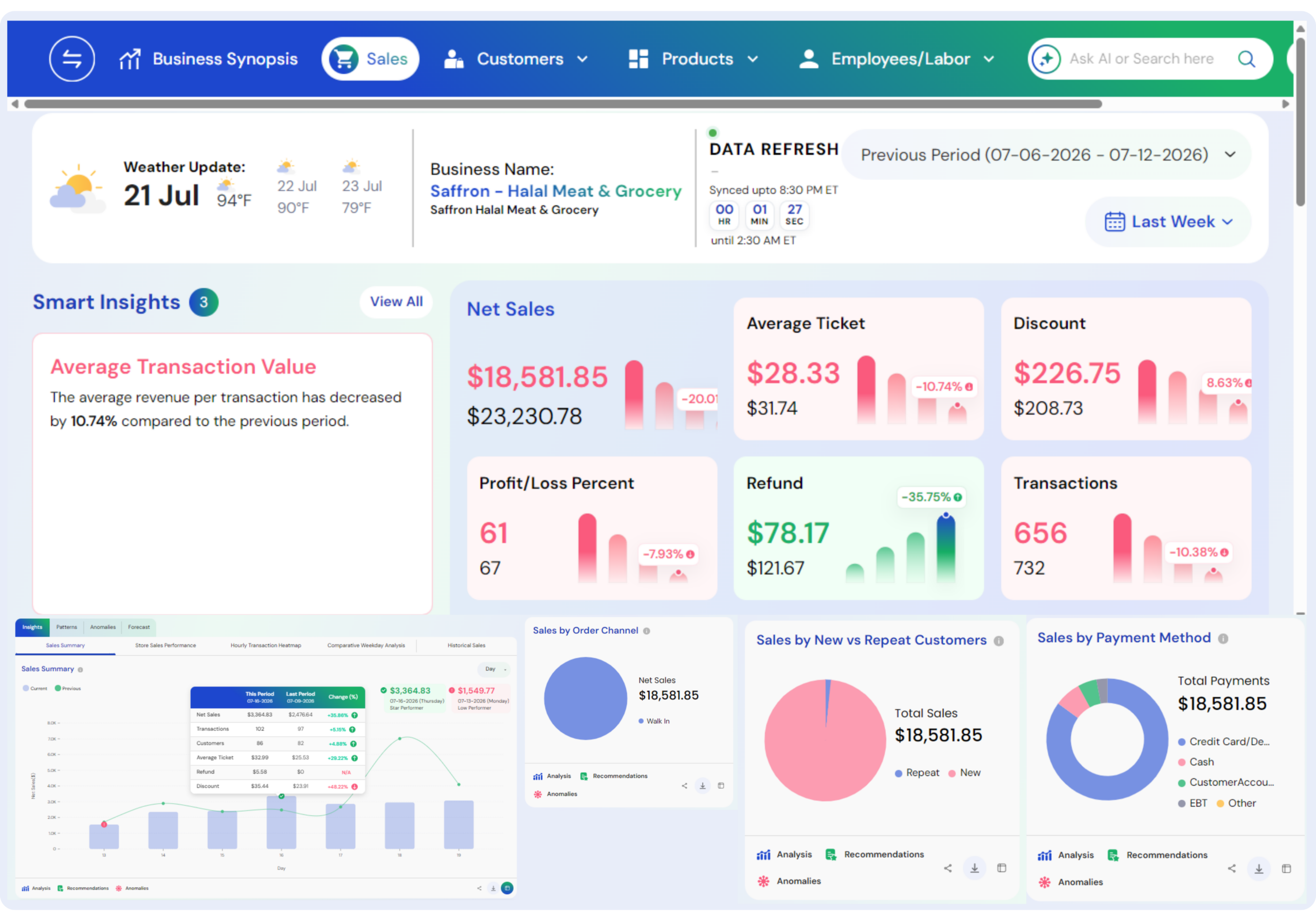
- Use geo-tagged sentiment dashboards to visualize sentiment on the basis of location, enabling targeted responses.
Also Read: How AI is Improving the Table-Turnover Rate for Restaurants
4.Multilingual and Cross-Cultural Support:
Language diversity and cultural differences that impact sentiment interpretation. To successfully analyze customer feedback from any language, it is important to implement multilingual NLP models which help to unlock insights worldwide.
Best Practices:
- Integrate language identification as a preprocessing step to route text to appropriate language models or translation pipelines.
- By using multilingual pre-trained models like XLM-R and multilingual BERT, businesses can easily analyze customer feedback across dozens of languages – all without the struggle of managing separate models for each language.
- If you maintain localized sentiment lexicons and slang dictionaries, you ensure your analysis tools pick up on regional nuances and context, delivering more precise insights.
- Hire native speakers or partner with linguistic experts for evaluating and refining model outputs.
Also Read: The Importance of Customer Analytics in Retail
5. Strong Data Privacy and Compliance Frameworks:
Multi-location businesses have to securely manage thousands to millions of customer data while your business complies with vast privacy regulations which is important for effective sentiment analysis.
It is essential for businesses to have a strong privacy framework that protects customer data, gains their trust and keeps your legal compliance everywhere.
Best Practices:
- Keep yourself updated with laws like GDPR, CCPA and other local privacy requirements to establish full compliance.
- It is essential to use strong encryption methods and access controls for protecting data that are both in transit and at rest.
- Clearly explain how you collect customer data and get their explicit consent to acquire the trust and transparency of your customers.
- Regularly review and audit your data practices to stay compliant and quickly adapt to changing privacy laws.
Implementing such strategies will help businesses to analyze customer sentiment responsibly and sustainably.
6. Real-Time Sentiment Monitoring and Alerts:
To quickly address customer concerns and protect your brand, use real-time analytics dashboards with alert systems that immediately alert and notify teams of sudden customer sentiment shifts or new customer issues.
Best Practices:
- Use streaming data pipelines like Apache Kafka, AWS Kinesis for ingesting customer feedback with minimal latency.
- Develop custom dashboards with filtering options for location, product lines, and sentiment categories.
- Configure automated alerts via email, SMS, or collaboration tools like Slack for increase in negative sentiment or trending complaints.
- Implement sentiment trends to identify emerging patterns proactively.
7. Leveraging AI and Machine Learning for Continuous Improvement:
Let AI-powered feedback loops learn from new data and human corrections to keep making your sentiment analysis better and more accurate every day.
Best Practices:
- Set up active learning frameworks where models query human annotators on uncertain samples for labeling.
- Analyze error patterns regularly to identify model weaknesses and update training data accordingly.
- Use unsupervised learning methods like topic modeling to discover new themes in customer feedback beyond sentiment polarity.
- Integrate AI chatbots and virtual assistants that collect structured feedback to complement unstructured text data.
Also Read: Choosing the Right AI Data Platform for your Business
8.Cross-Functional Collaboration and Employee Training:
When acted on effectively, sentiment insights drive success – and foster collaboration between marketing, customer service, operations, and analytics teams to interpret and use such insights wisely.
Best Practices:
- Provide training sessions for relevant teams to understand sentiment analysis outputs and limitations.
- Establish clear workflows for routing issues surfaced by sentiment analysis to the right departments.
- Encourage feedback from frontline employees to improve data quality and model relevance.
- Celebrate successes where sentiment insights often lead to improved customer satisfaction.
9.Integrating Sentiment Analysis into Business Processes:
For overcoming challenges while using sentiment insights, integrate sentiment analytics directly into your CRM, customer support, and marketing tools – that makes data-driven decisions effortless and smooth.
Best Practices:
- Use APIs to integrate sentiment scores and insights into existing business software.
- Customize CRM dashboards to include sentiment metrics along with traditional KPIs.
- Utilize sentiment data to personalize marketing campaigns and loyalty programs per location.
- Monitor customer journey touchpoints to identify pain points from sentiment trends.
Conclusion:
Customer sentiment analysis provides multi-location businesses a powerful opportunity to listen, learn, and respond effectively to their customers at all locations. But it comes with its own challenges.
Dealing with massive, diverse data streams from social media, reviews, surveys, and call centers can quickly feel overwhelming without the right tools.
Additionally, cultural differences and languages add further layers of complexity, while strict privacy laws require careful compliance.
So, then what will be the solution? A thoughtful, unified approach. Centralized data systems is your perfect choice which will gather feedback into one place, making it easier to normalize and analyze.
Now, multilingual AI models and localized slang dictionaries guarantee that sentiment is accurately interpreted across regions. It is essential to implement strong privacy frameworks to secure customer data and build trust, and a must-have system for your multi-location business in today’s world.
Real-time analytics with alert systems helps to keep your teams in the loop for quick action on emerging concerns, while protecting your brand reputation. So, by integrating sentiment insights directly into your CRM and marketing systems, empowers every team to make smarter, customer-focused decisions.
By addressing such challenges with smart technology and collaboration, multi-location businesses can transform sentiment analysis from a tough task into a true competitive advantage – thus creating happier customers and boosting growth everywhere they operate.
So, if you have any questions regarding the challenges or appropriate solutions while implementing Customer Sentiment analysis for multi-location businesses then feel free to reach us at Livelytics expertise and book a free demo, we will be glad to assist you.