Introduction
Imagine it’s a buzzing Saturday evening. Your restaurant is packed, orders are rolling in, and your staff is hustling to keep everything smooth. By closing time, you pull up your POS reports to see how the night went – total sales, top dishes, peak hours, and payment splits. These insights are undoubtedly useful.
But here’s a thought – what if you didn’t have to wait until the end of the night to see what’s happening?
What if, at 7 PM, you knew that your bestselling dish was running low, or that your dine-in wait times were longer than usual, so you could fix it immediately? That’s the power of real-time analytics.
In this blog, we’ll explore POS reports vs real-time analytics – what each offers, how they differ, and why modern restaurant business intelligence tools are blending both to keep you ahead of the competition.
Did you know, 76% of restaurant owners believe using technology—including real-time analytics—gives them a competitive advantage.
Also Read: Types of POS Systems for Restaurants
What are POS Reports?
POS reports are the reports generated by your Point of Sale (POS) system, showcasing comprehensive info about your restaurant’s sales, operations, and staff performance. Think of them as your daily or weekly report cards.
They include data such as:
- Total sales for the day, week, or month
- Best-selling menu items
- Payment methods used (cash, card, digital wallets)
- Discounts and voided transactions
- Staff sales performance
- Table turnover rates (in dine-in restaurants)
In simple words, POS reports for restaurants help you understand what happened in your business over a specific period. They’re great for analysing trends, making informed decisions about your menu, pricing, staffing, and planning for future growth.
“Data is power in restaurants. POS reports tell you what happened, but combining them with real-time analytics shows you what’s happening now, allowing operators to make smarter decisions in the moment.”
Expert Tip from Carl Orsbourn, Author of Delivering the Digital Restaurant and Former VP at Kitchen United
Also Read: How Restaurant Analytics and Reporting Drive Better business Decision
What are Real-Time Analytics?
Real-time analytics means getting instant insights from your restaurant data as things happen. Unlike POS reports, which show you what happened after the shift or day ends, real-time analytics lets you see what’s going on right now. For example:
- How many tables are occupied at this moment
- Which menu items are selling the fastest today
- Live inventory levels to avoid sudden stockouts
- Current sales vs. daily targets
- Which staff members are clocked in and their performance
In simple words, a real-time analytics dashboard gives restaurant owners and managers live visibility into operations, so they can make quick decisions, like reassigning staff during unexpected rushes, promoting a slow-selling dish mid-day, or ordering ingredients before they run out.
Also Read: Real-Time Analytics Why Does Your Business Needs It
POS Reports vs Real-Time Analytics: What are the Differences?

1. POS Reports vs Real-Time Analytics: Timing of Insights:
Restaurants run on data, but when you get that data changes everything. Here’s how timing makes a big difference between POS reports and real-time analytics.
POS Reports:
POS reports are like reading yesterday’s news. It gives you detailed summaries after it is done. For example, you can see your total sales, which dishes sold the most, how each server performed, etc, at the end of the day or week.
Real-Time Analytics:
Real-time analytics, on the other hand, is like having all the details of what’s happening on the go. It tells you what’s happening right now – which dishes are currently selling fast, whether there’s a sudden rush at lunch, if an ingredient is about to run out, or if online orders are peaking.
“Data is the new oil in the restaurant industry. Those who use it to drive daily decisions will always outperform those who don’t.”
— Aaron Allen, Global Restaurant Consultant
Also Read: Customer Analytics for Restaurants
2. POS Reports vs Real-Time Analytics: Actionability:
Another major difference between POS reports and real-time analytics is how they help you take action. One is reactive, the other is proactive – and this impacts your daily operations in big ways.
POS Reports:
POS reports are incredibly useful for making future decisions. For example, if last week’s report shows that your pasta dishes sold out every Saturday night, you can plan to order extra ingredients or prep larger batches next weekend. If reports show that certain staff members upsell desserts more effectively, you can use that data for training or reward programs.
Real-Time Analytics:
Real-time analytics empowers you to be proactive and act as things happen. For instance, if your dashboard shows that your signature burger isn’t selling well today, you can launch a quick in-house or social media promotion mid-shift to boost its sales before the day ends. Or, if your inventory data shows you’re running low on a key ingredient during rush, you can reorder in time or adjust menu availability.
Also Read: Customer Sentiments Analysis Vs Traditional Surveys
3. POS Reports vs Real-Time Analytics: Strategic Impact
Another key difference lies in how these tools support your overall strategy and growth. While both are important, they serve different purposes for your restaurant’s success.
POS Reports:
POS reports are fantastic for long-term strategy and planning. They help you see historical trends, seasonal patterns, and shifts in customer preferences over time. For example, by analyzing monthly POS reports, you might notice that iced coffees sell more during summer months, guiding you to create seasonal promotions or new beverage offerings.
It helps with menu engineering, staff training, forecasting future inventory needs, etc. All in all, it supports strategic decisions to grow your business steadily.
Real-Time Analytics:
Real-time analytics, however, focuses on your daily operational strategy and agility. It empowers you to optimize your restaurant’s performance at the moment.
For instance, if your analytics dashboard shows a spike in delivery orders during heavy rain, you can instantly allocate more staff to packaging or update delivery ETAs to keep customers happy. It’s about staying on top of everyday and ensuring better results & satisfied customers.
Sushi Tei – Combining POS Reports & Real-Time Insights
Sushi Tei, a leading sushi chain in Asia, integrated a real-time restaurant analytics dashboard with their POS system to get live visibility on table turnover, inventory levels, and customer ordering patterns across locations. This allowed chefs to prepare trending dishes proactively while managers could adjust staffing levels dynamically based on customer flow data.
Outcome: The chain optimised food preparation, reduced wastage, and improved service speed, leading to 10-15% higher daily revenue per outlet and better customer experiences across their restaurants.
Also Read: Best Marketing Strategies for Restaurants
4. POS Reports vs Real-Time Analytics: Data Presentation & Usability
Another important difference is in how these tools present data and how easy it is for teams to understand and use that data quickly.
POS Reports: POS reports for restaurants are often presented as structured tables or downloadable PDFs showing sales totals, item-wise breakdowns, labour costs, and void reports. While they’re detailed, they usually require manual analysis or exporting to spreadsheets for deeper insights. This is valuable for weekly meetings and strategic reviews, but it can be time & resource-consuming.
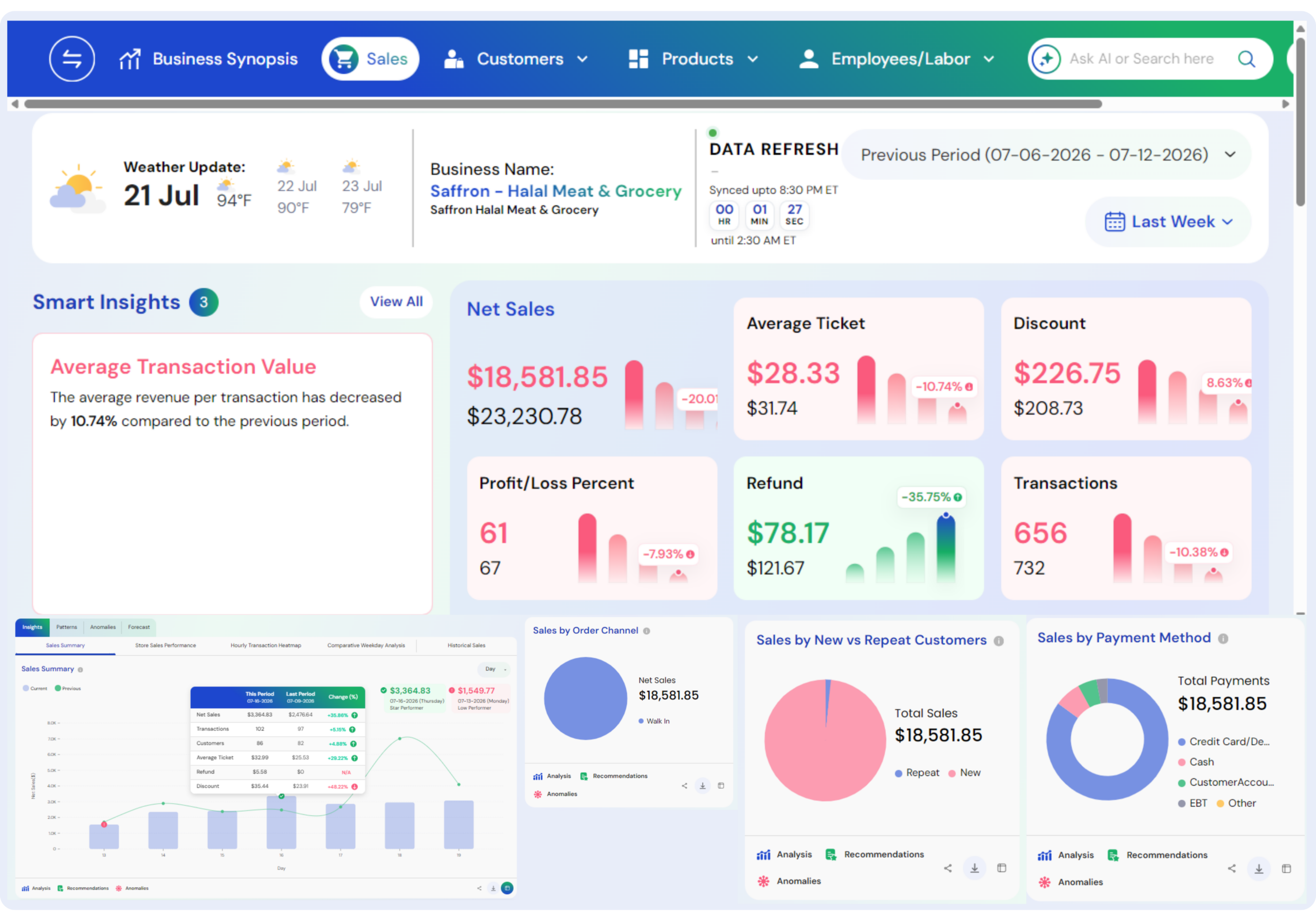
Real-Time Analytics: A real-time analytics dashboard is designed for quick and easy data interpretation through graphs, charts, and KPIs that are easy to understand. For instance, you can see a live comparison of sales by hour, real-time inventory depletion, or table turnover rates in visual formats. This instant clarity helps you make immediate decisions without manual digging or calculations.
Also Read: Automating Data Analysis Using Artificial Intelligence
5. POS Reports vs Real-Time Analytics: Accessibility & Flexibility
Also, it’s important to understand how POS reports and real-time analytics differ in terms of accessibility and flexibility. This impacts how your team uses data on the go.
POS Reports: Restaurant operators can access POS systems via back-office computers or download PDFs for review later. So, its accessibility is limited to specific devices or times. For example, your manager might review sales and labour reports the next morning. However, if you’re off-site or managing multiple locations, accessing these reports can be challenging without remote login setups.
Real-Time Analytics: Real-time analytics dashboards are designed for anytime, anywhere access. Most restaurant business intelligence tools offering real-time analytics come with mobile-friendly dashboards or cloud-based platforms.
This means you can check current sales, monitor staff performance, or track inventory levels live from your phone, no matter where you are. This flexibility ensures that you’re always connected, empowering proactive decision-making without being tied.
Also Read: Mobile Marketing for Restaurants
6. POS Reports vs Real-Time Analytics: Team Collaboration & Operational Alignment:
Another critical difference lies in how these tools support team collaboration and operational alignment. Let’s see how each impacts your restaurant’s daily teamwork.
POS Reports: POS reports for restaurants are mainly used by owners, managers, or accountants for reviewing sales, costs, performance metrics, etc. While they’re great for managerial decisions, they’re not designed for direct team-wide collaboration. For example, chefs, servers, and floor managers might not see these reports limiting their ability to align operations instantly based on data.
Real-Time Analytics: Real-time analytics dashboards are built to promote team collaboration. It ensures live data accessible to everyone. For instance, your kitchen team can see real-time ticket volumes, your servers can monitor table turnover rates, and managers can track live sales goals – all through their restaurant analytics dashboard or mobile devices. This fosters operational alignment, faster communication, and a culture of data-driven teamwork.
How McDonald’s Are Leveraging Real-Time Analytics for Faster Service?
McDonald’s uses advanced real-time analytics dashboards globally to monitor drive-thru times, kitchen preparation speeds, and order accuracy minute-by-minute.
What They Did:
McDonald’s integrated AI and machine learning into its operations to track service times in real time. If a location’s drive-thru wait time exceeded their standard, managers would receive instant alerts to redeploy staff or open additional lanes. This approach helped McDonald’s reduce average drive-thru wait times, improve customer satisfaction, and increase order throughput during peak hours – directly boosting sales while keeping operations efficient.
Also Read: How Livelytics Helps Retailers Reduce Operational Costs
7. POS Reports vs Real-Time Analytics: Problem Detection & Issue Resolution
Another important difference is in how POS reports & real-time analytics handle problem detection and issue resolution. This directly impacts your restaurant’s operational efficiency and customer experience.
POS Reports:
POS reports for restaurants are excellent for identifying problems after they’ve occurred. For example, if you notice in your weekly POS report that wastage was unusually high or certain items underperformed, you can investigate and fix the issue for future weeks. However, by the time these insights reach you, the damage, like lost sales, unhappy customers, or wasted inventory – has already happened.
Real-Time Analytics:
A real-time restaurant analytics dashboard empowers you to detect and resolve problems as they happen. For instance, if your dashboard shows a sudden spike in voids during lunch rush, you can check in to fix a problem. Similarly, if sales of a popular dish are low today, real-time analytics helps you check for issues right away, ensuring customers don’t miss out. It keeps your operations smooth and customers satisfied.
Also Read: How Business are Adopting to AI in Decision-Making
8. POS Reports vs Real-Time Analytics: Impact on Customer Experience
Another essential difference lies in how these tools contribute to customer experience and satisfaction. Both play a role, but their impact is quite different.
POS Reports:
POS reports for restaurants help improve customer experience over time. By analysing weekly or monthly sales reports, managers can identify top-selling dishes to keep in stock, understand peak hours to optimise staffing, and review voids or refunds to enhance service quality. However, these improvements happen gradually as you review past data and implement changes in future weeks.
Real-Time Analytics:
A real-time analytics dashboard enhances customer experience instantly. For example, if your live dashboard shows longer table turnaround times today, managers can immediately manage things accordingly to speed up service. If sales of a special dish are lower than expected, servers can start promoting it to guests in real time. Real-time analytics tools keep your entire team aligned with customer needs, ensuring smoother customer experience & loyalty.
Also Read: How AI Revolutionizes Customer Experience in the Restaurant Industry
9. POS Reports vs Real-Time Analytics: Impact on Promotions & Marketing
It’s important to see how these tools impact promotional strategies and marketing effectiveness. Both have unique roles in driving your restaurant’s growth.
POS Reports:
POS reports for restaurants help evaluate the effectiveness of past promotions. For example, you can review sales reports after a happy hour campaign to see if it increased beverage sales or if a weekend brunch offer drove higher ticket averages. These insights help you refine future marketing strategies based on what worked and what didn’t. However, since POS reports only show data after the promotion ends, you miss opportunities to adjust offers mid-way for better performance.
Real-Time Analytics:
Real-time analytics dashboards take promotional strategy to the next level by allowing you to monitor campaign performance on-the-go. If your dashboard shows that today’s lunch special isn’t selling well, you can immediately tweak messaging or have servers actively promote it. Similarly, if a flash dessert promo is driving high sales, you can extend it an extra hour to maximize revenue. This agility helps your marketing efforts succeed while campaigns are still running.
Also Read: AI for Restaurant Marketing
10. POS Reports vs Real-Time Analytics: Integration with Other Tools & Systems
Another crucial difference is in how these tools integrate with other restaurant business intelligence tools and platforms.
POS Reports:
POS systems generate reports within their own platform and usually keep them limited to that system’s reporting module. Even though some advanced POS systems let you export reports, they often don’t integrate deeply with broader restaurant business intelligence tools. As a result, you have to manually compile and analyse it to combine insights from inventory management, marketing performance, or labor scheduling.
Real-Time Analytics:
Real-time restaurant analytics dashboards are built with integration in mind. They pull data from multiple sources into a centralised, live analytics dashboard. This gives you a unified view of your restaurant operations, sales, staffing, and customer behavior in one place. Such seamless integration helps in making smarter, cross-functional decisions without juggling multiple platforms or manually combining datasets.
Take the Step Further with Livelytics AI!
Both POS reports and real-time analytics play crucial roles in restaurant success. But what if you could get the power of both in one place, along with intelligent suggestions on what to do next?
That’s where Livelytics comes in. Livelytics is an AI data-powered platform with machine learning, business intelligence, and advanced analytics capabilities. It combines detailed POS reports with live, real-time analytics, but goes a step further.
Using its data-driven intelligence, Livelytics suggests what to do, how to do it, and when to act – whether it’s restocking fast-moving items, adjusting menu pricing, scheduling staff shifts smarter, or launching promotions that actually work.
With Livelytics, you’re not just looking at data. You’re making decisions backed by AI insights, turning every report and dashboard into practical action for your restaurant’s growth and profitability.
Ready to see how Livelytics can transform your restaurant operations? Book your free demo today and take the guesswork out of your business decisions.
“AI and machine learning are no longer future technologies for restaurants; they’re critical tools for survival and growth in a competitive market.”
— Christopher Sebes, Restaurant Tech Entrepreneur & Former President of Xenial
To Wrap it All!
Both POS reports and real-time analytics have their place in running a successful restaurant. POS reports give you a clear view of past performance, while real-time analytics help you stay on top of what’s happening right now.
With a platform like Livelytics, you don’t have to choose between the two. Its AI-powered tools combine detailed POS reporting with live analytics, business intelligence, and machine learning to not only show you what’s happening but also suggest what to do next.
To know more how Livelytics can benefit you, how it integrates & beyond – then book a free demo with us right away.