The restaurant industry is continuously evolving even faster than before. Success today for restaurants does not depend on just great food and service
Increasing labor costs, changing food prices, delivery platform fees, and shifting customer behavior has made operators prioritize operational efficiency the most.
In restaurants, restaurant data analytics has become a powerful tool for gaining visibility, controlling costs, and driving smarter decisions.
Choosing the right data analytics solution is no longer optional; instead it is a strategic investment which enables long-term profits and growth.
Modern restaurants generate large amounts of data from POS systems, inventory software, payroll platforms, online ordering apps, and customer loyalty programs.
But without a structured restaurant analytics platform, data remain scattered over different places and even underutilized.
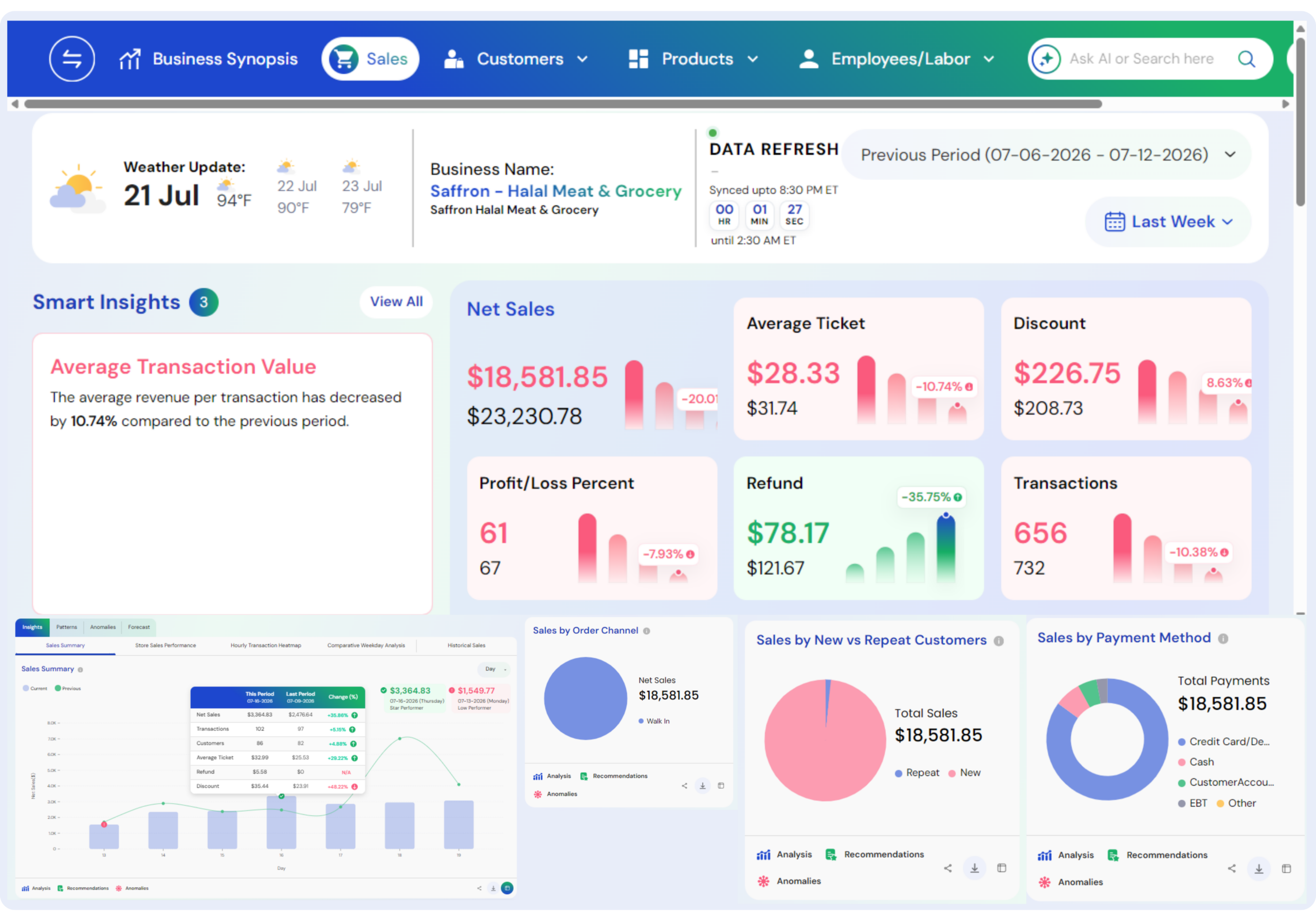
The right restaurant intelligence software combines data from multiple data sources into a unified dashboard through which operators monitor sales performance, manage labor costs, optimize menu pricing, track food cost percentage, and improve customer retention.
Whether you operate a single-location restaurant or manage a multi-unit franchise, choosing the right restaurant analytics system requires careful evaluation.
As every platform does not deliver the same deeper real-time reporting, predictive analytics, forecasting capabilities, or flexibility to integrate with your existing systems.
Some platforms offer basic descriptive reports, while other platform tools deliver advanced AI-driven insights which support demand forecasting, staffing optimization, and marketing ROI measurement.
This blog will walk you through how to choose the right restaurant data analytics solution based on your operational goals, scalability needs, and budget considerations.
By evaluating essentials like integrations, customizable dashboards, labor and inventory analytics, and customer behavior insights, you can choose a platform that converts raw data into clear actions and gives your restaurant a lasting competitive edge in a data-driven market.
Also Read: Optimizing Restaurant Menu With AI Powered Data Analytics
Why Restaurant Data Analytics Is Essential Today

Modern restaurants operate in highly competitive and fast evolving environments where profit margins are low.
Increasing food costs due to supply chain disruptions, seasonal availability, and changing vendor pricing make cost control highly challenging.
Meanwhile, labor costs continue to increase as wage rules keep changing and restaurants compete harder to attract and retain skilled employees.
Third-party delivery platforms also increase financial pressure by taking commissions and service fees which further reduce net margins on every order.
Customer expectations have also changed completely as today’s diners expect a smooth digital ordering with quick service, personalized offers, and consistent quality across dine-in, delivery, and mobile channels.
Meanwhile, marketing is done through social media, email campaigns, loyalty programs, paid advertising, and delivery apps making performance tracking even more complicated than before.
Without having a structured restaurant data analytics, operators often depend on their own instinct rather than insights. An effective analytics solution offers real-time sales tracking, labor optimization, demand forecasting, and measurable ROI.
By converting raw data into actionable insights, restaurants can make proactive decisions, protect margins, and establish sustainable growth in a competitive marketplace.
Also Read: Two Way Data Analytics In Shaping Retail Business
Step 1: Define Clear Business Objectives First
Before you assess any restaurant analytics software, first be clear on the areas where you actually want the system to improve. Analytics tools can track hundreds of metrics, but the right analytics solutions for your restaurant have to depend on your own operational priorities.
Start by asking the most important questions:
- Are you trying to reduce food waste and lower food cost?
- Do you need more labor cost control tracking by role, shift, and location?
- Are you preparing to open new locations and need unified reporting across every unit?
- Do you frequently run out of key ingredients or overstock slow moving items?
Once you have clear objectives, then you can align them with the right capabilities. For instance, reducing food cost requires inventory tracking, waste monitoring analysis.
For improving labor efficiency the restaurant requires sales-per-labor-hour reports, overtime alerts, demand-based scheduling insights.
For increasing customer retention you require to track visit frequency tracking, segmentation, loyalty performance, and churn prediction.
Scaling across locations requires consolidated dashboards, standardized KPIs, and standard tools that compare units fairly.
Without having clearly defined objectives, you may buy an analytics platform full of features that you may buy an analytics platform full of features which you may never use that causes wasted budget and poor adoption.
Also Read: Business Intelligence Vs Machine Learning
Step 2: Understand the Different Types of Analytics
Each restaurant analytics system does not offer the same level of insight. It is essential for operators to understand the different types of analytics which will help them to determine whether you require a basic reporting tool or a more advanced intelligence platform.
1. Descriptive Analytics – What Happened?
Descriptive analytics is the most basic level of reporting. It focuses on historical data and provides answers for simple performance questions.
For instance, descriptive analytics include:
- Daily and weekly sales reports
- Average check size
- Top-selling menu items
- Labor cost percentage
- Basic revenue summaries
Most POS systems deliver descriptive analytics. Though useful, descriptive analytics only displays past performance without explaining causes.
2. Diagnostic Analytics – Why Did It Happen?
Diagnostic analytics goes even more deeper into analytics by identifying patterns and correlations. It provides answers to questions like:
- Why did food cost increase last month?
- Why did Friday night revenue decline?
- Why are specific menu items losing popularity?
This type of analytics analyzes patterns across different data sources, showing actual causes behind performance changes by using deeper insights and advanced cross-functional reporting tools.
3. Predictive Analytics – What Will Likely Happen?
Predictive analytics uses historical data and forecasting models to make predictions about future outcomes like expected sales trends, staffing demand projections, inventory requirements, seasonal changes, and customer churn risk.
4. Prescriptive Analytics – What Should We Do?
As Livelytics emphasizes predictive analytics is the most advanced layer of analytics that provides actionable recommendations such as adjusting staffing levels, modifying menu pricing, launching targeted promotions, or reallocating marketing budgets.
While choosing an analytics solution, it is essential for you to decide whether you need a simple reporting tool or strategic intelligence platform that drives proactive decisions.
Also Read: Types of POS Systems for Restaurants
Step 3: Evaluate Integration Capabilities
A powerful restaurant data analytics solution requires combining all your operational data into one unified view. Restaurants depend on different systems to run daily operations, and if those systems do not interact with each other, then decision-making becomes fragmented.
Common restaurant data sources include:
- POS systems
- Inventory management software
- Payroll and HR platforms
- Online ordering platforms
- Third party delivery apps
- Loyalty programs
- Reservation systems
- Accounting software
As data remains fragmented across different digital platforms, restaurants might fail to get the complete picture, which makes it harder to identify actual profit drivers and operational problems.
For instance, sales reports from your POS system may look strong, but if labor data or delivery commission fees, then you may not know the actual profits.
Similarly, marketing performance cannot be accurately measured without connecting loyalty data and customer transaction history.
The right analytics solution should seamlessly integrate with your existing tools through APIs. It removes manual work, reduces reporting errors, and ensures real-time accuracy.
Integrated systems offer a complete overview regarding your operations which allow operators to make smarter, faster, and more confident decisions.
Also Read: Why Data Analytics is the New Secret Weapon for Successful Restaurants
Step 4: Consider Real-Time vs Scheduled Reporting
While choosing a restaurant data analytics solution, it is crucial to know the difference between real-time and scheduled reporting.
Some platforms offer live dashboards which update instantly as transactions occur, while other platforms refresh data daily or only at set intervals. The right analytics choice depends on your operational needs and restaurant size.
1.Real-Time Analytics Advantages
- Immediate operational visibility into sales, labor, and inventory
- Instant alerts for unusual sales drops, cost spikes, or performance anomalies
- Faster management decisions during peak hours
- Better control over daily targets and shift-level performance
Real-time reporting is essential for high-volume restaurants, multi-location brands, and businesses who need quick responses to changing conditions.
2. Scheduled Reporting Advantages
- Useful for long-term trend analysis and strategic planning
- Simpler infrastructure requirements
- Often more cost-effective for smaller operations
If your restaurant experiences frequent changes throughout the day, real-time monitoring can prevent losses and improve responsiveness.
However, if your focus is on weekly or monthly performance analysis, then scheduled reporting may be sufficient. Selecting the right reporting model ensures that your analytics systems align with your operations.
Also Read: Real-time analytics why does your business needs it
Step 5: Assess Scalability for Growth
If you plan to expand your restaurant business, scalability should be your topmost priority while selecting a data analytics solution.
Because an analytics solution that works for a single location may not support the complexity of multiple units, franchises, or regional operations.
An analytics system must grow along with your business without requiring constant restructuring of technical services.
Your data analytics tool should support:
- Multi-location reporting to compare performance across different branches
- Centralized dashboards that provide brand-level and location-level views
- Role-based access control so owners, managers, and staff only see relevant data
- Standardized KPIs across units for consistent benchmarking
- Easy addition of new locations without rebuilding reports or integrations
Scalable systems allow you to maintain consistent operations while gaining deeper insights when your services expands.
They ensure that data remains structured and comparable across all units, making growth more manageable and measurable.
Avoid analytics platforms that require rebuilding dashboards, frequent integrations, or redesigning reports every time you open a new location. While a truly scalable solution supports smooth expansion and long-term strategic growth.
Also Read: Why Multi-location Growth Breaks Without Unified Data and How Smart Business Fix it
Step 6: Evaluate Labor Analytics Features
Labor is one of the largest and most controllable expenses in restaurant operations. Even small inefficiencies in scheduling or productivity can significantly impact profit margins.That is why choosing a restaurant data analytics solution with strong labor analytics capabilities is essential
Your analytics system should include:
- Labor cost percentage tracking to monitor labor expenses relative to total sales.
- Sales per labor hour metrics to measure productivity and efficiency.
- Overtime monitoring to identify unnecessary payroll expenses and compliance risks.
- Forecast-based scheduling recommendations which align staffing levels with predicted demand.
- Shift performance analysis to evaluate peak and low productivity periods.
- Department-level breakdowns help to analyze performance between front-of-house and back-of-house.
Advanced labor analytics goes beyond simple time tracking tools. It connects sales data with staffing patterns that ensures that the right number of employees are scheduled at the right time.
This avoids overstaffing during slow hours and understaffing during busy hours, which can impact profits and customer experience.
When used effectively, labor analytics enhances operational efficiency, controls payroll costs, and enhances service quality which is an essential component of any restaurant analytics solutions.
Also Read: How Can Data Analytics Improve the Measurement of Employee Performance
Step 7: Examine Inventory & Food Cost Analytics
Food cost is one of the crucial factors affecting restaurant profits. Even small mistakes in inventory management can quickly reduce profit margins.
That is why a strong restaurant data analytics solution must include strong inventory and food cost tracking features.
When evaluating a system, look for capabilities like:
- Theoretical versus actual food cost comparison to find differences between expected and real usage.
- Waste tracking to track food spoilage, food over-portioning, and kitchen inefficiencies.
- Recipe-level ingredient costing to calculate accurate menu item margins
- Vendor price monitoring to track fluctuations and negotiate better purchasing terms.
- Purchase variance analysis to detect over-ordering or pricing inconsistencies.
- Low-stock alerts to avoid stockouts and last-minute emergency purchases.
Strong inventory analytics reduce food water and ensure better cost control. By connecting purchasing data with sales performance and recipe standards, restaurants get insights into profits at each item level.
Improved ordering accuracy not just saves money but also improves consistency in operations and guest satisfaction.
Also Read: AI for Restaurant Inventory
Step 8: Review Customer Analytics Capabilities
Customer data is one of the most important assets in modern restaurant operations. Beyond tracking sales, understanding how guests behave allows restaurants to make smarter marketing and operational decisions.
A strong restaurant data analytics solution should provide clear insights about customer patterns and preferences.
Your analytics platform should track:
- Visit frequency to identify loyal customers and occasional diners
- Average spend per visit to measure purchase behavior
- Customer segmentation on the basis of demographics, order history, or visit timing
- Customer lifetime value(CLV) to estimate long-term revenue contribution
- Churn risk indicators to find customers who may stop visiting.
- Promotion effectiveness to measure how campaigns influence repeat visits.
When restaurants understand customer behavior, they can customize offers, strengthen loyalty programs, and improve engagement.
Instead of depending on brand promotions, operators can target the right guests with the right message which drives higher retention, stronger loyalty, and sustainable revenue growth.
Also Read: Customer Analytics for Restaurant
Step 9: Examine Forecasting and AI Capabilities
Modern restaurant data analytics solutions are mostly integrating AI-driven forecasting tools that help to predict future performance rather than simply evaluating past results.
These advanced features convert data into forward-looking insights that help operators to make smarter planning.
Key features may include:
- Demand forecasting predicts busy hours based on past sales, seasonality, and external factors.
- Predictive staffing recommendations help to match the staff schedules with expected customers.
- Revenue trend prediction to identify growth opportunities or slowdown periods.
- Menu performance optimization using data patterns to highlight high-margin or declining items.
- Fraud detection alerts to identify unusual transactions or operational anomalies.
AI-powered analytics reduce uncertain decisions from operators. Instead of reacting to problems after they occur, AI-powered analytics helps restaurants to prepare in advance, optimize resources, and prevent losses.
This shift from reactive to proactive strategy improves efficiency, and creates more resilient operations in a competitive market.
Also Read: Customer Analytics in Retail
Step 10: Ensure Dashboard Customization
Even two restaurants operate in different ways. Whether it is a quick-service restaurant, fine dining establishment, cafe chain, or multi-unit franchise, every restaurant type gives priority to different performance metrics.
That is why having data customization is crucial while choosing a restaurant data analytics solution.
Your analytics platforms should allow:
- Custom KPIs customized to your operational goals
- Role-based dashboards so owners, managers, chefs, and marketing teams are able to see relevant data
- Drag-and-drop reporting for flexible layout adjustments
- Custom report building to analyze specific performance areas
- Export capabilities for sharing insights with stakeholders or accounting teams
Rigid dashboards which show only generic metrics can limit usability and reduce adoption. Wḥen users are not able to customize reports according to their needs then they use the system less.
A customizable dashboard ensures that each team member has access to those insights that matter to them the most which improve efficiency, clarity, and decision-making across the organization.
Also Read: How to Setup KPIs for your Business
Step 11: Evaluate Ease of Use and Adoption
Even the most advanced restaurant data analytics will not be effective if your team does not use it regularly. Offering both ease of use and adoption is equally important as technical capabilities.
A complex system can discourage managers and staff while interacting with the data.
While evaluating a platform, consider:
- User interface simplicity: whether the dashboard is clear, intuitive, and easy to navigate.
- Mobile accessibility: whether the managers can access reports on smartphones or tablets during working hours.
- Training resources: Whether the analytics solutions include tutorials, documentation, and learning materials are readily available.
- Onboarding support: Whether the vendor provides structured setup guidance and data configuration help.
- Customer service responsiveness: Whether support is available when issues arise.
Ease of analytics solution directly impacts ROI. When teams understand and trust the system, then they use the system daily to guide decisions.
Also Read: How Data Analytics Helps Restaurant Grow
Step 12: Review Data Security and Compliance
Restaurants have to handle large volumes of financial and customer data like payroll records, and loyalty program information.
Choosing a restaurant data analytics that does not have strong security measures can expose your business to data breaches, cause financial loss, and reputational damage.
Ensure the platform provides:
- Secure cloud infrastructure with trusted hosting environments
- Data encryption both in transit and at rest
- Role-based permissions to restrict access to sensitive information
- Regular automated backups to prevent data loss
- Disaster recovery plans to ensure business continuity
Security should be considered strongly. A reliable analysis provider will follow industry best practices and compliance standards to protect your data.
Strong security protection helps to reduce operational risk and also build trust with customers and stakeholders. In the data-driven sector, protecting data is just as crucial as analyzing data.
Step 13: Analyze Pricing Structure
Understanding the total cost for owning an analytics system is essential while selecting a restaurant data analytics solution. The listed subscription is just one part of the investment.
While making an informed decision, you are required to evaluate both direct and indirect costs over time.
Common pricing models include:
- Monthly subscription per location, which scales as you expand the business.
- Per-user licensing, based on the number of managers or team members accessing the system.
- Percentage-based pricing, based on revenue or transaction volume
- Enterprise custom pricing, usually designed for large multi-unit groups
In addition to base pricing, consider potential extra expenses like:
- Integration fees for connecting POS, inventory, or payroll systems
- Implementation costs for setup and data migration
- Training expenses for onboarding your team
- Upgrade charges for advanced features or expanded usage
Though the cheapest analytics solutions may seem attractive initially, they may not have scalability or advanced features. So a balanced system that scales smoothly and improves operations produces long-term ROI by reducing costs and supports smarter growth decisions.
Conclusion: Turning Data into Competitive Advantage
Choosing the right restaurant data analytics solution is not just a technology decision instead it is a strategic investment in the future of your business.
In today’s competitive and cost-centered landscape, restaurants cannot afford to depend on guesswork, spreadsheets, or outdated reports.
Rather data must be structured, integrated, and transformed into actionable insights which deliver measurable results.
Defining clear business objectives, evaluating integration capabilities, forecasting tools, scalability, customization, every step in the selection of data analytics tools play a crucial role.
The right platform should not just report what happened in the past, but also explain why it happened, and predict what is likely to happen next, and recommend what actions to take next.
When your priority is to control food costs, optimize labor, improve customer retention, or expansion across multiple locations, your analytics solution should align with your operational goals.
It is equally important to consider long-term factors like pricing transparency, security, ease of adoption, and ongoing scalability.
A well-chosen system evolves with your restaurant, supporting growth without requiring any manual work.
Ultimately, the best restaurant data analytics solution is one that converts information into intelligence and then intelligence into action.
When data becomes part of your daily decision-making then you move from reactive to proactive strategy strengthening profits, improving efficiency, and building a resilient restaurant brand prepared for long-term success.
If you still have any query while choosing the right restaurant data analytics solution, then you may book a free demo at Livelytics and we are more than happy to assist you.