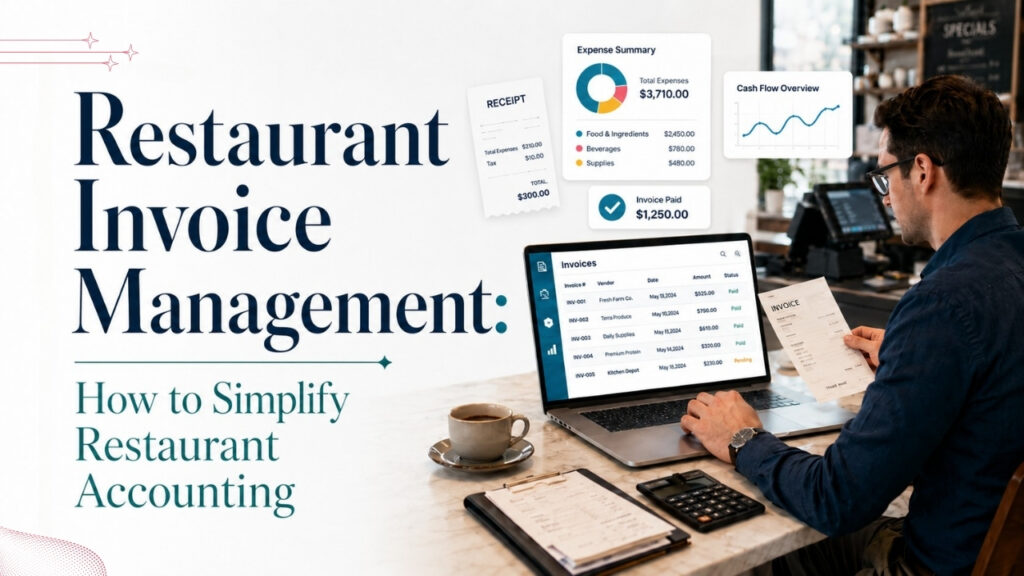

Restaurant invoice management plays an important role in keeping your restaurant accounting accurate, organized, and profitable. Every supplier bill, food delivery invoice, utility payment, repair expense, and service charge affects cash flow and profits of your restaurants.
When invoices are missing, entered late, duplicated, or recorded in the wrong category, then your financial reports become unreliable and your profit margins can get affected.
For many restaurant owners, restaurant accounting becomes stressful as invoices arrive from different sources such as paper receipts, emails, vendor portals, and delivery slips.
Without a clear process, it becomes difficult for restaurants to track expenses, verify supplier charges, manage due dates, and prepare accurate records for tax time.
A strong restaurant invoice management system helps to simplify this entire process. This allows you to collect invoices in one place, review them against deliveries, approve payments, categorize expenses correctly, and store records digitally.
This makes it easier for restaurants to manage accounts payable, control food costs, avoid duplicate payments, and improve cash flow.
With the right workflow and tools, restaurant owners can reduce manual errors, save time, and gain better visibility into daily expenses. Through this blog, we will walk you through how restaurant invoice processing, digital records, approval workflows, automation, and regular financial reviews can help simplify restaurant bookkeeping and create a smoother, more reliable accounting process.
Also Read: Why Restaurant Need a Food Inventory Management System
Why Restaurant Invoice Management Matters
Restaurant invoice management is more than storing bills and paying suppliers. It is the foundation of accurate accounting. Each invoice shows how your money is being spent, what items were bought, what vendors are charging, and where costs may be rising.
Restaurants usually deal with many vendors, that include food suppliers, beverage distributors, packaging companies, cleaning service providers, equipment repair companies, linen services, delivery platforms, software providers, and utility companies.
If invoice records are not properly managed, small mistakes can quickly become expensive.
Poor invoice management can cause:
- Missed supplier payments
- Duplicate payments
- Incorrect expense records
- Cash flow problems
- Food cost errors
- Tax preparation issues
- Vendor disputes
- Unclear profit margins
- Time wasted searching for documents
A restaurant may have strong sales but still struggle financially if invoices are not tracked properly. When invoice data is wrong, accounting reports become unreliable.
Owners may think food costs are under control while the prices are actually rising. Because they may believe cash flow is good while unpaid bills are accumulating.
Good invoice management gives restaurant owners clarity about their financial performance. It helps them to understand expenses, control costs, and also to make better business decisions.
Also Read: How to Improve Restaurant Operations
Key Strategies to Simplify Restaurant Accounting
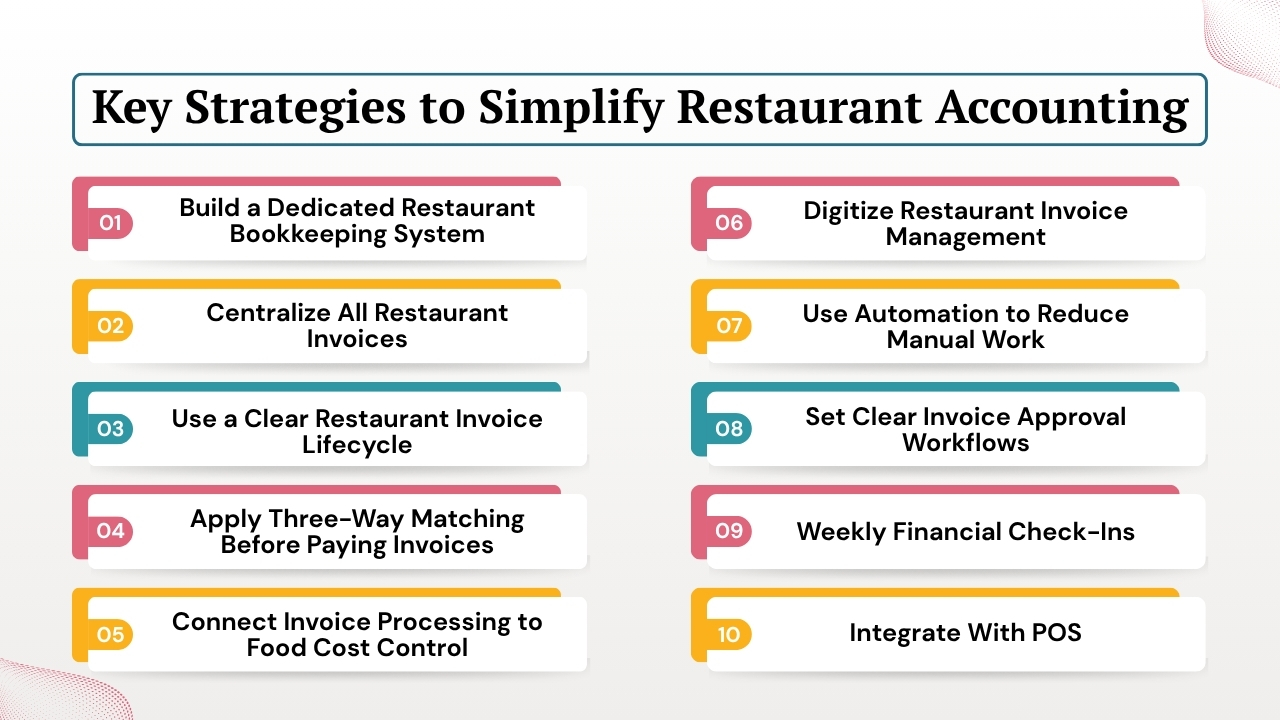
1. Build a Dedicated Restaurant Bookkeeping System
The first step to take by restaurants to simplify restaurant accounting is to set up a dedicated bookkeeping system. Many small restaurant owners begin their accounting with spreadsheets, paper receipts, or manual notes.
Though it may work in the beginning but it becomes risky when invoice volume, staff size, sales channels, and supplier relationships grow.
A proper restaurant bookkeeping system should organize all income and expenses in one system. It should connect with the POS system, bank account, payroll platform, inventory system, and invoice management software where possible.
A good bookkeeping system helps owners see:
- How much money is coming in
- How much is being spent
- Which expense categories are increasing
- Whether food cost is rising
- Whether payroll is aligned with sales
- Which vendors are charging more
- Whether cash flow is tight
- Whether tax records are complete
Restaurant bookkeeping should be updated consistently. Waiting until the end of the month for bookkeeping creates confusion and makes it harder for restaurants to catch mistakes.
Weekly reviews help restaurant owners to identify errors early, track supplier payments, and avoid financial surprises.
A strong bookkeeping system also separates personal and business finances. While restaurant owners mix personal spending with restaurant transactions will create tax issues, reporting problems, and unclear cash flow. A dedicated business bank account and business credit card make reconciliation easier and cleaner.
Also Read: Why Restaurant Need a Food Inventory Management System
2. Centralize All Restaurant Invoices
One of the biggest reasons restaurant invoice management becomes messy is that invoices arrive from many places. Where some suppliers send invoices by email, some suppliers include paper invoices with deliveries, while some use vendor portals.
While some suppliers send statements at the end of the month. If these invoices are not collected in one place, then there are chances that restaurant owners may easily miss payments, duplicate entries, or lose important records.
Restaurant invoices can arrive through email, EDI, vendor portals, or physically with deliveries, so centralizing all these invoices at one place is the first step to prevent documents from being missed.
Every restaurant should create one clear invoice intake process. Staff should have a clear, predefined process for directing every incoming invoice whether it is routed to a shared accounting email uploaded into invoice software, saved in a cloud folder, captured via a mobile scanning app, or entered into an accounting dashboard.
A centralized invoice system helps restaurants:
- Avoid lost invoices
- Prevent duplicate payments
- Track unpaid bills
- Improve approval speed
- Store records properly
- Make audits easier
- Compare vendor pricing
- Improve cash flow planning
Without centralizing all invoices at one place, invoice management becomes reactive. Owners only discover problems when a supplier calls about a late payment, a duplicate charge appears, or month-end reports do not match with reality.
Also Read: How to Use AI in the Restaurant Business
3. Use a Clear Restaurant Invoice Lifecycle
A better restaurant invoice process follows a clear lifecycle. Every restaurant invoice should move through the same basic steps: receive, verify, approve, record, pay, and store.
This is a repeatable process that includes receiving the invoice, reviewing it against purchase records and delivery receipts, approving it for payment, recording it in the accounting system, scheduling payment, and filling the invoice for future reference.
Here is a practical restaurant invoice workflow:
Receive the invoice
The invoice enters your system through multiple channels like email, physical delivery, scanning, file upload, or electronic data interchange(EDI). It is essential to centralize all incoming invoices in one place so no invoices get missed or delayed.
Verify the invoice
Each invoice should be carefully checked against the purchase order, delivery receipt, and agreed supplier pricing. It ensures accuracy in quantity, price, and terms, that helps to prevent overpayments or fraud.
Approve the invoice
Once invoice verified, the invoice is sent to the appropriate person such as a manager or authorized approver based on predefined rules such as invoice amount, vendor type, or expense category.
Record the invoice
After invoice approval, the invoice details are entered into the accounting system. It includes vendor name, invoice date, category, tax information, and payment terms to maintain accurate financial records.
Schedule Payment
Payments are then planned according to supplier terms, due dates, and the business’s cash flow to avoid penalties and maintain good relationships.
Store the invoice
Finally, the invoice is securely stored in a digital system, organized by vendor, date, category, and payment status for easy retrieval and audit readiness.
This approach ensures uniformity while simplifying staff training and reducing confusion.
Also Read: Restaurant KPI Dashboard The Key Metrics that Drive Growth
4. Apply Three-Way Matching Before Paying Invoices
One of the most crucial practices in restaurant invoice processing is three-way matching. It means checking the invoice against three records:
- Purchase order
- Delivery receipt
- Supplier invoice
Before payment is approved, the restaurants should confirm that the products ordered match with the products received and that the invoice charges for the right quantity and price.
Three way matching invoice is the foundation of invoice accuracy because it catches invoice quantity errors, price differences, and items that were billed but not delivered to customers.
This is especially crucial for food and beverage invoices. Restaurants order high volumes of produce, meat, dairy, dry goods, beverages, disposables, and packaging. Even small overcharges can add up quickly.
For instance, if a supplier charges slightly more than the agreed price on a frequently ordered item, that price may seem small on one invoice. But across hundreds of orders, it can reduce profit margins significantly.
Three-way matching helps catch:
- Missing items
- Short deliveries
- Wrong quantities
- Incorrect unit prices
- Duplicate charges
- Contract pricing mistakes
- Items billed but not received
This practice helps safeguard the restaurant by ensuring everything is checked before any funds are released from the bank account.
Also Read: Why Does Every Small Business Need Analytics
5. Connect Invoice Processing to Food Cost Control
Restaurant invoice processing is not just an accounting task. Rather it directly affects food cost accuracy. Because if invoice data is wrong, food cost reports will also be wrong.
As the invoice data is the foundation of food cost reporting, inaccurate, delayed, or miscategorized invoices can cause restaurant operators to believe their food cost percentage is lower than it really is.
This matters because food cost is one of the biggest expenses in a restaurant. If ingredient prices increase but the accounting system is not updated, menu pricing, and recipe costing become inaccurate. The restaurants may continue selling their dishes at old margins while actual costs increase.
A strong invoice system helps owners understand:
- Current ingredient prices
- Supplier price changes
- Product cost trends
- Recipe cost accuracy
- Menu item profitability
- Vendor overcharges
- Waste and spoilage impact
- Inventory valuation
When invoice data flows into inventory and recipe costing systems, owners can see the real cost of each menu item. It helps them decide whether to adjust menu prices, change suppliers, modify recipes, reduce portions, or promote higher-margin items.
Also Read: 10 Ways Restaurant Data Analytics Solution Reduce Costs Improve Profit
6. Digitize Restaurant Invoice Management
Paper-based invoice management creates many issues. Because paper invoices can be lost, damaged, misplaced, duplicated, or forgotten. They also require manual entry that increases the chance of errors.
While the digital invoice systems reduce manual effort, improve organization, make invoices easier to search and retrieve, and provide better security through access controls and digital storage.
A digital invoice system allows restaurants to scan, upload, store, search, and process invoices faster. This makes it easier for restaurants to access old records during tax preparation, supplier negotiations, audits, or financial reviews.
Digital invoice management can include:
- Email invoice capture
- Mobile invoice scanning
- OCR data extraction
- Vendor folders
- Cloud storage
- Approval workflows
- Payment status tracking
- Searchable records
- Secure access permissions
- Accounting software integration
The goal of digitizing invoices is to remove paper challenges and make invoice information available whenever it is needed.
Restaurants should digitize old records as well, especially if paper invoices are still stored in boxes. A clean digital archive saves time and reduces risk.
Also Read: Best Restaurant Business Intelligence Software
7. Use Automation to Reduce Manual Work
Restaurant owners and managers are already busy with staffing, service, customer issues, ordering, marketing, and daily operations. While manual invoice processing adds unnecessary pressure.
Automating invoice management can simplify repetitive tasks like data entry, invoice capture, approval routing, due-date reminders, reconciliation. It can also reduce manual workload, improve accuracy, speed up processing, identify discrepancies, and support better cash flow management.
Automation can help with:
- Reading invoice data through OCR
- Extracting vendor name, date, amount, and line items
- Matching invoices with purchase orders
- Routing invoices to the right approver
- Sending payment reminders
- Flagging duplicate invoices
- Highlighting pricing differences
- Categorizing expenses
- Syncing data with accounting software
- Creating real-time reports
Automating invoice management does not remove the need for human review. Because it makes the process faster and more reliable. Managers still need to approve exceptions, review unusual charges, and confirm crucial financial decisions.
An effective automation system improves the team’s efficiency while still maintaining proper oversight and control.
Also Read: Automating Data Analysis Using Artificial Intelligence
8. Set Clear Invoice Approval Workflows
A restaurant invoice should not be paid simply because it arrived. Every invoice requires an approval process. This is especially crucial for multi-location restaurants, restaurant groups, or businesses with several managers placing orders.
Automated approval workflows direct invoices to the right approver based on rules such as amount, vendor, or department. This reduces delays, removes manual routing mistakes, speeds up processing time, and ensures that each invoice is reviewed by the appropriate person for accurate and efficient approvals.
A good approval workflow should define:
- Who can approve small invoices
- Who must approve large invoices
- Which invoices require owner review
- Which categories need department approval
- Which vendors are approved
- What happens when an invoice has a discrepancy
- Who can schedule payment
- Who can edit invoice records
For instance, a $75 product invoice may only require manager approval. A $5000 equipment repair invoice may require owner approval. A new vendor invoice may require additional review before payment.
Clear workflows avoid confusion, delays, and unauthorized expenses. They improve accountability by maintaining a clear, trackable history for every invoice.
Also Read: How Restaurant Business Intelligence Helps Owners Make Faster Decisions
9. Weekly Financial Check-Ins
Managing invoices efficiently is essential for maintaining a restaurant’s finances and weekly financial check-ins play a crucial role in this process.
Restaurants by setting aside time each week to review invoices, transactions, and bank statements, restaurant owners and managers can ensure accuracy, avoid costly mistakes, and maintain steady cash flow.
This routine creates a proactive approach to financial management rather than reacting to restaurant issues at the end of the month. Weekly check-ins also help to keep financial records organized and up to date.
Instead of dealing with a lot of backlog invoices, staff can process and verify manageable and smaller amounts of invoices. Such restaurants improve accuracy and ensure that payments are made on time, making relationships with suppliers stronger.
Reconcile bank statements
Restaurants must match their bank transactions with recorded invoices and payments. With this process restaurants can identify if the entries are missed, if there are duplicate payments, or any unauthorized charges, which ensures that your financial records remain accurate and reliable.
Track cash flow
Businesses must track both incoming revenue and outgoing costs consistently. Tracking your cash flow carefully helps to keep steady finances, prevent cash shortages, and plan upcoming payments effectively.
Identify errors early
Reviewing invoices on a weekly basis helps them to find duplicate invoices, incorrect billing, or any suspicious transactions. Addressing such concerns early helps these restaurants from becoming larger financial concerns.
Maintain organized records
Restaurants must store all invoices and financial documents systematically. As organized records make it easier for restaurants to retrieve information during audits, reporting, or decision-making processes.
Improve financial control
Consistent check-ins strengthen overall financial oversight, helping the restaurant remain stable, transparent, and well-managed.
Also Read: Ways Restaurant Data Analytics Solution Reduce Costs Improve Profit
10. Integrate with POS
Integrating your invoice management system with your POS(Point of Sale) system is a powerful way to simplify restaurant accounting. Such integration allows sales data to flow directly into your accounting process that reduces manual entry and improves accuracy.
Because when restaurant data is synchronized in real-time, then restaurant owners can gain better visibility into revenue, expenses, and overall financial performance.
When your POS system is integrated, then it becomes easier for restaurants to match invoices with actual sales and inventory usage. This helps restaurants to ensure that supplier invoices are accurate and matches with the food items that were sold or consumed. This saves time for staff that allows them to focus more on operations rather than administrative tasks.
Automate Data Entry
When POS systems and accounting systems are connected then they automatically transfer sales, payment, and transaction details into your financial records. This reduces the need for manual data entry, saves time, and reduces the risk for any human mistakes.
Improve Financial Accuracy
When POS systems are directly integrated helps restaurants to keep sales records, invoices, taxes, and reports consistent. As the data moves automatically between systems, there are few chances of invoice mismatches, duplicate invoice entries or missing transactions.
Track Inventory More Effectively
Restaurants can compare POS data with inventory levels and supplier invoices to understand the movement of stock. This helps to identify if there is wastage of inventory, shortages, over-ordering, or pricing issues before they impact profits.
Speed Up Reconciliation
By matching daily sales, card payments, cash deposits, supplier bills, and invoices becomes faster and easier. This helps restaurants to complete accounting tasks faster and avoid bookkeeping delays.
Enhance Financial Visibility
Having real-time data gives restaurant owners a clearer view of revenue, expenses, profit margins, and cash flow. Having better visibility into finances helps restaurants to make smarter decisions and stronger cost control.
Reduce Staff Workload
Automating processes reduce repetitive admin tasks, that allows staff to focus more on customer service, operations, and improve the overall restaurant experience.
Also Read: POS Reports Vs Real-Time Analytics
Common Pitfalls to Avoid
1. Waiting Until Month-End for Reconciliation
By delaying restaurants to reconcile invoices until the end of the month creates confusion, errors, and missed payments. If supplier bills, delivery receipts, POS reports, and payment records are reviewed too late, then small restaurant invoice problems may go unnoticed for weeks.
A missing invoice, duplicate bill, incorrect billing charge, or unrecorded expenses can affect cash flow and financial reports of restaurants. So it is essential for restaurants to reconcile invoices daily or weekly to ensure every bill matches with the goods that they received, every payment is recorded accurately, and every cost is placed in the right category.
Also Read: The Complete Guide to Restaurant Business Analytics
2. Relying Too Much on Manual Data Entry
When restaurants do manual data entry then there are high chances of accounting mistakes. While if invoice details are copied from paper bills, emails, or spreadsheets into accounting software, then the staff may enter the wrong invoice amount, date, supplier name, invoice number, tax value, or payment status.
Further there are high chances of errors when the same data is entered into multiple systems like POS, inventory, and bookkeeping platforms. Using digital invoice tools, POS integration, and automated workflows helps restaurants to reduce any repetitive work, improve accuracy, and keep financial records more reliable.
Also Read: A Complete Guide to Data Analytics for Restaurants
3. Ignoring Supplier Price Fluctuations
Restaurants can lose profit if they fail to compare supplier invoices with agreed pricing. Food, beverage, packaging, and supply costs may often change, but not every increase in costs is correct or approved. While small price changes across multiple invoices can quickly increase food costs and reduce profit margins.
By regularly reviewing invoices helps restaurants to identify overcharges, missed discounts, contract pricing errors, and price change. It allows managers to control expenses, negotiate better rates, and make smarter menu or inventory decisions.
Also Read: Why Restaurant Need a Food Inventory Management System
Essential Tools and Practices for Restaurant Accounting
1. Use Digital Storage for Vendor Records
Using cloud-based storage makes restaurant invoice management easier, faster, and more organized. Rather than relying on paper files or email attachments, managers can store vendor invoices, receipts, contracts, purchase orders, and payment records in a secure location.
It allows authorized team members to access documents whenever required, search records quickly, and avoid losing crucial paperwork. Digital storage helps restaurants to support better tracking, auditing, and communication between restaurant managers, accountants, and suppliers.
Also Read: Restaurant Performance Metrics Every Owner Must Track
2. Follow Standardized Accounting Procedures
Consistent accounting procedures help restaurants to reduce confusion and improve financial accuracy. Restaurants must use standard invoice templates, clear approval steps, and proper expense categories.
Following the Uniform System of Accounts for Restaurants helps them to ensure that costs are gathered correctly across food, beverages, labor, utilities, repairs, and other operating expenses. It makes reporting more reliable and easier to compare over time.
3. Maintain a Weekly Payment Schedule
Restaurants must maintain a weekly payment schedule that helps to keep cash flow predictable and strengthen vendor relationships. Managers can review approved invoices, plan upcoming payments, and avoid missed due dates.
Using organized tools and consistent practices helps restaurant teams to spend less time managing paperwork and more time focusing on daily operations.
Conclusion
Restaurant accounting and invoice management are not back-office tasks. Rather they directly affect profits, cash flow, supplier relationships, food cost accuracy, tax readiness, and long-term business growth.
It gives the strongest explanation of invoice lifecycle, three-way matching, duplicate payments, pricing errors, and the connection between invoices and food cost. There are many strategies to be implemented such as automation, digital invoice systems, approvals, audits, reconciliation, record keeping, and staff training.
A stronger restaurant financial process combines all three ideas which is clean accounting, accurate invoice processing, and smart automation.
Restaurant owners should centralize invoices, digitize records, verify every invoice, automate repetitive tasks, categorize expenses properly, monitor supplier pricing, reconcile regularly, and review financial KPIs every week.
When restaurant accounting is organized, owners gain more than clean books. They gain control. They can see where money is going, protect margins, prevent costly errors, improve cash flow, and make smarter decisions before problems become expensive.
A restaurant does not become financially strong by chance. It becomes strong through systems, discipline, and accurate data. A better invoice and accounting process is one of the simplest ways to protect profit and build a more stable restaurant business.
If you still have any query with restaurant invoice management about how to simplify restaurant accounting then you may book a free demo at Livelytics and we are more than happy to assist you.