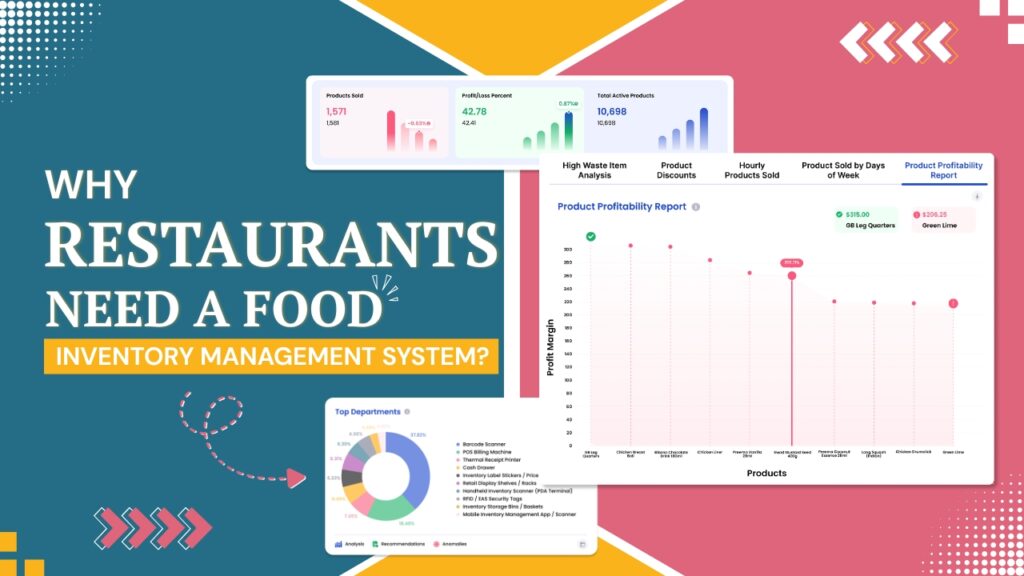
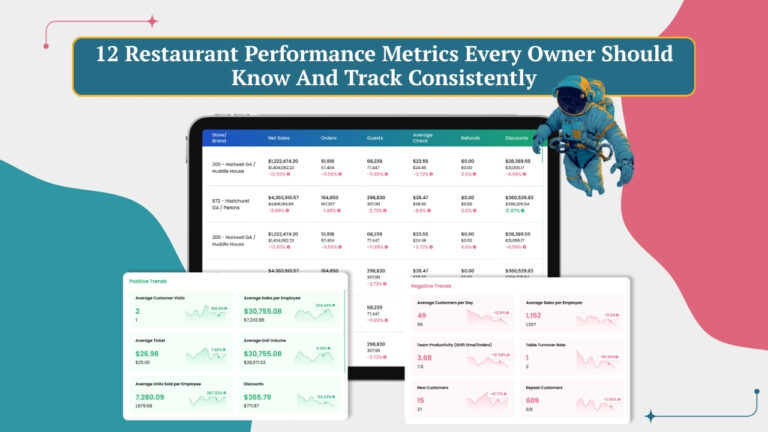
The restaurant industry lost $162 billion to food waste last year. Let that sink in for a moment. While you’re focused on perfecting your menu and delivering exceptional service, your walk-in cooler is quietly bleeding profit. That case of organic tomatoes you forgot about? It just costs you $40. The over-ordered ribeyes sitting in your freezer? There goes another $200.
Here’s what most restaurant owners don’t realize: inventory mismanagement isn’t just about spoilage. It’s the silent killer of restaurant profitability, affecting everything from your food cost percentage to your cash flow, menu pricing, and even your ability to scale.
If you’re still managing inventory with spreadsheets, clipboards, or gut feeling, you’re not just behind the curve; you’re actively sabotaging your bottom line.
But food inventory management software comes to the rescue.
In this comprehensive guide, we’ll break down exactly why modern restaurants can’t survive without a robust Food Inventory Management System, how to choose the right solution for your operation, and what separates average restaurants from highly profitable ones. Keep reading to discover how the right technology can transform your inventory from a cost center into a profit driver.
Also Read: AI for Restaurant Inventory
What is a Restaurant Food Inventory Management System and How Does it Help?
A Food Inventory Management System is software that helps restaurants track everything in their kitchen, from the moment ingredients arrive to when they’re served on a plate.
Think of it as a smart assistant that knows exactly what you have in stock, what you’re running low on, and what’s about to expire. Inventory management software for restaurants automatically connects to your point-of-sale system, so when you sell a burger, it knows to subtract the bun, meat, lettuce, and toppings from your inventory.
The best inventory software for restaurants does more than just count; it alerts you when it’s time to reorder, flags items nearing expiration so you can use them in specials, and shows you where you’re losing money through waste or over-portioning.
Also Read: Restaurant Profit Margin Analytics Tool to Boost Profits
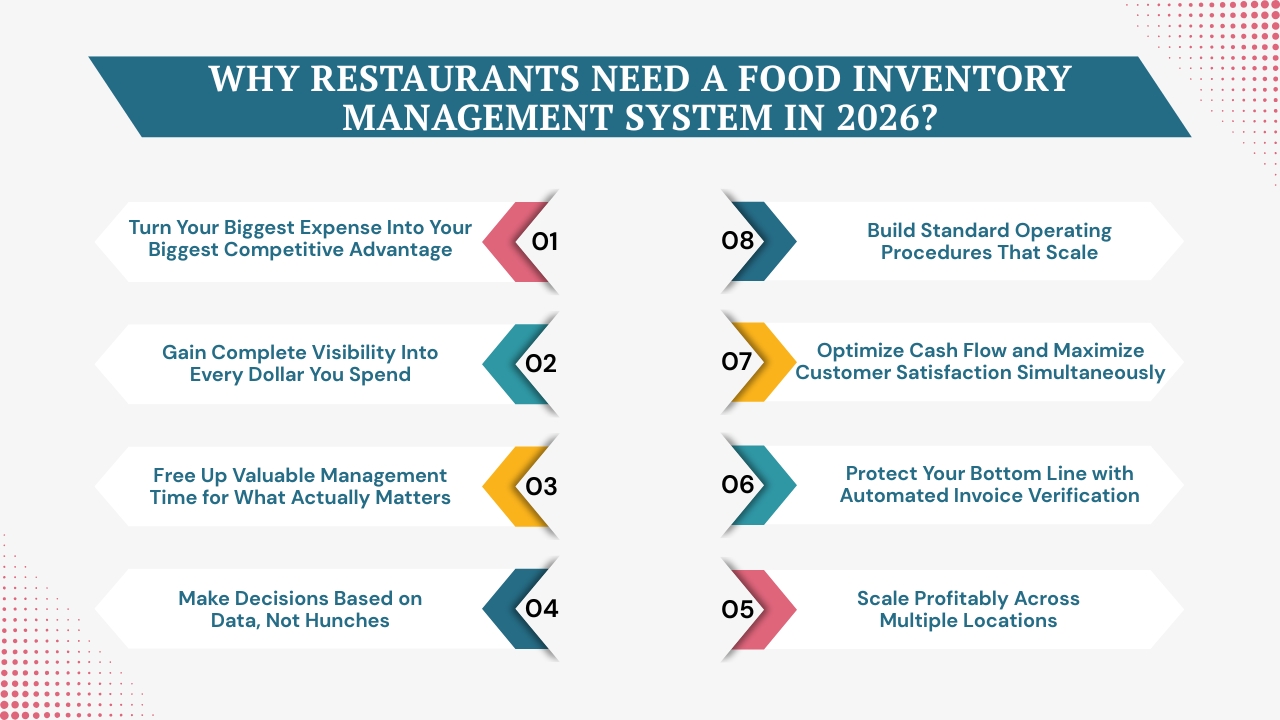
Why Restaurants Need a Food Inventory Management System in 2026?
The margin for error in restaurant operations has never been smaller. With labor costs rising, customer expectations at an all-time high, and economic uncertainty affecting consumer spending, you need every possible advantage.
1. Turn Your Biggest Expense Into Your Biggest Competitive Advantage
Food costs typically represent 28-35% of your revenue. That’s your single largest controllable expense and the single greatest opportunity to improve your bottom line.
The best inventory software for restaurants transforms guesswork into precision. It provides restaurant data analytics solutions that show you exactly what’s happening with every ingredient, every shift, every day, empowering you to make confident decisions that directly impact profitability.
With restaurant inventory tracking software, you make purchasing decisions based on precise, real-time data. You know exactly:
- Your actual usage rate over the past 30 days, week by week
- How much inventory do you have across all storage locations at any moment
- Which items are approaching expiration so you can plan specials around them
- Which menu items drive the most consumption and deserve priority
Restaurants don’t have to change the pricing, menu, or portions. It is just a game of better visibility.
Also Read: How to Create an Effective Restaurant Daily Sales Report
2. Gain Complete Visibility Into Every Dollar You Spend
Inventory management software for restaurants with integrated restaurant analytics and reporting reveals patterns that manual systems simply cannot detect.
- You’ll discover that your lunch shift consistently over-portions pasta by 15%, and you can correct it immediately.
- You’ll see that Tuesday deliveries always include items you don’t actually need until Thursday, and you can adjust ordering schedules to improve cash flow.
- You’ll identify which cooks maintain the tightest cost controls and can share their best practices across your team.
This level of visibility transforms how you operate. According to Georgetown University research, nearly 70% of restaurant food waste stems from food that is prepared, served, and never eaten, not just spoilage. Modern inventory tracking for restaurants helps you identify and prevent this waste before it happens, turning potential losses into protected margin.
Also Read: The Role of Data Analytics in Reducing Restaurant Waste
3. Free Up Valuable Management Time for What Actually Matters
Modern inventory tracking for restaurants reduces counting time by 60-75%. If your kitchen manager currently spends 8 hours per week counting inventory, that’s roughly $25,000 per year in labor costs you’re investing in data collection alone.
With the best food inventory management software and automated tracking, analytics, and reports, managers spend less time with clipboards and more time coaching staff, refining recipes, ensuring quality, and driving sales. The data you need flows automatically, more accurately, more timely, and requires a fraction of the labor.
That’s not just cost savings. It’s redirecting your most valuable resource, management attention, toward activities that actually grow your business.
Also Read: The Future of Restaurant and Retail Decision Intelligence
4. Make Decisions Based on Data, Not Hunches
Restaurant Business Intelligence, powered by inventory data, reveals opportunities that instinct alone would never uncover.
Data Analytics in Restaurants shows you:
- Which menu items deliver the best actual margin after accounting for waste (often different from theoretical food cost)?
- How do seasonal fluctuations affect your needs so you can adjust purchasing proactively?
- Which vendors consistently deliver the best value, not just on price, but on quality, accuracy, and reliability?
- What are your true recipe costs versus theoretical costs, exposing exactly where margin leaks occur?
For example, you might discover that your best-selling burger actually delivers lower profit than you thought because of inconsistent portioning, and fixing that one issue adds 8% to that item’s margin. Or you learn that purchasing certain items bi-weekly instead of weekly reduces spoilage by 40% without affecting availability.
These insights don’t come from experience; they come from data. All automated with the right platform. And they translate directly to profit.
Also Read: Benefits of Data-Driven Decision Making
5. Scale Profitably Across Multiple Locations
The best inventory software for restaurants provides enterprise-level restaurant analytics and reporting that gives you complete visibility across your portfolio while still allowing local operational flexibility.
You can see:
- Performance comparisons across locations, identifying your top performers and opportunities for improvement
- Standardized recipes and costs that maintain consistency while allowing for local vendor relationships
- Consolidated purchasing power that leverages your total volume for better pricing
- Transfer tracking between locations that optimizes inventory utilization across your network
- Anomaly detection that flags when one location’s numbers deviate from expected patterns
This centralized visibility without centralized rigidity is what allows successful restaurant groups to scale while maintaining the operational excellence that made them successful in the first place.
Also Read: Why Multi Location Growth Breaks Without Unified Data and How Smart Business Fixes it
6. Protect Your Bottom Line with Automated Invoice Verification
Industry studies show that invoice discrepancies occur in approximately 8-12% of all restaurant deliveries, representing thousands of dollars in overcharges annually for even modest-sized operations.
Quality inventory management software for restaurants includes invoice reconciliation features that automatically flag discrepancies between what you ordered, what you received, and what you were charged. This protection happens in real-time, allowing you to address issues immediately while the delivery is still fresh in everyone’s memory.
This single feature often pays for the entire software investment within months, while also improving vendor accountability and strengthening your negotiating position.
7. Optimize Cash Flow and Maximize Customer Satisfaction Simultaneously
Restaurant Data Analytics Solutions use historical sales data, seasonal trends, and upcoming reservations to predict exactly what you’ll need and when. Instead of guessing or over-ordering “to be safe,” you’re making mathematically optimized purchasing decisions.
Research shows that restaurants using predictive analytics for inventory management reduce stockouts by up to 45% while simultaneously decreasing overstock situations by 30-40%.
This means you’re investing working capital more efficiently, buying what you need, when you need it, while ensuring customers can always order what they want. It’s the rare business improvement that enhances both financial performance and customer experience.
Also Read: How AI Revolutionizes Customer Experience in the Restaurant Industry
8. Build Standard Operating Procedures That Scale
As you grow from one location to multiple units, consistency becomes everything. Inventory Management Software for Restaurants creates the standardization framework that allows you to scale successfully.
Your recipes, portion sizes, ordering procedures, and quality standards live in the system, accessible to every location but controlled centrally.
New managers don’t need to figure out inventory management; they follow established protocols built into the software. Training becomes faster and more consistent because the system guides users through proper procedures. When you open a new location, you’re not starting from scratch; you’re deploying proven systems with built-in best practices.
Restaurant Business Intelligence platforms show you which locations execute best, allowing you to identify and replicate successful practices across your network. This operational consistency isn’t just about efficiency; it’s about protecting your brand promise.
Also Read: Business Intelligence for Restaurants
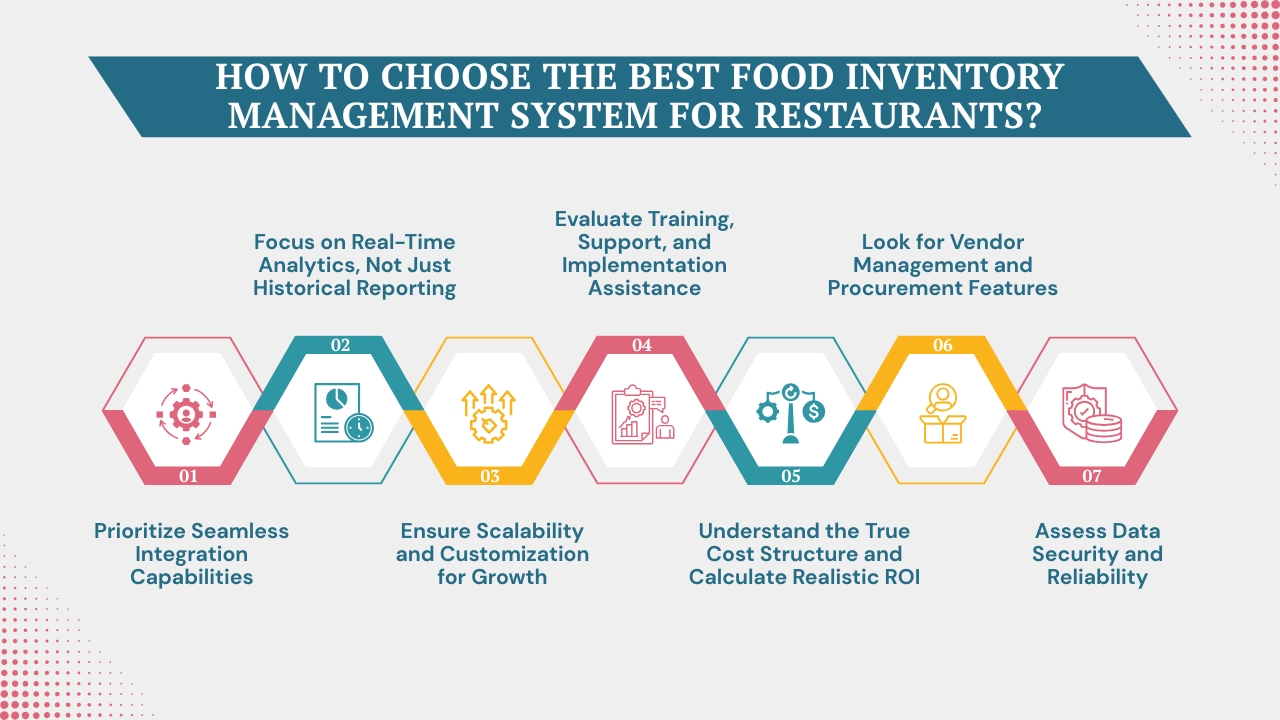
How to Choose the Best Food Inventory Management System for Restaurants?
Not all restaurant inventory tracking software is created equal. The market is flooded with solutions. Choosing the wrong system can create more problems than it solves, wasting money, frustrating your team, and delivering little actual value. Here’s how to separate the contenders from the pretenders and select the best inventory software for restaurants for your specific operation:
1. Prioritize Seamless Integration Capabilities
Your Food Inventory Management System needs to talk to your other systems. Period.
At a minimum, look for:
- POS integration: Automatically deducts ingredients based on sales without manual data entry
- Accounting software connection: Syncs with QuickBooks, Xero, or your financial system for real-time COGS updates
- Vendor ordering platforms: Place orders directly with suppliers from within the inventory system
- Recipe management: Links inventory to plate costs dynamically, automatically recalculating when prices change
If a system operates in isolation, it’s creating more work, not less.
So, ask potential vendors: Show me exactly how your system integrates with my current POS and accounting software. What does the data flow look like in real-time? If they can’t demonstrate this clearly, keep looking.
Also Read: POS Reports Vs Real-Time Analytics
2. Focus on Real-Time Analytics, Not Just Historical Reporting
Many systems provide historical reports. What you actually need is real-time restaurant analytics and reporting that alerts you to problems while you can still fix them.
The difference is critical: Finding out next week that you had 22% waste last Thursday doesn’t help. Getting an alert at 2 PM on Thursday that waste is trending 40% above normal for the shift? That’s actionable intelligence you can use immediately.
The best inventory software for restaurants should provide:
- Live dashboards: Current inventory values, variance alerts, and usage trends visible at a glance
- Predictive analytics: Forecasts based on historical patterns, upcoming events, and seasonal trends
- Exception reporting: Automatic alerts when metrics fall outside expected ranges
Look for restaurant data analytics solutions that don’t just show you what happened, they tell you what’s happening now and what’s likely to happen next, giving you time to intervene.
Also Read: Real-Time Analytics Why Does Your Business Needs it
3. Ensure Scalability and Customization for Growth
Will this system grow with you? Can it handle:
- Additional locations without exponential cost increases
- Seasonal menu changes and limited-time offerings
- Multiple storage locations per site (walk-ins, dry storage, bar, satellite kitchens)
- Different user permission levels (chef sees everything, line cooks see only their station)
- Custom reporting for your specific KPIs and business model
The best inventory software for restaurants adapts to your operation, not the other way around. Avoid systems that force you into rigid templates or charge exorbitant fees for basic customization.
Expert tip: If you’re a single location now but have expansion plans, verify the multi-unit pricing structure upfront. Some vendors offer attractive single-location pricing but charge prohibitively for additional units, creating expensive lock-in situations.
Also Read: How to Setup KPIs Key Performance Indicators for Your Business
4. Evaluate Training, Support, and Implementation Assistance
Even the most powerful inventory management software for restaurants is useless if your team won’t use it. Evaluate:
- Onboarding process: Is there dedicated implementation support, or are you given login credentials and left to figure it out?
- Training resources: Live training sessions, video tutorials, documentation, and ongoing education programs
- Customer support quality: Response times, knowledge level, availability (24/7 or business hours only?)
- User community: Active forums or user groups where you can learn from other operators
The vendors offering the cheapest monthly fees often provide the weakest support, and those savings evaporate when you’re spending 20 hours troubleshooting problems on your own.
5. Understand the True Cost Structure and Calculate Realistic ROI
Inventory tracking for restaurants typically costs between $100-500 per location per month, but pricing structures vary dramatically.
Consider:
- Monthly subscription fees: Per location, per user, or flat rate?
- Implementation costs: One-time setup fees, data migration, and initial training
- Hardware requirements: Barcode scanners, tablets, and printers. What’s included vs. sold separately?
- Integration fees: Are POS and accounting connections included or extra?
- Support costs: Is phone support included or premium-tier only?
Calculate your potential ROI based on:
- Expected food cost reduction: Industry average is 2-4%, but conservative estimates are safer
- Labor savings: Time eliminated from manual counting and data entry
- Cash flow improvement: Reduced inventory carrying costs from optimized ordering
- Waste reduction: Documented savings from better rotation and portion control
For most restaurants, the ROI payback period is 3-6 months. So, consider the pricing based on the ROI you are getting out of it and make a decision accordingly.
Also Read: The ROI of Restaurant Business Intelligence
6. Look for Vendor Management and Procurement Features
Quality Inventory Management Software For Restaurants goes beyond internal tracking to optimize your entire supply chain:
- Multi-vendor price comparison: See which supplier offers the best value for each item
- Invoice reconciliation: Automatic verification that you received what you ordered at the agreed price
- Vendor performance scoring: Track on-time delivery, accuracy rates, and quality issues
- Purchase order creation: Generate orders based on par levels and usage forecasts
These features transform vendor relationships from transactional to strategic, often delivering ROI that exceeds the software cost through better pricing and fewer invoice errors alone.
Also Read: AI for Retail Inventory Management
7. Assess Data Security and Reliability
Your inventory data is business-critical. Evaluate:
- Cloud-based vs. on-premise: Cloud offers better accessibility and automatic updates; on-premise offers more control
- Data backup protocols: Frequency, redundancy, disaster recovery capabilities
- Uptime guarantees: What happens when the system goes down during service?
- Security certifications: SOC 2, PCI compliance if handling payment data
- Data ownership: Can you export your data if you switch systems?
The cheapest restaurant inventory tracking software options often cut corners on infrastructure. A system that crashes during your busiest service or loses data during a migration isn’t cheap, it’s expensive.
Check out Livelytics, an AI Powered Food Inventory Management System for Restaurants!
Livelytics isn’t just another Food Inventory Management System. it’s the AI-powered command center for modern restaurants that understand data is their competitive edge.
Your customers expect personalized experiences. They want their favorites remembered, their dietary preferences understood, and consistently excellent food every single visit. Your team expects clear direction. You can’t deliver any of this by guessing or relying on outdated spreadsheets.
Livelytics was built specifically for restaurants like yours, operations that are data-focused, growth-minded, and committed to delivering exceptional experiences while maintaining operational excellence.
Why Modern Restaurants Choose Livelytics?
1. AI That Actually Works For You
Livelytics uses artificial intelligence and machine learning to do what no human could: analyze thousands of data points across your inventory, sales, customer behavior, and market trends to predict exactly what you need.
It understands that your Thursday lunch crowd is different from Saturday dinner. It knows which dishes sell together, which ingredients you consistently over-order, and which menu items drive the most profit after accounting for waste.
Also Read: Artificial Intelligence Vs Machine Learning
2. Real-Time Alerts That Save You Money
Livelytics monitors your operation continuously and provide real-time alerts you the moment something’s wrong, waste spiking on a particular shift, inventory running dangerously low on a key ingredient, food costs trending above target.
These aren’t annoying notifications. They’re opportunities to fix issues before they become expensive mistakes.
Also Read: How Real-time Dashboard Drive Smarter Business Decisions
3. Liv AI: Your Intelligent Restaurant Assistant
This is where Livelytics separates itself completely. Meet Liv AI, your 24/7 intelligent assistant that speaks restaurant, understands data, and answers your questions instantly.
- What’s my actual food cost this week compared to last month?
- Which menu items should I promote based on what’s in inventory?
- Why did waste increase on Tuesday’s dinner shift?
- What do I need to order for next weekend based on my reservations?
Just ask. Liv AI analyzes your data using advanced machine learning and gives you clear, actionable answers in seconds. Your sous chef can ask about prep yields. Your GM can check profitability trends. Your purchasing manager can compare vendor performance. Everyone makes better decisions because everyone has access to insights, not just data.
Also Read: How to Use AI in the Restaurant Business
4. Beyond Inventory: Complete Restaurant Intelligence
Livelytics doesn’t just track inventory in isolation. The platform connects inventory tracking for restaurants with menu management, pricing optimization, and customer analytics into one unified intelligence system.
When ingredient costs change, you immediately see the impact on every menu item’s profitability. When certain dishes consistently generate waste, the system identifies it and helps you fix it. When customer preferences shift, you have the data to adapt your menu strategically rather than reactively.
5. Built for Growth, Designed for Restaurants
Livelytics is intuitive from day one, your team can start using it productively within hours, not weeks. Setup is simple. The mobile interface is designed for actual kitchen environments. The learning curve is minimal because the system was built specifically with restaurant workflows in mind.
As you scale from one location to five to twenty, Livelytics scales with you seamlessly. Cloud-based architecture means no servers to maintain, no IT headaches, no expensive infrastructure. Just seamless management, regardless of your scale.
6. Pricing That Makes Sense
No massive upfront investment. No hidden fees. No paying for features you’ll never use. Livelytics operates on a transparent subscription model that fits restaurant economics, predictable monthly costs that scale as your business grows. You pay for intelligence that delivers measurable ROI, not software licenses gathering dust.
7. The Competitive Edge Data-Driven Restaurants Have
The restaurants winning right now aren’t necessarily the ones with the best locations or the biggest marketing budgets. They’re the ones with the best intelligence.
They know their true costs down to the ingredient level. They predict demand accurately and order accordingly. They identify profit leaks before they become big problems. They personalize customer experiences using behavior data. They make menu decisions based on comprehensive profitability analysis, not gut feel.
Ready to see what AI-powered restaurant intelligence can do for your operation?
Book a free demo and discover how Livelytics transforms data into your most powerful competitive advantage.
Final Thoughts
The restaurant industry’s margins are too thin and competition too fierce to operate on guesswork. And, the restaurants that thrive aren’t the ones with the biggest budgets; they’re the ones with the best data.
The best inventory software for restaurants delivers real-time Restaurant Analytics And Reporting, predictive insights, and actionable intelligence that helps you reduce waste, optimize purchasing, and protect profitability. Modern Restaurant Business Intelligence platforms connect inventory tracking for restaurants with menu management, pricing, and customer data, giving you the complete operational picture you need to make confident decisions.
At Livelytics, we’ve built Restaurant Data Analytics Solutions specifically for growth-focused restaurants that refuse to settle. Our platform brings together Inventory Management Software For Restaurants with AI-powered intelligence designed to help you work smarter, not harder.
Want to see how intelligent inventory management can transform your operation? Book a free demo and discover what’s possible when your data works for you.