Restaurant Sales Forecasting is one of the crucial strategies to be implemented by restaurants that aims to grow confidently. Being in a highly competitive market, restaurant owners cannot simply depend on their instinct to make decisions.
Rather they require clear, data insights to predict future revenue, prepare for demand, and improve overall restaurant performance. That is why implementing restaurant revenue forecasting is essential.
These tools help restaurants to estimate future sales by learning about historical sales data, seasonal patterns, customer trends, holidays, promotions, and other factors which influence everyday performance.
As the sales are not the same for restaurants every day. Revenue can either increase or decrease based on the day of the week, weather conditions, local events, menu changes, and customer traffic.
Without forecasting tools, restaurants may either schedule more staff during slow days, less staff during busy hours, or over-order ingredients, or may lose the opportunities for achieving maximum profits.
Even a small mistake in operations can increase labor costs, inventory wastage, and affect the overall guest experience. A strong sales forecast helps restaurant owners to get visibility into daily operations that help them to make smarter operational and financial decisions.
Effective sales forecasting for restaurants is not just about good numbers on a report. Rather it helps for better inventory management, efficient employee scheduling, stronger budgeting, and improved profits.
It helps restaurants to respond faster to changing demand and also prepare themselves for challenges and ensures long-term growth. Whether you are running a small cafe, a quick service outlet, or a full-service restaurant, using restaurant analytics and forecasting helps to make your business more stable and profitable.
Through this blog, we will walk you through how Restaurant Sales Forecasting works, why implementing such tools is essential, what data you require, and how to use practical forecasting methods to predict future revenue with more accuracy and confidence.
Also Read: How Restaurant Can Predict Trends With Analytics
What Is Restaurant Sales Forecasting?
Restaurant sales forecasting involves the process of predicting future revenue based on existing data and business patterns. These tools helps restaurants to answer questions like:
- How much revenue are we likely to make tomorrow?
- What should we expect next weekend?
- Will next month be stronger or weaker than last month?
The goal of sales forecasting is not to predict the future accurately with precision because no businesses can do that. Instead, implementing sales forecasting helps restaurants to reduce any type of uncertainty and make smarter decisions.
A good forecast creates realistic expected sales so managers can prepare before time.
For restaurants, forecasting is essential as the business is highly dynamic. Daily sales of restaurants may change based on day of the week, time of day, local events, weather, promotions, online delivery demand, customer traffic, and even social media trends.
It means restaurants require forecasting methods which are flexible, practical, closely connected to real operating conditions.
Restaurant sales forecasting combines both past data with your current business context. If your restaurant is performing well on weekends, experiences a sales drop on a rainy day, or experiences an increase in sales during local festivals, then your forecast must reveal those patterns.
Also Read: How to Create an Effective Restaurant Daily Sales Report
Why Sales Forecasting Is Critical for Restaurants
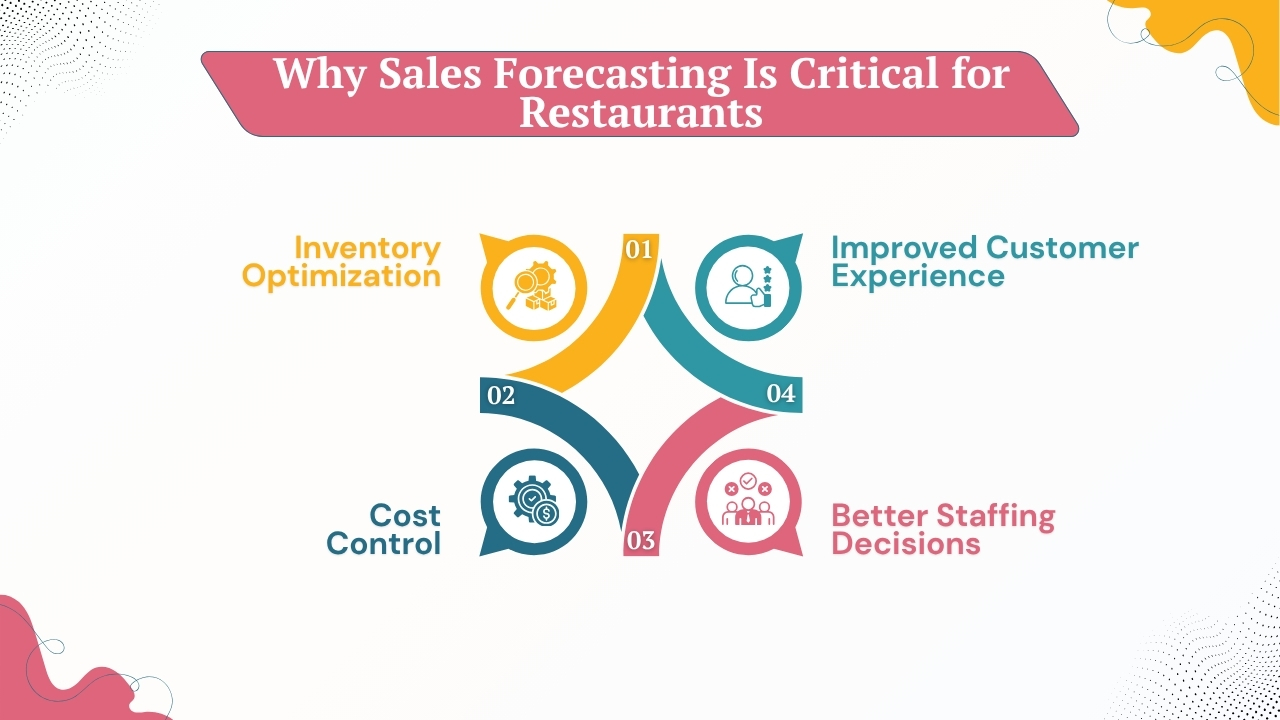
Sales forecasting is crucial for restaurants as it helps them to estimate customer demand, manage stock efficiently, control expenses, and optimize staffing.
When restaurants have accurate forecasts, it helps them to reduce inventory waste, avoid inventory stockouts, improve customer experience, and make smarter business decisions that support consistent growth and long-term profits.
1. Inventory Optimization
Accurate sales forecasting helps restaurants to order the right amount of ingredients based on their expected demand. This helps restaurants to reduce any food spoilage, unnecessary waste, and prevent last minute buying of ingredients at higher costs.
Also Read: AI for Restaurant Inventory
2. Cost Control
One of the largest expenses in any restaurant is food cost. Managing food cost is essential for gaining profits. Sales forecasting helps managers to buy ingredients in the right amount instead of overstocking or excess waste.
When restaurants align their food cost with expected demand, it helps them to maintain a good food cost percentage and improve overall financial performance.
Also Read: Cost Effective AI Solution for Restaurants
3. Better Staffing Decisions
Sales forecasting helps restaurants to predict both busy and slow hours with more accuracy. This allows managers to schedule the right number of staff for each shift that ensures smooth operations.
Proper staffing helps restaurants to avoid unwanted labor expenses due to overstaffing and also prevent less staff during busy hours, which improves efficiency, service quality, and overall team productivity.
Also Read: How Data Analytics Improve Employee Performance
4. Improved Customer Experience
Accurate forecasting ensures that restaurants have the essential ingredients and popular menu items always available when customers order them. Avoiding ingredient stockouts, helps restaurants to regularly align with customer demand and give them a good dining experience.
It causes higher customer satisfaction, positive reviews, and repeat visits, because customers believe that their favorite food dishes will always be available in restaurants.
Also Read: How AI Revolutionizes Customer Experience in the Restaurant Industry
Types of Restaurant Sales Forecasting
1. Short-Term Forecasting
Short-term forecasting focuses on predicting restaurant sales on a daily or weekly basis. This helps restaurants to manage everyday operations such as inventory ordering and staff scheduling.
When restaurants accurately predict demand, then it helps them to ensure that they have the right amount of ingredients in stock and the right number of staff.
It helps restaurants to reduce waste, control labor expenses, and maintain smooth service which ensures that customers have consistent and efficient dining experiences every time.
Also Read: The Future of Restaurant & Retail Decision Intelligence
2. Medium-Term Forecasting
Medium-term forecasting focuses on predicting sales over a monthly basis. It helps restaurants to plan beyond daily operations. This type of forecasting is essential for budgeting, which helps restaurant owners to predict revenue, control expenses, and allocate their resources effectively.
Additionally medium-term forecasting helps restaurants to plan discounts or marketing campaigns, by identifying the best periods to attract customers. When restaurants have more visibility about upcoming trends, restaurants can make smarter financial and marketing decisions.
Also Read: Business Intelligence Dashboard for Data Collection
3. Long-Term Forecasting
Long-term forecasting focuses on predicting sales over quarterly or yearly periods. It helps restaurants to offer a strategic view of business performance. This type of forecasting helps restaurant owners to plan expansions such as opening restaurants at new locations or increasing seating capacity.
It helps restaurants to implement major decisions such as equipment upgrades or adopting new technology. When restaurants have long-term insights, businesses can find growth opportunities, manage risks, and develop strategies for sustainable and profitable expansion.
Step-by-Step Process to Create Accurate Forecasts
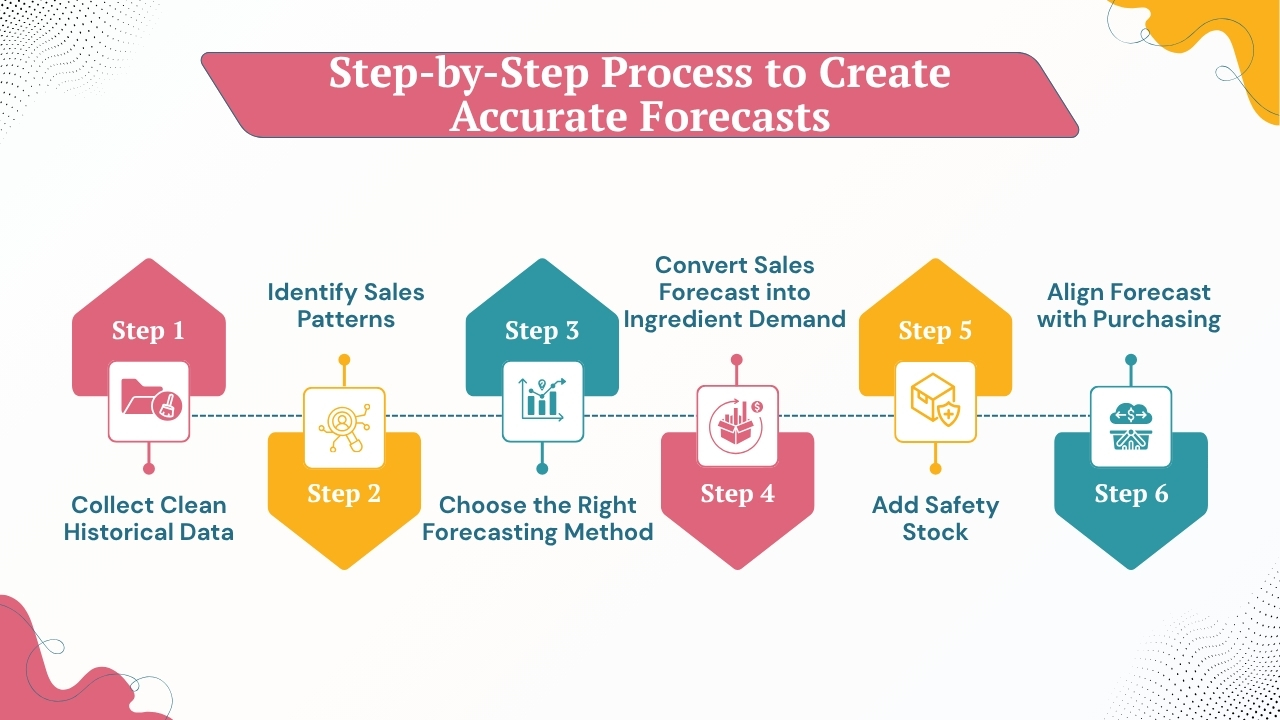
Step 1: Collect Clean Historical Data
For accurate restaurant sales forecasting, it is possible only when restaurants have clean and reliable past data. Because your sales forecast will only be accurate based on the accurate data that you use, so it is essential to begin with well-organized sales records.
Accurate data helps restaurants to understand customer demand, seasonal patterns, and customer buying early.
To build a powerful forecasting base, focus on these essentials:
-
Gather enough data
Restaurants must use at least 6-12 months of past sales data which helps to make sales forecasts. It helps restaurants to understand their busy seasons, customer patterns, and slower periods.
-
Track daily sales details
Restaurants must track sales on a daily basis. When restaurants break down sales on a daily basis, which helps them to identify their patterns by day, week, and month.
-
Use item-level sales when possible
Restaurants must use sales data based on item-level that helps to provide deeper insights into the menu items which sell most and about best-selling food items.
These insights help restaurants to identify demand patterns, improve efficiency of forecasting, plan inventory better, and make smarter menu and purchasing decisions.
Also Read: How Does Data Analytics Helps Restaurant Grow
Step 2: Identify Sales Patterns
After having clean data, the next step is to identify meaningful sales patterns. When restaurants understand how they perform with time, it helps them to make accurate forecasts and make better operational decisions.
Analyzing these trends helps restaurants to predict customer behavior and manage their operations accordingly.
Focus on identifying the following important patterns:
-
Peak hours
Analyze both lunch and dinner sales separately to find busy hours and identify the items that customers demand the most, improve staffing levels, preparation planning, and service efficiency.
-
Weekly trends
Compare weekday and weekend sales to find regular customer traffic patterns. It helps restaurants to adjust staffing, inventory, and promotions based on predictable customer demand changes.
-
Seasonal patterns
Evaluate increase in sales during festivals, holidays, and special occasions to understand seasonal demand patterns, and manage inventory, staffing, and promotions more effectively.
-
External factors
Also consider external factors such as weather conditions and local events as it directly influences customer behavior, customer demand patterns, and overall restaurant sales performance.
For instance, restaurants may have high delivery orders during rainy days, while more people visit restaurants during weekends. When restaurants recognize these patterns, it helps to improve forecasting accuracy and operational efficiency.
Also Read: How to Create an Effective Restaurant Daily Sales Report
Step 3: Choose the Right Forecasting Method
Every restaurant does not require advanced forecasting systems. The accurate forecasting method depends on the size of your restaurant, complexity of your operations, and the amount of data you have available.
Choosing a method which fits your size helps you make accurate predictions without complicating the process.
Here are the main forecasting approaches restaurants can use:
-
Basic methods for small restaurants
Small restaurants can begin with simple methods like moving average and weighted average. These are easy to manage in spreadsheets and work well when sales patterns are relatively stable.
-
Intermediate methods for growing restaurants
Trend analysis and regression models are useful for restaurants with more consistent growth patterns. They help identify changes over time and measure how specific factors influence sales.
-
Advanced methods for large or multi-location businesses
AI-based forecasting and machine learning models are essential for restaurant chains with large datasets. Such systems can analyze customer demand patterns, external factors, and real-time data to give highly accurate predictions.
Also Read: Choosing the Right AI Data Platform for Your Business
Step 4: Convert Sales Forecast into Ingredient Demand
This is the phase where many restaurants make mistakes. Forecasting sales alone is not enough unless those numbers are converted into actual ingredient requirements.
A forecast becomes useful only when it helps the kitchen and purchasing team know exactly what to prepare and order.
To convert sales forecasts into ingredient demand, focus on these key elements:
-
Recipe standardization
Ensure that every menu item has a standard recipe, clear listing of ingredients and their quantities so that you can accurately plan inventory, maintain consistency, and improve forecasting accuracy.
-
Portion sizes
Accurate portion sizes help to find the exact amount of ingredients required based on forecasted sales, improving inventory planning, reducing waste, and supporting cost control.
-
Yield percentages
Yield percentages track ingredient loss during cooking and preparation, which helps restaurants to order ingredients with more accuracy, reduce waste, prevent inventory shortages, and maintain better inventory control.
For instance, if you forecast selling 100 burgers, you must calculate the number of buns, patties, slices of cheese, vegetables, and sauces required.
If yield loss is ignored, you may under-order ingredients and face shortages during service.
When forecasts are converted into ingredient demand ensures smoother operations, better inventory planning, and less waste.
Also Read: Business Intelligence for Marketing
Step 5: Add Safety Stock
Demand in the restaurant industry is never completely predictable which is why adding safety stock is essential. Safety stock acts as a buffer to protect your operations from getting impacted due to unexpected rise in demand, supplier delays. Even a small difference in safety stock can often cause stockouts and lost sales.
To determine the accurate safety stock, consider these below important factors:
-
Demand variability
If sales frequently fluctuate, then restaurants require a high level of safety stock buffer to handle increase in demand and prevent restaurants from running out of important ingredients.
-
Supplier reliability
When suppliers are not dependable or deliveries are inconsistent, restaurants may need more safety stock to avoid inventory shortages and keep operations running smoothly without any disruption.
-
Lead time
Longer supplier lead times require restaurants to maintain higher safety stock levels, ensuring that they don’t run out of ingredients while waiting for new deliveries to arrive.
It is also essential to adjust safety stock based on item type. Perishable items such as vegetables or dairy should have a low buffer to avoid spoilage, while dry goods like rice or packaged items can have a higher buffer.
Smart safety stock ensures product availability while reducing waste and controlling expenses.
Step 6: Align Forecast with Purchasing
Sales forecasting only provides real value when it is directly connected to your purchasing process. Without such connection, forecasts remain theoretical and fail to improve operations.
Aligning forecasts with purchasing ensures that inventory decisions are based on actual expected demand.
Follow these best practices to create an effective system:
-
Automate purchase orders
Use forecast data to automate purchase orders, saving time, reducing manual errors, which improves ordering accuracy across daily operations.
-
Sync with inventory systems
Integrate forecasting with your inventory system so stock levels update in real time, ensuring accurate tracking, better planning, and improved decision-making across operations.
-
Adjust based on real sales
It is essential to continuously compare actual sales with forecasted numbers and make daily adjustments to improve accuracy, reduce errors, and strengthen future planning and decision-making.
Together, these steps form a continuous feedback loop which drives smarter decisions and ongoing business improvement.
It ensures continuous learning and refinement. With time, it causes better purchasing decisions, reduced waste, improved efficiency, and stronger overall profits.
Also Read: How Livelytics Helps Restaurant Boosts Revenue
Popular Sales Forecasting Methods Explained
1. Moving Average Method
Moving average method is one of the simplest and widely used forecasting methods in restaurants. It works by taking past sales data and calculating an average over a fixed duration such as the last 7, 14, or 30 days, to predict future demand.
It helps to smooth short changes and provide a stable sales prediction. This type of sales forecasting is essential for restaurants with steady customer flow and predictable demand patterns.
One of the biggest advantages of such a sales forecasting method is that it can be created easily and managed using spreadsheets without using advanced tools.
However, its main limitation is that it does not respond quickly to sudden changes such as promotions, weather changes, local events, or unexpected rise in demand. Even so, this type of forecasting method remains a strong beginning for small restaurants beginning with sales forecasting.
Also Read: Data Mining Vs Data Science
2. Weighted Moving Average
The weighted moving average method is an improved forecasting method of the simple moving average, designed to provide more accurate forecasts. It works by assigning greater importance to recent sales data while giving less weight to past data.
This sales forecasting approach allows forecasts to respond more quickly to existing trends and changes in customer behavior. When restaurants focus on their recent performance, it delivers more valid and timely predictions as compared to other basic sales forecasting methods.
It is especially useful for restaurants where demand changes due to promotions, seasonal changes, or changing customer preferences. Though it is a more advanced sales forecasting method, it can be easily implemented using spreadsheets.
Also Read: Customer Analytics for Restaurants
3. Regression Analysis
Regression analysis is an advanced forecasting method that helps restaurants to understand how various factors influence sales. Instead of just depending only on past data, regression analysis analyzes relationships between sales and other variables such as weather, marketing campaigns, pricing changes, and local events.
This approach offers deeper, data-driven insights by revealing why sales increase or decrease, and not just reveal when sales change. This type of analysis is essential for planning promotions, optimizing staffing, and improving inventory management.
By identifying the crucial factors of demand, restaurants can make more informed and strategic decisions. Regression analysis suits well for businesses which require more than basic forecasting and also have a clear understanding of performance patterns.
4. AI & Machine Learning Forecasting
AI and machine learning forecasting use advanced algorithms to predict restaurant demand with high clarity. Systems such as Livelytics analyze large amounts of past and real-time data, identifying complex patterns which traditional methods may not be able to detect.
These models keep continuously learning and improving, that makes forecasts more accurate with time. One of the important benefits of this forecasting is real-time adjustment that allows predictions to update based on live sales, weather changes, and other external factors.
This approach works well for multi-location restaurants which enables centralized analysis and optimization across outlets. It is well suited for businesses that are growing, AI-driven forecasting supports automation, improves efficiency, and helps restaurants to make faster, smarter, and more data-driven decisions.
Also Read: Artificial Intelligence Vs Machine Learning
Factors That Affect Restaurant Sales Forecasting
1. Seasonality
Seasonality is a crucial factor in restaurant sales forecasting because demand often changes during specific seasons of the year. For instance, festivals and holidays may increase customer traffic, while tourism patterns can cause seasonal spikes at some locations.
By knowing when demand rises or falls, businesses can plan inventory, staffing, and promotions more effectively, which ensures they achieve maximum revenue during busy periods and manage slower seasons efficiently.
2. Weather
Weather conditions can influence restaurant sales and customer behavior. For instance during rainy days, restaurants may experience an increase in delivery orders, while dine-in customers may reduce during rainy days.
When restaurants analyze weather patterns combined with past sales data, restaurants can predict demand, adjust their staffing, and plan inventory more effectively for maintaining smooth operations and consistent service.
3. Local Events
Local events can have a strong influence on restaurant sales and customer traffic. Local events like concerts, sports events, and community gathering often bring large crowds to locality that increases demand.
Restaurants can benefit by predicting these spikes, preparing for more inventory, and adjusting staff levels. Tracking local event orders helps businesses to align operations and maximize sales opportunities during high-traffic durations.
4. Menu Changes
Menu changes can highly impact customer demand and preferences. Introducing new dishes may attract more customers or may shift demand away from existing items. Seasonal menus and limited-time offers can also create a temporary rise in sales.
By tracking how new food items perform, restaurants can adjust forecasts, manage inventory better, and refine their menu to align with customer tastes and maximize overall revenue.
Also Read: Optimizing a Restaurant Menu With AI Powered Data Analytics
Key Metrics to Track
Tracking the right metrics is essential to measure the effectiveness of your forecasting and overall performance. These important indicators help to identify gaps, improve accuracy, and optimize operations.
1. Forecast Accuracy (MAPE)
Mean Absolute Percentage Error (MAPE) measures how closely predicted sales are connected to actual results. A lower MAPE indicates high accuracy, helping you trust your forecasts for better planning. Tracking this metric regularly helps restaurants to refine your forecasting methods and improve decision making with time.
2. Food Cost Percentage
This metric tracks the revenue which is spent on food ingredients. It helps restaurants to understand cost efficiency and profits. Accurate forecasting supports better purchasing decisions which keeps food costs within the ideal range and reduces unwanted expenses.
Also Read: How to Calculate Food Cost Percentage
3. Waste Percentage
Waste percentage tracks the inventory wasted due to spoilage, over-preparation, or poor planning. A high inventory waste level indicates that the inventory has been either over ordered or inaccurate forecasts. Reducing inventory waste directly improves profits and operational efficiency.
Also Read: AI Solutions For Reducing Restaurant Waste
4. Stockout Rate
It measures how often menu items are unavailable when customers order them. A high stockout rate causes lost sales and poor customer experience. Tracking stockout rate helps restaurants to ensure better inventory planning and product availability consistently.
Conclusion
Restaurant sales forecasting is no longer optional; rather it has become a crucial part of running a successful and profitable restaurant. In today’s competitive environment, depending on guesswork is not just enough.
Sales forecasting provides a strong foundation for stronger decision-making across every aspect of your business.
It supports important areas like inventory management, which ensures you order the right quantities, efficient staffing to match demand, better cost control to protect profit margins, and overall business growth.
When these tools are used accurately, forecasting helps you operate with confidence and clarity.
Forecasting is not just about predicting future sales rather it’s about having full control over your restaurant operations using data. It helps you to shift from reactive decisions to proactive planning.
To succeed in forecasting, begin with clean and accurate data, choose the right forecasting method for your business size, connect forecasts directly to purchasing, and continuously refine your approach based on actual results.
When implemented effectively, sales forecasting transforms your restaurant into a data-driven, efficient, and highly profitable business ready for long-term success.
If you still have any query about Restaurant Sales Forecasting about how to predict future revenue, then you may book a free demo at livelytics and we are more than happy to assist you.