As a restaurant owner, COO, or operations leader, growth is exciting, but it’s also overwhelming.
You’re expanding on the surface.
- But is revenue truly increasing?
- Are profits improving or just sales?
- Is every location operating at the same efficiency?
There are so many questions, but no clear answers.
You already have data. It’s sitting inside your POS systems. Inventory tools. Payroll software. Accounting platforms. The problem isn’t access to information. The problem is that it lives in silos.
You have the numbers, but not the clarity.
That’s where the best restaurant business intelligence software comes in.
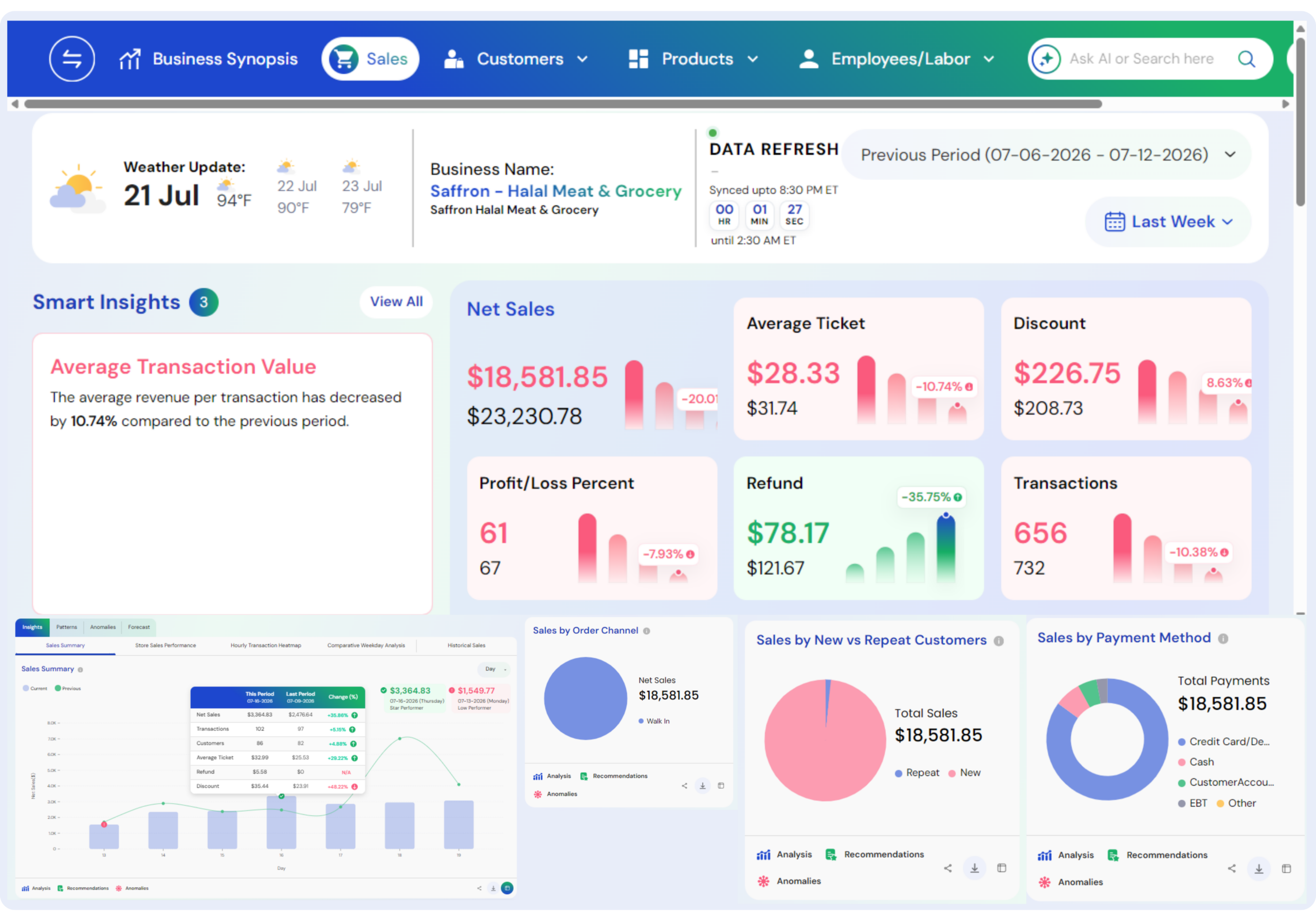
The right Restaurant BI software doesn’t just pull reports. It connects your data across locations, centralizes it into one intelligent dashboard, sends proactive alerts, highlights risks, and even provides actionable recommendations. It helps you move from reactive management to confident, data-driven leadership.
Curious to understand how business intelligence software for restaurants works, what real benefits it delivers, and how restaurant analytics software can transform operations at scale?
Let’s dig in.
Also Read: Business Intelligence for Restaurants
What Is Restaurant Business Intelligence Software?
Restaurant BI software (Business Intelligence software for restaurants) is a centralized data platform designed to help restaurant leaders make smarter, faster, and more profitable decisions.
Instead of checking multiple systems separately, your POS for sales, inventory software for stock levels, payroll for labor costs, and accounting tools for financial reports, Restaurant BI software connects all of them into one unified view.
It doesn’t just collect data. It organizes, analyzes, and translates it into insights you can actually act on.
For example, instead of simply showing that food costs increased, restaurant analytics software can help you see:
- Which location is driving the increase
- Which menu items are affecting margins
- Whether vendor pricing changed
- If portion control issues are impacting profitability
In simple terms, the best restaurant business intelligence software helps you answer four critical questions:
- What is happening? (real-time performance visibility)
- Why is it happening? (root cause analysis)
- What will happen next? (predictive forecasting)
- What should we do about it? (data-backed recommendations)
For growing brands, Restaurant BI software becomes a single source of truth. It enables owners, COOs, and operations teams to monitor revenue, control costs, benchmark locations, optimize labor, reduce waste, and forecast demand, all from one intelligent system.
It replaces scattered data with clarity and reactive decisions with strategic control.
It’s really like Moneyball for restaurants; all the data your business generates can tell you where your strengths and weaknesses are, so you can coach teams and improve performance.
Damian Mogavero, Founder of Avero
Also Read: How Restaurant Business Intelligence Helps Owners to Make Faster Decisions
How Restaurant BI Software Works & Helps Restaurant Business: From Data to Predictive Intelligence?

1. Data Integration Across All Systems
Modern restaurant BI software connects with your POS, inventory management, payroll, accounting, vendor platforms, and online ordering systems. Instead of operating independently, all operational and financial data flows into one centralized intelligence layer.
Why this matters:
Growing restaurants gain a single source of truth. Leadership no longer wastes time reconciling numbers from multiple systems. Everything, revenue, costs, margins, and performance, is visible in one place.
The biggest problem isn’t getting reports; it’s that they’re all in different places. By the time we consolidate everything, it’s already old data.
Source: Reddit
Also Read: Two Way Data Analytics in Shaping Retail Business
2. Data Cleaning & Standardization
Raw restaurant data is often inconsistent. Different systems format information differently. Locations may categorize items differently. Errors and duplicates can occur.
Restaurant BI platforms automatically:
- Clean inaccurate entries
- Remove duplicates
- Standardize naming conventions
- Align financial metrics across locations
Why this matters:
Accurate insights depend on clean data. Standardization ensures reliable reporting and prevents conflicting numbers during executive reviews.
Also Read: Automating Data Analysis Using Artificial Intelligence
3. Identifying Patterns & Trends with Machine Learning
Once data is structured, the system analyzes it to uncover patterns and correlations. Machine learning models detect trends such as:
- Rising food costs tied to specific vendors
- Labor inefficiencies during certain shifts
- Seasonal sales fluctuations
- Menu items impacting profitability
Why this matters:
Instead of reacting to surface-level numbers, leadership understands root causes and long-term performance patterns.
Also Read: Business Intelligence Vs Machine Learning
4. Real-Time Dashboards, Instant Reports & Alerts
Modern restaurant analytics software delivers live dashboards and automated reporting. It also sends alerts when performance deviates from targets, such as:
- Food cost exceeding thresholds
- Labor-to-sales ratios spiking
- Sudden drops in location revenue
Why this matters:
Decision-making becomes proactive. Issues are flagged immediately rather than discovered at month-end.
Also Read: Real-Time Analytics Why Does Your Business Needs it
5. Enabling Predictive Intelligence & Forecasting
Using historical performance, seasonal trends, and operational data, the best restaurant business intelligence software generates forecasts for:
- Future sales
- Inventory requirements
- Staffing needs
- Margin projections
Why this matters:
Restaurants can optimize purchasing, schedule labor accurately, reduce waste, and plan expansion with confidence rather than guesswork.
Also Read: How Predictive Intelligence Transforms Retail
6. Continuous Learning & Optimization
As more data enters the system, machine learning models refine their accuracy. Forecasts become more precise, anomaly detection improves, and recommendations grow smarter over time.
Why this matters:
The intelligence evolves alongside your business. As your restaurant brand scales, your BI system becomes increasingly accurate and strategic.
Also Read: Benefits of Supply Chain Optimization for Businesses
Running a Growing Restaurant Without BI vs With Restaurant BI Software
Most growing restaurants don’t struggle because they lack data; they struggle because their data is fragmented.
In a traditional setup, your POS tracks sales. Inventory software monitors stock. Payroll manages labor. Accounting closes the books. Each system works well on its own, but none of them truly communicates with each other. Leadership ends up reviewing separate reports, manually connecting numbers, and making decisions based on partial visibility.
This model includes reporting, but not real intelligence.
Modern Restaurant BI software changes that foundation. Instead of operating in silos, restaurant business intelligence software integrates every critical data source into a single unified platform. It doesn’t just show what happened. It connects revenue to food costs, labor to demand patterns, vendor pricing to margin shifts, and translates those connections into actionable insights.
Here’s how traditional workflows compare to a modern restaurant analytics software approach.
| Business Area | Without Restaurant BI Software | With Modern Restaurant BI Software |
| Data Sources | Separate POS, inventory, payroll, and accounting systems work independently. | Integrated data from all systems into one centralized platform. |
| Reporting | Basic sales reports, static spreadsheets, and month-end financial summaries. | Real-time dashboards, automated reporting, and executive summaries. |
| Revenue Visibility | Sales data available, but limited profitability breakdown. | Real-time revenue, margin, and contribution analysis per location and menu item. |
| Profit Clarity | Profit is reviewed monthly after accounting closes the books. | Live profit tracking with cost breakdowns and performance alerts. |
| Performance Visibility | Sales-focused view with limited cost insights. | Complete visibility into revenue, food cost, labor cost, and profit margins. |
| Food Cost Control | Variances discovered after the month-end review. | Instant food cost variance alerts and waste tracking. |
| Labor Optimization | Labor schedules are adjusted reactively. | Predictive labor planning based on demand trends. |
| Multi-Location Performance | Manual comparison using spreadsheets. | Automated benchmarking across all outlets. |
| Vendor Management | Price changes are noticed only during invoice review. | Vendor price tracking and impact analysis. |
| Decision Speed | Delayed decisions due to fragmented reports. | Faster, data-backed decisions from centralized dashboards. |
| Forecasting & Planning | Based on last year’s numbers or intuition. | AI-driven forecasting using real-time historical data. |
| Leadership Reporting | Teams prepare reports manually for management meetings. | Automated executive dashboards with actionable insights. |
| Scalability | Complexity increases with every new location. | Centralized visibility that scales with growth. |
Food cost creep is real. It’s never one big spike; it’s small changes over time that kill you if you’re not watching closely.
— Reddit user (r/KitchenConfidential)
How 5 Leading Restaurants Grew Faster with Restaurant Business Intelligence Software?

Different segments. Different business models. Different scales. But one consistent truth is that the restaurants growing with the most confidence are the ones treating data as a core operational asset.
The five leading restaurants below didn’t just get lucky with their growth. They made a deliberate bet on data, and the results speak for themselves.
1. McDonald’s Reduced Food Waste by 30% with Predictive Demand Forecasting
McDonald’s integrated AI-powered BI and predictive analytics across its global network to forecast demand at the individual restaurant level, factoring in weather, local events, and historical sales patterns. The outcome was a 30% reduction in food waste, tighter labor scheduling, and faster service times across 40,000+ locations worldwide.
The lesson: When you stop guessing and start forecasting, waste drops and margins grow.
Also Read: AI Solution for Reducing Restaurant Waste
2. Domino’s Drove 90%+ Sales Growth Over a Decade Using Restaurant Analytics
Domino’s used restaurant analytics software to gain granular visibility into delivery performance, order accuracy, and location-level efficiency. By systematically identifying and closing operational gaps, they transformed from a struggling brand into one of the best-performing QSR stocks of the last decade, posting over 90% sales growth and becoming a benchmark for data-driven restaurant operations globally.
The lesson: Data doesn’t just improve operations. Used strategically, it can rebuild an entire brand’s competitive position.
Also Read: Why One-Burger Chain Drive Through Location is always slower and How Livelytics Reveals the Truth
3. Chick-fil-A — Achieved #1 Customer Satisfaction Ranking for 9 Consecutive Years
Chick-fil-A uses centralized above-store BI reporting to monitor service times, order accuracy, and guest satisfaction metrics in real time across every location. By catching operational drift early, before it reaches the guest, they’ve maintained the top spot in the American Customer Satisfaction Index for nine consecutive years, an unmatched achievement at their scale.
The lesson: Consistency at scale isn’t accidental. It’s a data discipline.
Also Read: How AI Revolutionizes Customer Experience In Restaurant Industry
4. Sweetgreen Scaled to 220+ Locations While Holding Food Cost Under 28%
Sweetgreen built a data-first culture from day one, using restaurant BI software to manage menu performance, supply chain efficiency, and labor optimization simultaneously across a rapidly growing footprint.
The result: aggressive expansion to 220+ locations while maintaining food cost under 28%, well below the industry average, and preserving the menu consistency their brand is built on.
The lesson: The best time to invest in BI is before you scale, not after.
Also Read: How to Calculate Food Cost Percentage
5. Dine Brands (Applebee’s & IHOP), Improved Franchisee Performance Across 3,200+ Locations
Dine Brands implemented centralized restaurant BI software across its Applebee’s and IHOP portfolio to benchmark performance across franchisees, identify best practices at top-performing locations, and have data-backed conversations with underperformers. The result was measurable improvement in franchisee operational consistency across more than 3,200 locations in over 100 countries.
The lesson: In franchising, the brands that win are the ones that can show franchisees exactly what great looks like, in numbers.
Ready to Be the Next Restaurant That Grows Smarter? Meet Livelytics, An AI Powered BI Platform!
If reading through this guide has you thinking, This is exactly what my restaurant operation needs, then you’re already halfway there. The other half is finding the right platform to make it happen.
If that’s what you are wondering, Livelytics is worth looking at. It is an AI and ML-powered business intelligence restaurant software tool curated to help restaurant businesses grow with data-driven insights and decisions.
Here’s why?
- One Platform, Every Data Source — Livelytics connects 650+ integrations, including POS systems, ERPs, SaaS tools, databases, and more. No more toggling between platforms or manually reconciling numbers.
- AI-Powered Restaurant Intelligence — Livelytics doesn’t just show you what happened. Its AI engine uncovers hidden patterns, identifies your top and bottom performers, and delivers decision-ready insights that turn gut feelings into smart, strategic action, automatically.
- ML-Driven Future Recommendations — Livelytics’ machine learning models continuously learn from your restaurant’s unique data to predict what’s coming next, from demand spikes and inventory needs to shifting guest preferences, so you’re always one step ahead
- Real-Time Operational Intelligence — Get lightning-fast visibility into kitchen workflows, service bottlenecks, resource allocation, and daily operations, so your team fixes problems in the moment, not the morning after.
- AI-Powered Menu Optimization — Identify your top-performing dishes, phase out low-margin items, and implement smart pricing strategies that boost profitability without sacrificing guest satisfaction.
- Smarter Inventory Control — Predict ingredient needs before stockouts happen, eliminate overstocking waste, and ensure the right supplies are always in the right place at the right time.
- Guest Experience Analytics — Track customer feedback, spot shifting preferences, and build the kind of personalized guest experiences that turn first-time visitors into loyal regulars.
- Marketing ROI Clarity — Know exactly which offers, promotions, and loyalty programs are driving revenue and stop spending budget on the ones that aren’t.
- LivAI, Your Always-On AI Assistant — Ask any question about your restaurant’s performance and get instant, data-backed answers with LivAI. It gives every leader decision-ready intelligence at their fingertips.
- Easy to Set Up and Use — No lengthy IT implementation. No complicated onboarding. Livelytics is designed so your team can get up and running fast and actually use it daily without needing a data scientist in the room.
- Affordable & Scalable for Every Stage of Growth — Enterprise-grade restaurant BI shouldn’t come with an enterprise-only price tag. Livelytics is built to deliver serious ROI, whether you’re managing two locations today or twenty tomorrow.
All in all, Livelytics gives you the clarity, foresight, and control to run a smarter, faster, and more profitable restaurant operation.
Want to try things out in real-time and understand how things work in your restaurant operations? Then book a Free Demo today.
Final Thoughts
The restaurants winning right now aren’t necessarily the ones with the biggest budgets or the most locations. They’re the ones making better decisions, faster, because they’ve built their operations on a foundation of clean, connected, actionable data.
Restaurant business intelligence software doesn’t replace your experience, your instincts, or your team. It sharpens all three. It gives you the clarity to know what’s actually happening, the foresight to anticipate what’s coming, and the confidence to act decisively when it matters most.
Whether you’re running three locations or thirty, the path to smarter, more profitable growth starts with better information.
And better information starts today.
If you’re curious about what a BI platform built specifically for restaurants looks like in practice, Livelytics offers a free demo, no pressure, no commitment, just a clear look at what’s possible for your operation.
Book a free Livelytics consultation today.