Unlike before, running a restaurant is more difficult now. Because of rising food costs, labor shortages, unpredictable guest traffic, and intense competition, even strong execution of strong concepts can fail if daily execution of operations is not accurate.
That is why understanding how to improve restaurant operations has become a main priority for restaurant owners, general managers, and multi-unit leaders who want consistent performance and good profit margins.
Restaurant operations are not bound to what happens in the kitchen, instead it includes labor scheduling, inventory management, food cost control, service speed, order accuracy, cleanliness, training, and the systems which helps them to keep every shift to run smoothly.
The challenge is that small inefficiencies add up fast. Because a few extra labor hours, increasing waste, inconsistent portioning, slow ticket times, or poor communication between front of house and back of house can quietly drain profits.
In multi-location restaurant groups, overall averages can hide weak-performing stores, delaying action until losses and operational issues become harder to fix. The solution is not guesswork rather it’s operational discipline backed by clear benchmarks and real-time visibility.
Through this blog, you will learn proven strategies to optimize restaurant performance, reduce cost leaks, and build consistent execution across every shift and location.
We will walk you through practical steps to improve restaurant management, streamline workflows, train teams faster, and develop repeatable standards that protect quality while improving efficiency.
Also we will explore how modern restaurant business intelligence(BI) tools like Livelytics combine data from POS, labor, and inventory systems to highlight what are the strategies that are working or not working and where the biggest opportunities for improvements and growth exist.
Also Read: Predictive intelligence in restaurant a game changer
Improving Restaurant Operations: Strategies for Consistency, Cost Control, and Growth
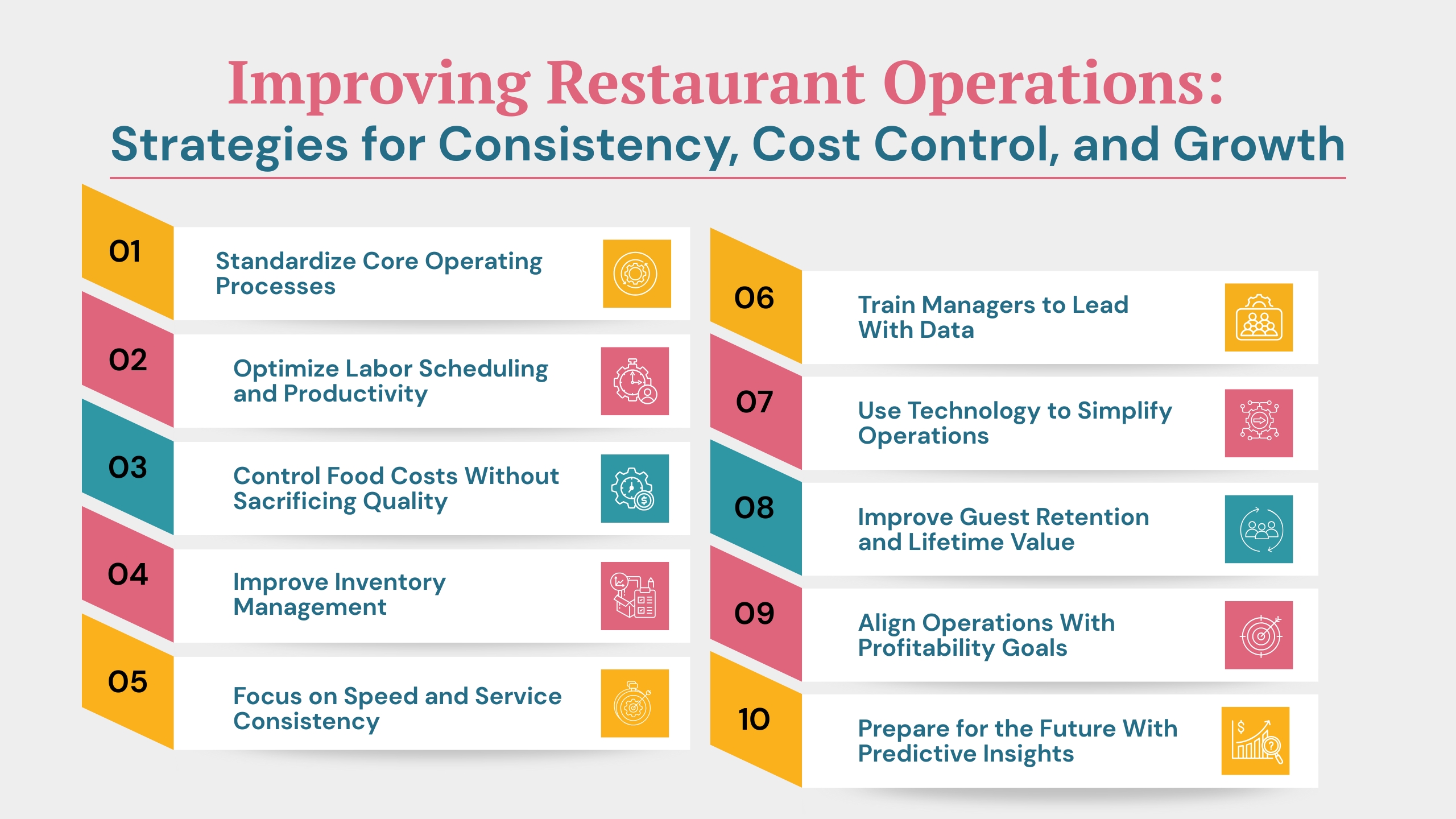
1. Standardize Core Operating Processes
One of the biggest operational challenges in restaurants is inconsistency across shifts, staff, and locations is one of the biggest reasons that performance and guest experience suffer.
When procedures vary by shift, manager, or location, then performance becomes unpredictable. Guests may receive great service one day and a poor experience the next, food quality can fluctuate, and costs become harder to control. Across multiple locations, even small inconsistencies quickly grow into bigger problems, that makes it harder for leaders to identify the strategies that are working and that need improvement.
Why standardization matters
Standardized operating processes establish one consistent manual of how work should be executed every day. They ensure that food quality, service speed, cleanliness, and cost control remain consistent regarding who is working or which location is being evaluated.
This type of consistency builds guest trust as customers know what to expect every time when the guests visit their restaurant. It simplifies training, reduces errors, and makes accountability simple because expectations are clear and measurable.
When standards are clear, then managers spend less time correcting mistakes and more time leading teams which improves execution and lets them focus on guest experience.
Key areas to standardize
Some of the most important processes to standardize include:
- Opening and closing checklists: It keeps every shift consistent by standardizing setup, cash handling, station readiness, inventory checks, and end-of-day cleaning so crucial steps never get skipped.
- Food prep and portioning: It involves following standard recipes, exact ingredient measurements, and clear plating guides to ensure consistent taste, control food costs, and improve kitchen efficiency on a daily basis.
- Inventory receiving and storage: It involves following a standard process for counting deliveries, checking quality, labeling terms, rotating stock using FIFO, and tracking temperature to avoid spoilage and unnecessary food waste.
- Cleaning and sanitation: It involves using correct chemicals, and maintaining inspection and task log and thereby ensuring food staff, protecting staff and guests, and consistently maintaining regulatory compliance standards.
- Guest service & escalation: Guest service and escalation should follow standard greetings, service steps, and compliant-handling procedures with clear manager escalation rules to resolve issues quickly, consistently, and professionally across all shifts and locations.
Documenting such processes clearly is essential. Written visual guides, digital checklists make standards easy to follow and refer to. When these processes are easily accessible and reinforced regularly then accountability improves and restaurant operations become predictable, efficient, and scalable.
Also Read: AI for Restaurant Inventory
2. Optimize Labor Scheduling and Productivity
Labor is one of the largest controllable expenses in a restaurant, but it is often managed based on instincts rather than data. When staffing decisions are reactive, then often too many staff are scheduled during slow hours and few staff is scheduled during busy hours increasing payroll, slowing service, and costing sales. While optimizing labor scheduling needs a data-driven approach.
The first step towards labor optimization is scheduling staff on the basis of their historical sales and customer traffic patterns. By analyzing past data on the basis of week, time of day, season, and local events, managers get to predict demand more accurately. This allows schedules to be built around expected customers rather than a fixed number of staff that ignore real demand.
Next, align staffing levels to specific dayparts. As staffing levels during lunch, dinner, late-night, and weekend shifts require different counts of staff. Matching the right number of people and the right roles to each daypart ensure maximum labor coverage without unnecessary labor hours.
Cross-training employees is another powerful driver. Because when staff work at multiple stations, then managers have the flexibility to adjust coverage in real time.
While cross-trained teams reduce the need for extra staff, improve teamwork, and help maintain service levels during unexpected busy hours.
Real-time visibility is crucial because tracking labor cost as a percentage of sales during the shift allows managers to correct staffing immediately, reduce staff hours when sales are slow or add staff support when demand increases. This strategy is more effective than reviewing labor reports days later when corrective action is not possible.
In the end, understanding productivity metrics like sales per labor hour helps managers to make smarter-in-the-moment decisions. Rather than reacting late after the shift ends, managers get to proactively manage staffing to protect both guest experience and profits.
With time, such practices create a disciplined and predictable approach to labor management which drives stronger profit margins and more consistent service.
Also Read: How Data Analytics Helps to Improve Employee performance
3. Control Food Costs Without Sacrificing Quality
Controlling food costs is one of the most important responsibilities in restaurant management, yet it is also one of the easiest areas for profits which can quietly drain profits over time.
Food cost creep rarely happens due to one single major mistake. Rather, small inefficiencies like inconsistent portioning, excess food preparation, poor inventory control, increases food cost over time. During times of inflation, such issues grow faster, making proactive food cost management essential.
The foundation of effective food cost control is having standard recipes and food portion sizes. Clearly documented recipes with exact measurements ensure consistent quality while avoiding over-portioning that increases costs without improving the guest experience.
Reducing food waste through better prep planning also plays a major role. Accurate forecasting allows kitchens to prepare the right quantities of food, reducing food spoilage. Proper labeling, FIFO rotation, and storage standards further support waste reduction.
Restaurants must also track vendor price changes consistently. Regular invoice reviews help operators to identify price increases early, renegotiate prices when needed, or adjust menu pricing strategically.
Menu engineering supports food cost control without sacrificing quality. Promoting high-margin items through menu design and staff recommendations improves profitability while maintaining guest satisfaction.
Also Read: How to Calculate Food Cost Percentage
4. Improve Inventory Management
Inventory is one of the biggest expenses for restaurants where they lose money even without realizing it. Poor inventory management often causes food spoilage, over-ordering, stockouts, and too much cash on shelves.
When inventory is not handled consistently then the kitchens often run out of major food ingredients during busy hours or have excess ingredients that expire before it can be used.
Improving inventory management creates smoother operation, better purchasing decisions, and stronger profitability.
A strong starting point is setting par levels based on sales velocity. Par levels define the ideal amount of each item to keep on hand, based on how quickly it sells. Instead of ordering by habit, managers can order to a target level that matches actual demand. This reduces overstock while preventing emergency purchases.
Next, schedule inventory counts consistently. Weekly or bi-weekly counts help teams to identify variances early, track usage patterns, and identify waste or theft before it grows.
Consistency matters more than perfection because regular counts build discipline and improve accuracy over time.
Stock rotation is another important driver of savings. First in and First out ensures older items are used first, reducing spoilage and maintaining quality. Clear labels, date stickers, and organized storage make FIFO easier to follow during busy shifts.
Restaurants should also eliminate low-moving or redundant SKUs. Too many similar items create confusion, increase storage needs, and raise the risk of waste. Streamlining inventory simplifies ordering, improves kitchen speed, and strengthens purchasing leverage.
In the end, align ordering frequency with demand. High-volume items may require frequent ordering, while slow-moving products should be ordered less often or in smaller quantities. When ordering matches real sales patterns, inventory stays reliable.
Effective inventory management reduces spoilage, improves cash flow, and ensures the kitchen always has what it needs to execute consistently.
Also Read: AI for Retail Inventory Management
5. Focus on Speed and Service Consistency
Operational improvement is not only about controlling costs rather it also directly shapes the guest experience. In most restaurants, guests judge quality by how fast the food arrives, whether the order is accurate, and whether the experience feels consistent every visit.
When speed and service execution vary by shift, team, or location, repeat business declines and negative reviews increase. Building systems that support fast, reliable service is one of the strongest competitive advantages that a restaurant can develop.
Start by defining clear service time targets for each stage of the experience like greeting, drink delivery, ticket times, and table turn goals. When teams know the standard, managers can coach performance and identify bottlenecks quickly. Pair targets with simple tracking, like timed checks during peak hours.
Next, simplify menus to reduce kitchen complexity. Large menus increase prep requirements, slow down ticket times, and raise the risk of mistakes. Streamlining items, limiting variations, and standardizing modifiers helps kitchens execute faster while maintaining quality.
Communication between the front and back of the house is another crucial factor. Clear expo processes, kitchen display systems, consistent ticket notation, and defined handoff points reduce confusion and remake orders. Even small changes like a single person calling orders or using standardized call-backs improve flow.
Use pre-shift meetings to align the team on goals, expected volume, specials, staffing gaps, and service focus points. A quick five-minute meeting keeps the team aligned, reduces confusion, and ensures everyone starts the shift with the same goals and priorities.
In the end, monitor order accuracy and remake rates. Remakes are expensive and slow service. Tracking patterns by menu item, station, or shift helps identify training issues or process breakdowns.
Restaurants that consistently deliver fast, accurate service build trust, earn stronger reviews, and outperform competitors even when prices are higher.
Also Read: How AI Unlocks Business Insights that drive required results
6. Train Managers to Lead With Data
Many restaurants struggle not because of poor frontline effort, but because managers have to make decisions without clear and timely data.
And when leaders depend on intuition or end-of-week reports, then issues like increasing labor costs, food waste, or declining guest satisfaction often go unnoticed until they impact profits.
Training managers to lead with data shifts operations from reactive problem-saving to proactive performance management.
The first step is helping managers to understand that the data matters during the shift and not when the shift ends. Real-time visibility allows leaders to adjust staffing, pacing, and priorities before small issues turn into major losses.
Rather than reacting to last week’s numbers, managers can influence today’s results.
Effective managers are trained to track core performance indicators. Labor cost percentage helps to balance staffing with demand, while food cost variance highlights waste, portioning errors, or ordering problems.
Ticket size and sales mix show whether upselling and menu strategy are working, and guest satisfaction trends reveal service or quality issues before they become negative reviews.
Equally important is training managers how to interpret and act on these metrics. Data should drive clear decisions reducing labor during slow periods, reinforcing portion control, coaching service behaviors, or adjusting promotions mid-shift. Without action, metrics are just numbers on a screen.
Training should also focus on simple dashboards and alerts rather than complex reports. When data is easy to understand and accessible in real time, managers are more likely to use it consistently.
By empowering managers to read and respond to performance data, restaurants create leaders who foresee problems, take timely corrective action, and continuously improve results during the shift and not weeks later.
Also Read: Two Way Data Analytics in Shaping a Retail Business
7. Use Technology to Simplify Operations
Technology should make restaurant operations easier rather than more complex. Many restaurants struggle because their systems do not communicate due to which managers struggle between platforms, export spreadsheets, and manually reconcile data.
This approach wastes a lot of time and delays decision-making. While the goal of restaurant technology should be clarity, speed, and actionable insights and not more reports.
At the core of operations is the POS system that provides real-time visibility into sales, menu performance, and order flow. POS data helps restaurants to identify best-selling items, slow movers, busy hours, and modifier trends that impact both labor and food costs.
Labor management tools also play an important role in scheduling, time tracking, and payroll accuracy. When labor systems integrate with sales data, managers get to schedule based on demand, monitor labor cost as a percentage of sales in real time, and make adjustments instantly during the shifts.
Inventory systems support cost control by tracking usage, waste, and vendor pricing. Integrating inventory tools helps to match purchasing and recipes to actual sales, helping restaurant operators to identify differences, reduce food spoilage, and improve ordering accuracy.
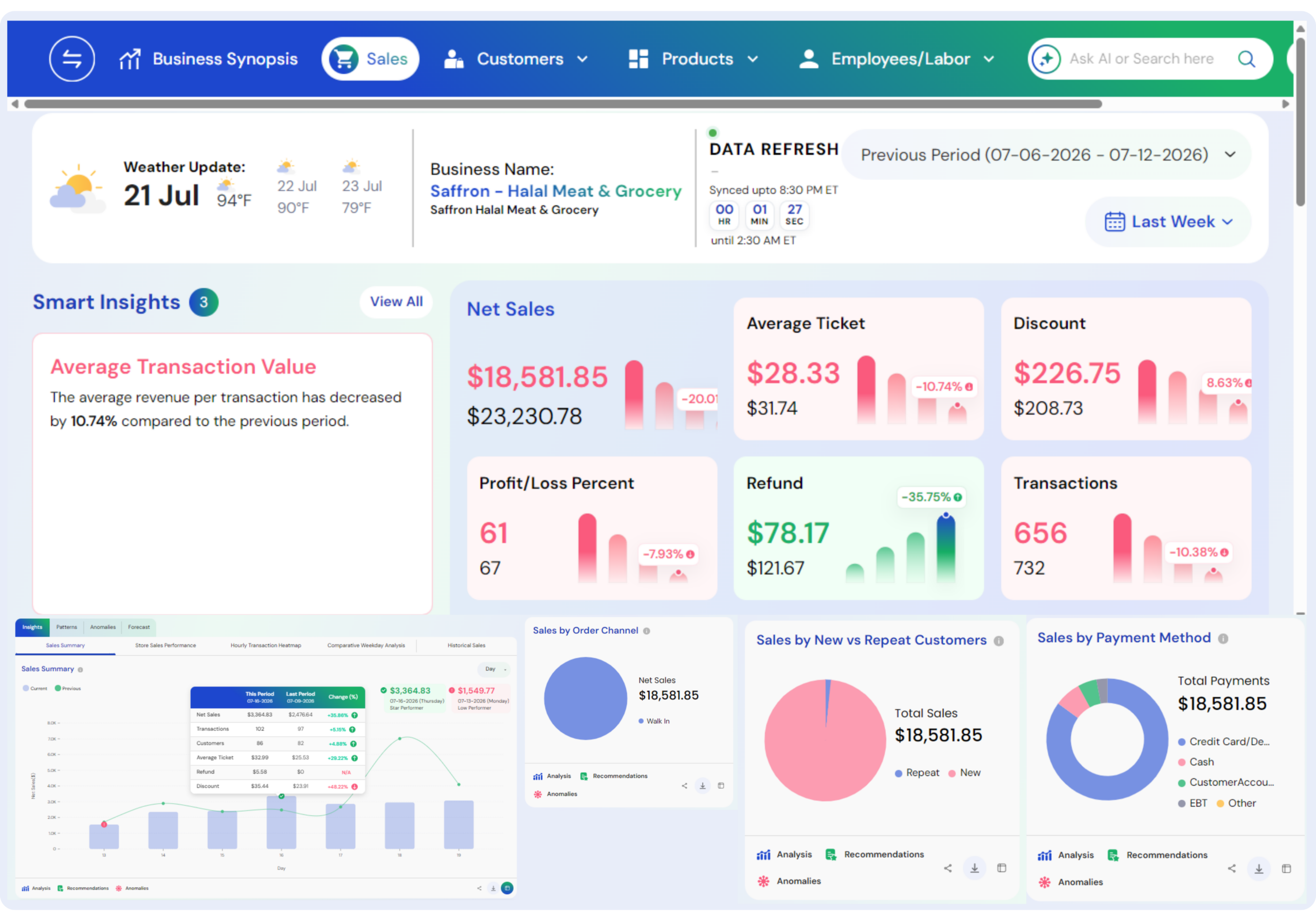
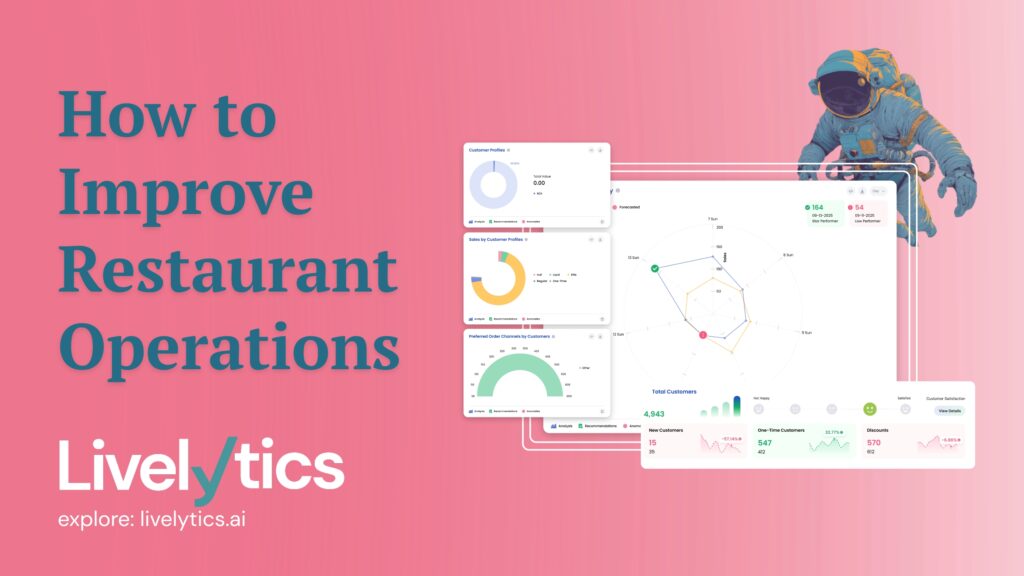
The most important feature is Business Intelligence dashboards, which bring sales, labor, inventory, and guest data into a single view dashboards. Instead of extracting reports from multiple different systems, managers see key metrics at one place, alerts highlight issues while they happen.
The ultimate goal is an unified system that aligns teams, reduces manual work, and enables faster and smarter decisions across every shift and location.
Also Read: Benefits of Data-Driven Decision Making
8. Improve Guest Retention and Lifetime Value
Operational excellence does not end at food execution or service speed rather it extends to how effectively a restaurant builds long-term relationships with guests. Retaining existing customers is one of the most powerful and cost-effective ways to improve profits.
Acquiring a new guest often costs more than bringing back a satisfied guest, which makes repeat visits an operational priority and not just a marketing initiative.
Providing quality food and services consistently is the foundation of customer retention. Guests return to your restaurants when they know that they will receive the food quality, portion size, and service experience every time when they visit regardless of the shift or location.
Maintaining operational discipline in recipes, service steps, and cleanliness impacts whether guests are confident to choose your restaurant to dine again.
Personalization further strengthens loyalty. When promotions, offers, and rewards are on the basis of actual guest behavior like their favorite food items, visit frequency, or order channels then they feel relevant.
A well designed loyalty program encourages repeat visits without depending on heavy discounting while protecting margins.
Fast issue resolution is another crucial factor. Even strong operations experience occasional mistakes, but how quickly and effectively staff respond often determines whether a guest returns.
Empowering teams with clear recovery guidelines and visibility into guest history allows problems to be resolved during the visit, turning negative experiences into trust-building moments.
Finally, tracking guest feedback and sentiment trends closes the loop. Reviews, surveys, and digital feedback reveal patterns that may not appear in sales reports alone.
When operators treat this data as an operational signal then it is not just reputational management; rather it also becomes a powerful tool for continuous improvement.
Even a small increase in repeat visits can vastly increase revenue and margins, making guest retention a direct outcome of operational excellence.
Also Read: How AI Revolutionizes Customer Experience in Restaurant Industry
9. Align Operations With Profitability Goals
Strong restaurant operations are not just about running a smooth shift rather they are about driving sustainable profits. Every operational decision, from staffing levels to preparation processes, directly affects margins.
When teams focus only on speed or quality without understanding financial impact then improvements can feel productive while quietly eroding profit. The most successful operators intentionally align day-to-day execution with clear financial goals.
This alignment starts by evaluating processes through a profit lens. Every change should answer a simple question of whether this reduces cost or increases revenue without harming the guest experience.
For instance, simplifying a menu item may reduce prep time, lower food waste, and speed service all of which raise profit margins while maintaining quality. Small efficiencies, when repeated across hundreds of shifts, may result in major time and cost savings.
Simplicity is equally important. Processes that are difficult to execute increase mistakes, slow service, and create labor inefficiencies. When procedures are easy for staff to follow, then consistency improves and managers spend less time correcting errors. Operational clarity supports both cost control and team performance.
Guest experience must remain central. Reducing costs at the expense of quality or service often backfires by reducing repeat visits and lifetime value. Operational decisions should strengthen reliability, speed, and accuracy as factors that guests notice immediately. A positive experience protects revenue while making efficiency gains sustainability.
Finally, aligning operations with profits requires visibility. Managers need access to metrics that connect actions to outcomes, like labor cost percentages, contribution margins, and waste trends. When teams see how daily decisions impact financial results, accountability increases.
Also Read: Restaurant Profit Margin Analytics Tool to Boost Profits
10. Prepare for the Future With Predictive Insights
The future of restaurant operations is no longer about reacting to yesterday’s problems rather it’s about predicting tomorrow’s opportunities and risks. As margins tighten and competition intensifies, operators who depend on historical reports are always one step behind. Predictive insights shift management from reactive to proactive control.
Sales and labor forecasting are the foundation of more proactive, profit-focused restaurant operations.
Modern systems analyze historical trends, seasonality, weather patterns, promotions, and local events and predict demand with increasing accuracy.
This allows managers to schedule labor accurately, order inventory confidently, and avoid overstaffing, understaffing, or last-minute adjustments.
Automated recommendations take forecasting a step further rather than just presenting data, advanced tools suggest actions like adjusting staffing levels, modifying prep quantities, or rebalancing menu availability.
Smart alerts provide real-time protection during execution. Predictive systems can indicate potential issues before they fully materialize like labor trending over target, unusual waste patterns, or declining sales velocity. This early warning system allows managers to intervene mid-shift preventing small issues from becoming end-of-day losses.
Scenario modeling adds strategic flexibility. Operators can simulate pricing changes, menu updates, or promotional strategies and understand their potential impact before rolling them out. This reduces risk while supporting smarter growth decisions.
By acting before problems occur, predictive insights protect margins, stabilize operations, and create consistency across locations. Restaurants that embrace this approach are better equipped to adapt, compete, and grow in an increasingly complex operating environment.
Conclusion
Improving restaurant operations is not about one big sudden change, rather it’s about building a system that operates well every day, even when the dining room is full, staff is stretched, or costs increase unexpectedly.
The strongest operators win by standardizing core processes, training teams with clear expectations, and using real-time data to identify issues early. When you tighten execution around labor, food cost, inventory, service speed, and guest experience, small improvements start compounding into meaningful profit.
The goal is to achieve consistency with consistent prep, service, cleanliness, and decision-making. It helps to reduce waste, avoids overstaffing, and protects quality guesswork with visibility so managers do not have to spend hours struggling with reports and can focus on training, correcting, and leading.
Most importantly, operational excellence should align with profitability. Every process should either reduce cost, increase revenue, or improve the guest experience enough to drive loyalty.
With a continuous improvement mindset measure, test, adjust, and repeat where restaurants become more resilient, more scalable, and more profitable in any market.
If you still have any query about how to improve restaurant operations then feel free to book a free demo as we are more than happy to assist you.