Restaurant margins have never been easy but in 2026, the pressure is on like never before. Food prices change every month, wages keep rising, staffing turnover stays high, and guests move between dine-in, pickup, delivery, and third-party apps without warning.
In today’s reality, restaurant businesses don’t lose money only from big mistakes rather they lose it through tiny, repeatable inefficiencies like portion creep, hidden waste, overtime spikes, discount dependency, slow ticket times, and unprofitable channel mix. That’s why restaurant data analytics solutions have become a must-have for operators who want to reduce costs and protect profit.
At its simplest, restaurant analytics connects the data you already generate like POS sales, labor schedules, inventory usage, online ordering performance, guest reviews, and marketing results into one clear view of what is happening and why.
Rather than reacting after the month-end Profit and Loss confirms the damage, you get early signals and actionable insights that help you fix problems while they are still manageable.
This is what makes data-driven restaurant management so powerful; rather it turns decisions like pricing, staffing, menu engineering, and promotions into repeatable systems backed by evidence.
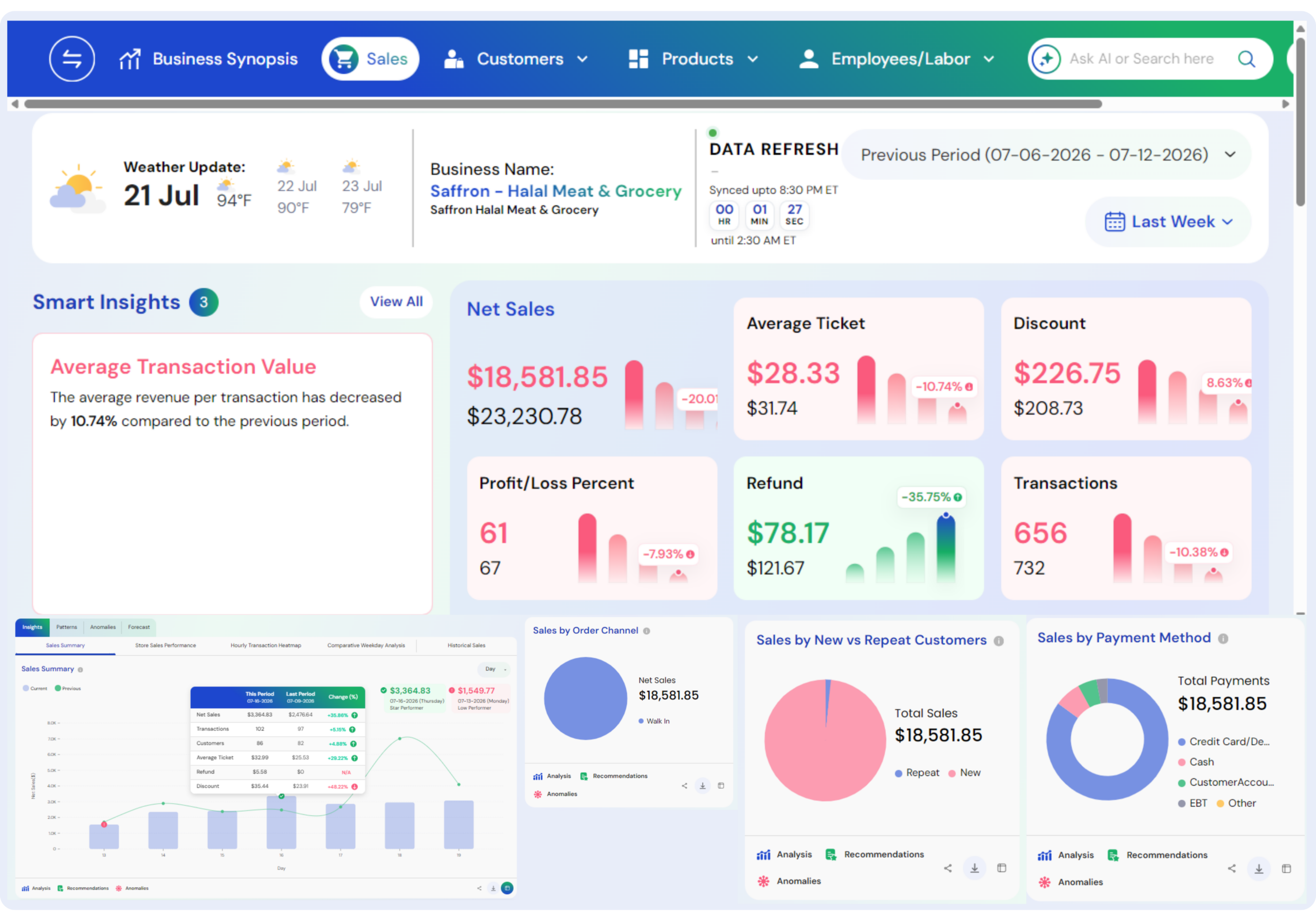
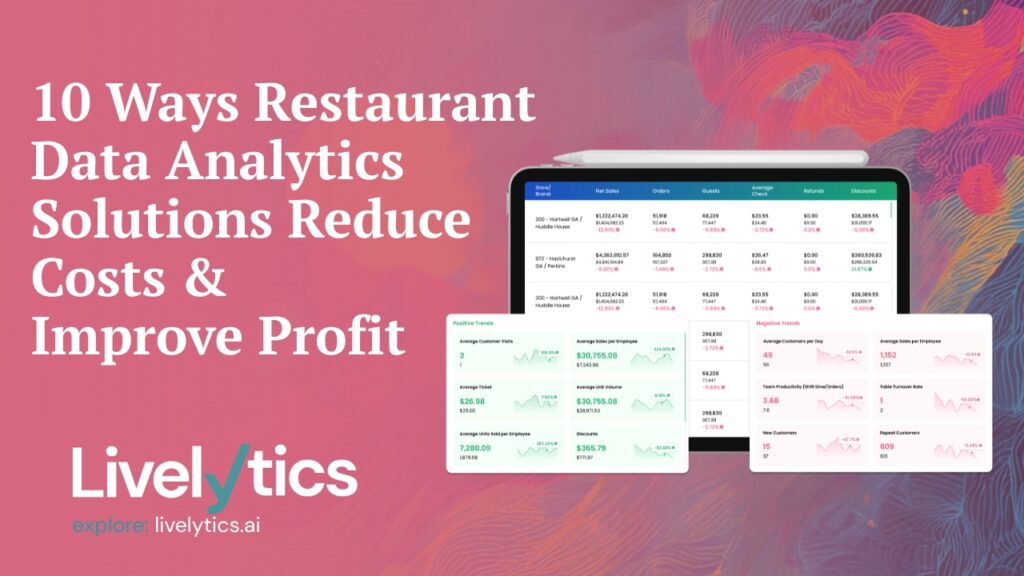
Through this blog, we will break down 10 ways restaurant data analytics improves profitability by reducing food cost variance, tightening labor efficiency, reducing waste, improving throughput, increasing order accuracy, and making marketing more profitable. You will also see how an all-in-one restaurant performance dashboard like Livelytics can make these insights easier to act on without struggling with spreadsheets.
If your goal is to increase restaurant profit, control prime cost, and run a smoother operation with fewer surprises, the strategy ahead will show you exactly where analytics delivers real ROI.
Also Read: Why Data Analytics is the New Secret Weapon for Successful Restaurants
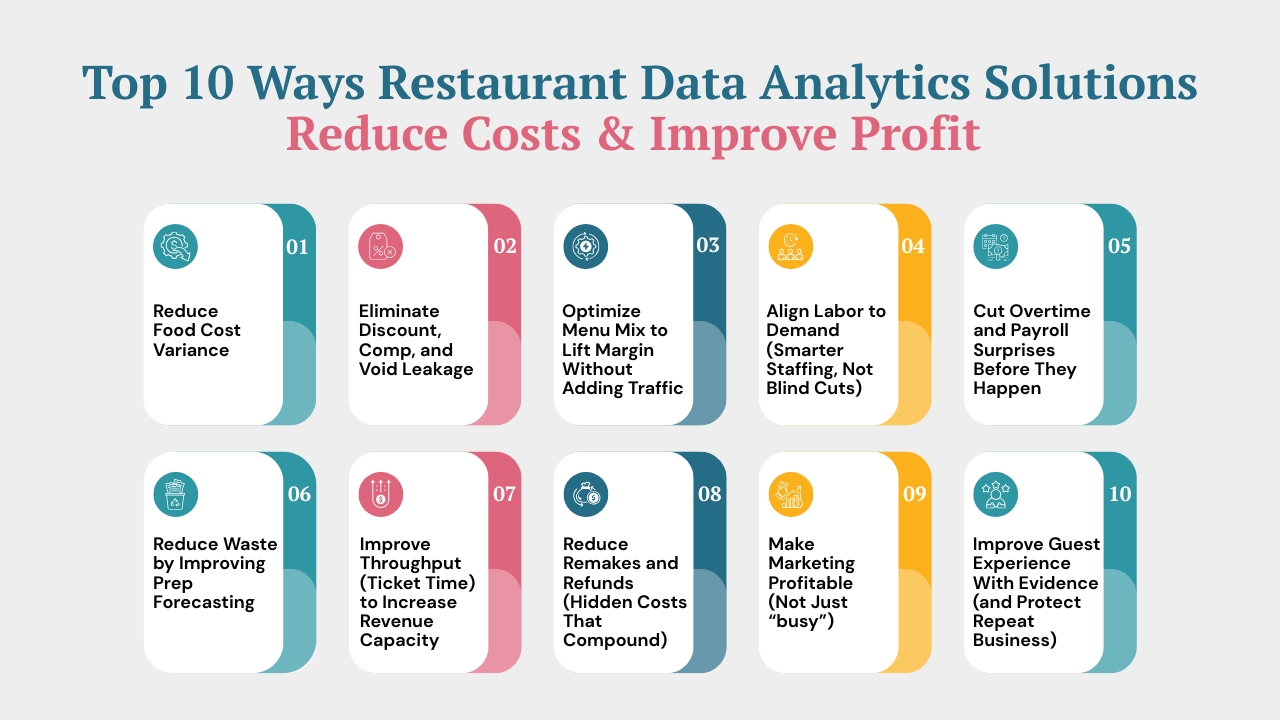
Top 10 Ways Restaurant Data Analytics Solutions Reduce Costs & Improve Profit
1. Reduce food cost variance
Food cost variance is one of the most dangerous profit losses in restaurants because it gradually accumulates over time, often unnoticed, until profit margins are significantly eroded.
Even when sales are strong, food cost expenses can drift upward because of portion changes, inconsistent food preparation, food spoilage, untracked waste, or vendor price change. That’s why reducing variance is mostly the fastest route to improving profits.
Restaurant data analytics helps you identify variance early by comparing expected usage and costs against what is actually happening. Rather than seeing food cost as one monthly percentage, you get visibility into which categories and ingredients are changing.
You can also track patterns by daypart or shift, showing whether variance increases on weekends, during rush periods, or when new staff are on the line.
Once the root cause is identified, the solution becomes clear whether it is refining portion sizes for top sellers, aligning prep quantities with actual demand, improving storage practices, renegotiating vendor contracts, or implementing tighter for high-risk items.
Livelytics helps to make variance trends easier to interpret so you can stop guessing why food cost is rising, and fix the true driver faster.
Also Read: How to Calculate Food Cost Percentage
2. Eliminate discount, comp, and void leakage
Discounts, comps, and voids are sometimes necessary to maintain customer satisfaction, but when left unchecked then they can erode profits. Offering uncontrolled discounting, especially when staff use it as a quick solution for service issues, often goes unnoticed, quietly reducing profit margins.
Restaurant data analytics reveal key metrics like the discount rate as a percentage of net sales, comps, and voids broken down by employee, shift, and daypart, and whether certain menu items are disproportionately impacted. It also shows promo dependency, where customers only purchase when there are offers in place, further reducing profit margins.
The key to improving profit here is reducing this leakage while maintaining a seamless and positive guest experience. To address this, practical actions include setting clear discount rules with manager approvals, ensuring comps are used strategically with a “service recovery playbook” that outlines when and why to comp items.
Also identifying recurring issues with specific items because of quality, prep time, or packaging can help address the root causes of comps and prevent avoidable losses.
Finally, replacing blanket discounts with smart bundles offers higher perceived value and better margins, making each deal more profitable for the business.
Livelytics helps to turn discount activity into a clear pattern so you can manage it like a system and not a surprise at month-end.
Also Read: Retail Pricing Strategy
3. Optimize menu mix to lift margin without adding traffic
Many restaurants focus on increasing guest traffic to grow profit, but a faster and more sustainable approach is optimizing the menu mix, directing customers toward higher-margin items rather than simply chasing volume. The right menu strategy can drive profitability without needing to attract more guests.
Restaurant data analytics provides a detailed breakdown of menu performance, including contribution margin for each item, identifying “volume traps”(high sales but low margins), and highlighting which items drive additional sales through add-ons(attach rate). It also monitors category performance shifts over time, helping you understand what is working and what is not.
By analyzing this data, you can guide customer demand toward items with higher profit margins. Practical steps involve promoting “puzzles” which are high-profit but low popularity items by giving them better placement and visually appealing photos to attract attention.
Adjusting portion sizes, swapping ingredients, or making small pricing changes can help rework volume traps. Additionally, refining the menu layout to feature your highest-margin items while reducing the visibility of low-profit options can influence customer selections and improve profitability.
Training servers to upsell 2-3 specific profitable items ensures consistency and helps drive additional revenue.
Livelytics helps you identify which items deserve promotion, repositioning, helping you make smarter and data-driven decisions.
Also Read: Optimizing a Restaurant Menu With AI Powered Data Analytics
4. Align labor to demand (smarter staffing, not blind cuts)
Labor costs are one of the largest controllable expenses for restaurants, but just reducing staffing without a strategy can result in slower service, and more errors, negative reviews, and fewer repeat business.
To avoid such issues it is essential to implement labor management smartly, align staffing with actual demand rather than simply reducing working hours. Restaurant data analytics provides detailed information about labor efficiency.
Key metrics like labor cost percentage by daypart, sale per labor hour(SPLH), role productivity(such as sales per server or orders per cook-hour), and staffing versus demand accuracy(forecast versus actual) can help to identify where labor is being underutilized or wasted.
By tracking these metrics, you can optimize staffing strategy to maximize productivity without compromising service quality. Profits improve when you reduce labor waste while ensuring smooth operations.
Strategies for achieving this include addressing overstaffed day party, which mostly happens in mid-afternoon and late-night weekday shifts, whenever demand usually drops.
During peak times, adding extra coverage helps to avoid service delays and reduces the risk of customer dissatisfaction. Cross-training staff across different roles not just helps to reduce overtime but also creates more flexibility in managing varying demand patterns.
Additionally, tracking “schedule accuracy” weekly comparing predicted staffing levels against actual demand allows for continuous optimization of staffing decisions.
Livelytics helps in identifying whenever productivity drops or where staffing does not align with actual demand. It empowers you to optimize your schedules and workflows based on data, ensuring a more efficient operation without negatively impacting the guest experience.
Also Read: How Data Analytics Improve the Measurement of Employee Performance
5. Cut overtime and payroll surprises before they happen
Overtime is one of the most expensive and often preventable expenses in restaurants. Not only does it increase labor costs, but it can also lower employee morale and create disruptions within the team. Most overtime happens from predictable patterns which is due to short staffing, slow onboarding, inefficient shift handoffs, or poor station coverage. However, with the right analytics these overtime issues can be addressed proactively.
Restaurant data analytics provides a clear view of overtime trends and their root causes. Key data points include tracking overtime hours by week and role, identifying recurring overtime causes like specific days, stations, or managers that consistently cause overtime.
Reducing overtime improves profit by lowering payroll spikes, while also improving staff retention. Practical actions include identifying your two overtime-causing shifts and redesigning schedules to better align with demand. Adjusting your staffing plan helps provide enough coverage while preventing any shifts from being overstaffed.
Additionally, improving the training timeline for roles that usually cause challenges such as prep roles or high-traffic stations, helps to minimize overtime due to slow onboarding. Structured shift handoffs are essential to eliminate “cleanup creep”, ensuring that each shift is fully prepared for the next.
Effective prep planning ensures timely kitchen close-outs, avoiding delays that can lead to unnecessary overtime. By proactively managing these factors, you can address issues before they lead to extra hours worked.
Livelytics helps to identify overtime risk patterns early, giving you the ability to address the root cause like understaffing or inefficiencies instead just covering the costs. This data-driven approach ensures smarter scheduling, better labor cost control, and a healthier work environment.
Also Read: How Blind Spots Costing Your Business More than you think
6. Reduce waste by improving prep forecasting
Waste in restaurants is often misunderstood as simply “bad ordering,” but the root cause is usually poor forecasting. Whether it’s preparing too much food, preparing food too early, or making the wrong mix of food items, waste is mostly an operational issue that can be addressed with better data and smarter planning.
Restaurant data analytics provides a more accurate way to forecast demand. By analyzing data across multiple factors, like day-of-week and daypart patterns, seasonal or event-based traffic shifts, and item-level sell through timing, you can make more clear decisions about what food to prepare, when to prepare, and in what quantity. This insight allows you to plan for demand instead of depending on just assumptions.
Improved prep forecasting drives profit by reducing spoilage, streamlining inventory management, and ensuring consistent availability of items. Practical steps involve creating prep par based on real sales trends instead of outdated practices, ensuring you don’t overprepare. Creating “prep tiers” with a base amount and flexible preparation helps avoid overcommitting early in the day or week, reducing waste when demand doesn’t align with expectations.
Additionally, adjusting ordering frequency for perishables ensures you are not left with excess stock that expires before it is used. Tracking waste by category such as over-prep, expired items, remakes, returns, or damage, helps to identify the exact sources of waste, enabling you to make focused improvements.
Livelytics helps by making demand patterns more visible and actionable, enabling you to prep based on reality and not assumptions. By analyzing and predicting demand with precision, you can drastically reduce waste, improve efficiency, and ultimately improve profitability.
Also Read: AI Solutions for Reducing Restaurant Waste
7. Improve throughput (ticket time) to increase revenue capacity
Slow ticket times and operational bottlenecks are more than just a service issue rather they directly limit your revenue potential. When your kitchen is not able to keep up with the demand, you lose valuable table turns and the capacity to fulfill delivery orders, which significantly affect your profits.
Improving throughput, or speeding up ticket times, allows you to fulfill more orders within the same fixed costs, improving overall revenue capacity. Restaurant data analytics provides you the insight you need to optimize kitchen efficiency.
By analyzing ticket trends by daypart, you can identify when challenges are most likely to occur. You can also identify specific menu items or stations that cause spikes in ticket time, helping you target the areas that need the most attention.
Analytics also reveals the link between slower service and higher remake rates which are delays in the kitchen often result in more errors, creating a cycle that slows down operations.
Throughput impact can also be tracked by channel mix, revealing whether delivery increases are overwhelming your kitchen and affecting dine-in service. By understanding these patterns, you can take action to improve speed without sacrificing quality.
Practical actions include identifying the top bottleneck items and redesigning their preparation flow to streamline operations. Implementing batch prep for high-demand items or redistributing station tasks during peak hours can help reduce pressure on your kitchen and improve efficiency.
Livelytics excels at linking operational speed with factors like staffing levels, menu design, and channel mix to optimize efficiency. With real-time insights helps you implement targeted, data-driven fixes. This enables you to address the root causes of slow ticket times, make measurable improvements, and increase your revenue capacity all without sacrificing the guest experience.
Also Read: How AI Helps in Boosting Restaurant Revenue and Profits
8. Reduce remakes and refunds (hidden costs that compound)
Remakes and refunds are a hidden double expense for restaurants, costing both product and customer trust. Beyond that, they disrupt your operations by adding labor costs, slowing down kitchen efficiency, and often resulting in negative reviews that damage your reputation. Addressing remakes and refunds is crucial, both for improving your bottom line and and improving customer satisfaction.
Restaurant data analytics provides the ability to track and analyze the root causes of remakes and refunds. By tracking metrics like remake rate and refund patterns, you can identify recurring issues and trends. Analytics also offers insights into accuracy issues by channel, highlighting differences between delivery and dine-in orders that may require different processes.
Furthermore, it can also identify frequent error items, such as complex builds, custom modifiers, or packaging problems that are prone to mistakes. By shifting focus to shift patterns also helps identify when errors peak whether during weekend rushes or new staff training periods so you can proactively address them.
By reducing remakes and refunds directly improves profits because it reduces waste, lower the need for comps, and improves customer retention. Important steps to be taken include simplifying builds for high-error items like complex menu combinations or items with many modifiers which are subject to mistakes.
Introducing packaging checklists for delivery orders vastly reduces errors in the delivery process, ultimately improving both product quality and customer satisfaction. During busy hours, adding expo verification where a supervisor or lead staff member checks whether the order before it leaves the kitchen helps to identify issues before they reach the customer.
Another important action is using targeted retraining based on error patterns. Rather than offering generic training like “be careful,” focus retraining efforts on areas with the highest frequency of mistakes. This ensures that staff receive the right support for specific issues rather than unclear reminders.
Livelytics helps by transforming remakes into trackable trends, allowing you to identify the underlying issues. It connects these trackable trends to staffing levels, day part pressure, or workflow gaps, allowing you to identify exactly where the issues are happening.
Livelytics provides actionable insights which help to solve the actual cause of problems like understaffing during peak hours, issues with a specific menu item, or problem in the handoff between kitchen and front-of-house. By addressing the underlying problems, you can reduce remakes and refunds, and improve operational efficiency and profitability.
Also Read: Cost-Effective AI Solution for Restaurants
9. Make marketing profitable (not just “busy”)
Many restaurants depend on promotions to boost traffic, but all traffic is equally profitable. A promotion that brings in a high volume of orders can still be unprofitable if it attracts customers who are only looking for discounts and shifts demand to low-margin channels or reduces overall average order value(AOV).
To ensure your marketing campaigns are profitable, it is essential to measure not just the volume of orders but also the actual impact of any promotion incurred on overall business.
Restaurant data analytics provide insight into the whole scenarios like how your promotions are performing. Some important metrics to track include acquisition cost relative to profit per order, so you can monitor whether the cost of attracting new customers through promotions is actually generating the profits you expect.
Additionally, you can also track profitability by channel for promoted offers, which helps you to see whether promotions on delivery, dine-in, or takeout are creating sustainable profits. It also helps detect offer dependency and discount fatigue, revealing whether customers are depending more on discounts rather than paying full price.
When you analyze these metrics, you can make smarter marketing decisions that not just improve traffic but also generate long-term profit.Practical actions include tracking retention outcomes, and not just focusing on how many orders a promotion generates.
You can also shift from blanket percentage discounts and instead offer strategic bundles and value-adds that enhance perceived value while protecting profit margins.
Segmentation plays an important role as well like rewarding repeat guests differently from first-time customers helps target the right incentives to the right audience.
You can also measure promo impact on AOV and attach rate to see if the promotion is affecting the number of add-ons or upsells during the order. If add-ons decline, it may indicate that the promotion is prioritizing price over value, potentially lowering overall profitability.
Livelytics connects marketing performance to real outcomes like profitability and retention. This data-driven approach allows you to evaluate the actual impact of your campaigns and invest confidently.
By knowing which promotions create loyal guests and which ones reduce profit margins, then you can focus your marketing expenses on strategies which deliver sustainable growth and long-term profit.
Also Read: How AI Helps in Boosting Restaurant Revenue and Profits
10. Improve guest experience with evidence (and protect repeat business)
A poor guest experience is one of the most costly problems that restaurants usually face. It not just drives away repeat customers but also causes refunds, negative reviews, and higher marketing costs. Rather than guessing what is wrong or reacting emotionally to complaints, using data to understand and improve the guest experience allows to offer effective and evidence-based solutions.
Restaurant data analytics transforms guest feedback into clear, actionable patterns. By analyzing sentiment themes, you can identify recurring issues like slow service,order inaccuracies, cleanliness, friendliness, or value.
Monitoring review trends over time provides insights about how the guest experience is evolving, while identifying complaint spikes by daypart or channels that helps you identify when and where issues are more likely to occur.Operational problems like understaffing causes slower service and worse reviews, give you the actual causes behind negative experiences.
Improving the guest experience increases profitability by increasing customer retention, reducing the need for discounts and also word-of-mouth recommendations. Practical actions include addressing the top two recurring complaints with operational fixes whether it is improving service speed or food quality.
By connecting staffing decisions to guest experience data, you can ensure you have the right number of resources during busy hours when mostly reviews are less. Tracking the effectiveness of service recovery initiatives helps to assess whether such changes are actually reducing complaints.
Monitoring guest experience separately by channel such as dine-in versus delivery also allows you to customize improvements to different customer touchpoints.
Livelytics helps to make guest experience both measurable and actionable. By transforming guest feedback into quantifiable data, Livelytics ensures that improvements become systematic and not emotional. This approach allows us to create lasting, data-driven changes that improve guest satisfaction.
Conclusion
Restaurant data analytics solutions offer powerful tools to identify any inefficiencies, optimize restaurant operations, and improve profits. With data, restaurants can make more informed decisions across various aspects of operations like inventory management, labor scheduling, marketing, and guest experience.
Analytics helps to find hidden costs and areas for improvement like reducing waste, overtime, and fine-tuning menu offerings to match with customer preferences and profitability goals.
By focusing on important metrics like labor cost percentage, ticket times, and remake rates, restaurants can make processes run smoothly and reduce costly mistakes.
Having insights into customer behavior, promotional performance, and retention, restaurants can optimize their marketing strategies to attract and retain profitable customers.
Analytics also helps to make smarter staffing decisions, ensuring that the right number of staff work during busy hours, improving service speed and customer satisfaction.
Additionally, by monitoring guest feedback and operational trends, restaurants can proactively address issues that affect the guest experience, reducing the risk of negative reviews and lost business.
Ultimately, the goal is to create a data-driven culture where improvements are based on solid evidence causing more consistent performance, stronger customer loyalty, and a healthier bottom line.
With the right analytics solutions, restaurants can not only reduce costs but also make the strategic decisions that drive sustainable growth and long-term success.
If you still have any query with the ways that restaurant data analytics reduce costs and improve profit then you may write to us at livelytics and we are more than happy to assist you.