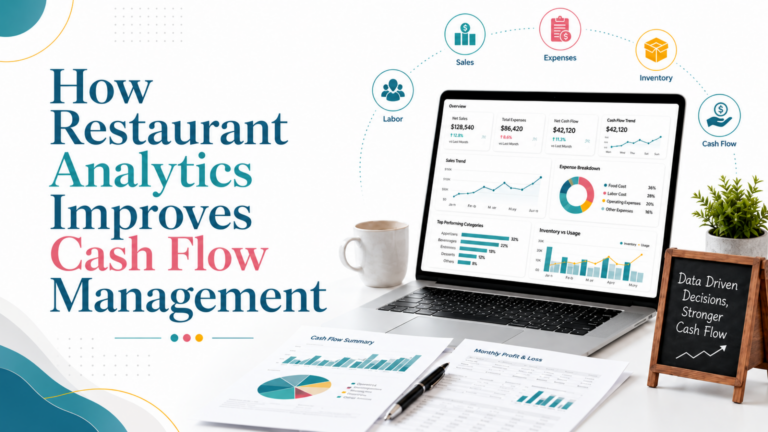
Here’s a reality check: 30-40% of restaurant food inventory ends up as waste, while simultaneously, stockouts cost the industry billions in lost sales annually. The culprit? Inaccurate sales forecasting.
This is the problem with most of the restaurants. They are guessing ordering based on last month’s numbers, manager intuition, or panic-buying to avoid running out.
The gap between guessing and knowing is costing you money daily.
Why This Matters Now?
If you’re a restaurant owner watching profits disappear into the dumpster and are looking to level up your forecasting game, then below we’ll be explaining the basics of forecasting food and Beverage Sales for restaurants, how to get started, and what smart restaurants are doing.
Let’s get started.
Also Read: Restaurant Demand Forecasting Reduce Waste and Increase Profits
What Does Forecasting for Food and Beverage Sales Mean?
Forecasting food and beverage sales is the process of using historical data, current trends, and predictive analytics to estimate future demand for your menu items across specific time periods.
It combines your POS transaction history, reservation data, seasonal patterns, weather forecasts, local events, and other variables to predict exactly what you’ll sell, when you’ll sell it, and in what quantities.
For example, a downtown pizzeria uses an AI-powered restaurant platform that analyzes two years of sales data and predicts that next Friday will generate $12,000 in revenue with 180 covers.
It factors in Friday’s forecasted rain (reducing patio orders by 30%), a nearby concert ending at 9 PM (spiking late-night orders by 45%), and historical patterns showing Friday customers order 25% more appetizers. Based on this, data analytics in restaurants generates the prep list, optimal staff schedule, and purchasing recommendations. That’s forecasting: turning uncertainty into executable operational plans.
Also Read: Restaurant Sales Forecasting How to Predict Future Revenue
Why Traditional Forecasting Methods Are Failing Modern Restaurants?
Traditional forecasting, relying on spreadsheets, gut instinct, and last year’s averages, can’t keep pace with today’s volatile restaurant environment. Here’s why these outdated methods are costing operators money:
1. They Ignore Real-Time Variables.
Traditional methods look backward at historical averages, completely blind to what’s happening right now. Weather, local events, and sudden market shifts can swing restaurant sales by 20-30%, variables that static spreadsheets never account for.
Also Read: Real-Time Analytics Why Does Your Business Needs It
2. Manual Processes Create Costly Delays
Managers spend hours each week building forecasts that are already outdated by the time purchasing decisions are made. Human error compounds the problem, leading to over-ordering (waste) or under-ordering (lost sales).
Also Read: Cost-Effective AI Solutions for Restaurants
3. No Menu Item-Level Granularity
Traditional forecasting tells you total revenue or covers, not how many portions of each dish to prep. That gap forces kitchens to guess, which drives food waste and inconsistent guest experiences.
Also Read: Optimizing a Restaurant Menu With AI Powered Data Analytics
4. They Can’t Adapt to Shifting Consumer Behavior
Static historical data can’t detect that vegan options are trending up 40% or that delivery orders spike every rainy Thursday. Consumer behavior moves fast, manual systems don’t, and restaurants will be left behind.
5. Limited Multi-Location Scalability
Managing forecasts across multiple locations with separate spreadsheets creates inconsistency, blind spots, and wasted time.
Also Read: How AI Revolutionizes Customer Experience in the Restaurant Industry
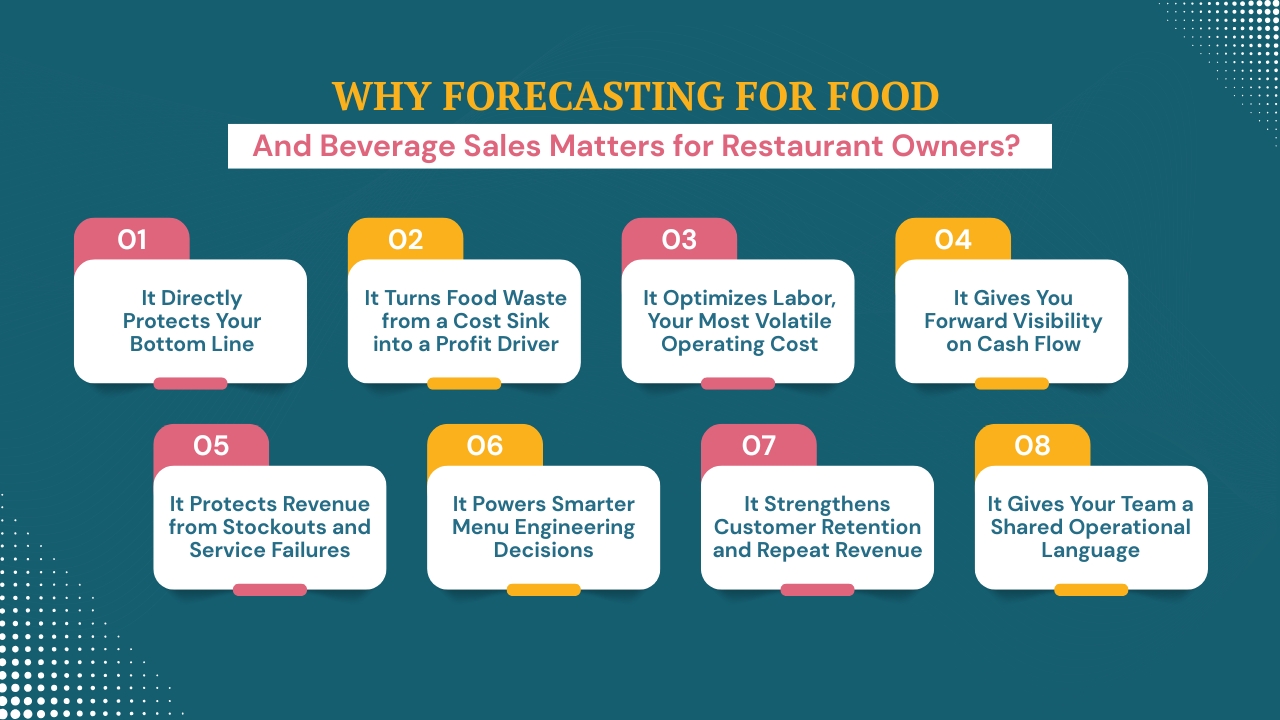
Why Forecasting for Food and Beverage Sales Matters for Restaurant Owners?
1. It Directly Protects Your Bottom Line
Every dollar lost to over-ordering or idle staff is a dollar you can’t recover. Full-service operators who reported a loss in 2024 had labor costs consuming a median of 42.9% of sales, over 6 percentage points higher than those who turned a profit. Restaurant business intelligence forecasting keeps both food and labor spend locked to actual demand, not assumptions.
- Reduces overspending on inventory and idle labor during slow periods
- Keeps prime cost (food + labor) within the healthy 60% threshold
- Turns two of your biggest cost centers into controllable, predictable expenses
- Gives owners and CFOs a clear lever to protect margins without cutting quality
2. It Turns Food Waste from a Cost Sink into a Profit Driver
The average restaurant wastes 4–10% of all food purchased, paid for, prepped, and thrown away before earning a cent. AI-powered restaurant intelligence forecasts demand at the menu item level so operators order exactly what will be used. The payoff is significant: every $1 saved in food waste generates $14 in additional revenue.
- Replaces “order the usual” purchasing with data-driven, item-level precision
- Reduces spoilage costs that silently erode margins every single week
- Supports sustainability goals that 91% of consumers say influence where they choose to dine
- Makes prep lists and purchasing decisions proactive, not reactive
Also Read: AI Solutions for Reducing Restaurant Waste
3. It Optimizes Labor, Your Most Volatile Operating Cost
Scheduling too many staff or too few both cost money, just in different ways. Restaurant labor costs rose 18.3% over three years, with 89% of operators flagging it as a significant challenge, yet only 36% of restaurants consistently hit their labor cost targets. Data analytics in restaurants enables demand-driven scheduling that matches staffing levels to forecasted covers, shift by shift.
- Eliminates overstaffing during slow periods and scrambling to cover busy ones
- Reduces overtime spend by building schedules around predictive demand data
- Gives managers a data-backed schedule instead of one built on gut instinct
- Directly closes the gap between operators who hit labor targets and those who don’t
Also Read: How Data Analytics Improves the Measurement of Employee Performance
4. It Gives You Forward Visibility on Cash Flow
Over 72,000 restaurants closed in the US in 2024, with 82% of business failures stemming from cash flow problems. Restaurant analytics and reporting platforms provide a 1–2 week forward revenue view, so financial decisions are made ahead of the crunch, not during it.
- Replaces end-of-month financial surprises with week-ahead revenue projections
- Aligns vendor payment timing with forecasted incoming cash
- Helps owners plan promotional activity during predicted slow periods
- Gives stakeholders and investors reliable financial visibility for smarter decisions
Also Read: How Restaurant Use BI Dashboards to Track to Track Sales Labor and Inventory
5. It Protects Revenue from Stockouts and Service Failures
Running out of a popular item mid-service isn’t just a missed sale; it’s a damaged guest experience that drives customers to competitors. AI-driven demand forecasting can reduce lost sales from unavailable products by up to 65%. AI-powered restaurant platforms calibrate prep quantities and purchasing to what customers will actually order, not what managers estimate from memory.
- Ensures high-margin items are always available during peak demand windows
- Prevents service failures that trigger negative reviews and lost loyalty
- Aligns kitchen prep to forecasted covers for each daypart
- Eliminates costly emergency supplier orders placed at premium pricing
Also Read: How Livelytics Can Help Restaurants to Boost Revenue
6. It Powers Smarter Menu Engineering Decisions
Most restaurants price and position menu items on guesswork, not data. Restaurants that update their menu based on food cost and margin data are seeing 10–15% improvements in net profit, even without raising prices.
AI-powered restaurant intelligence identifies which items are driving margin, which are dragging it down, and when to push high-profit dishes based on forecasted demand patterns, turning your menu into an active profit tool, not a static list.
- Identifies underperforming items before they silently erode margins week after week
- Reveals demand patterns that show when and where to promote high-margin dishes
- Reduces menu complexity by flagging low-velocity items that tie up prep time and inventory
- Aligns ingredient purchasing with forecasted item-level demand, cutting prep waste at the source
Also Read: Benefits of Data-Driven Decision Making
7. It Strengthens Customer Retention and Repeat Revenue
Filling seats tonight matters, but filling them next month is where real profitability is built. Restaurants average a retention rate of just 55%, well below the global benchmark of 75%, with 70% of first-time diners never returning. Restaurant analytics and reporting platforms identify visit frequency patterns, at-risk guests, and demand trends, so operators can act on retention before customers quietly disappear. A 5% increase in customer retention correlates with a 25% increase in profit.
- Flags declining visit frequency before a loyal guest becomes a lost one
- Enables personalized promotions timed to forecast slow periods to re-engage regulars
- Connects demand data to loyalty program performance for measurable ROI
- Builds a more predictable, recurring revenue base that reduces dependence on new customer acquisition
Also Read: Customer Sentiment Vs Traditional Surveys
8. It Gives Your Team a Shared Operational Language
Forecasting isn’t just a finance function; it’s the operational blueprint that aligns every department. When kitchen, front-of-house, and procurement teams all work from the same demand forecast, the gap between planning and execution closes.
Strong forecasting backed by an AI-powered restaurant platform eliminates guesswork from strategy, helping restaurant owners anticipate demand, labor, and inventory needs, and make proactive decisions that protect profit margins and improve guest satisfaction.
- Replaces siloed decision-making across kitchen, scheduling, and procurement with one unified data view
- Reduces communication breakdowns that lead to over-prep, stockouts, and staffing gaps
- Gives shift managers the confidence to make real-time adjustments backed by data, not instinct
- Creates a culture of accountability where every department is aligned to the same operational targets
Also Read: Restaurant Demand Forecasting Reduce Waste and Increase Profits
How to Forecast Food and Beverage Sales, Ft. Restaurant Business Intelligence Platform?
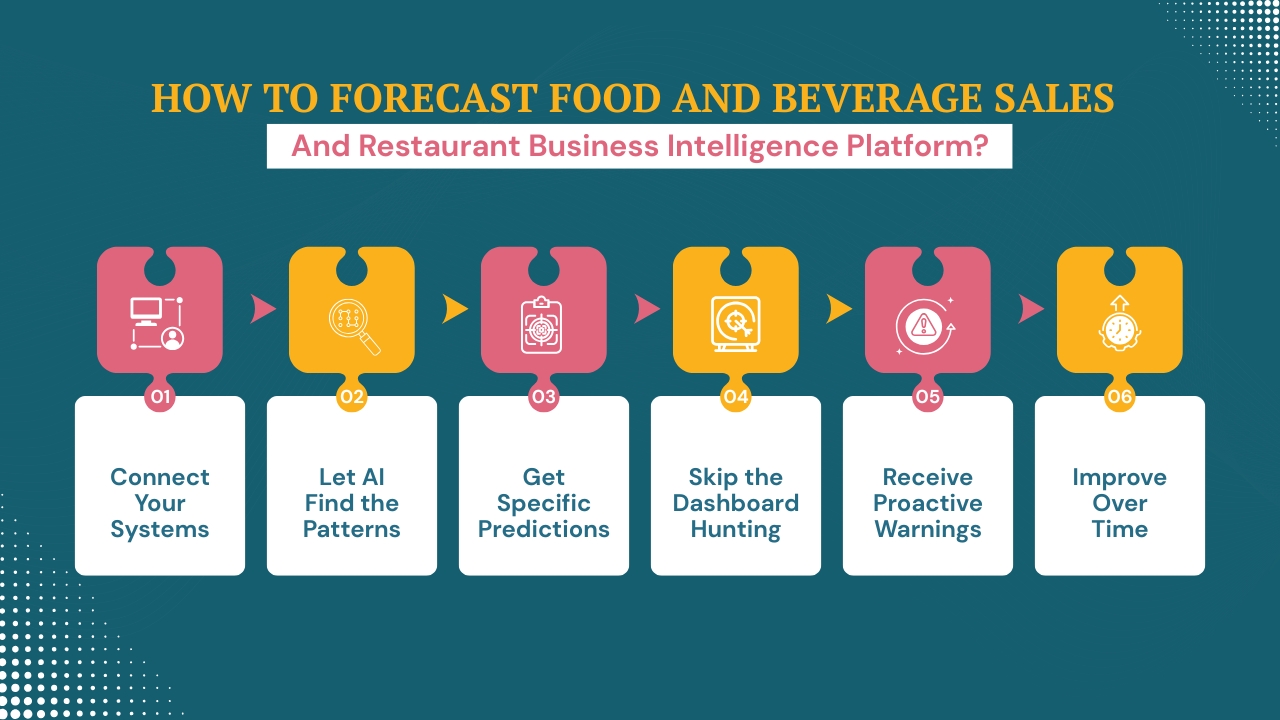
Accurate forecasting starts with fixing one core problem: your data is scattered. But modern restaurant business intelligence platforms connect these systems into one intelligence layer, so instead of guessing based on incomplete information, you’re predicting based on the complete picture.
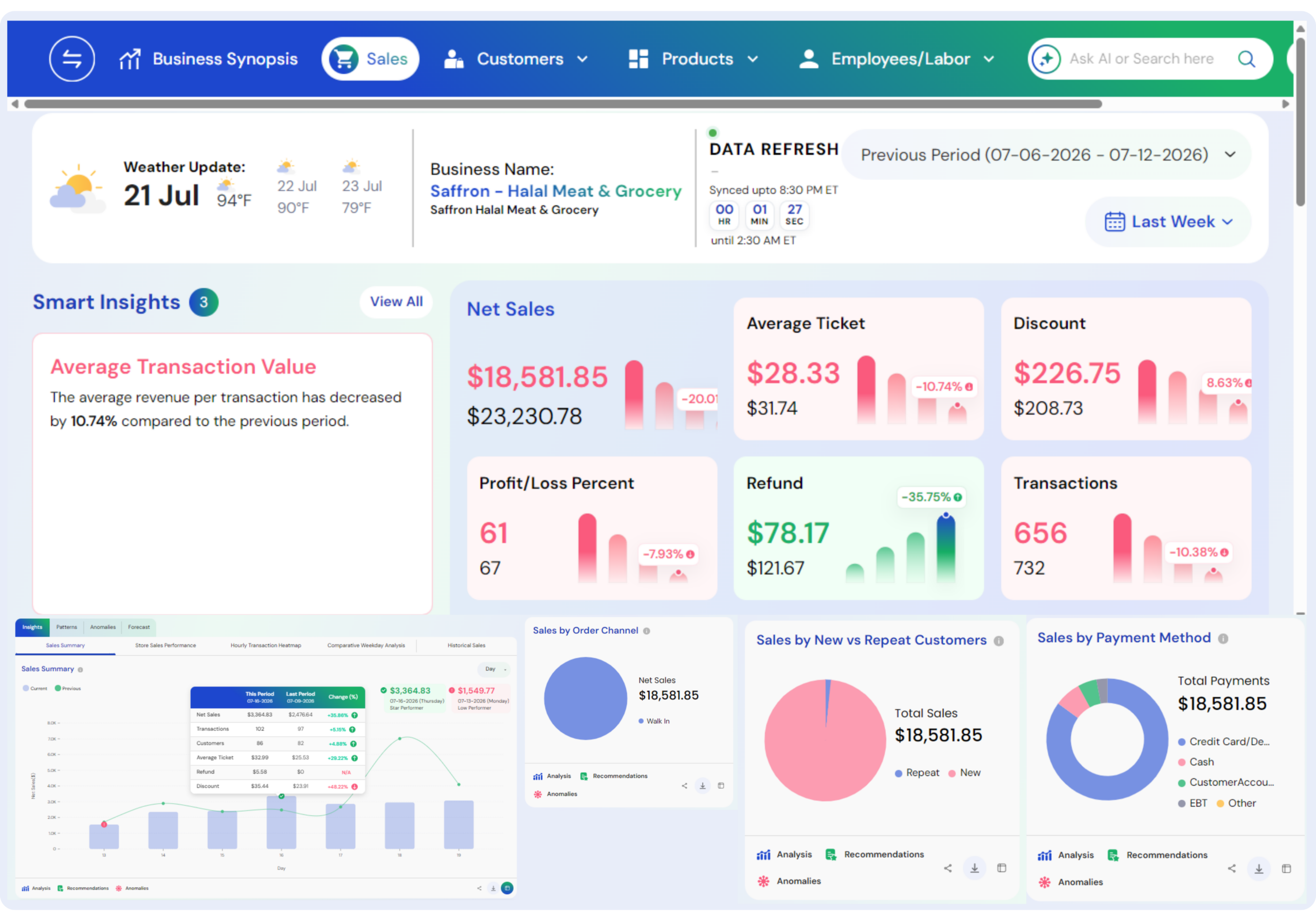
Livelytics, our AI-powered data platform for the restaurant business, does exactly this: connecting 10+ operational sources (POS, online ordering, delivery, labor, inventory, accounting) into a unified AI intelligence layer that turns fragmented data into actionable forecasts.
Here’s how the process works:
1. Connect Your Systems
Your POS already tracks every transaction. Your online ordering platform knows delivery trends. Your reservation system shows booking patterns. The issue isn’t missing data; it’s that these systems don’t talk to each other.
AI-powered restaurant platforms unify them into one view, pulling in external factors like weather and local events, so all your data is visible, making food and beverage sales forecasting easier and data-backed.
2. Let AI Find the Patterns
Manual forecasting means staring at spreadsheets, hoping to spot trends. An AI-powered restaurant intelligence platform like Livelytics automatically analyzes thousands of variables at once, catching that rainy Tuesdays boost soup sales 35%, or nearby concerts drive late-night orders up 40%.
The system learns your specific business patterns: seasonality, day-part performance, menu correlations, and how events impact demand. It’s not guessing from last year’s average; it’s understanding what actually drives your sales today.
Also Read: Business Intelligence Vs Machine Learning
3. Get Specific Predictions
“We’ll do $12,000 in revenue tomorrow” doesn’t help your kitchen. Modern data analytics in restaurants with its AI and ML features predicts menu-item demand: 47 pizzas, 32 salads, 18 craft beers.
Your prep team knows what to make. Your purchaser knows what to order. Your manager knows whether to push specials or preserve inventory. Forecasting becomes operational, not just financial.
With Livelytics, you even get real-time, data-powered recommendations on what to do, how to do, and the impact as well.
Also Read: How Predictive Intelligence Transforms Retail
4. Skip the Dashboard Hunting
Most forecasting systems bury answers inside dashboards and reports. You know the question: Why is Thursday lunch trending down? But finding the answer means navigating multiple screens and pulling custom reports.
Restaurant analytics and reporting work the other way: you ask, and it answers all in real-time.
With Livelytics’ personal assistant “Liv AI”, you can ask the questions, and it gets back to you with the relevant data you need. (Based on the data collected + current market situation).
Also Read: Business Intelligence Dashboard for Data Collection
5. Receive Proactive Warnings
The best systems don’t just predict, they alert you before problems hit. Restaurant analytics and reporting platforms flag deviations in real-time: Saturday’s unexpected rain drops patio demand 30% (adjust staffing now), supplier prices just spiked (renegotiate before it hits margins), waste patterns look unusual (check for theft or spoilage).
Livelytics’ predictive intelligence delivers these warnings with high AI confidence, labor optimization alerts, COGS spike detection, and unexpected shrink patterns, so you’re acting on intelligence, not reacting to yesterday’s problems.
6. Improve Over Time
AI-powered restaurant platforms compare predictions against actual results and get smarter automatically. For multi-location operators, the advantage multiplies: see which stores forecast accurately and why, spot operational differences between high and low performers, and turn forecasting into continuous improvement instead of monthly guesswork.
Cross-location benchmarking reveals the execution patterns that drive stronger predictions across your entire network.
How Leading Restaurants Are Getting an Edge with Accurate Forecasting? [Case Studies]
Case Study 1: Chipotle, 30% Waste Reduction with Targeted Sales Forecasting
Chipotle reduced food waste by nearly 30% while maintaining menu availability at 99.8% by implementing an AI-powered restaurant intelligence system that forecasts sales at the menu-item level.
The demand-prediction system estimates foot and vehicle traffic, combined with historical sales data, to predict which menu items and how many of each the restaurant will need to prepare. By accurately forecasting, Chipotle eliminated thousands of dollars in spoilage per location while ensuring ingredients were always available during peak demand periods.
Case Study 2: University Restaurant, 90% Forecasting Accuracy Using Bayesian Models
A Japanese restaurant achieved a 90% forecasting using AI and ML. The restaurant analytics and reporting system analyzed POS data, reservation numbers, weather conditions, local events, and seasonal patterns to predict daily customer counts and revenue.
The forecasting value and actual value followed the same trend, with an average difference of only 15.5 customers per day. This level of precision allowed management to optimize purchasing decisions and labor scheduling based on reliable revenue predictions rather than gut instinct.
Case Study 3: IKEA Food Services, 23-54% Waste Reduction Through Smart Forecasting
IKEA’s pilot program using smart scale systems for demand forecasting resulted in a 23–54 percent decrease in food waste over six months across multiple locations.
By implementing systematic sales forecasting rather than relying on manager estimates, IKEA identified patterns in customer traffic and purchasing behavior that traditional methods missed. The concrete, measurable results from the pilot program convinced management of how accurate demand prediction translates directly into cost savings and operational efficiency.
Final Thoughts
Every point covered in this guide comes back to one truth: the restaurants winning today are the ones replacing gut instinct with data-backed decisions.
The cost of inaccurate forecasting is real and daily, in wasted inventory, bloated labor, missed sales, and cash flow surprises. But so is the upside of getting it right.
Modern restaurant business intelligence platforms have made accurate, AI-powered forecasting accessible to operators of every size. The only question is how long you can afford to wait.
If you’re ready to take control of your forecasting, Livelytics connects your restaurant’s data into one intelligent layer, turning fragmented numbers into precise, actionable predictions that protect your margins and drive consistent growth. Book a Free Demo now.