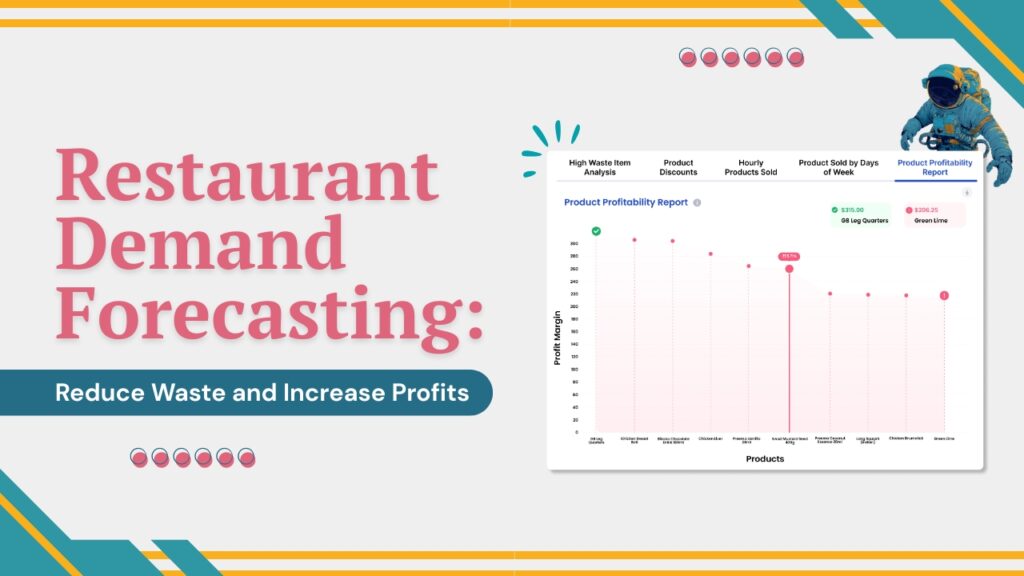

Restaurant demand forecasting has become an essential strategy for restaurants aiming to reduce waste, improve efficiency, and increase profits.
In this highly competitive restaurant industry, restaurants cannot just rely on guesswork for running their operations smoothly. If there is any change in customer traffic, seasonal demand, delivery trends, labor availability, and food costs may impact overall restaurant performance.
That is why more restaurants are using data-driven forecasting for making daily and long-term decisions.
At its core, restaurant demand forecasting is the process of predicting future sales and customer demand of restaurants using historical sales data, seasonal trends, weather patterns, local events, and menu performance.
By using these forecasting tools effectively, restaurants may improve inventory management, plan purchasing stock accurately, which helps to avoid costly mistakes like overordering, understocking, or overpreparing food.
Demand forecasting helps restaurants to reduce food waste, stronger profit margins, and seamless operations.
Accurately forecasting sales helps restaurants to better labor scheduling. This helps managers to align staffing levels with expected demand, which reduces unnecessary labor costs during slow hours while also ensuring that the right number of employees are scheduled during busy periods.
Better forecasting improves restaurant operations because it helps restaurants to prepare an accurate amount of food, maintain menu availability, and offer an exceptional customer experience.
In these days when the food prices keep rising and customer behavior becomes harder to predict, demand planning has become essential for restaurants. Forecasting is a practical solution for restaurants which helps them to protect profit margins and support growth.
Restaurants that can forecast demand effectively may improve cost control, operational efficiency, and also to make more confident business decisions.
Through this blog, we will walk you through how restaurant demand forecasting helps businesses to reduce waste and increase profits, even while improving inventory control, labor efficiency, and overall performance. For restaurants that are aiming to grow sustainably, forecasting will be a competitive advantage.
Also Read: Restaurant Sales Forecasting
What Is Restaurant Demand Forecasting?
Restaurant demand forecasting involves the process of estimating how much customer demand will affect your business experience over a future period.
This demand can be measured in many ways, which includes total sales, number of covers, orders by menu item, delivery volume, ingredient usage, labor needs, and daypart traffic.
At its core, forecasting answers an important question of restaurant which is:
What is likely to happen next, and how should the restaurant prepare for it?
For instance, a restaurant may forecast:
- How many guests will visit on Friday night
- How many burgers, pizzas, or salads may be sold tomorrow
- How many cooks and servers should be scheduled for a holiday weekend
- Whether a promotion will increase demand during a slow afternoon period
Without forecasting, decisions made by restaurants will be based on their instincts, past habits. Though past experience of running restaurants is essential, intuition may not be helpful for running restaurants smoothly in a quickly changing restaurant industry.
Forecasting blends experience with real operational data, that makes decisions more reliable and measurable.
Demand forecasting can be short-term, medium-term, or long-term.
Short-term forecasting helps restaurants for planning daily and weekly operations. This type of forecasting will be used for prep planning, purchasing, staffing, and shift management.
Medium-term forecasting helps with monthly planning. This type of forecasting will be used for vendor management, promotional calendars, and budget control.
Long-term forecasting supports restaurants for business decisions such as menu strategy, expansion planning, equipment investment, and seasonal planning.
It has become essential for restaurants to understand that demand forecasting is not just about predicting revenue. Though forecasting tools may forecast strong sales but still may lose revenue if their labor, food cost, and waste are not aligned with their demand.
Effective forecasting connects expected sales to operational action. These tools not just reveal the demand but also about the actions to be done in response.
In practical terms, good forecasting helps restaurants to prepare the right amount of food, schedule the right number of people, and allocate resources more effectively. This helps restaurants to bring clarity to their daily decisions and also improves consistency in operations.
Also Read: Real-Time Analytics Why Does Your Business Need it
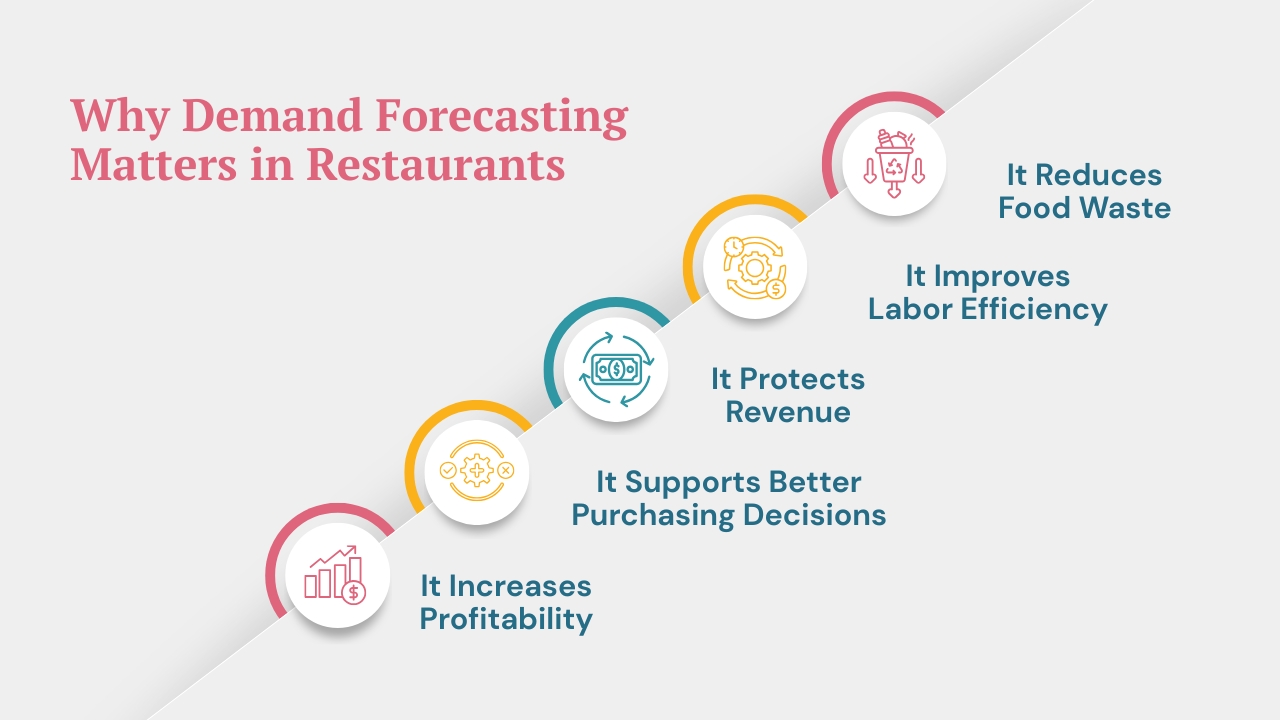
Why Demand Forecasting Matters in Restaurants
Restaurants operate in one of the most complex and thin margins. Costs keep changing, customer behavior shifts constantly, and many factors are outside the restaurant operator’s control.
Because of this, forecasting is not optional, rather it is a practical tool for running a stable and profitable business.
1. It Reduces Food Waste
One of the biggest advantages of restaurant demand forecasting is waste reduction. If restaurants overorder inventory or overprep menu items often cause food spoilage, expired stock, and discarded food. This will not be just an operational problem but also causes revenue losses.
When restaurants forecast demand accurately, it helps them to buy accurate stock and prepare the right amount of food as per actual requirements. This leads to less unused ingredients, less overproductions, and tighter food cost control.
Also Read: AI Solutions for Reducing Restaurant Waste
2. It Improves Labor Efficiency
Labor is one of the highest expenses of demand. Poor demand forecasting may result in overscheduling during slow periods and understaffing during busy periods.
Overstaffing or understaffing will turn expensive for restaurants. If restaurants overschedule staff wastes payroll while understaffing may reduce service speed, employee morale, and guest satisfaction.
Demand forecasting helps managers to align staffing with expected traffic, daypart demand, and seasonal patterns. This helps to create a more efficient labor staffing without sacrificing service quality.
Also Read: How Data Analytics Improve the Measurement of Employee Performance
3. It Protects Revenue
Running out of popular menu items during busy service hours can quickly impact restaurant revenue. Every stockout means missed sales, frustrated customers, and a weaker dining experience.
With time, if menu items are inconsistently available then it may damage guest trust and reduce repeat guest visits. Demand forecasting helps restaurants to stay prepared by maintaining high-demand items in stock and plan accurately for busy periods, promotions, or sudden increases in customer traffic.
Also Read: How AI Helps in Boosting Restaurant Revenue and Profits
4. It Supports Better Purchasing Decisions
Demand forecasting helps restaurants to make smarter purchasing decisions by revealing expected demand to restaurant operators. Instead of relying on guesswork, these tools help restaurants to order ingredients based on projected demand.
It helps to improve inventory turnover, reduce emergency stock purchases, lowers the chances of overstocking, and supports profitable cash flow by purchasing the right amount of stock in an accurate, timely, and efficient way.
Also Read: Benefits of Data-Driven Decision Making
5. It Increases Profitability
Forecasting increases restaurant profits by reducing food waste, labor inefficiency, avoiding stockouts, and reducing unwanted expenses.
It helps to improve profit margins across all operations by helping restaurants to plan accurately, use resources efficiently, and avoiding costly mistakes. As a result, businesses can manage expenses well, protect revenue, and earn more revenue consistently over time.
Also Read: Restaurant Profit Margin Analytics Tool to Boost Profits
Common Causes of Forecasting Problems in Restaurants
Many restaurants understand the importance of forecasting but still they struggle with accuracy because restaurants often consider it as a rough estimate instead of being a consistent, data-driven process that is built on proper analysis and regular review.
Here are some of the most common reasons why restaurant demand forecasting fails:
1. Relying Only On Last Week’s Numbers
Restaurants that depend only on last week’s sales make demand forecasting more inaccurate. As customer demand keeps changing due to weather, holidays, local events, promotions, school schedules, competitor activity, and changing customer trends because restaurants require broader data to predict demand confidently.
2. Ignoring DayPart and Item-Level Demand
Total daily sales will not reveal the restaurant demand. While demand often shifts by breakfast, lunch, dinner, late night, dine-in, takeaway, and delivery. Hence, item-level forecasting has become essential for restaurants because different menu items get sold out differently.
Also Read: Optimizing Restaurant Menu With AI Powered Data Analytics
3. Lack of Integrated Data
Many restaurants collect data from different systems like POS, labor, inventory, reservation, and online order data. Though these systems operate separately, it becomes difficult for restaurants to create a complete and accurate view of demand.
While if the data from different systems is not connected, forecasting may lack providing a complete view of demand that makes demand less accurate and restaurant operations harder to manage effectively.
Also Read: A Complete Guide to Data Analytics for Restaurants
4. Overlooking External Factors
Restaurant demand is affected by more than internal operations alone. Other external factors like weather, festivals, sports, events, concerts, office traffic, and tourism patterns can influence customer flow, sales volume, and customer buying behavior.
Also Read: Leveraging AI to Collect Customer Insights
5. No Regular Review Process
Forecasts need regular reviewing and updates to remain useful. When restaurants are unable to compare predicted demand with actual results, then they may not be able to correct mistakes, while accuracy reduces over time, and planning decisions also become less reliable.
Also Read: How AI Revolutionizes Customer Experience in the Restaurant Industry
6. Poor Communication Across Teams
Forecasting is not just effective when all teams work on it together. If the kitchen, purchasing team, managers, and front-of-house staff do not use shared insights, then reports may remain isolated and operations see little actual improvement.
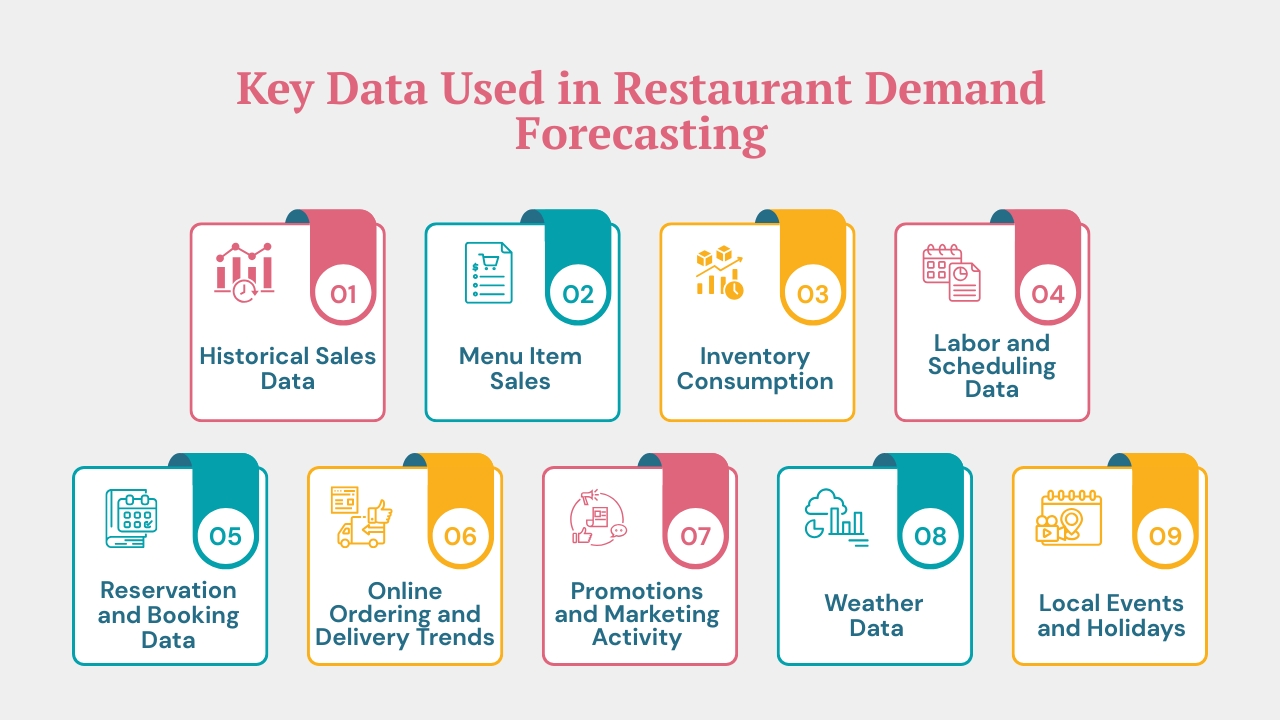
Key Data Used in Restaurant Demand Forecasting
Accurate restaurant demand forecasting often relies on strong and reliable data. When the data used for forecasting is relevant, complete, and trustworthy, the more accurate the forecast will be and the better decisions which restaurants can make.
1. Historical Sales Data
Historical sales data is the foundation for restaurant demand forecasting. It reveals restaurant patterns by day, week, month, season, and year. They show the periods that are busy, the items that sell most, and the way revenue changes over time.
Also Read: Business Intelligence Dashboard for Data Collection
2. Menu Item Sales
Forecasting menu item sales helps restaurants to prepare their food items accurately by forecasting demand for specific dishes. Instead of depending just on total sales, forecasting menu item sales helps restaurants to plan inventory, prep, and production around the items which customers are most likely to order.
Also Read: How to Create an Effective Restaurant Sales Report
3. Inventory Consumption
Restaurants need to know the way menu items sales convert into ingredient usage. It helps restaurants to accurately purchase inventory, prep planning, and inventory control.
Connecting menu demand with ingredient usage helps restaurants to make accurate purchasing decisions and maintain better inventory control.
Also Read: AI For Restaurant Inventory
4. Labor and Scheduling Data
Labor and scheduling data helps restaurants to align their staffing with their expected demand. When forecasting tools review past staffing and labor productivity, managers can estimate the number of employees required for future shifts and service periods.
Also Read: How Data Analytics Improves Employee Performance
5. Reservation and Booking Data
Reservation and booking data offer full-service restaurants crucial forward-looking demands. By analyzing booking data, managers can forecast guest counts, plan staffing levels, and prepare operations accurately for upcoming service periods.
Also Read: How AI is Improving Table-Turnover Rate in Restaurants
6. Online Ordering and Delivery Trends
Online ordering and delivery trends are crucial because off-premise demand mostly differs from dine-in traffic of customers. Restaurants with strong delivery business should forecast each channel separately for better planning.
Also Read: Restaurant Data Analysis
7. Promotions and Marketing Activity
Promotions and marketing activity can significantly influence restaurant demand. Special offers, ad campaigns, email marketing, and limited-time menus often increase traffic so forecasting should account for these demand changes.
Also Read: Business Intelligence for Restaurants
8. Weather Data
Weather data matters because it can change customer behavior. Rain may reduce walk-in traffic while increasing delivery orders, and temperature shifts can also influence beverage sales and menu preferences.
Also Read: How Data Analytics Help Restaurant Grow
9. Local Events and Holidays
Local events and holidays can strongly influence restaurant demand. Festivals, school breaks, concerts, sports events, and public holidays often increase or shift customer traffic, so accurate forecasting should include these demand drivers.
Methods of Restaurant Demand Forecasting
There is no single forecasting method which works for every restaurant. The best approach depends on the size of the business, the quality of available data, and the complexity of operations.
1. Historical Trend Analysis
This is the most basic demand forecasting method. Restaurants analyze past sales and use trends to predict future demand. For instance, if Friday evenings are consistently strong, the restaurant expects a similar performance next Friday. Though this method is easy to apply, it works best when combined with other variables.
Also Read: How Restaurant Can Predict Trends With Analytics
2. Moving Averages
A moving average uses the average of recent periods to smooth out short-term fluctuations. This type of forecasting helps restaurants to identify broader patterns without overreacting to one usually high or low day.
Also Read: How Livelytics Can Helps Restaurants Boost Revenue
3. Seasonal Forecasting
Many restaurants experience recurring seasonal demand. Summer tourism, winter holidays, school calendars, and festive periods all affect traffic. Seasonal forecasting accounts for these recurring patterns.
Also Read: How AI Revolutionizes Customer Experience in the Restaurant Industry
4. Event-Based Forecasting
This method adjusts forecasts based on known external events, such as concerts, holidays, local festivals, sports matches, or nearby conferences. It is especially useful for restaurants located in event-driven areas.
Also Read: How AI Unlocks Business Insights That Drive Required Results
5. Regression Analysis
Regression forecasting examines how sales are influenced by multiple variables such as weather, promotions, holidays, delivery activity, and local events. It helps explain not just what demand looks like, but why it changes.
Also Read: Automating Data Analysis Using Artificial Intelligence
6. AI and Machine Learning Forecasting
Modern restaurant forecasting platforms use AI and machine learning to analyze large amounts of data quickly. These systems detect patterns across sales, labor, weather, events, and customer behavior. They can also improve over time as more data becomes available.
AI-driven restaurant demand forecasting is especially effective for multi-location brands and businesses that have complex demand as AI tools can process more variables than manual forecasting methods.
Also Read: Artificial Intelligence Vs Machine Learning
How Forecasting Reduces Waste
Food waste is one of the most measurable areas where implementing accurate demand forecasting provides real value. Food waste may happen while ordering, storage, preparation, cooking, and service. Demand forecasting helps restaurants to reduce waste at every stage.
1. Smarter Purchasing
Smarter purchasing helps restaurants to order ingredients closer to actual demand. When forecasts are accurate, restaurants can avoid overordering, reduce food waste, improve inventory control, and make better purchasing decisions based on the ingredients to be used during upcoming service periods.
Also Read: Restaurant KPIs Dashboard
2. Better Prep Planning
Better prep planning helps kitchen teams to prepare the right amount of food for each shift. When demand is predicted accurately, restaurants can reduce overpreparation, unnecessary waste, and also reduce the number of unsold food which will have to be discarded after service ends.
Also Read: How Do Fast Food Restaurants Ensure Consistent Food Quality
3. Improved Menu Engineering
Improved menu engineering helps restaurants to identify items that are regularly overproduced or may have unpredictable demand. With these insights restaurants adjust food portions, refine preparation methods, or reposition menu items to reduce waste, improve consistency, and better align production with actual customer demand.
Also Read: Optimizing a Restaurant Menu With AI Powered Data Analytics
4. Stronger Shelf-Life Management
Stronger shelf-life management helps restaurants to align forecasted demand with current inventory levels. This helps teams to use ingredients in the right order, prioritize items that have shorter shelf life, reduce food spoilage, and improve overall inventory control across daily operations.
Also Read: AI for Retail Inventory Management
5. More Controlled Production During Slow Periods
More controlled production during slow periods helps restaurants to avoid preparing too much food due to uncertainty. With better demand forecasting, teams can prepare food more carefully, reduce unwanted overproduction, reduce waste, and manage slow shifts with more discipline and confidence.
How Forecasting Increases Profits
Restaurant demand forecasting has a strong impact on profits. Because forecasting improves revenue, strengthens cost control, and increases operational efficiency that helps restaurants to make smarter decisions that support consistent profits.
1. Lower Food Cost Percentage
Lower food cost percentage is one of the clearest advantages of better forecasting. Forecasting helps restaurants to order stock accurately based on demand and reduce waste, so less inventory is lost to spoilage or overproduction, while more of the inventory purchased is converted into actual sales.
Also Read: How to Calculate Food Cost Percentage
2. Higher Labor Productivity
Restaurants achieve higher labor productivity when staffing is aligned more closely with expected demand. Forecast based staff scheduling helps restaurants to reduce unnecessary labor hours, improve work efficiency, and maintain service quality without overspending on staffing during slower periods.
3. Fewer Lost Sales From Stockouts
Demand forecasting helps restaurants to reduce lost sales due to stockouts which is one of its advantages. By forecasting demand accurately, restaurants can manage top-selling menu items available even during peak periods, avoid any missed revenue opportunities, and also provide a reliable customer experience.
Also Read: Business Intelligence for Dashboard
4. Better Use of Promotions
Better use of promotions allows restaurants to target slower periods more effectively. Forecasting helps identify when promotions can increase traffic and also shows whether a campaign is likely to generate profitable new demand or simply reduce margins on sales that would happen anyway.
5. Improved Cash Flow
Improved cash flow is another benefit of accurate forecasting. When restaurants purchase more precisely, they avoid tying up money in excess inventory, reduce unnecessary stock levels, and keep cash available for other important operational needs and growth opportunities.
Also Read: Key Metrics Every Restaurant Owner Should Be Tracking
6. Better Decision-Making at Every Level
Better decision-making at every level is one of forecasting’s biggest strengths. From general managers to kitchen leads to owners, clearer demand visibility supports smarter daily choices. Such small, consistent improvements over time, leads to stronger weekly results and better long-term financial performance.
Also Read: Benefits of Data-Driven Decision Making
How to Build an Effective Restaurant Demand Forecasting Process
Forecasting is more effective when implemented effectively as a routine and not just occasionally. Establishing a structured demand forecasting process helps restaurants to improve accuracy, make better decisions, and achieve more reliable operational results.
1. Collect Clean, Consistent Data
An effective demand forecasting starts with clean, consistent data gathered from POS, inventory, labor, and reservation systems. Remove errors, duplicates, and missing values because demand forecast accuracy depends highly on the quality of the data used.
2. Forecast at the Right Level
Establish forecasts at the right level and not just on total weekly sales. Use location, daypart, menu category, item, and sales channel data to create more detailed forecasts and useful decisions.
3. Add Operational Context
Add operational context which makes forecasting more realistic. Restaurants must include weather, local events, promotions, holidays, and business conditions so projected demand reveals what is actually likely to happen.
Also Read: The Blind Spots Costing Your Business More Than You Think
4. Involve the Team
Managers, chefs, and buyers bring valuable everyday insights that data alone may miss. While combining operational experience with forecast data leads to practical, accurate, and informed restaurant decisions.
5. Compare Forecast to Actual Performance
Reviewing forecasted results against actual performance helps restaurants to identify gaps, refine their forecasting methods, and improve future accuracy through regular learning and adjustment.
6. Turn Forecasts into Action
A forecast should always lead to action. Restaurants should use projected demand to adjust ordering, prep, staffing plans, and production schedules so that daily decisions align closely with expected business requirements.
Also Read: Choosing the Right AI Data Platform for Your Business
7. Use the Right Technology
Spreadsheet-based forecasting may work for smaller restaurants, but growing businesses require dedicated analytics or restaurant intelligence platforms which automated forecast and scenario planning.
Conclusion
Restaurant demand forecasting is no longer only a tool used for planning rather it has become a crucial part for running a profitable and efficient operation.
By accurately predicting customer demand, restaurants can reduce food waste, control labor costs, and avoid expensive mistakes such as overordering or stockouts.
These improvements directly improve the foundation of restaurants while also establishing smoother, more consistent daily operations.
The real value of forecasting comes from converting data into action. When restaurants use forecasts to guide purchasing, prep, staffing, and production decisions, they operate with greater clarity and control.
Rather than reacting to problems after they occur, teams can prepare in advance and make smarter choices throughout the day. With time these small, consistent improvements cause stronger financial performance and better resource management.
Forecasting also supports a better guest experience. When restaurants are well prepared then service runs more efficiently, popular items are always available, and customers also receive a more reliable experience. Such consistency builds trust and encourages repeat visits.
In a highly competitive and industry of thin margins, restaurants that adopt demand forecasting gain a competitive advantage. Because such restaurants waste less, plan better, and perform more consistently.
Ultimately, forecasting is not just about predicting demand rather it is about building a smarter, more sustainable, and more profitable restaurant business.
If you still have any query about restaurant demand forecasting to reduce waste and increase profits then you may book a free demo at Livelytics and we are more than happy to assist you.