For the restaurant industry, food waste has become a major concern due to high quantities of edible food wasted on a daily basis because of poor planning, excessive food production, and poor inventory management.
Due to the increase in problems regarding sustainable food management, rise in operational expenses, and environment impact has motivated restaurants to adopt innovative solutions for reducing food waste in restaurants.
Therefore for restaurants data analytics has become essential for reducing food waste in restaurants and improving efficiency in restaurant operations.
By integrating big data, predictive analytics, and artificial intelligence allows restaurants to collect and analyze customer behavior, buying patterns, inventory usage.
With these technologies, restaurant managers can make decisions based on data insights while preparing food, purchasing ingredients, menu planning, and food portion control.
Advanced inventory management systems and point-of-sale(POS) systems enable restaurants to monitor food consumption patterns, and find the areas which are causing food waste. This helps restaurants to highly reduce food spoilage, overstocking of ingredients, and unnecessary discarding of food products.
Additionally, implementing food waste reduction strategies through analytics helps restaurants to not just reduce operational costs and also supports environmental sustainability by reducing unnecessary gas emissions and thereby conserving natural resources.
Customers today prefer businesses that show commitment towards environmental sustainability. Hence, it has become essential for restaurants to make data driven decisions for achieving high profits.
This blog will walk you through how restaurants can use data analytics, machine learning, and smart waste management systems to reduce food waste, improve efficiency, and lead to a more sustainable future in the restaurant industry.
Also Read: AI Solutions for Reducing Restaurant Waste
Understanding Food Waste in Restaurants
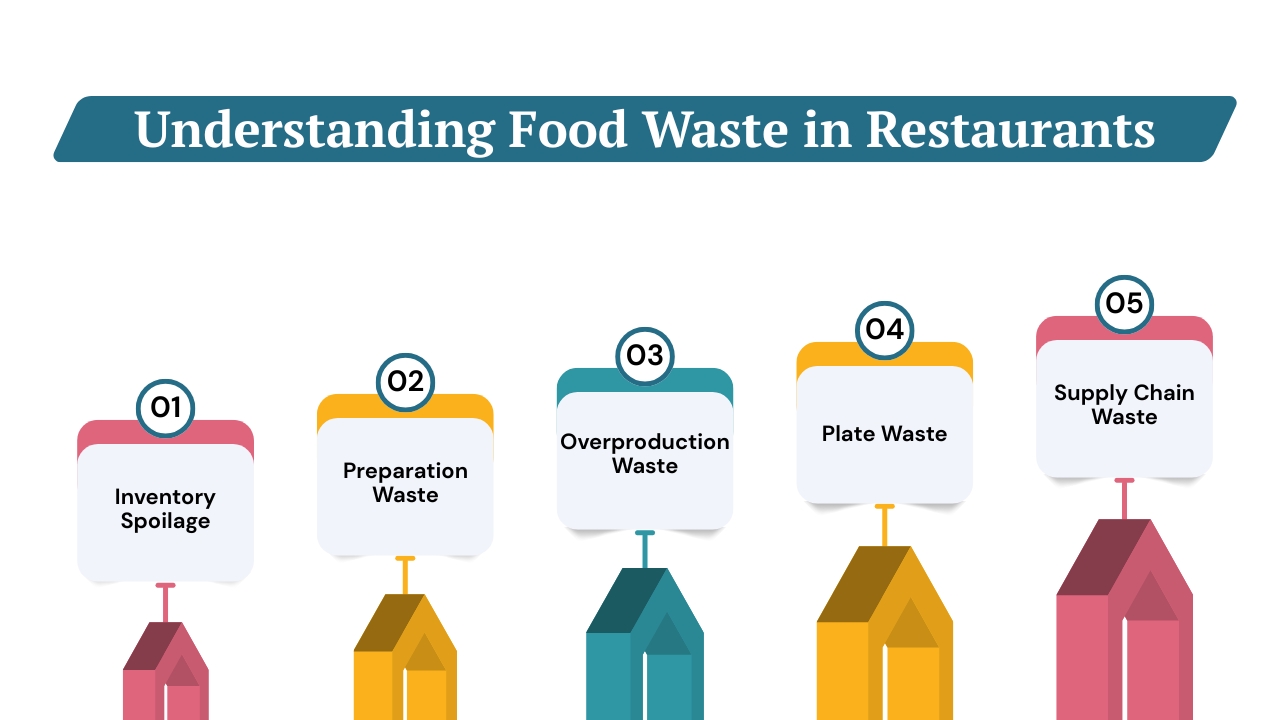
1. Inventory Spoilage
One of the common forms of food waste in restaurants is inventory spoilage. This happens when ingredients expire before they can be used while preparing food.
This concern often happens because of overordering, inaccurate demand forecasting, poor inventory storage conditions, and ineffective rotation of inventory practices.
Many perishable food items such as seafood, dairy products, vegetables are vulnerable to food spoilage. Proper inventory management and tracking food systems are essential for reducing food losses and improving food usage.
Also Read: AI for Restaurant Inventory
2. Preparation Waste
Food preparation waste occurs during the food preparation phase. This includes inaccurate cutting methods, kitchen errors, and unwanted food overpreparation during food preparation activities.
In many restaurants, if there is no proper staff training and inconsistent processes increase the quantities of food waste. Implementing food preparation techniques and standard kitchen operations can help to reduce unwanted food discarding and improve food productivity.
Also Read: Proven Solutions to Food Waste in Restaurants
3. Overproduction Waste
Restaurants often prepare more food than necessary to prevent food shortage during busy hours. This practice is usually found in buffets, catering services, and quick-service restaurants.
However, preparing high amounts of food quantities often causes large amounts of unused food being wasted at the end of service. Restaurants by accurately forecasting sales and data-driven food production can highly reduce food waste due to overproduction.
Also Read: How to Reduce Food Wastes in Restaurants and Improve Profitability
4. Plate Waste
Plate waste refers to food left unfinished by customers. Many reasons like large food portion sizes, poor menu design, and different customer expectations cause such type of food waste.
Plate waste also provides insights about customer satisfaction, food quality, and food menu preferences helps restaurants to improve their services and also reduce food waste.
Also Read: The Role of Data Analytics in Reducing Restaurant Waste
5. Supply Chain Waste
Food waste can happen even before ingredients arrive at the restaurant. If there are any delays in food delivery, supplier inconsistency, poor transportation conditions, and improper handling of food can lead to food spoilage and reduced food quality.
Modern data analytics tools such as Livelytics enable restaurants to have better visibility into the supply chain which help them to track operations more effectively and reduce waste at every phase.
Also Read: Benefits of Supply Chain Optimization for Businesses
Why Food Waste Is a Critical Business Problem
1. Financial Losses
Food waste causes high financial challenges for restaurants due to increase in operational expenses in several areas. Wasted ingredients result in lost inventory, higher purchasing expenses, additional labor costs, and increased disposal fees.
Restaurants also lose energy and resources used in storing and preparing food that is never consumed. Even a small increase in food waste can highly reduce annual profits. For restaurant chains operating in multiple locations, such food losses even become larger and negatively affect business performance in the long-term.
Also Read: Restaurant Profit Margin Analytics Tool to Boost Profits
2. Sustainability Concerns
Food waste has a serious impact on the environment because it wastes resources like water, electricity, labor, fuel, and agricultural inputs. When food is wasted decomposes in landfills, releasing methane gas can cause climate change and environmental pollution.
Due to the rise in environmental awareness, restaurants and consumers are encouraging restaurants to adopt sustainable waste management and reduce their impact on the environment.
Also Read: Business Intelligence for Marketing
3. Customer Expectations
Modern consumers increasingly prefer restaurants that take environmental conservation responsibility and implement sustainable business practices.
Restaurants that actively reduce food waste often have stronger loyalty from customers, improves brand reputation, and gain positive attention on social media platforms.
Also Read: How AI Revolutionizes Customer Experience in The Restaurant Industry
4. Operational Inefficiency
Food waste often shows deeper operational problems within restaurant management. Improper demand forecasting, poor coordination in the kitchen, inefficient workflow, can cause excessive food waste.
When restaurants reduce food waste, they can improve operational efficiency, enhance management, and establish more disciplined and productive business operations.
Also Read: How to Improve Restaurant Operations
The Role of Data Analytics in Reducing Food Waste
Data analytics help restaurants to shift their decisions from being reactive to predictive. Using insights rather than guessing, restaurants can optimize inventory control, food preparation, purchasing, and waste management.
Analytics tools enable restaurants to track customer demand, ingredient use, and operational performance in real time through which restaurants can reduce food spoilage, improve efficiency, lower expenses, and support sustainable food management practices.
Also Read: Business Intelligence and Data Analytics Services
Real-Time Inventory Intelligence
Inventory management is one of the most crucial areas where data analytics enables restaurants to reduce food waste and improve operational efficiency. Traditional inventory systems depend on counting inventory manually, tracking through spreadsheets, or employee estimates.
While these methods are slow, inaccurate, and reactive, which makes it difficult for restaurants to manage inventory effectively. As a result, businesses may experience inventory overstocking, food spoilage, and unnecessary food disposal.
Modern analytics platforms integrate directly with POS systems, inventory software, supplier systems, and kitchen management tools. It provides restaurants more visibility into inventory activities in real-time and helps managers to make quicker and more accurate decisions about food purchasing and stock management.
Also Read: Real-time Analytics Why Does your Business Needs it
1. Accurate Inventory Monitoring
These systems track quantities of ingredients, movement of stock, and reduce food waste in real time that helps restaurants to maintain proper inventory levels.
Also Read: AI for Retail Inventory Management
2. Usage Trend Analysis
Analytics systems help restaurants to identify changing demand patterns and usage trends. When demand for a specific ingredient reduces, managers can reduce food orders before any food spoilage occurs.
Also Read: How Restaurant Can Predict Trends With Analytics
3. Expiration Tracking
Modern systems enable restaurants to track expiry of ingredients and alert staff when ingredients are about to expire which improves freshness of food.
Also Read: 12 Performance Every Restaurant Owners Must Be Tracking
4. Automated Waste Prevention
Automated alerts notifies teams when there is excessive inventory or unusual inventory usage patterns happen. It helps restaurants to avoid ingredient overstocking, improves inventory rotation, and reduces unwanted food waste in restaurant operations.
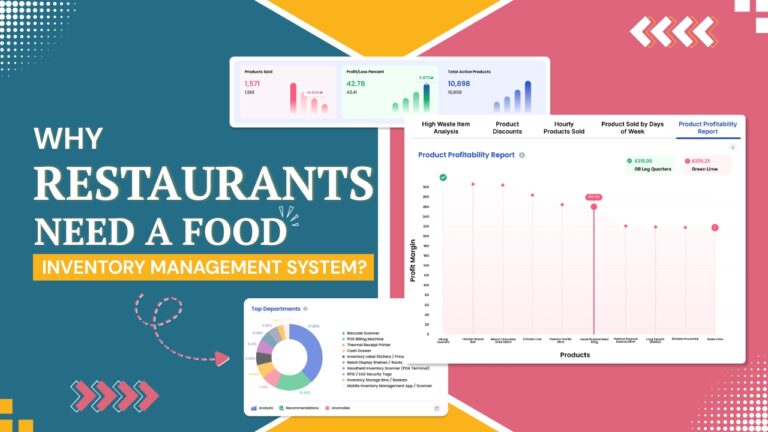
Also Read: Why Restaurant Needs a Food Inventory Management System
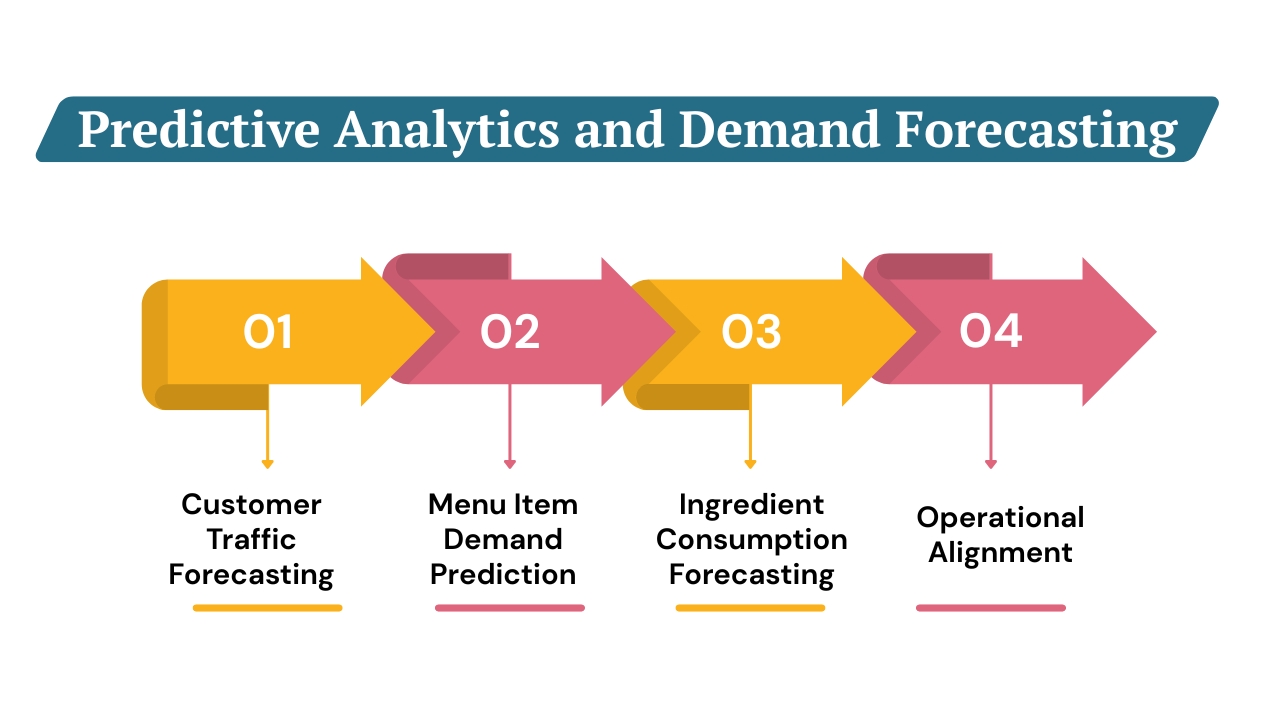
Predictive Analytics and Demand Forecasting
Predicting customer demand is one of the most challenging aspects in restaurant operations because customer demand keeps changing constantly due to external and internal factors.
Many factors such as weather conditions, holidays, local events, tourist patterns, economic changes, seasonal patterns, can highly impact the number of customers visiting the restaurants.
Without the right customer demand forecasting, restaurants often produce more food, overstock ingredients, and end up wasting prepared meals which causes higher operational expenses and reduced efficiency.
Predictive analytics solves this challenge by using past and real-time data to predict future customer demand more accurately. Machine learning models analyze large datasets from POS systems, customer behavior patterns, and sales history to generate reliable forecasts.
These systems continuously improve over time when these systems process more data that makes predictions more accurate and useful for planning restaurant operations.
1. Customer Traffic Forecasting
Predictive models estimate expected customer flow to the restaurant based on past customer patterns, weather conditions, and special events that help restaurants to prepare food more efficiently.
expected customer flow based on past trends, weather conditions, and special events, helping restaurants prepare efficiently.
Also Read: Data-Driven Social Media Strategies for Businesses
2. Menu Item Demand Prediction
Analytics tools help restaurants to identify the dishes which are popular on specific days or seasons which helps restaurants to plan food preparation and reduce food waste.
Also Read: How Data Analytics Can Help Restaurants Optimize Menus
3. Ingredient Consumption Forecasting
Analytics systems help restaurants to predict the quantity of each ingredient that will be required avoiding any overordering and food spoilage.
Also Read: How Restaurants Can Predict Trends With Analytics
4. Operational Alignment
Restaurants can match their inventory purchasing, staffing, food preparation with expected customer demand. For instance, rainy days may witness an increase in soup and delivery orders, while weekends may require high food preparation volumes.
This alignment reduces waste while maintaining service quality and operational efficiency.
Also Read: How Predictive Intelligence Transforms Retail
Waste Tracking and Data Visibility
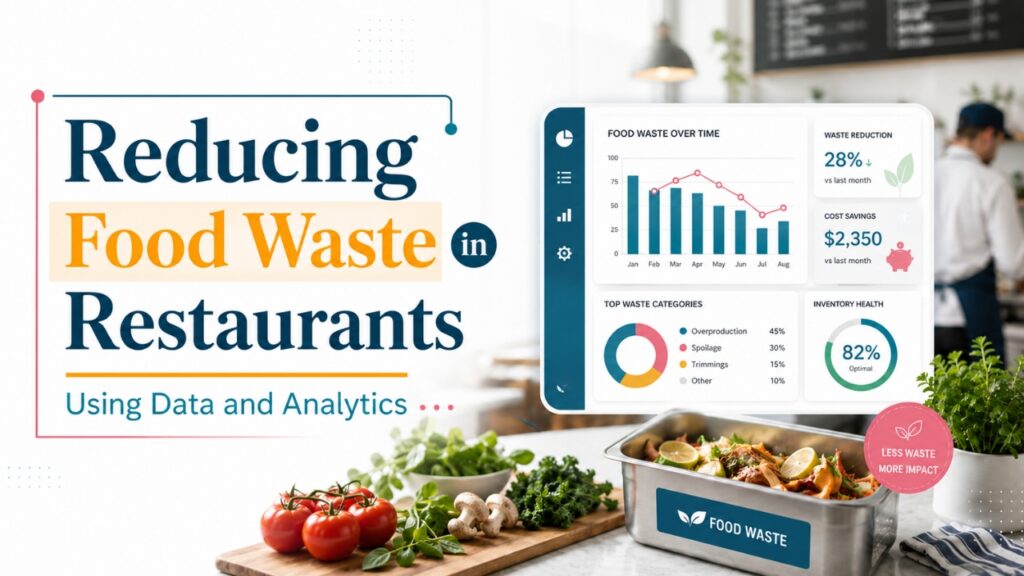
Restaurants cannot effectively reduce food waste unless they track the food waste and understand the areas that are causing food waste. Modern waste tracking systems provide insights about the food which is wasted, when the food waste happens, why food waste happens, and which kitchen areas or stations are having high food waste.
Having high visibility into restaurant operations helps them to shift from guesswork to data-driven decisions improving overall efficiency and sustainability.
Analytics dashboards play an important role in identifying recurring waste patterns. For instance, dashboards may reveal a specific kitchen shift consistently generating higher food spoilage, or about the certain menu items that are frequently left unfinished by customers.
Such systems can also highlight ingredients which may repeatedly expire before use. When restaurants identify these patterns, restaurants can take corrective actions rather than applying general or ineffective solutions.
Also Read: Customer Analytics for Restaurants
1. Waste Identification and Measurement
Modern systems track the quantity of food is wasted, how much food is discarded, and at what phase food waste mostly happens. It ensures accurate reporting and analysis.
Also Read: Leveraging AI to Collect Customer Insights
2. Pattern Recognition and Analysis
Analytics dashboards determine trends such as specific shifts, menu items, or ingredients which generate excessive food waste, which help managers to identify root causes behind food waste.
Also Read: How AI Unlocks Business Insights That Drive Required Results
3. Smart Tracking Technologies
Restaurants are highly using smart tracking technologies like AI-powered waste recognition systems, kitchen monitoring tools to automate waste tracking and reporting.
Also Read: How Real-Time Dashboard Drive Smart Business Decisions
4. Operational Accountability
Tracking waste helps restaurants to create transparency and accountability across kitchen teams. Managers can implement targeted improvements, reduce food inefficiencies, and reduce food waste using right and real-time data insights.
Also Read: How to Improve Restaurant Operations
Menu Engineering and Data-Driven Optimization
Menu design plays an important role in determining how efficiently a restaurant operates and how much food waste it generates. Certain menu items may not sell frequently, require specialized ingredients, or create preparation inefficiencies that increase food waste.
Some dishes also generate low profit margins while contributing highly to unused or spoiled ingredients. As a result, poorly optimized menus can directly increase operational costs and reduce sustainability.
Data analytics helps restaurants to optimize menu design by evaluating important performance indicators like sales performance, ingredient usage, profitability, waste contribution, and customer preferences.
By analyzing this data, restaurants can clearly understand which dishes are performing well and which are causing inefficiencies. This enables more informed decision-making and better menu planning.
1. Performance-Based Menu Evaluation
Analytics identifies high-profit, low-waste dishes and highlights low-profit, high-waste items which may need redesigning or removal.
Also Read: Why Data Analytics is the New Secret Weapon for Successful Restaurants
2. Ingredient Efficiency Analysis
Systems detect ingredient overlap opportunities across multiple dishes, helping reduce unnecessary stock complexity and waste.
Also Read: Two Way Data Analytics in Shaping Retail Business
3. Seasonal and Demand Insights
Data helps restaurants identify seasonal opportunities where certain dishes perform better and should be promoted accordingly.
Also Read: Restaurant Demand Forecasting Reduce Waste and Increase Profits
4. Menu Optimization Decisions
For instance, a seafood dish requiring unique ingredients may cause spoilage if customer demand is not consistent. Analytics may recommend removing the item, making it seasonal, redesigning the menu recipe, or sharing ingredients across multiple dishes.
Through data-driven menu engineering, restaurants can simplify operations, reduce inventory waste, and improve overall efficiency while maintaining customer satisfaction and profitability.
Also Read: How Data Analytics Help Restaurants Grow
Portion Control and Plate Waste Reduction
Oversized food portions lead to high food costs and unnecessary plate waste in restaurants. Though many restaurants assume that larger portions improve customer satisfaction, data analytics often reveals that customers regularly leave good amounts of food uneaten.
This not just increases food waste but also reduces operational efficiency and profitability. As a result, optimizing food portion sizes has become a crucial area to be focused for data-driven restaurant management.
Plate waste analytics helps restaurants to better understand customer eating patterns and adjust serving sizes accordingly.
Analyzing food consumption patterns of customers, restaurants can identify the menu items which are frequently left unfinished, and the dishes where portion sizes may be excessive.
Some modern systems even use AI-based image recognition systems to instantly analyze leftover food and measure waste levels more accurately.
1. Customer Behavior Analysis
Analytics tools help restaurants to understand how customers consume different dishes which enables better portion design and reduced waste.
Also Read: Customer Sentiment Analysis for Multi Location Business Challenges and Solutions
2. Portion Size Optimization
If data shows that customers consistently leave certain items like unfinished, restaurants can adjust portion sizes without affecting perceived value.
Also Read: What is Business Intelligence for Supply Chain Optimization
3. Flexible Serving Options
Restaurants can introduce half food portion sizes, variable sizing, and build your own meal options to align customer needs and reduce food waste.
Also Read: Cost Effective AI Solutions for Restaurants
4. Improved Menu Personalization
Data-driven insights enables restaurants to design more personalized dining experiences for customers, ensuring customers receive appropriate food portion sizes, also reducing plate waste and improving overall customer satisfaction and cost efficiency.
Smart Purchasing and Supplier Analytics
Procurement decisions play a crucial role in determining how much food waste a restaurant generates. Most restaurants face challenges due to bulk overordering, inconsistent supplier quality, delayed deliveries, and limited visibility into purchasing patterns.
Such issues often cause excess inventory, food spoilage, and increased operational expenses. Without the right data insights, inventory procurement becomes reactive rather than being strategic which often causes high food waste.
Modern analytics platforms help restaurants to verify supplier performance using crucial metrics such as reliability, pricing, freshness, delivery timing, and waste contribution.
Analyzing this data, enables restaurants to identify the most efficient suppliers and make informed purchasing decisions.
Predictive procurement systems further improves smart purchasing by recommending optimal ingredient quantities, delivery schedules, supplier adjustments, and purchasing time based on expected demand.
1. Optimized Order Quantities
Analytics helps restaurants to identify the accurate amount of ingredient levels that they need to order, avoiding any type of overstocking and reducing food in restaurants.
2. Supplier Performance Evaluation
Smart systems enable restaurants to evaluate suppliers based on reliability, freshness, pricing, and consistency in delivery to ensure they make better procurement decisions.
Also Read: How Predictive Intelligence Transforms Retail
3. Demand-Based Purchasing
Predictive systems enable restaurants to align their purchasing decisions with forecasted customer demand thereby reducing unnecessary inventory stocking.
4. Cost and Waste Reduction
Small procurement reduces excess inventory stocking, food spoilage, emergency purchasing expenses, and improves negotiations by offering measurable supplier performance insights for better contract decisions.
Kitchen Workflow Optimization
Kitchen workflow inefficiencies are a major source of operational waste in restaurants. Problems such as duplicate food preparation, over-prepping ingredients, any type of miscommunication between different locations, inconsistent cooking methods, and poor inventory storage practices can highly increase food waste and reduce efficiency.
These issues often happen due to a lack of coordination and visibility within kitchen operations often causing unnecessary ingredient loss and reduced productivity.
Operational analytics helps restaurant managers to identify and track key performance indicators such as prep efficiency, production timing, labor productivity, waste generation by location, and recipe consistency.
Analyzing this data enables restaurants to better understand where inefficiencies happen and implement targeted improvements. Such a data-driven approach helps kitchens to operate more smoothly and reduce unwanted waste.
1. Improved Prep Efficiency
Analytics find the delays and inefficiencies in food preparation which helps managers to smooth workflows and reduce any unnecessary duplication effort.
2. Waste Monitoring by Station
Restaurants can track the kitchen stations that generate the most waste and take corrective actions like retraining staff or improving procedures.
3. Standardized Cooking Processes
Having data insights helps restaurants to maintain consistency in cooking methods and portion controls, reducing errors and overproduction of food.
4. Optimized Labor Productivity
Analyzing workflow patterns helps restaurants to improve staff coordination, reduce staff idle time, and improve overall kitchen efficiency.
Through optimizing workflow, restaurants can achieve faster operations, reduce waste levels, and improve consistency in food preparation, and improve labor efficiency ultimately causing more sustainable and profitable kitchen management.
Also Read: How Data Analytics Improve the Measurement of Employee Performance
Dynamic Pricing and Surplus Management
Dynamic pricing is one of the effective applications of data analytics in reducing food waste in restaurants. Often restaurants waste edible food simply because demand decreases unexpectedly or items are about to expire.
This causes unnecessary financial loss and high impact on the environment. Using analytics systems enables restaurants to convert surplus food into revenue opportunities rather than food waste.
Modern analytics platforms can automatically generate time-based discounts, promotional bundles, and special offers on delivery applications, helping restaurants to quickly sell excess inventory before it becomes unsellable and becomes waste.
For instance, bakery items can be offered at discounted prices in the evening, unsold lunch meals can be converted into dinner specials, and surplus ingredients can be used in promotional menu items to attract customers.
1. Time-Based Discounting
Restaurants use time-based discounts on perishable food items to improve sales, reduce food spoilage, reduce food waste, and recover revenue before products expire.
2. Surplus Food Conversion
Restaurants can convert or repurpose unsold food into daily appeals, combo meals, or promotional offers to maximize ingredient usage, reduce food spoilage, and improve operational profits.
3. AI-Powered Pricing Decisions
AI-powered systems analyze customer behavior and sales patterns to identify ideal discounts, maximize recovering revenue, and reduce food waste through smarter pricing decisions.
Also Read: Artificial Intelligence Vs Machine Learning
4. Revenue Optimization
Dynamic pricing helps restaurants to recover costs from surplus inventory by reducing food waste in restaurants, improving profits, and supporting more efficient and sustainable food management practices.
Conclusion
Reducing food waste in restaurants is an operational necessity and also essential for sustainability in today’s highly competitive restaurant industry.
Because of increase in food costs, environmental concerns, and changing customer expectations, restaurants can not just depend on traditional methods to improve their operations and management.
Instead data and analytics provide a strong foundation for transforming the way food is purchased, prepared, and consumed.
Using predictive analytics, real-time inventory systems, waste tracking tools, and AI-driven forecasting, restaurants can make more accurate decisions by analyzing past data and customer preferences and highly reduce unwanted waste.
These technologies help restaurants to have better visibility into procurement, storage, preparation, and customer consumption to ensure that resources are used efficiently.
Additionally, data-driven insights help restaurants to optimize menus, control portion sizes, optimize kitchen workflows, and improve supplier coordination.
Ultimately, adopting a data-driven approach to reduce food waste not just reduces operational expenses but also improves environmental sustainability and brand reputation.
Restaurants that adopt analytics are better positioned to meet environmental goals which improve overall profits and customer satisfaction.
Therefore, integrating data and analytics into restaurant operations is essential for building a more efficient, responsible, and sustainable future in the hospitality industry.
If you still have any query about reducing food waste in restaurants using data and analytics then you may book a free demo at livelytics and we are more than happy to assist you.