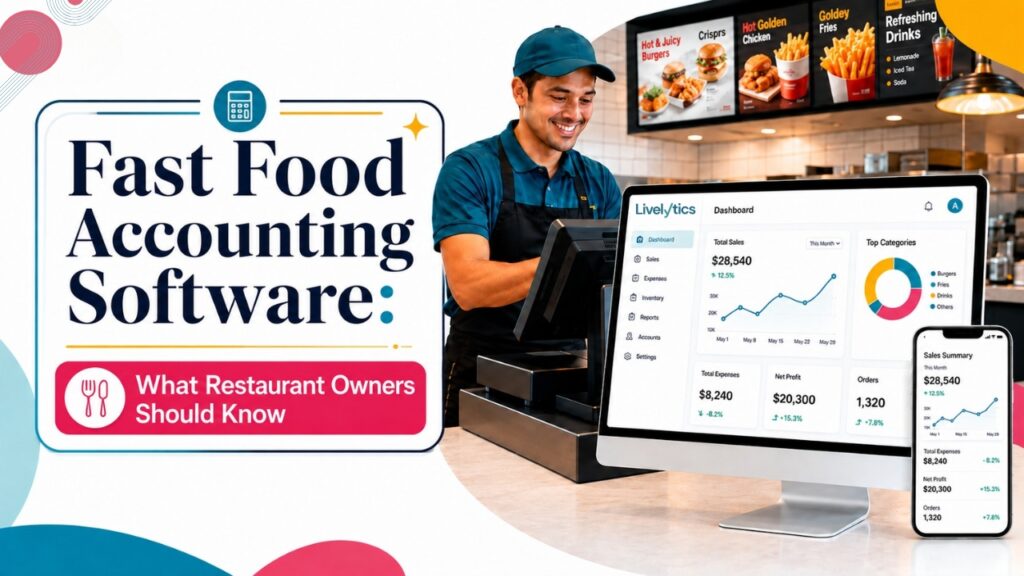

For running a fast food restaurant it is essential for owners to balance quick service, high order volume, and low profit margins every single day. In a fast food restaurant orders come in quickly, ingredients move fast, and employees work in different shifts, and expenses can change every week.
Without having access to the accurate financial system, it becomes difficult for restaurant owners to monitor sales, control expenses, manage payroll, review supplier invoices, and understand real profits. And this is where fast food accounting software becomes essential.
Fast food accounting software allows restaurant owners to organize financial data at one place. Using this software, restaurants can track daily sales, food costs, labor costs, vendor payments, payroll, taxes, cash flow, and profit margins with more accuracy.
For fast food businesses, accounting does not just mean recording income and expenses, instead it involves understanding how every cost affects the profits of the restaurants.
Even a small increase in ingredient prices, extra labor hours, delivery app fees, or missed invoice errors can reduce restaurant profits quickly. With the accurate restaurant accounting software, restaurant owners can find issues earlier and instantly take action before they become bigger financial problems.
Modern accounting software for fast food restaurants can also connect with POS systems, payment tools, inventor platforms, bank accounts, and analytics dashboards. It creates a clearer view of restaurant performance and helps owners to manage operations more efficiently.
Through this blog, we will explain what fast food restaurant owners should know about accounting software, its key features, benefits, integrations, common mistakes, and how it can help improve financial control, cost management, and long-term profitability.
Also Read: Why Restaurants Need a Food Inventory Management System
Why Fast Food Restaurants Need Specialized Accounting Software
Fast food restaurants are different from many other small businesses. As these restaurants process hundreds or thousands of transactions quickly, often across dine-in, drive-thru, pickup, delivery apps, kiosks, mobile ordering, catering, and loyalty platforms. While every channel may have different fees, taxes, discounts, refund rules, and settlement timelines.
A generic accounting system may record income and expenses, but it may not explain why profits are reducing. Sales may look higher on paper, but rising delivery commission fees can still reduce or eliminate the actual profit.
Though this system may show payroll expense, but not that one slow daypart is consistently overstaffed. It may track food purchases, but fail to show how those costs relate to recipes, waste, spoilage, theft, or menu item profits.
This is where quick service restaurant accounting software is essential. This software is designed to handle the financial challenges that restaurants face everyday. It helps restaurant owners to connect sales, labor, inventory, invoices, payroll, and reporting into one organized workflow.
For fast food businesses, small mistakes can add up quickly. A few incorrect vendor prices, duplicate invoices, untracked waste, poor cash controls, or missed delivery deductions can reduce profit without even being noticed.
When restaurant owners wait until month-end to review the numbers, then many issues have already affected their profits. Good accounting software allows owners to identify problems earlier, giving them time to correct issues before they become expensive costs.
Also Read: How do Fast Food Restaurants Ensure Consistent Food Quality
The Biggest Accounting Challenges in Fast Food
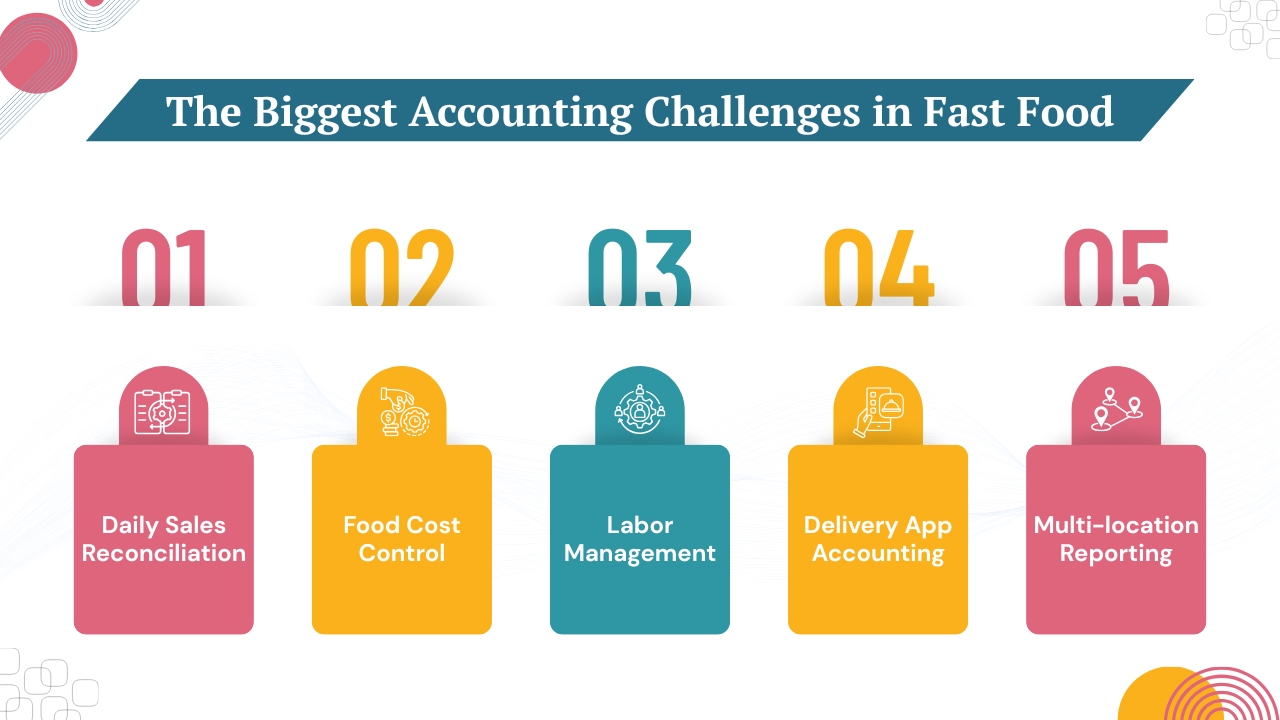
Fast food restaurants face several accounting challenges that can quickly affect profit if they are not managed properly.
1. Daily sales reconciliation
Fast food businesses collect payments through cash, credit cards, debit cards, mobile wallets, gift cards, online ordering, delivery platforms, and third-party apps.
Every payment channel should be checked against POS sales, bank deposits, processor reports, and accounting records. And if the records do not match then the restaurants may not know whether any revenue is missing, delayed, or reduced by processing fees.
Also Read: Restaurant Sales Forecasting How to Predict Future Revenue
2. Food cost control
Food costs can change quickly in fast food operations. Even if there is a slight increase in ingredient prices or portioning error then it can affect thousands of orders in a single day.
Without connected accounting, inventory, and sales data, restaurant owners may only notice food cost problems after profits have already reduced.
Also Read: Why Restaurants Need a Food Inventory Management System
3. Labor management
Labor is one of the biggest expenses in fast food operations. Owners require to know if staffing aligns with customer demand by hour, shift, daypart, sales channel, and location. Because even a staff schedule that seems accurate may become costly during slow periods.
Also Read: How Data Analytics Improve the Measurement of Employee performance
4. Delivery app accounting
Third-party delivery apps can increase sales, but they also add commissions, service fees, refunds, discounts, adjustments, and delayed payouts. Without proper tracking, owners may think delivery orders are more than they actually are.
Also Read: Restaurant Profit Margin Analytics tool to Boost Profits
5. Multi-location reporting
For fast food groups, some stores may perform well while other stores may lose money. Without location-level reporting, performance of strong stores can hide the performance of weak stores. Accurate reporting helps owners to compare each location and fix problems faster.
Also Read: Why Multi Location Growth Breaks Without Unified Data
What Fast Food Accounting Software Should Do
Good fast food accounting software should do more than record daily transactions. It should give restaurant owners a clear view of the financial health of business, that helps them to track money, control costs, and make better decisions every day.
At a basic level, the software should manage revenue, expenses, vendor bills, payroll, taxes, bank activity, cash flow, and financial statements.
For fast food restaurants, it should also connect with the POS system, organize sales by channel, track COGS, support inventory costing, simplify payroll, automate accounts payable, and create restaurant-specific reports.
A strong system should help restaurant owners answer important questions such as:
- Which location made the most profit this week?
- Are food costs increasing because of supplier prices, waste, or portioning?
- Which shift or daypart is overstaffed?
- Are delivery orders still profitable after commission fees?
- Are cash deposits matching POS reports?
- Are invoices paid on time?
These insights help restaurant owners protect profit and run the business more confidently.
Also Read: POS Reports Vs Real-Time Analytics
Key Features to Look For in Food Accounting Software
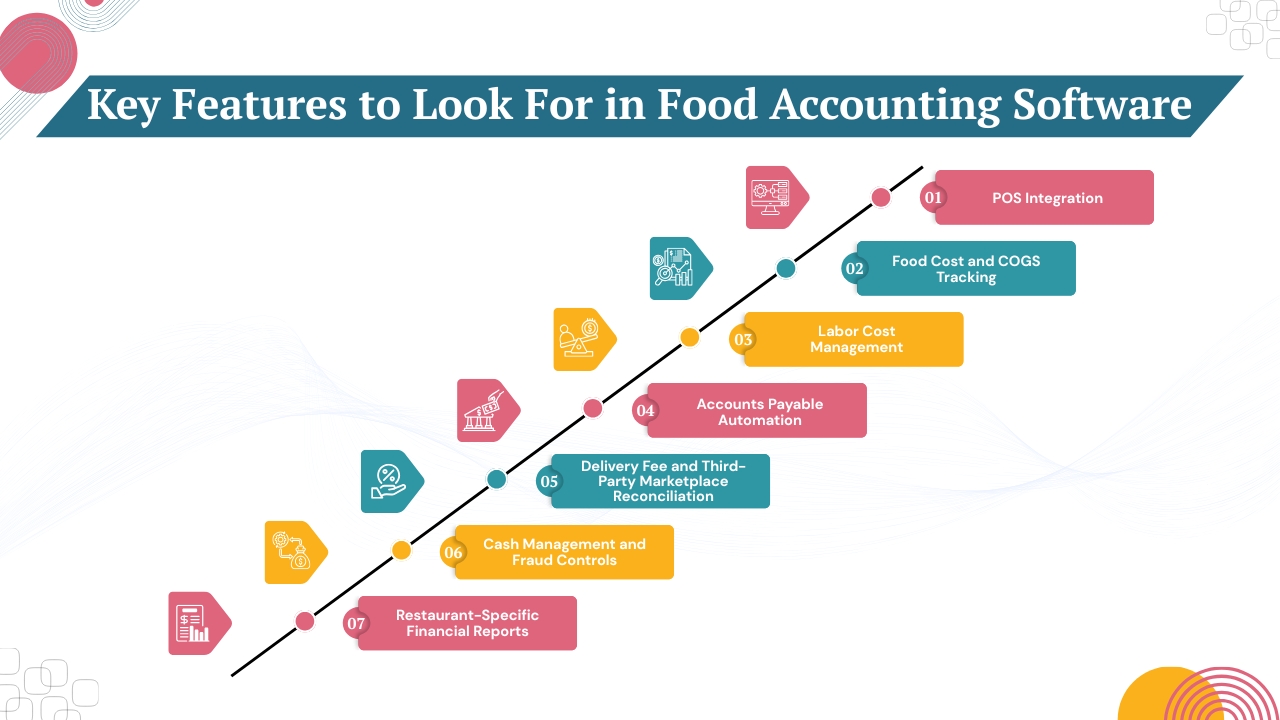
1. POS Integration
Your POS is the financial foundation of a fast food restaurant. Every order, refund, discount, tax amount, payment type, and tip begins here. If your accounting software does not connect properly with your POS, then your team may spend hours manually entering sales data.
Manual entry increases the risk of accounting mistakes which slows down reporting. By the time the restaurant data is entered, reviewed, and corrected, the information may already be outdated.
A proper POS integration should automatically extract daily sales into the accounting system. It should separate cash, credit cards, gift cards, loyalty redemptions, online orders, delivery sales, refunds, discounts, taxes, and tips. It allows restaurant owners to compare POS totals with bank deposits and payment processor settlements.
For fast food businesses, POS integration is especially important because transaction volume is high. Even a small reconciliation error repeated every day can create major reporting problems over time.
2. Food Cost and COGS Tracking
Food cost is one of the important numbers that determines a fast food restaurant’s profitability. It reveals how much restaurants spend on ingredients compared to what they sell.
But food cost goes beyond supplier invoices because it is also shaped by recipes, portion sizes, waste, spoilage, theft, vendor pricing, menu mix, and inventory accuracy.
Strong food cost tracking helps owners to understand the difference between theoretical cost and actual cost. Theoretical cost is what your food should cost based on recipes and sales. Actual cost is what your food costs after waste, errors, over-portioning, and operational issues.
If your actual food cost is higher than your expected food cost, then it usually means there is a problem that needs attention. The problem may be over-prepping, incorrect recipes, unrecorded waste, supplier price increases, employee mistakes or theft. Accounting software connected to inventory and POS data can help to reveal these gaps.
For fast food restaurants, it matters because volume is high and menu prices are often competitive. Rising ingredient costs can quickly reduce profit unless you adjust menu prices, portion sizes, promotions, or supplier agreements.
Also Read: Cost Effective AI Solution for Restaurants
3. Labor Cost Management
Fast food owners are required to control labor expenses without affecting service quality. Understaffing leads to long queues, slow drive-thru times, unhappy customers, and lost sales. Overstaffing reduces profit, especially during slower hours.
Good accounting software should connect with payroll and scheduling systems so restaurant owners can track labor costs by location, shift, role, and daypart. It helps them to see whether labor is aligned with sales.
For instance, if labor cost is quite high between 2PM and 5PM, then the issue may not be total weekly payroll. Though the issue may be a specific slow period where the staff schedule does not match with the demand. Without daypart-level reporting, this problem can stay hidden.
Fast food owners should look for software that tracks regular hours, overtime, payroll taxes, benefits, tips where applicable, and labor percentage. When such data is combined with sales forecasts, owners can build smarter schedules.
This is also where tools like Livelytics can add value. Livelytics uses restaurant data to show labor efficiency, overstaffed shifts, demand patterns, and labor optimization opportunities. Such type of intelligence helps restaurant owners to go beyond payroll reporting and into better scheduling decisions.
Also Read: Restaurant Performance Metrics Every Restaurant Owner Must Track
4. Accounts Payable Automation
Supplier invoices are an important part of fast food accounting. Restaurants receive bills for food, beverages, packaging, cleaning supplies, uniforms, equipment repairs, utilities, rent, marketing, delivery services, and technology subscriptions.
If invoices are handled manually, then several problems can happen. Bills entered late, duplicated, coded to the wrong category, paid after the due date, or missed completely.
An increase in vendor price may go unnoticed. Vendor credits may be missed or left unused. And managers may approve purchases without understanding the budget impact.
Accounts payable automation helps to solve these problems. The software can capture invoices, match them to vendors, assign expense categories, route approvals, track due dates, and sync payments with accounting records.
For multi-location fast food restaurants, AP automation becomes even more valuable. A central office requires visibility into what each store is ordering, which vendors are being used, and whether costs are changing across locations.
Also Read: Big Data Analytics for Restaurant Turning Data Into Profit
5. Delivery Fee and Third-Party Marketplace Reconciliation
Delivery platforms can increase sales, but they can also make accounting more complicated. Fast food restaurants may receive sales from Uber Eats, DoorDash, direct online ordering, and catering platforms.
Each platform may deduct commissions, service fees, marketing fees, refunds, adjustments, and taxes before sending payouts.
If delivery fees are not deducted correctly, then gross sales can make delivery orders appear more profitable than they actually are. And if fees are not categorized accurately, then the profit and loss becomes unclear.
Fast food accounting software should help to reconcile third-party delivery reports with POS sales and bank deposits. It should separate gross sales, commissions, refunds, promotions, taxes, and net profits.
This is crucial because delivery can look strong from a revenue perspective while producing weak profit margins. So restaurant owners need to know whether delivery orders are truly increasing profit or just adding kitchen workload.
6. Cash Management and Fraud Controls
Even though the use of digital payments is increasing, many fast food restaurants still accept cash. Cash creates accounting risk because there are chances that it can be counted inaccurately, deposited late, misplaced, or stolen.
Good accounting software should support cash drawer reconciliation, deposit tracking, over/short reporting, and manager approvals. Owners should be able to compare expected cash from the POS with actual cash counted and deposited.
Cash controls are especially crucial in high-volume fast food locations where many employees use registers throughout the day. Small cash variances may seem harmless, but repeated patterns can indicate training problems or fraud.
Advanced analytics tools help to identify unusual refund patterns, excessive voids, discount abuse, and suspicious cash handling. Livelytics, for instance, highlights fraud indicators like void patterns, discount abuse, and cash handling alerts as part of its restaurant intelligence approach.
Also Read: How to Create an Effective Restaurant Daily Sales Report
7. Restaurant-Specific Financial Reports
Though a basic profit and loss report is useful, fast food owners require more detailed reporting. The best systems should produce reports that are specific to restaurant operations.
Important restaurant reports include daily sales summaries, weekly P&L, food cost percentage, labor cost percentage, prime cost, cash flow, sales by channel, sales by daypart, menu item profitability, vendor spending, invoice aging, tax liability, and location comparison.
Monitoring prime cost is crucial as it combines both food cost and labor cost which are two of the biggest controllable expenses in a restaurant. When prime cost is very high, it can strain profits even if sales appear strong.
For multi-location fast food businesses, reports should show performance by each location. Owners should be able to compare performance of one location against another and quickly identify the stores that need attention.
Also Read: How Does Data Analytics Help Restaurant Grow
Best Accounting Software Options for Fast Food Restaurants
There is no such single best accounting software for every fast food restaurant. The right choice of software depends on your restaurant size, number of locations, budget, POS system, reporting needs, and how much accounting support you already have.
1. QuickBooks Online
QuickBooks Online works well for small fast food restaurants that require affordable bookkeeping, bank feeds, payroll integrations, invoicing, expense tracking, and basic financial reporting. Though it is familiar to many accountants, restaurants may require extra tools for inventory, recipe costing, and deeper food cost tracking.
2. Xero
Xero is another strong option for small to mid-sized restaurants that require cloud-based accounting, bank reconciliation, bill tracking, integrations, and clean reporting. Though it is simple to use QuickBooks, it may require connected restaurant tools for advanced inventory, labor, and COGS insights.
3. Restaurant365 and MarginEdge
Restaurant365 is more suitable for growing fast food brands, franchises, and multi-location restaurant options. It combines accounting with inventory, scheduling, accounts payable, reporting, and operation. While MarginEdge is useful for invoice processing, POS integration, food cost tracking, and inventory support.
4. Livelytics for smarter insights
Fast food brands that want stronger visibility must pair accounting software with Livelytics. This helps restaurant owners to understand profits, labor efficiency, customer trends, menu performance, store-level results, and operational risks across locations.
Also Read: How AI Unlocks Business Insights That Drive Required Results
What Owners Should Know
1. Focus on prime cost
Prime cost is one of the most crucial numbers in a fast food restaurant. This includes your COGS and labor costs, which are usually the two biggest controllable expenses.
If prime cost is too high, then even strong sales may not lead to good profits. Owners should review this prime cost regularly to understand whether food purchasing, portion control, staffing, or scheduling needs improvement.
2. Reduce manual work
Fast food accounting should not depend on manual data entry, paper invoices, or repeated spreadsheet updates. Good software automates daily sales imports, invoice processing, payroll records, expense categorization, and bank reconciliation.
It reduces errors, saves time, and helps managers to focus more on operations, rather than chasing numbers.
Also Read: Can Data Analytics Be Automated
3. Choose restaurant-specific software
Generic accounting tools may track income and expenses, but fast food restaurants require more detailed features. The software should handle inventory costing, vendor invoices, recipe costs, delivery app fees, payroll, tax reporting, and POS integration. Restaurant-specific tools make it easier to understand real profits.
4. Track by location, channel, and daypart
Restaurant owners should know about the stores, sales channels, menu items, and shifts that are performing best. It helps to identify hidden losses, overstaffing, high food costs, and low-margin delivery orders before they affect the business.
Also Read: Why Multi Location Growth Breaks Without Unified Data and How Smart Business Fix it
Why Fast Food Owners Should Not Rely Only on Month-End Reports
Though month-end reports are useful, they are often too late for fast food restaurants. Fast food operations move quickly, and small problems can affect profit every day.
Because a sudden increase in ingredient costs, repeated overstaffing, missed vendor credits, or high delivery fees can damage profit margins long before the monthly report is ready.
Fast food owners need daily or weekly visibility and not just end-of-month summaries. It does not mean reviewing every transaction each day. It means having accounting software that highlights problems early so owners can act before losses increase.
For instance, if food costs rise due to supplier pricing or waste, the system should show it quickly. If staff is too high during slow afternoon hours, then schedules can be adjusted before the next payroll cycle.
A modern accounting workflow should connect past performance with current decision-making. Accounting reports show what happened, but tools such as Livelytics help to explain why it happened and where action is required. It gives fast food owners better control over expenses, staffing, inventory, and profitability.
Also Read: Key Metrics Every Restaurant Owner Should be Tracking
Where Livelytics Fits in the Accounting Software Stack
Livelytics should not be considered as a replacement for accounting software such as QuickBooks, Xero, Restaurant365, or other bookkeeping systems. Rather, Livelytics works best as a restaurant business intelligence platform that brings operational and financial data together.
Accounting software records the financial performances. Livelytics helps owners to understand the operational reasons behind the numbers.
For instance, your accounting system may show that labor cost increased last week. Livelytics can help to reveal whether the increase in labor cost came from overstaffing, slower sales, overtime, poor scheduling, or demand changes.
Your accounting system may reveal why the food cost actually rose. Livelytics can help to identify COGS alerts, ingredient cost spikes, waste patterns, and menu profitability issues.
This is important for fast food owners because the numbers alone do not always explain the problem. A P&L may show lower profit, but owners still need to know what caused it.
- Was it food waste?
- Poor menu mix?
- Higher delivery fees?
- Slower drive-thru throughput?
- Bad labor scheduling?
- Vendor price increases?
- Store-level inconsistency?
Livelytics helps connect those dots by giving restaurant leaders real-time dashboards, store scoring, forecasting, anomaly detection, labor insights, menu intelligence, and operational alerts. When livelytics is paired with strong accounting software, it helps restaurant owners to move from bookkeeping to smarter decision-making.
Conclusion
Fast food accounting software is no longer only a tool for capturing income and expenses. Rather it is a practical system which helps restaurant owners to understand where money is coming from, where the money is invested, and how daily decisions affect profit.
In a fast food business, even small cost changes can quickly become serious problems as the sales volume is high while profit margins are narrow.
The right software helps restaurant owners track sales, food costs, labor expenses, vendor bills, payroll, taxes, delivery fees, cash flow, and financial reports at one place.
This software also connects with POS systems, inventory tools, payroll platforms, and reporting dashboards which helps owners to see the complete financial data rather than depending on scattered data.
For fast food restaurants, better accounting gives better control. As it helps owners to identify increasing food costs, overstaffed shifts, delivery commission losses, missing deposits, late invoices, and underperforming locations before they damage profits.
When accounting data is paired with restaurant intelligence tools like Livelytics, owners gain even deeper insight into labor efficiency, menu performance, store trends, and operational risks.
Ultimately, strong fast food accounting software helps restaurants to shift from being reactive to smarter business management. This gives business owners the clarity that they require to protect margins, improve cash flow, reduce waste, and grow confidently.
If you still have any query about fast food accounting software about what restaurant owners should know then you may book a free demo at livelytics and we are more than happy to assist you.