Introduction:
In the constantly evolving restaurant industry, data is no longer just a byproduct of your daily operations – it’s a strategic asset. According to a recent report by Deloitte, “restaurants using advanced analytics witnessed a 10-15% increase in operational efficiency and a 7-10% increase in revenue.
This shows how restaurant analytics and restaurant reporting can significantly reshape your decision making, allowing business to operate more smartly and effectively. Restaurant owners today face fierce competition where consumer preferences keep shifting and rising costs.
Such analytics and reporting tools help to track customer behavior, manage inventory, monitor employee performance, and menu optimization to improve efficiency and improve overall business performance.
As Jeff Bezos once said, “If you double the number of experiments you do per year, you are going to double your inventiveness.” Analytics allows restaurants to experiment intelligently – testing promotions, twisting menus, and forecasting demand with precision.
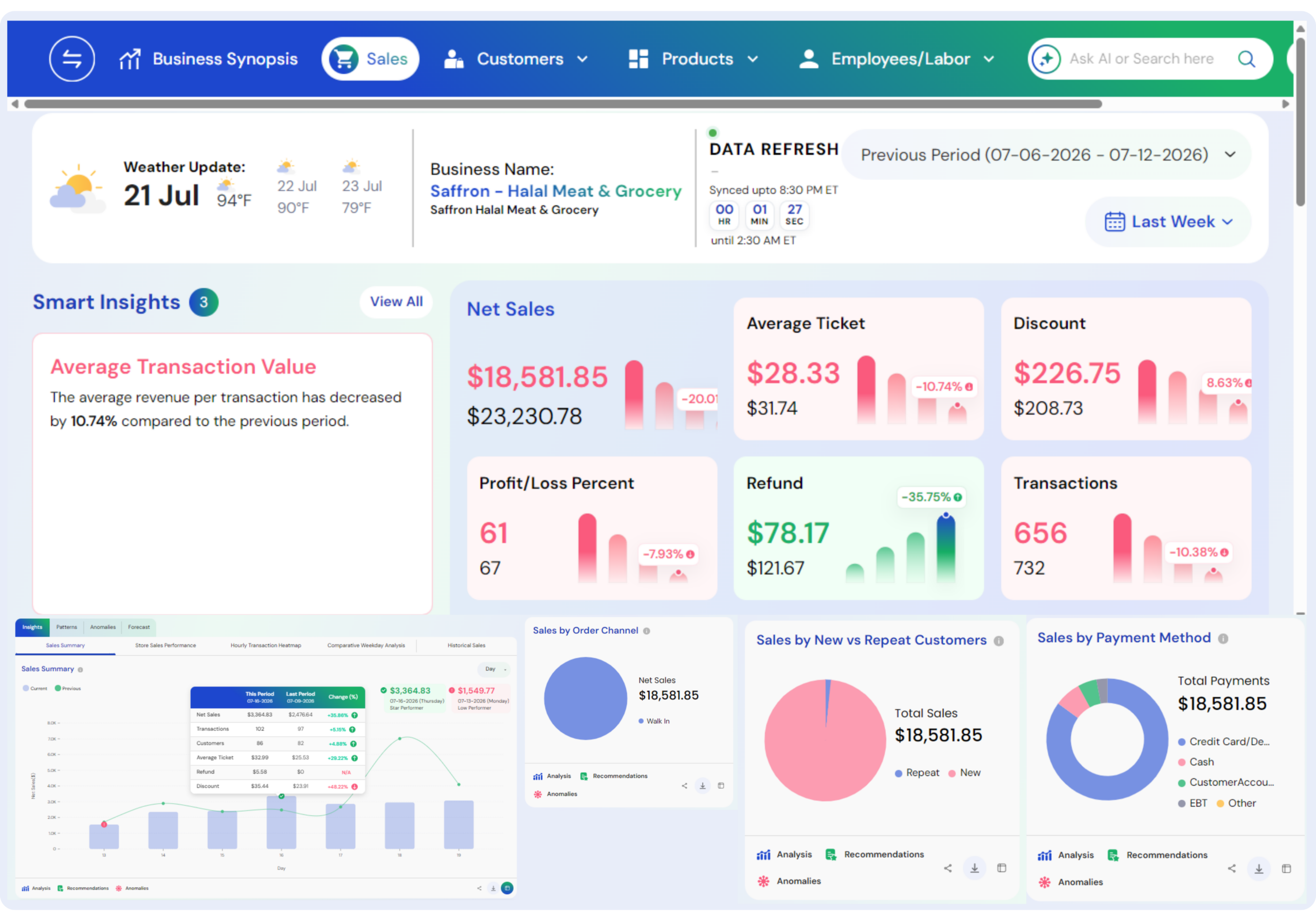
Imagine accessing real-time dashboards that disclose peak hours, best-selling dishes, and waste patterns all in one place. This level of real-time insights helps restaurant businesses to cut costs, improve service, and improve customer loyalty.
So, whether you run a small local eatery or a multi-location chain, embracing restaurant analytics is no longer a luxury – it’s a necessity. It empowers you to make decisions from your own gut feelings to data-backed strategies that boost growth.
Ready to explore how analytics and reporting can revolutionize your restaurant’s decision making? Through this blog we will walk you through the key ways data can help you work smarter and serve better.
Also Read: Benefits of Data-Driven Decision Making
So, Exactly What is Restaurant Analytics and Reporting?
Restaurant analytics and reporting which involves collecting data, analyzing that data, and visualizing data from all areas of aspects of your restaurant’s operations which help business owners and managers to make informed smarter business decisions.
Such tools collect data from various sources which includes your sales transaction, customer feedback, inventory tracking, employee performance, and your marketing efforts.
Now, assume analytics as the “brain” that interprets your customer data which will reveal the ongoing patterns and trends in your restaurant business such as the favorite dishes for your customers, your busiest hours, or how hardworking and efficient does your staff work.
These reporting tools then take these insights and present these insights in clear, visual formats which are very easy to understand like dashboards, charts, and reports that can make you understand and upon complex data easily.
A recent report by the National Restaurant Association shows that 70% of successful restaurants have already integrated analytics in daily operations through which they optimize their menus, manage their staff, manage labor costs, and enhance guest satisfaction.
It is only by using restaurant analytics and reporting that you can By using restaurant analytics and reporting, you can identify opportunities to boost sales, reduce costs, improve customer satisfaction, and smooth operations.
For example, you might discover that a popular dish is frequently out of stock, or that certain shifts require more staff to handle peak demand dishes among the customers.
You can benefit largely by monitoring main performance indicators which includes average ticket size, table turnover, and labor costs which are essential factors for running a profitable restaurant.
Also Read: How Does Data Analytics Help Restaurant Grow
Why Restaurant Analytics Matter?
Functioning in a highly competitive restaurant landscape, just depending on your gut feelings will not help your business to flourish or grab customer attention. Restaurant analytics tools help you to unlock the power of data that helps you to make smarter, faster decisions that improves your efficiency and profitability.
And only by analyzing real-time information from sales, customer behavior, inventory, and staff, you gain clear insights that drive meaningful improvements in your business. Analytics provides restaurant owners and managers powerful tools to gain deep insights into their operations, customer preferences, and market trends.
It helps restaurants to optimize every phase of operations from inventory management to marketing efforts, which helps to create an efficient, customer-centric, profitable business.
Also Read: How Data Analytics Can Help Restaurants to Optimize Menus
Key Benefits of Analytics for Restaurants:

1.Enhanced Customer Understanding and Personalization:
Imagine if you get to look into the customer’s preferences, habits and spending patterns – analytics helps you to just do that. These analyzed data which are collected through your Point of Sale(POS)system and loyalty programs, you get to learn about the most favorite dishes of your customers, your peak hours, and which all promotions connect well with your customers.
Such deeper understanding helps you to customize your menu, marketing, and service which helps to match your customer’s unique taste preferences, building loyalty, and improving repeat visits.
Such insights help your restaurants to do personalized marketing and service delivery. Because restaurants get to target their loyal customers with special promotions on their favorite dishes, or delight them with offers during their preferred dining times.
Also Read: Customer Analytics for Restaurants
2. Optimized Menu Planning and Pricing Strategies:
Restaurant analytics and reporting allows you to rank the performance of each menu item based on its sales volume, profitability, and customer feedback.
Such insights will allow restaurants to keep the likes of their customers first and refine their menu by considering best selling items or discontinuing less popular or less profitable items.
Meanwhile, analytics helps to decide prices for every item based on insights that show how price adjustments will affect customer demand and overall revenue. By implementing dynamic pricing, like offering discounts during slow hours or premium pricing during high-demand hours helps you to achieve maximum profits by considering your customers preferences.
Also Read: Food Menu Ideas for Restaurants
3.Enhanced Operational Efficiency:
Analytics plays a crucial role in optimizing and simplifying your restaurant operations. It is only by assessing sales and customer flow, that restaurants are able to predict their busy and slow hours. It helps them for ideal staffing schedules that eventually reduces labor costs without compromising service quality.
It helps you to manage your inventory effectively because analytics systems provide data regarding the ingredients usage and waste which helps you to avoid any over-stocking or stock outs which helps you to save your expenses and also provide you with fresher menu items.
Nevertheless, real-time analytics will help managers to find any inconsistencies or inefficiencies which will help for taking immediate corrective action.
Also Read: How Livelytics Helps Retailers to Reduce Operational Costs
4.Smarter Marketing Strategies:
Traditional marketing efforts often do broad campaigns which may not effectively target the right audience. Meanwhile, analytics helps restaurants create focused, data-driven marketing strategies which will give you clear, measurable outcomes.
Understanding customer behavior and segmenting customers helps to develop personalized loyalty programs, targeted email campaigns, and social media offers which usually customers can easily connect.
On top of that, analytics also monitors the performance of your marketing efforts which further helps them to get insights about customer engagement and return on investment.
Such feedback loop helps restaurants to improve their marketing approaches consistently which effectively improves your campaigns and smarter budget use.
Also Read: AI for Restaurant Marketing for Maximum Conversion
5. Proactive Decision Making and Trend Adaptation:
The restaurant industry is often influenced by constantly changing customer preferences, new food trends, and seasonal changes. Analytics tools provide you with real-time data and predictive insights which help them to foresee shifts and adapt to the changes quickly.
For example, if data insights show increasing customer demand for plant based options then a restaurant should quickly take action by adding vegan dishes. Such tools help you to identify the most favorite dine time for customers and to make informed decisions on opening hours or special event planning.
6. Financial Performance and Profitability:
Finally, the goal of analytics is to enhance the operations of restaurants. Only by combining insights regarding customer behavior, menu performance, operations, and marketing, can restaurants find possibilities to increase revenue and reduce their expenses.
Deciding prices on the basis of analytics driven data helps you to be competitive yet profitable menu pricing. While identifying inefficiencies or waste through data analytics helps you to save your expenses.
Also Read: How AI Helps in Boosting Restaurant Revenue and Profits
Key Sources in Restaurant Analysis:
For making the most of analytics, it’s important to collect data from the right sources:
1. Point-of-Sale(POS)Systems:
It involves collecting sales data like order details, customer transaction amounts, customer’s mode of payments, discounts applied, and more.
Also Read: Types of POS Systems for Restaurants
2. Customer Feedback:
It involves collecting insights which are gathered from online reviews, surveys, social media, and customer feedback which helps you to understand whether the customers are happy with the dishes served or services provided and spot key areas to improve.
Also Read: Boosting Brand Loyalty With Customer Sentiment Analysis
3. Inventory Management Systems:
By tracking stock levels, supplier deliveries, and waste, you can better control costs and ensure your restaurant always has the supplies it needs.
Also Read: AI for Restaurant Inventory
4. Staff Scheduling Software:
By using data on labor hours, shift patterns, and productivity enables you to optimize workforce management, ensuring the right staff are scheduled at the right time.
5. Marketing Platforms:
By analyzing email campaigns, loyalty programs, and social media data, you get to identify which promotions truly drive customer engagement and boost customer retention.
Also Read: Choosing the Right AI Data Platform for Business
How to Implement Restaurant Analytics?

Implementing restaurant analytics becomes effective only with a structured approach. Below are five important steps to successfully integrate analytics into your business.
1.Define Clear Objectives and Key Metrics:
Before collecting data, it’s important to set specific goals. Some of the common objectives are increasing sales, improving customer retention, managing inventory, or improving staff efficiency.
Clear goals help you to concentrate on the most relevant data. Identify key performance indicators (KPIs) that align clearly with such objectives. For example:
- Sales Growth: Track key metrics like average check size, revenue per guest, and best-selling dishes to understand performance and make informed decisions.
- Customer loyalty: Track key metrics like visit frequency and how frequently they redeem promotions which helps to measure customer engagement and campaign success.
- Operational efficiency: Track some of the key metrics like labor costs, table turnover rates, and inventory waste to improve efficiency and increase overall restaurant profitability.
Also Read: How Livelytics Help Retailers Reduce Operational Costs
2. Choose the Right Technology and Data Sources:
Most modern Point of Sale (POS) systems include basic analytics capabilities. So it is important on the basis of your needs to consider advanced analytics platforms that integrate data from different sources like POS transactions, customer loyalty programs, and more.
It is only by selecting user-friendly software with real-time reporting and strong integration abilities helps to smooth data collection and analysis, providing a detailed view of your restaurant’s performance.
Also Read: Artificial Intelligence Vs Machine Learning
3.Collect Clean and Consistent Data:
Accurate analytics mostly depend on high-quality data. Make sure that your POS and other systems are well configured to capture detailed, consistent and error-free information.
So you must train your staff to work on proper data entry procedures, which includes item naming and accurate modifiers which will help you to avoid data inconsistencies.
Also Read: Business Intelligence Dashboard for Data Collection
4. Analyze Data and Generate Actionable Insights:
Data is not useful if not interpreted accurately. Utilize analytics tools to visualize trends and identify the patterns in sales, customer behavior, and operations. Search for insights which help to find peak dining times, menu item performance, and customer preferences.
So, convert these insights into actionable strategies which include staffing schedules due to busy hours, promote favorite dishes, or launch targeted marketing campaigns for specific customer segments.
Also Read: How AI Unlocks Business Insights the Drive Required Results
5. Develop a Data-driven Culture and Train Your Team:
For successful implementation of analytics, it is important that everyone in your organization, which spans from management to front line staff, understands its value and supports its implementation.
You must promote regular discussions around analytics insights and recognize team successes that are the outcome of data-driven improvements.
Integrating Analytics Across Systems:
Integrating analytics with other systems helps you to unlock the full potential of their data. It is only by combining information for Point of Sale(POS) with other systems like Customer Relationship Management(CRM), inventory, and marketing platform helps you to create a detailed view of your business, which enables you to make smarter decisions and smooth operations.
1.POS and CRM Integration:
Integrating your POS with CRM systems combines customer purchase history, customer preferences, and loyalty program data. Such unified data allows you to do highly personalized marketing, targeted promotions, and improved customer engagement.
Because by understanding individual customer behaviors you get to customize offers which help you to improve customer retention and increase their lifetime value.
2.Inventory and Supply Chain Management:
By integrating analytics with inventory and supplier management systems helps you to track stocks in real time, their usage rates, and supplier performance.
It eventually helps restaurants to reduce waste, avoid stockouts and optimize ordering processes, which saves money and ensures menu consistency. Analytics helps to predict customer data based on your sales history, inventory orders and more.
Also Read: What is Business Intelligence for Supply Chain Optimization
3.Marketing Automation:
Integrating analytics with marketing platforms helps you to do data-driven campaigns which are based on customer responses.
Automated email, SMS, and social media marketing activated by customer behavior and preferences identified through analytics. Such integration will maximize the return of Investment by delivering timely, relevant messages which will increase sales.
Emerging Trends in Restaurant Analytics and Reporting for 2025:
The restaurant industry is rapidly changing, with analytics and reporting playing an important role in taking better business decisions. Below are some trends shaping 2025:
1. AI-Driven Predictive Analytics:
More restaurants are depending on AI tools like livelytics to predict customer demand, optimize inventory, and customize marketing efforts for taking proactive decision making rather than reactive responses.
Also Read: How Predictive Intelligence Transforms Retail
2.Real-Time Cloud-Based Dashboards:
With Cloud-Based Dashboards, managers get instant access to view sales, inventory, and customer data from anywhere which allows quick operations and adjustments during busy hours.
Also Read: Real-Time Analytics Why Does Your Business Needs it
3.Omnichannel Data Integration:
As customers are constantly on a move between dine-in, delivery, and digital ordering, combining data from all channels helps you to get a complete view which supports personalized experiences and smooth consistent service.
4.Voice-Activated Analytics:
Voice Assistants and natural processing allows you to get hands-free access to reports and insights, while making data interaction easier and more efficient for restaurant owners.
Conclusion:
In today’s fast evolving and competitive restaurant industry, restaurant analytics and reporting have become necessary tools for making informed strategic decisions.
By transforming raw data into clear insights, restaurants get to know about their customer preferences, optimize the menu, manage inventory, and streamline your operations more than ever.
These data-driven decisions not just improve your profits but also improve the overall dining experience, establishing greater customer loyalty and satisfaction.
Restaurant analytics empowers your businesses to identify trends, predict customer demand, and personalize marketing efforts, which helps them to adapt quickly to changing market conditions.
Integrated reporting systems like Livelytics sheds light upon real-time key performance indicators which helps managers to react quickly to operational challenges and make the most of new opportunities.
On top of that, AI and predictive analytics are further enhancing the analytics which helps restaurants to understand customer needs and optimize resources proactively.
Ultimately the restaurant businesses that are successful today embrace analytics as a core of their business strategy using data to not just track performance but also drive continuous improvement.
So, using the power of analytics and reporting is not just a luxury – it’s essential for flourishing in such a modern competitive dining landscape.
If you still have any query about how restaurant analytics and reporting drive better business decisions, feel free to reach us at livelytics expertise and we are more than happy to assist you.