You are opening 1 location. 2 locations. 5 locations. 10 locations. It all looks good on paper.
- More locations.
- More teams.
- More customers.
- More revenue.
- More Profits
However, it also comes with increased management, responsibilities, accountability, and data.
All of it becomes overwhelming.
- The CEO sees one revenue number.
- The operations team sees another.
- Regional managers rely on spreadsheets pulled at different times.
- And leadership meetings turn into debates over whose data is correct instead of deciding on the next course of action.
This is where multi-location growth often stalls. The real challenge isn’t managing more locations; it’s managing one source of truth across all of them.
This is why unified data becomes a non-negotiable foundation for sustainable multi-location growth.
In this blog, we’ll explore why multi-location growth fails without unified data, the hidden risks decision-makers often underestimate, and how modern AI-driven data platforms are changing the way growing businesses stay in control without slowing down expansion.
According to research, 69% of companies say poor data limits their ability to make informed decisions, largely because fragmented and unstructured data makes it impossible to get a unified view across systems.
Also Read: Customer Sentiment Analysis for Multi-location Business
What is Unified Data, Exactly in Multi-Location Businesses?
Unified data in a multi-location business simply means this:
All your business data, from every location, system, and team, flows into one consistent, connected view that leaders can trust.
Instead of each location operating with its own reports, tools, and numbers, unified data brings everything together so the business sees one reality, not many versions of it.
In practical terms, unified data connects sales, inventory, operations, customer behavior, staffing, and financial data across all locations into a single framework.
For multi-location businesses, this matters because growth multiplies complexity.
The result isn’t just cleaner dashboards, it’s faster, more confident decision-making. Leaders can spot trends across locations, identify underperforming units early, replicate what’s working, and scale with clarity instead of guesswork.
Also Read: Two Way Data Analytics In Shaping Retail Business
Why Multi-Location Growth Fails without Unified Data & How to Solve it?

1. Costs Rise Quietly While Revenue Looks Fine
Have you ever looked at your numbers and thought, Revenue is growing… so why do margins feel tighter?
This is a common reality in multi-location businesses.
One location over-orders inventory just to be safe, another runs short and rushes last-minute purchases, and a third carries excess staff during low-demand hours.
On their own, these decisions seem reasonable. Across locations, they quietly add up to higher costs and hidden waste without showing up clearly in top-line reports.
How unified data changes this: When data is unified, cost patterns become visible across locations. Leaders can immediately see where waste is creeping in, which locations are out of sync with demand, and where efficiency can be improved, before margins take a hit.
Also Read: The Blind Spot Costing Your Business More than Your Think
2. Decisions Take Longer Than They Should
Does every major decision require one more report or one more clarification?
As the business grows, decisions that once took hours start taking weeks. Teams debate whose numbers are correct, leaders hesitate to act, and opportunities slip by while data is being validated.
The business isn’t short on information; it’s short on aligned information.
How unified data changes this: With one trusted view across all locations, decisions move faster. Leaders spend less time verifying data and more time acting on it. The conversation shifts from Are these numbers right? to What’s the smartest next move?
How Starbucks Streamlined 35k+ Stores Globally with Unified Data?
Starbucks unified data from in-store purchases across 35k+ stores, mobile apps, loyalty programs, inventory systems, and external signals into a centralized data platform. AI and ML models were then applied to this unified data to improve demand forecasting, inventory planning, personalization, and store-level decision-making.
Results:
- 8× more frequent inventory counts, improving product availability
- Reduced stockouts and waste, especially for high-volume items
- Higher customer engagement through AI-driven personalized offers
- Faster decision-making across thousands of locations using real-time insights
Also Read: Benefits of Data-Driven Decision Making
3. High-Performing and Underperforming Locations Look the Same on Paper
Do all your locations appear average in reports, even though you know some are clearly doing better than others?
When data isn’t unified, strong locations often mask weak ones. Performance gaps stay hidden because metrics aren’t standardized, comparisons aren’t fair, and insights arrive too late.
Leadership senses inconsistency but lacks the clarity to act early.
How unified data helps: Unified data standardizes performance metrics across locations. Leaders can instantly see which locations are outperforming, which need attention, and what best practices should be scaled, turning location-level insights into enterprise-wide improvements.
Also Read: Customer Sentiment Analysis for Multi-Location Business
4. Customer Experience Becomes Inconsistent Across Locations
Do customers have a great experience at one location and a forgettable one at another, even though the brand is the same?
When data lives in silos, customer insights stay local.
One location understands buying behavior and preferences, while another operates blindly. Promotions work in some places but fail in others, and leadership can’t clearly see why.
Over time, this inconsistency weakens brand trust and makes growth harder to sustain.
How unified data helps: Unified data connects customer behavior, sales, and feedback across all locations. Leaders can see what customers respond to, where experience gaps exist, and how to deliver consistency, so the brand feels familiar and reliable, no matter the location.
Also Read: How AI Revolutionizes Customer Experience in the Restaurant Industry
5. Further Expansion Starts Feeling Risky Instead of Strategic
Do you find yourself hesitating before opening the next location, even when demand clearly exists?
As businesses grow, leaders want expansion to feel like a calculated, confident step. But without unified data, it often feels like a risk.
Performance looks good in some locations, unclear in others, and it’s hard to tell which success factors are actually repeatable. Important signals, true profitability, operational readiness, and market consistency get buried in disconnected reports.
Over time, expansion decisions slow down, not because growth isn’t possible, but because confidence is missing.
How unified data helps: Unified data gives leadership a complete, comparable view of performance across locations. It highlights which markets are working, what’s driving success, and where risks exist, so expansion becomes a strategic move backed by evidence, not intuition.
Also Read: Retail Pricing Strategy
6. Profits Decline Even While Revenue Continues to Grow
Have you ever looked at your numbers and thought, We’re growing, so why do margins feel tighter?
This is a common challenge in multi-location businesses without unified data.
Small inefficiencies creep in quietly, excess inventory here, uneven staffing there, rising operational costs that don’t stand out in isolation.
Each issue seems manageable on its own, but together they slowly erode profitability, often without triggering immediate alarms.
How unified data helps: Unified data connects revenue, costs, and operational metrics across all locations. It makes margin leaks visible early, helps leaders understand where profits are being lost, and enables timely corrective action before financial pressure builds.
Also Read: How AI Helps Boosting Restaurant Revenues and Profits
7. Marketing Results Feel Inconsistent and Hard to Explain
Do marketing campaigns work well in some locations but barely move the needle in others?
When customer, sales, and campaign data aren’t unified, marketing decisions are made on partial insight.
Campaigns are rolled out broadly, budgets are spread thin, and leadership struggles to understand what’s actually influencing customer behavior at the local level.
The result is wasted spending and unpredictable outcomes.
How unified data helps: Unified data ties marketing performance directly to customer behavior and sales across locations. Leaders can see which campaigns work, where they work best, and why, allowing marketing efforts to be optimized, localized, and scaled with confidence.
Also Read: AI For Restaurant Marketing
8. Daily Operations Become Harder to Control at Scale
Do day-to-day issues start popping up more often as you add locations, despite having experienced teams in place?
Without unified data, operational visibility breaks down as the business grows. Leaders don’t see issues until they escalate, miss demand spikes, staffing mismatches, and delayed responses to operational bottlenecks.
Each location may be managing fine on its own, but at the enterprise level, control slowly slips.
How unified data helps: Unified data gives leadership real-time visibility into operations across all locations. It helps spot operational issues early, align teams around the same priorities, and maintain control as complexity increases without micromanaging every location.
Also Read: Blind Spots Costing Your Business More Than you Think
9. Forecasting Feels More Like Guesswork Than Planning
Do forecasts become harder to trust as you add more locations?
In multi-location businesses without unified data, forecasting often relies on incomplete or uneven inputs.
One location’s trends can skew projections, seasonal demand gets misread, and regional differences are missed entirely. Leaders plan based on averages, not reality, which leads to overstocking in some locations, missed demand in others, and constant course-corrections throughout the year.
How unified data helps: Unified data brings together historical trends, real-time performance, and location-level patterns into one view. Forecasts become grounded in what’s actually happening across the business, not just what’s easiest to measure, making planning more reliable, responsive, and confident.
How Walmart Achieved30% Reduction in Out-of-Stock Items with Unified Data Across 10k+ Stores?
Walmart unified data from its 10k+ stores, supply chain systems, online orders, inventory, and customer behavior into a centralized data platform. AI and machine learning models were applied to this unified data to improve demand forecasting, inventory replenishment, and operational planning across locations.
Results in numbers:
- Up to 30% reduction in out-of-stock items in key categories
- Improved inventory turnover, reducing excess stock across stores
- Faster replenishment cycles, helping stores respond better to local demand
- More accurate forecasting across thousands of locations using real-time data
Also Read: How Restaurant Can Predict Trends With Analytics
10 You Lose Edge to Your Competitors & Miss Opportunities
Have you ever looked back and thought, We should have acted on this earlier? In multi-location businesses without unified data, opportunities often appear as small signals scattered across locations, slightly higher demand in one region, improving customer behavior in another, or a product gaining quiet traction. When data stays siloed, these signals don’t connect.
Leadership only sees the full picture once the opportunity is already obvious or already taken by a competitor.
How unified data helps: Unified data connects insights across all locations and surfaces patterns early. It helps leaders recognize momentum while it’s still emerging, evaluate opportunities with confidence, and act before growth windows close, turning insight into timely action instead of hindsight.
Also Read: Customer Analytics in Retail
How the Right AI Tools Simplify Unified Data and Multi-Location Management?

Adding more locations shouldn’t mean adding more chaos. But for most growing businesses, that’s exactly what happens, until they bring in the right technology.
Modern AI-driven data platforms are built specifically to solve the unified data problem. They don’t just collect information; they connect it, standardize it, and make it accessible in real time across every location, system, and team.
Here’s how the right AI tools change the game for multi-location businesses:
1. They Unify Data Automatically, Without Manual Work
Think about how much time your team currently spends pulling reports from different systems, cleaning up inconsistencies, and trying to make everything match up.
AI-powered platforms handle all of that automatically. They connect to your POS systems, inventory tools, staffing platforms, CRM, and financials, then unify everything into one consistent view without anyone lifting a finger. What used to take your team days or even weeks now happens continuously in the background.
Businesses that automate data integration reduce reporting time by up to 80%, freeing teams to focus on strategy instead of spreadsheets.
Also Read: Data Mining Vs Data Science
2. They Enable Automated Reporting Across All Locations
Remember the last time you needed a performance report and had to wait for someone to manually compile it?
AI tools eliminate that wait entirely. They generate automated reports that are consistent, timely, and customized for whoever needs them. Your operations team gets operational metrics, finance sees margin analysis, and regional managers receive location-specific insights, all delivered on schedule and always up to date.
No more chasing people for numbers. No more version control nightmares. Just reliable reports, exactly when you need them.
Also Read: How Restaurant Analytics Drive Better Results
3. They Deliver ML-Powered, Data-Backed Recommendations
Here’s where AI gets really powerful: it doesn’t just show you what happened, it tells you what to do next.
Machine learning algorithms analyze patterns across all your locations, customer behavior, sales trends, inventory movement, and staffing efficiency, then generate specific, actionable recommendations.
- Should you adjust pricing at certain locations?
- Which products should you promote in which regions?
- Where do staffing levels need optimization?
These aren’t vague suggestions. They’re specific actions based on what’s actually working across your business right now.
Also Read: How Do Machine Learning and Artificial Intelligence Help Businesses
4. They Surface Hidden Insights and Emerging Patterns
You know that feeling when you look back and think, We should have caught this earlier?
AI prevents that. It continuously analyzes data to spot things you’d never catch manually,
- a product quietly gaining traction in three locations,
- staffing inefficiencies showing up only during specific shifts,
- And customer behavior is shifting in ways that aren’t obvious
Leaders get proactive alerts about what’s working and what needs attention, not months-old insights from quarterly reviews.
Also Read: AI to Collect Customer Insights
5. They Provide Real-Time Performance Alerts and Anomaly Detection
Imagine knowing about a problem the day it starts, not weeks later when it’s already cost you thousands.
AI platforms monitor everything continuously across all locations.
- Revenue dips unexpectedly?
- Inventory hitting critical levels?
- Customer complaints spiking in a specific region?
You get an alert immediately.
Businesses using real-time anomaly detection report catching issues 60-70% faster than traditional monthly review cycles. That’s the difference between a quick fix and a costly problem.
Also Read: Real-Time Analytics Why Does Your Business Needs it
6. They Make Forecasting Accurate and Adaptive
Let’s be honest: most forecasting feels like educated guessing, especially when you’re managing multiple locations with different patterns.
AI changes that completely. It learns from your historical performance, seasonal patterns, and real-time signals to generate forecasts that actually reflect what’s happening in each market. And as conditions change, demand spikes, supply shifts, and customer preferences evolve, AI adapts automatically.
Companies using AI-powered forecasting report 20-30% improvements in forecast accuracy, which translates directly into better inventory planning, smarter staffing decisions, and fewer costly surprises.
Also Read: AI For Retail Inventory Management
7. They Standardize Performance Tracking Across All Locations
Ever tried comparing locations when everyone tracks things slightly differently?
AI platforms solve this by creating standardized dashboards that measure every location against the same benchmarks.
You can instantly see
- who’s crushing it,
- who’s struggling,
- and most importantly, what your top performers are doing differently.
That last part is gold. When you can clearly see why Location A outperforms Location B, you can replicate those practices across your entire business. One retail chain did exactly this and increased underperforming locations’ revenue by an average of 18% within six months.
Also Read: How to Setup Key Performance Indicators
8. They Scale Effortlessly as You Grow
Here’s the best part: AI platforms grow with you.
Whether you’re managing 5 locations or 50, the system adapts. Add a new location, and it automatically connects to your unified view. No need to hire more analysts, build new reporting structures, or overhaul your tech stack.
You maintain complete visibility and control without the complexity multiplying every time you expand.
Discover Livelytics: Your AI-Powered Data Intelligence Platform
If you’re managing multiple locations and struggling with fragmented data, scattered reports, and unclear insights, Livelytics is built specifically for businesses like yours.
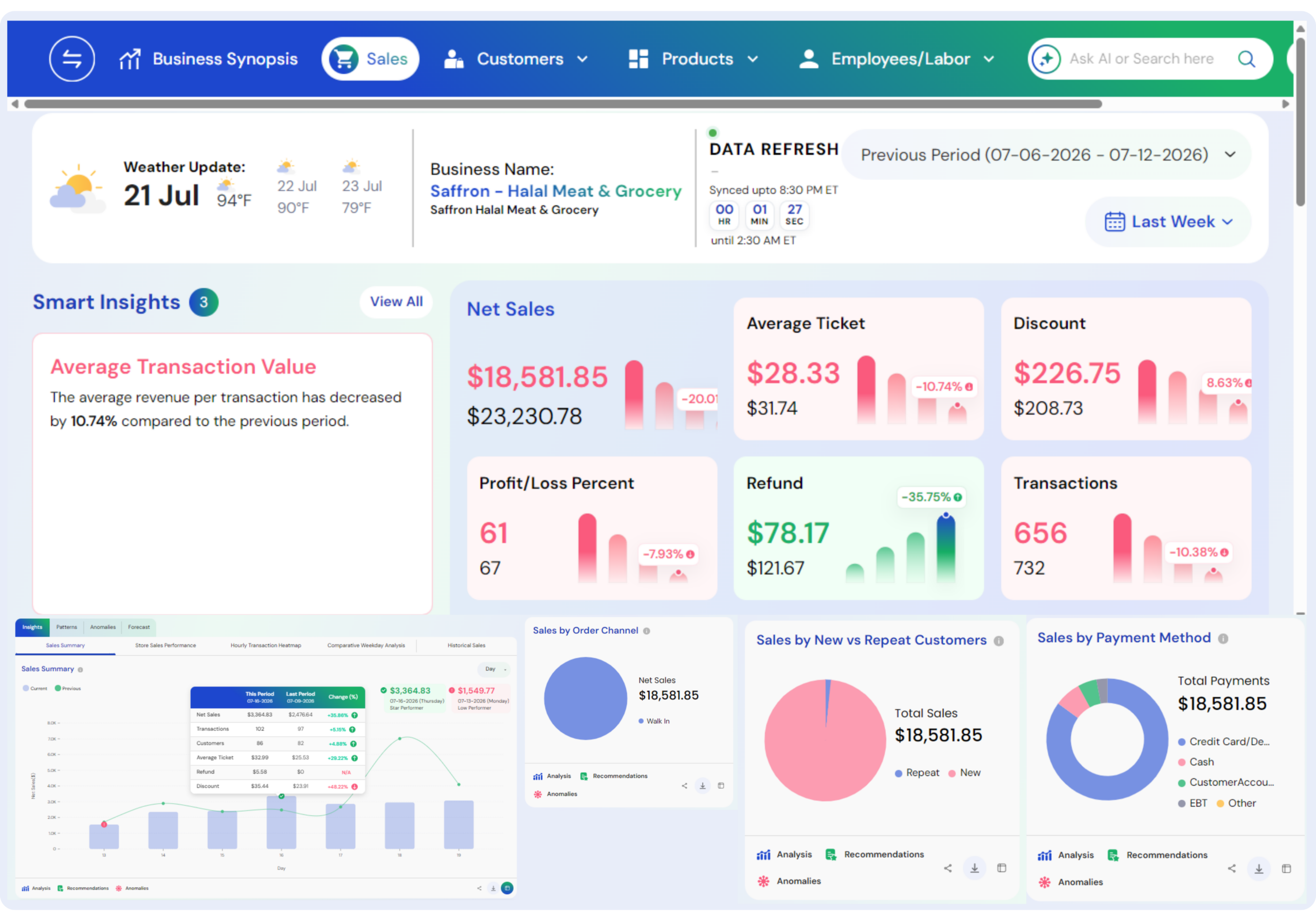
Livelytics is an AI-powered data intelligence platform designed to unify your multi-location data and transform it into actionable intelligence, so you can manage your multi-location business with ease.
- Connects with 650+ tools effortlessly, so data from every location, sales, inventory, operations, marketing, and finance, flows into one place without manual work
- Automatically organizes and categorizes data, so every location follows the same structure and metrics, making comparisons fair and meaningful
- Turns complex data into clear visuals, helping leaders instantly understand what’s working, what’s not, and where attention is needed
- Delivers automated reports, so you always have up-to-date insights without waiting on teams or chasing spreadsheets
- Sends automated alerts when something needs attention—rising costs, unusual drops, or operational red flags—before they become bigger issues
- Offers ML-powered recommendations, guiding leaders toward the next best action instead of leaving them to interpret raw numbers
- Includes LIV AI, an AI-powered assistant that lets you ask questions in simple language and get clear, contextual answers across all locations
What makes Livelytics especially helpful is its ease of adoption. You don’t need long implementation cycles or heavy technical effort; setup is simple, support is available 24/7, and the platform scales naturally as your business grows.
Pricing stays affordable, you can try it through a free demo, cancel anytime, and there are no long-term commitments.
Final Thoughts
Unified data isn’t just a nice-to-have for growing businesses.
- It’s the foundation that makes everything else possible.
- It’s what turns expansion from a risky bet into a confident, strategic move.
- It’s what helps you replicate success instead of hoping it happens again.
- And it’s what keeps you in control as complexity increases.
The good news? You don’t need a massive tech overhaul or a team of data scientists to get there. Modern AI-powered platforms have made unified data accessible, affordable, and genuinely easy to implement. The tools exist. You just need to choose the right one.
And, if you are looking for one such tool and would like to see what unified data actually looks like for your business? Book a free Livelytics demo, no commitments, just a clear look at how AI-powered data intelligence can change the way you grow.