Restaurants and retail businesses are entering a phase, where faster, more accurate, and more adaptable decisions directly impact profitability and the customer experience.
In an environment of thin margins, shifting demand, labor shortages, rising food and unpredictable consumer behavior, businesses can’t depend on instincts or traditional reporting alone.
This is where Restaurant & Retail Decision Intelligence is changing the way operators plan, execute, and optimize their everyday business operations.
Unlike traditional business intelligence(BI), decision intelligence combines real-time data, AI-powered analytics, predictive forecasting, and prescriptive insights which helps managers to take faster and smarter actions.
Static dashboards only summarize about yesterday but decision intelligence platforms let you know about what is happening now, why it is happening, and what action should be taken next.
This allows managers to make smarter decisions across labor optimization, inventory management, sales performance, pricing, and customer experience in fast-moving operational environments.
For multi-location restaurant chains and retail brands, decision intelligence delivers true multi-unit visibility. By delivering clear, prioritized insights in real time, decision intelligence helps managers take confident action immediately by adjusting staffing, inventory or promotions before issues escalate and customer experience worsens.
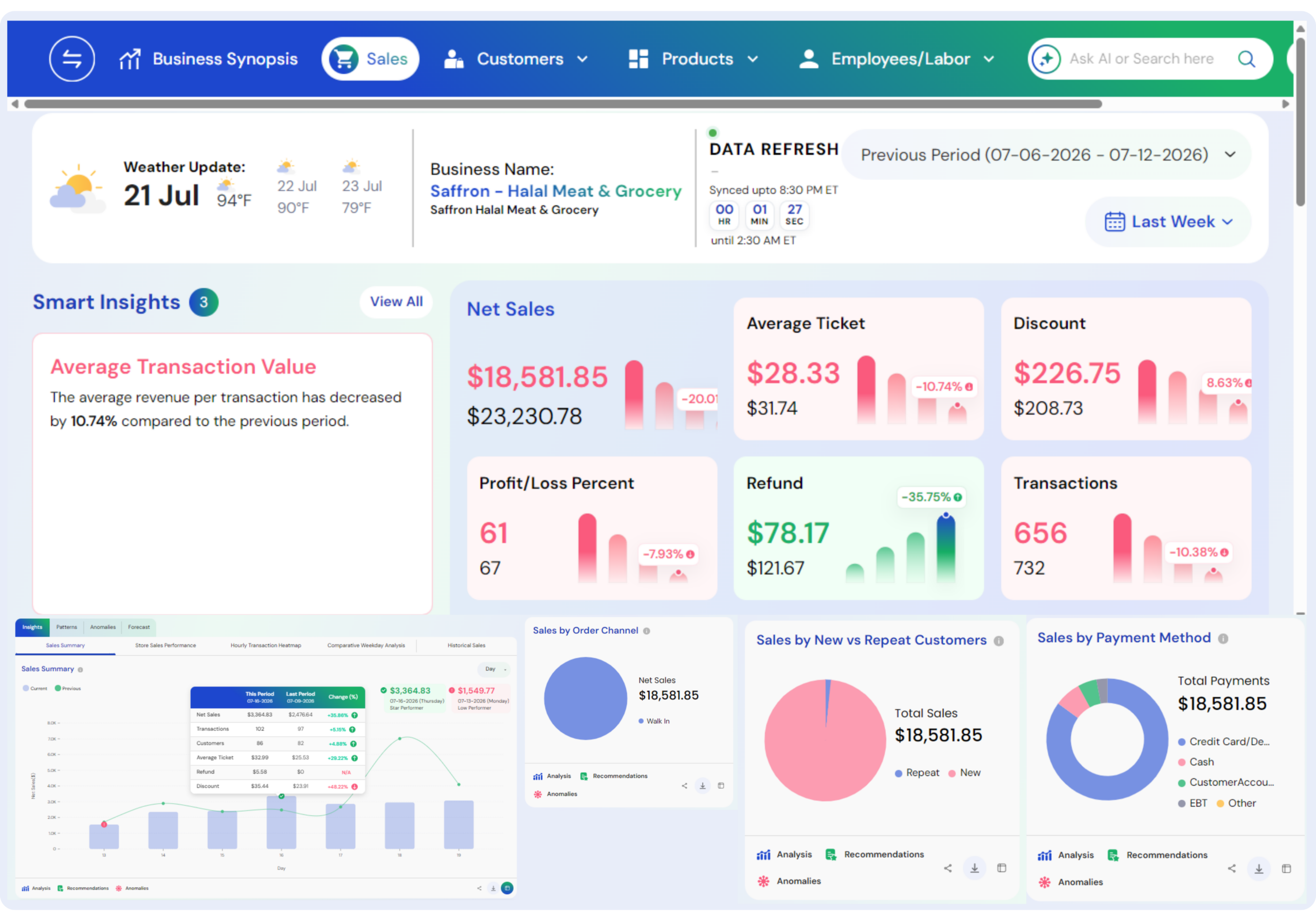
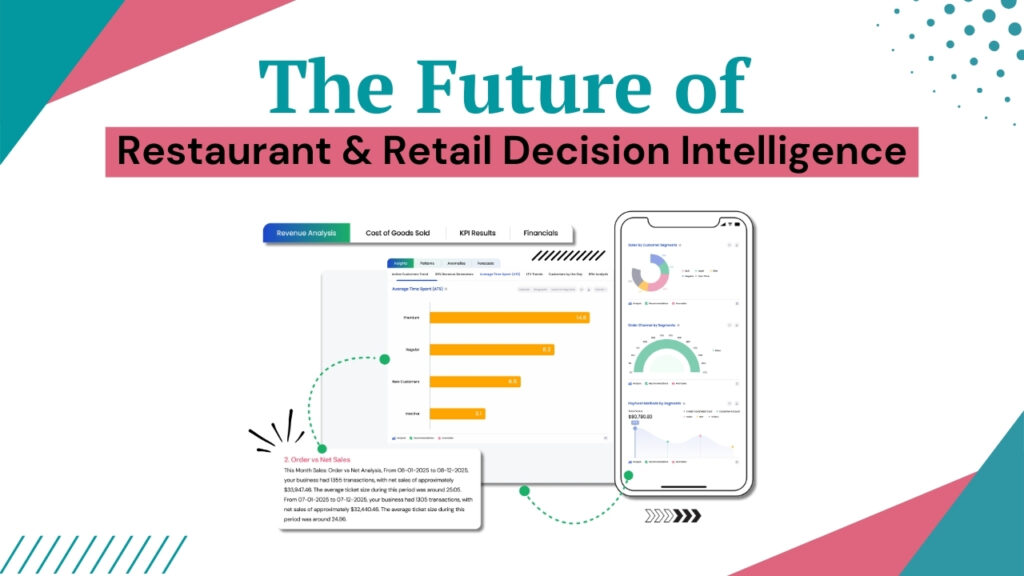
Platforms like Livelytics define the next generation of AI decision intelligence for restaurants and retail operations. By transforming complex operational data into clear, prioritized, and actionable recommendations, Livelytics helps teams from being reactive to proactive leadership.
As competition becomes more intense and customer expectations rise, decision intelligence is not an optional tool rather it is becoming the foundation for sustainable growth, and better customer experiences.
Also Read: Predictive Analytics in Restaurants a Game Changer
Why Restaurants and Retailers Can No Longer Rely on Traditional BI
For years, business intelligence(BI) systems have been considered as the foundation of operational reporting for restaurants and retail brands. Sales dashboards, weekly summaries, and monthly performance reports help leaders to track revenue, costs, and past trends.
But today, restaurant and retail stores do not function in stable and predictable environments. Because demands change every hour, labor availability changes daily, and other weather, local events, promotions can instantly impact performance.
In this high-speed reality, traditional Business Intelligence is often too slow and too backward-looking to support real-time decisions leaving operators reacting after problems already affect service, sales, and margins.
Also Read: Why Business Intelligence Needs to Think Not Just Show
The Limits of Historical Reporting
Traditional BI tools focus on explaining past performance and not the present. It answers questions like last week’s revenue , last month’s top-performing store, or yesterday’s labor costs.
Even though these insights are useful for accounting, leadership reviews, and long-term planning but are rarely useful when managers have to make instant decisions.
Operating in fast-changing environments, restaurants and retailers experience performances changing within minutes due to weather, foot traffic, staffing gaps, or sudden demand spikes.
So a restaurant manager controlling busy dinner hours unexpectedly cannot wait for the next day’s report to decide whether they require more staff or adjust preparation.
Likely, a retail store experiencing a stockout needs real-time visibility and not a summary after sales are already lost.
Also Read: How AI Unlocks Business Insights That Drive Required Results
Information Overload Without Direction
Another major weakness of traditional BI is information overload without direction. Most dashboards show plenty of charts and KPIs, but they rarely make it obvious what deserves a manager’s attention right now.
In restaurants and retail, with leaders already struggling with staffing, customer needs, inventory checks, and service quality, it’s unrealistic especially during busy hours to expect them to scan through dashboards, interpret trends, diagnose causes, and decide on the best response.
As a result, teams or managers usually react late because by the time they observe a sales drop, labor spike, or inventory shortage, the shift may already be over and they cannot fix the issue as the time has already passed.
If the managers find dashboards to be complex and unclear then the managers may depend back on instincts and past habits which will lead to inconsistent action from one location to another.
For instance two stores can face the same problem but each store may respond to the problem in different ways which will lead to inconsistent customer experiences and unpredictable performance.
Decision intelligence is different from traditional BI because these systems prioritize the most important signals explaining the factors that drive the change, and recommending clear next steps by turning raw data into faster and more consistent action.
Also Read: Improved Decisions Through Decision Intelligence
What Is Decision Intelligence in Restaurants and Retail?
Decision intelligence is redefining analytics for restaurants and retail, by moving past historical reporting and offering active, real-time guidance which helps managers to make better operational decisions.
Its core purpose is to help teams decide faster and smarter by continuously analyzing data and turning insights into clear, actionable recommendations.
In restaurants and retail, where demand and operations shift hour by hour, static dashboards aren’t enough, decision intelligence combines several capabilities teams need into a single, practical approach.
First, these systems use real-time data about sales, labor activity, inventory levels, and promotions to offer insights which helps managers to have an accurate understanding of what is happening now, not hours or days later.
In the fast-moving retail and restaurant sector, live visibility into sales, labor, inventory, is critical because even small information delays can quickly turn into missed sales and worse customer experiences.
Second, decision intelligence uses AI pattern recognition to define what normal performance looks like by location, time period, and business context.
Since fluctuations are normal in restaurants and retail due to daypart, seasonality, and local factors. AI learns expected patterns and warns only meaningful deviations so teams focus on what truly needs attention.
Third, predictive forecasting allows decision intelligence to look ahead. It combines historical trends with current conditions like weather, foot traffic to predict demand, staffing news, and inventory usage.
This helps managers to prepare for busy hours, prevent inventory stockouts, and optimize labor before problems rise.
Finally, decision intelligence offers prescriptive recommendations so managers don’t just let them see dashboards, rather they also receive specific actions like adjusting staffing, restocking inventory, or modifying promotions.
With data-driven, context-aware guidance, teams can respond quickly and consistently across shifts and locations.
This shift changes how operators view data, transforming it into a real-time decision engine which guides teams and managers from just awareness into taking actions with speed and convenience.
Platforms like Livelytics translate complex analytics into clear, prioritized guidance that helps teams make better decisions every hour, every day.
Also Read: Decision Intelligence Vs Business Intelligence
The Role of Real-Time Data in Decision Intelligence
Real-time data is the foundation of modern decision intelligence in restaurant and retail operations.
Every day, restaurants and retailers generate huge amounts of operational data from POS transactions, labor schedules, inventory movements, promotions,customer visits, and ordering patterns.
And when this data is integrated and analyzed continuously, then it creates a live, accurate view of what is happening across the business at any given moment.
Decision intelligence platforms consume this data in real time, removing the delays caused by batch reporting or end-of-day summaries.
Managers and leaders do not have to wait for yesterday’s reports instead will get instant visibility into sales trends, labor efficiency, and inventory levels across all locations.
This shared, real-time view ensures that everyone from store managers to regional leaders operates with the same source of data.
In restaurant and retail operations, speed matters because even a 30-minute delay in identifying a demand rise can lead to long waits which may frustrate customers who may never return.
Real-time data also enables managers to take smarter prioritization by allowing decision intelligence to detect and respond to meaningful changes as they unfold, instead showing up in reports.
Managers can spot sales slowing in one location while accelerating sales in another location, and see labor costs rising faster than demand , or detect inventory levels dropping faster than expected.
This helps teams to respond instantly by adding staff, shifting inventory, changing promotions before problems increase, and protecting services, sales, and margins in real time.
Most importantly, real-time intelligence turns raw data into action in real-time when these insights matter most rather than hours or days later.
In contrast, real-time decision intelligence delivers timely, actionable insights linked directly to decisions that protect revenue, elevate customer experience, and maintain operational efficiency.
Also Read: Real-Time Analytics Why Does Your Business Needs it
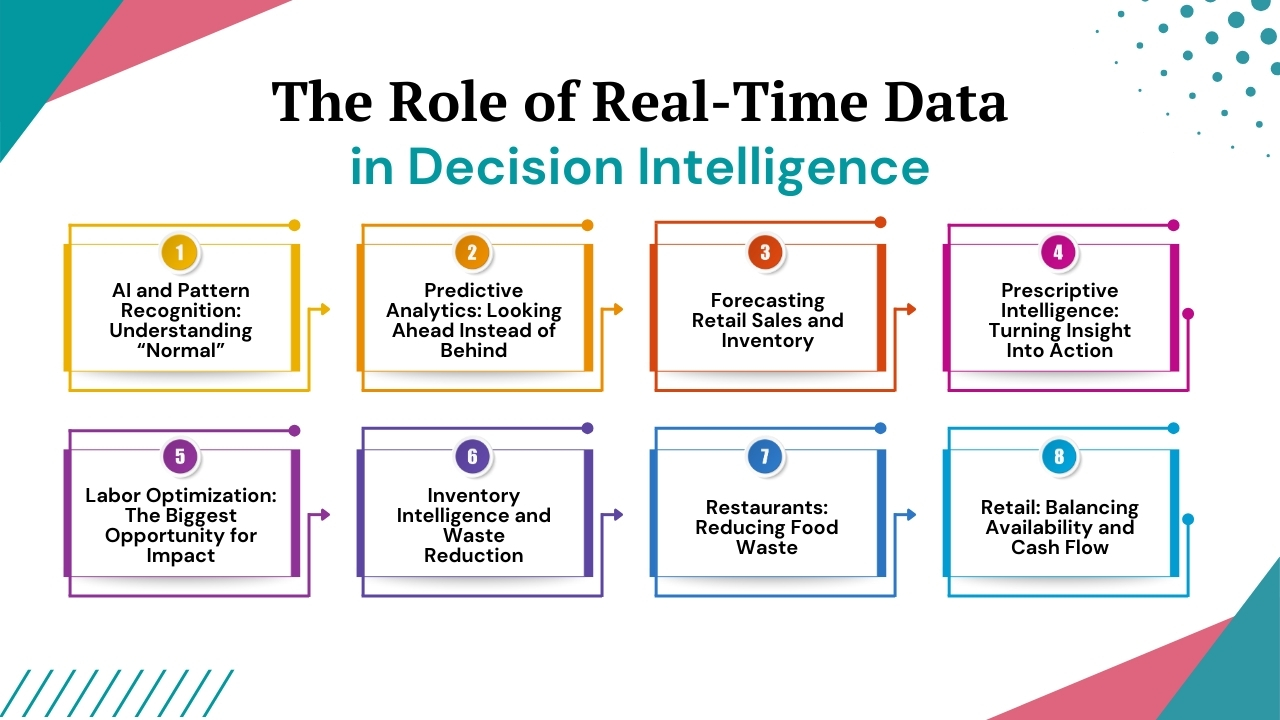
1. AI and Pattern Recognition: Understanding “Normal”
One of the most significant advances in decision intelligence is AI-powered pattern recognition, which allows systems to understand what “normal” performance looks like before flagging an issue.
Restaurants and retail stores face constant variations in demand. Monday demand differs from Friday, lunch patterns differ from dinner patterns, and factors like weather, holidays, local events, and promotions can rapidly shift traffic and purchasing behavior.
Traditional BI tools struggle in such environments because they depend on static limits that often treat even normal variation as a concern.
AI-driven decision intelligence takes a more intelligent and contextual approach. Machine learning models analyze huge volumes of past and real-time data to learn patterns for each location, time of day, and operating condition.
By learning a unique baseline of each location, AI can assess performance against expected behavior for exact dayparts and thereby offering which are both accurate and useful.
This contextual awareness allows platforms like Livelytics to detect meaningful deviations rather than generating unnecessary inaccurate warnings.
This shift is crucial for moving from noise to signal because not every drop in sales requires action and not every rise in sales indicates an opportunity that needs intervention.
Decision intelligence separates normal shifts like predictable slow periods or temporary surges from real problems like a busy-hour sales drop or labor costs without higher sales.
AI-powered pattern recognition filters out unnecessary alerts, so managers only see the alerts that truly require attention and action.
Instead, managers will get focused insights that highlight issues which may have real operational impact. It helps teams to smartly prioritize what matters, respond faster, and act consistently to improve efficiency, protect margins, and elevate the customer experience.
Also Read: Why Data Analytics is The New Secret Weapon for Successful Restaurants
2. Predictive Analytics: Looking Ahead Instead of Behind
Predictive analytics is where decision intelligence is different from traditional BI. Traditional BI explains about the events that already happened, while predictive analytics focuses on what is likely to happen next. It allows restaurants and retailers to plan ahead rather than reacting too late.
Predictive models combine historical patterns with real-time data as they form that predict future outcomes with greater accuracy unlike static reports or manual forecasting.
This forward-looking approach is essential in fast-paced sectors like restaurants and retail where demands keep changing because of weather, local events, promotions, or sudden customer behavior changes.
It helps operators to predict periods of surges or slowdowns before they show up in the reports, which enables them to make smarter decisions in the moment.
For instance, it can forecast expected traffic or sales for upcoming hours, estimate how promotions will affect demand, and predict which products or menu items may run low if consumption continues at the current pace.
The biggest advantage with predictive analytics is timing because when businesses see what will happen in the future, then they can adjust staffing, inventory, and proactively protect customer experience thereby reducing waste and improving margins.
Instead of being reactive, predictive analytics turns data into early signals that help them stay ahead of challenges and opportunities. In restaurants, predictive analytics play a crucial role for accurately forecasting demand before it actually happens.Predictive models analyze historical sales patterns along with real-time data like weather forecasts, local events, daypart behavior, and active promotions.
It helps operators to predict hourly and daily customer traffic with much precision that helps them know when busy hours are most likely to happen and when slower periods are expected.
Additionally, predictive models forecast menu item-level demand, thereby identifying the dishes that are more likely to sell more or less during specific time windows.
This insight supports smarter prep planning in the kitchen, ensuring that the right quantities are prepared and there is no overproduction. It helps restaurants to significantly reduce food waste while maintaining high availability for popular items.
By aligning staffing levels and food preparation with forecasted demand, predictive analytics enables better labor scheduling, smoother operations, and a more consistent customer experience while also protecting margins in a highly competitive environment.
Also Read: How Predictive Intelligence Transforms Retail
3. Forecasting Retail Sales and Inventory
In retail, predictive analytics is essential for forecasting sales and managing inventory clearly. By analyzing historical sales data along with current trends, seasonal patterns, and promotional activity, predictive models can predict product demand at a location-specific level.
This allows retailers to understand not just about the items that will sell, but where and when it is most likely to sell, reducing the risk of no-inventory in high-demand stores, and excess stock in slower locations.
Predictive analytics also helps retailers prepare for seasonal shifts like holidays, or regional buying patterns that impact demand differently across markets.
By identifying selling patterns in advance, teams can adjust purchasing and distribution strategies before demand increases or declines.
Another important advantage of predictive analytics is evaluating promotion effectiveness. Predictive models can estimate how promotions will impact demand, helping retailers to avoid discounts which either shifts sales forward or erodes profit margins.
Instead of reacting to inventory stockouts or costly overstock situations after they occur, predictive analytics allows proactive planning which will improve inventory turnover, protect margins, and offer shopping experience for customers.
Also Read: AI For Retail Inventory Management
4. Prescriptive Intelligence: Turning Insight Into Action
Insight alone does not drive results rather action does. That’s why prescriptive intelligence is one of the most valuable parts of decision intelligence for restaurants and retail businesses.
Descriptive analytics explains what happened and predictive analytics forecasts what is likely to happen next. Prescriptive intelligence answers the most important question about “What should we do about it?”
It converts data into clear, specific recommendations based on predicted outcomes, business rules, and real-world constraints.
In restaurants, prescriptive intelligence can recommend staffing adjustments when demand is expected to rise. Because if forecasts show busy dinner hours, the system might suggest extra staff, shifting roles to protect speed of service.
It may also recommend some changes in operations like increasing preparation for high-demand items, adjusting menu availability, or modifying orders for delivery platforms.
In retail, prescriptive intelligence helps to avoid missed sales and profit margin loss by proactively recommending inventory actions. For instance, if one location is projected for inventory stockout of a fast-selling product while another location has excess inventory, the system can recommend an inventory transfer.
These systems may also suggest restocking timing, highlighting products at risk of overstock, and guide strategies to reduce inventory waste and protect cash flow.
Prescriptive intelligence also strengthens promotion performance by quickly spotting what is not working and recommending smarter adjustments like refining the target segment. It may recommend adjusting discount levels or rescheduling the promotions to align with peak traffic periods.
Rather than guessing what will work, managers get data-backed suggestions that improve effectiveness and reduce unnecessary discounting.Platforms like Livelytics make prescriptive intelligence practical by presenting recommendations in clear, human-friendly language.
Managers don’t need to interpret through complex reports or interpret complicated charts. They receive prioritized guidance with obvious next steps, enabling faster execution, more consistent decisions across locations, and better outcomes for sales, margins, and customer experience.
Also Read: Leveraging AI To Collect Customer Insights
5. Labor Optimization: The Biggest Opportunity for Impact
One of the most largest controllable expenses in both restaurants and retail is labor, so it remains one of the complex areas to manage. Because where overstaffing quietly erodes margins, understaffing may cause long queues, slower services, and frustrated customers.
Decision intelligence solves this challenge by continuously evaluating labor efficiency using real-time data. It analyzes sales per labor hour, compares staffing against forecasted demand, and measures productivity at each role level.
Instead of depending on tight schedules or gut instinct, managers receive dynamic guidance that adapts to actual conditions on the flow. With time, this smarter approach will reduce unnecessary staff overtime, improve service consistency, and create a healthy work environment.
Employees would feel less stressed during busy hours as staffing matches with demand reducing staff burnout. Even the morale of employees will improve with smoother shifts and clearer priorities.
Businesses also control labor costs sustainably, protecting service quality and customer experience.
Also Read: How Data Analytics Improve The Measurement of Employee Performance
6. Inventory Intelligence and Waste Reduction
In fast-changing, low-margin environments, inventory intelligence and waste reduction is where decision intelligence delivers major impact by keeping the right products in the right place at the right time.
Rather than depending on guesswork, decision intelligence continuously adjusts inventory decisions by real-time sales, seasonal shifts, and location-specific demands.
It can forecast about the products that will run out of stock, or about items that are at risk of expiring, and where excess stock is building up.
Managers receive clear recommendations such as adjusting reorder quantities, transferring inventory between locations, or prioritizing high-risk items in promotions.
With time, this reduces waste, prevents inventory stockouts, protects cash flow, and improves product availability without overbuying.
Also Read: AI For Restaurant Inventory
7. Restaurants: Reducing Food Waste
By forecasting item-level demand, decision intelligence helps restaurants significantly reduce food waste while protecting service quality.
Instead of preparing food based on guesswork or yesterday’s sales, teams can plan production using forecasts of daypart patterns, seasonality, reservations, local events, and weather changes.
This allows kitchens to prepare the right quantities of high-risk ingredients, which will reduce overproduction, and reduce inventory spoilage for fresh items with short shelf life.
When demand changes unexpectedly, the system can recommend quick adjustments, like slowing preparation on low-selling items, or promoting certain dishes to move inventory before it expires.
Over time, restaurants reduce food costs, improve consistency, and run a more efficient kitchen by maintaining guest satisfaction or speed.
Also Read: AI Solution for Reducing Restaurant Waste
8. Retail: Balancing Availability and Cash Flow
Smarter inventory replenishment helps retailers reduce stockouts, avoid excess inventory, and protect margins. Decision intelligence replaces fixed min/max rules by constantly recalculating what each location actually needs.
It combines historical demand patterns with real-time sales signals, seasonal trends, promotions, and local factors which will influence buying behavior.
At the same time, it accounts for supplier lead times, order constraints, and distribution capacity so recommendations are practical and not theoretical.
Rather than treating every store the same, these systems identify where demand is rising, inventory is aging, and specific items may sell out before the next delivery arrives.
Managers receive clear actions like adjusting reorder quantities, shifting inventory between nearby locations, or timing replenishment to match forecasted demand spikes.
The result is better product availability, faster inventory turnover, and stronger margin protection across the entire network.
Conclusion
The future of restaurant and retail operations is not about replacing human judgment rather it is about strengthening it. As restaurant and retail environments grow more complex and change accelerates, managers can no longer depend solely on instinct, static reports, or hindsight.
Decision intelligence gives teams the clarity about what they need to understand about what is happening, why performance is shifting, and how to respond effectively.
It augments human experience with context, foresight, and practical guidance, allowing people to focus on leadership rather than constant reaction.
In day-to-day operations, this creates fewer surprises and more control, helping teams anticipate demand, balance labor without sacrificing service, reduce waste without hurting availability, and make customer-focused decisions with confidence.
With time, organizations shift from being reactive to proactive where decisions are consistent, repeatable, and aligned across locations.
This shift also changes culture by building trust, improving collaboration, and clarifying accountability because everyone is working from the same shared intelligence.
Platforms like Livelytics represent a new generation of operational intelligence designed to think alongside operators and not after the fact.
By explaining about what is changing, prioritizing what matters, and recommending actions, these systems become trusted operational partners instead of passive reporting tools.
In a world defined by constant volatility, decision intelligence is no longer optional. It is the foundation for sustainable growth, resilient operations, and lasting competitive advantage in both restaurants and retail.
If you still have any query regarding the future of restaurant & retail decision intelligence, then you may write to us at Livelytics and we are more than happy to assist you.