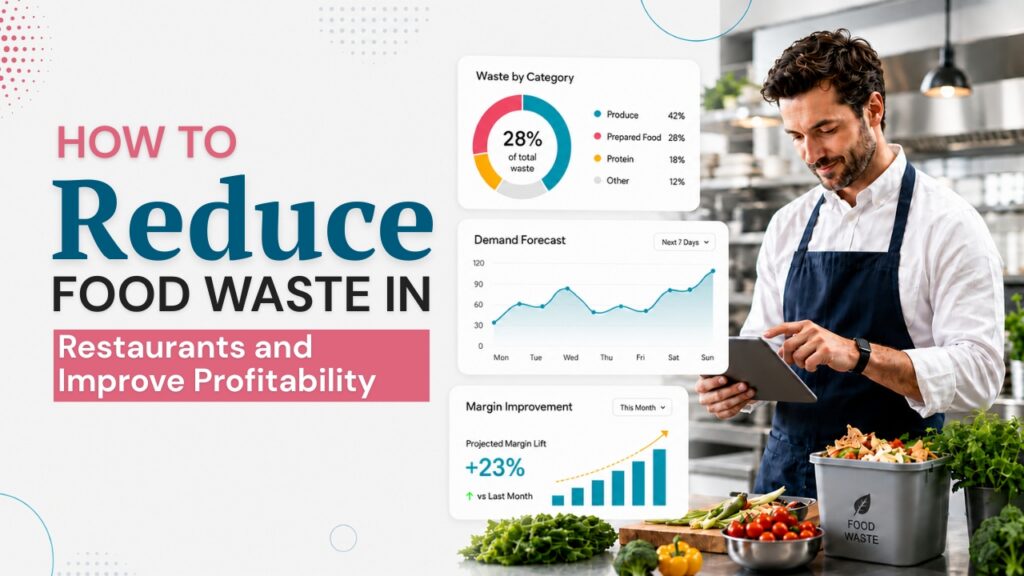

Food waste in restaurants is one of the highest hidden expenses that quietly reduces profit margins. Each spoiled ingredient, over-prepped item, incorrect food order, oversized portion, and unsold dish shows that though the revenue was already spent but not recovered.
For restaurant owners, reducing waste is not just about sustainability, instead it is a direct way to improve restaurant profitability, reduce food costs, and establish more efficient operations.
Many restaurants struggle with food waste as they do not have clear visibility into the ingredients that are being wasted, know why food waste is happening, and how often food waste occurs.
Poor inventory management, weak demand forecasting, inconsistent portion sizes, and over-ordering can instantly increase restaurant expenses. When such problems happen on a daily basis, then they damage profit margins and make it harder for managers to achieve profitability.
The good fact is that restaurants can reduce food waste with simple but effective systems. Using the FIFO method, tracking a daily waste log, training staff, standardizing food portions, repurposing ingredients, and improving ingredient ordering decisions can make a huge impact in restaurant operations.
Technology also helps restaurants to reduce food waste. Tools like Livelytics help restaurant owners to connect sales, labor, inventory, and operational data so they can identify waste patterns faster and make smarter decisions.
Using better restaurant data and stronger processes, restaurants can reduce unnecessary waste, improve food cost control, increase kitchen efficiency, and protect long-term profits.
This blog will walk you through the practical ways to reduce food waste in restaurants and convert waste reduction into a powerful profitability strategy.
Also Read: AI Solutions for Reducing Restaurant Waste
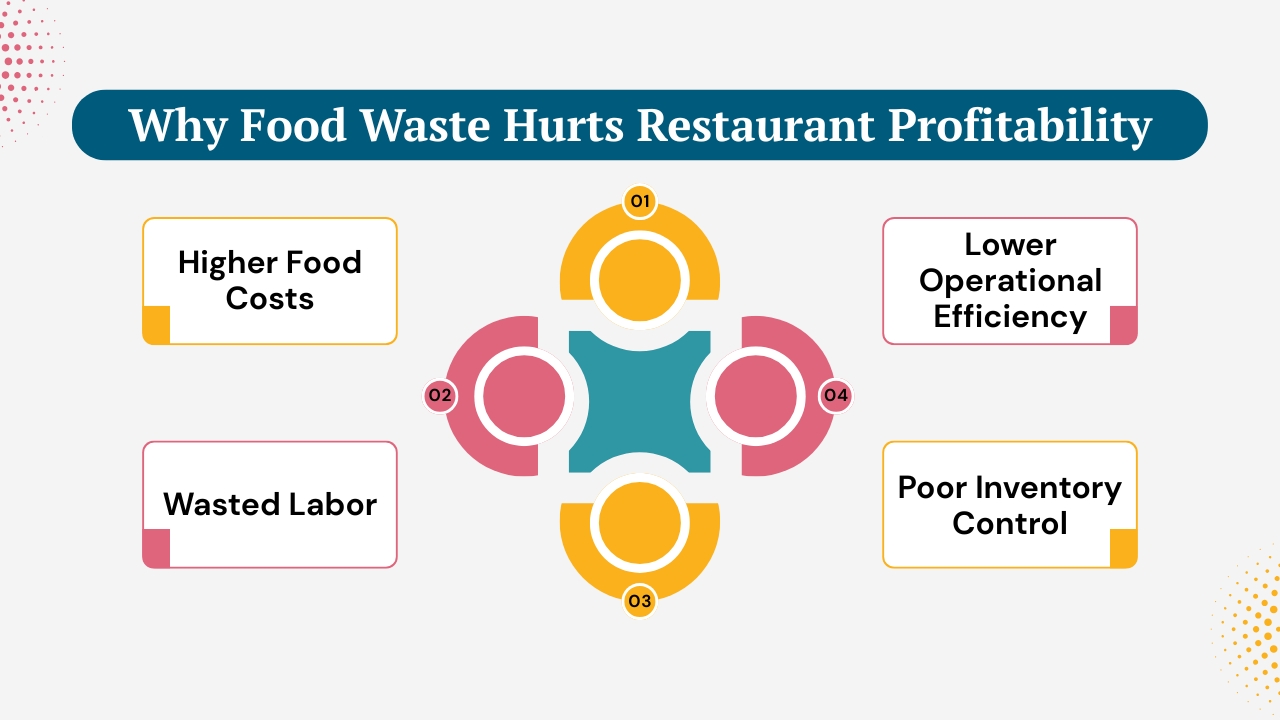
Why Food Waste Hurts Restaurant Profitability
Food waste affects restaurant profitability because purchase ingredients become lost money when they are not sold. Because it wasted labor, storage space, food preparation, cooking, packaging, and cleanup time that increases the total loss exceeding ingredient expenses.
Poor forecasting, over-ordering, over-preparation, oversized portions, and weak inventory control often lead to repeat business losses. These daily problems often reduce profit margins, restrict cash pressure, and make it difficult for restaurant owners to identify why profit is reducing before service decisions can be corrected properly.
Key ways food waste affects profitability include:
1. Higher Food Costs
Higher food costs occur when ingredients are wasted before generating revenue, which increases cost of goods sold and reduces overall restaurant profit margins significantly.
Also Read: How Inventory Software for Restaurants Reduce Food Costs
2. Wasted Labor
Wasted labor happens when employees receive, store, prep, cook, package, and clean food but never gets sold or contributes to restaurant revenue during daily operations.
Also Read: Restaurant Performance Metrics Every Restaurant Owner Should be Tracking
3. Poor Inventory Control
Poor inventory control causes overstocking, expired ingredients, and duplicate order that forces restaurants to spend revenue on ingredients that they may actually need.
Also Read: Why Restaurants Need a Food Inventory Management System
4. Lower Operational Efficiency
Food waste reduces operational efficiency as storage areas are overloaded, increasing cleanup tasks for restaurants, and making demand planning less accurate for future ordering of inventory on a daily basis.
Also Read: The Future of Restaurant and Retail Decision Intelligence
Understand the Main Types of Restaurant Food Waste
Before a restaurant can reduce food waste, it is essential to understand the areas that cause food waste. Most food waste comes under two broad categories.
- Pre-consumer waste happens before food reaches the guest. It includes spoiled ingredients, expired stock, over-prepped food, burned food, or incorrectly prepared food items, poor storage, food prep waste, duplicate prep, and kitchen mistakes.
- Post-consumer waste happens after food reaches the guest. It includes food that was left uneaten by customers, oversized food portions, side dishes which customers do not finish, buffet waste, and plate waste.
Such distinction of food waste is essential as each type of food waste requires a different solution. Pre-consumer waste can be reduced through smarter inventory purchasing, stronger inventory control, proper food storage, better demand forecasting, discipline in food preparation, and staff training.
While post-consumer waste can be reduced through food portion management, menu analysis, customer feedback, packaging improvements and a clear understanding of food items that guests actually eat.
Instead of simply saying, “We waste too much food,” restaurants should identify exactly where, why, and how often waste is happening. Rather they must ask better questions like:
- Which items are wasted most often?
- Which shift creates the most waste?
- Which menu items have the highest plate waste?
- Which ingredients expire before use?
- Which prep batches are too large?
- Which suppliers create quality issues?
- Which stores or locations perform worse than others?
This is where analytics becomes crucial. And a platform like Livelytics can help restaurant owners to connect sales, inventory, labor, and operational data so they can identify waste patterns, instead of depending on guesswork.
Also Read: Restaurant Demand Forecasting Reduce Waste and Increase Profits
Key Strategies to Reduce Waste & Increase Profits
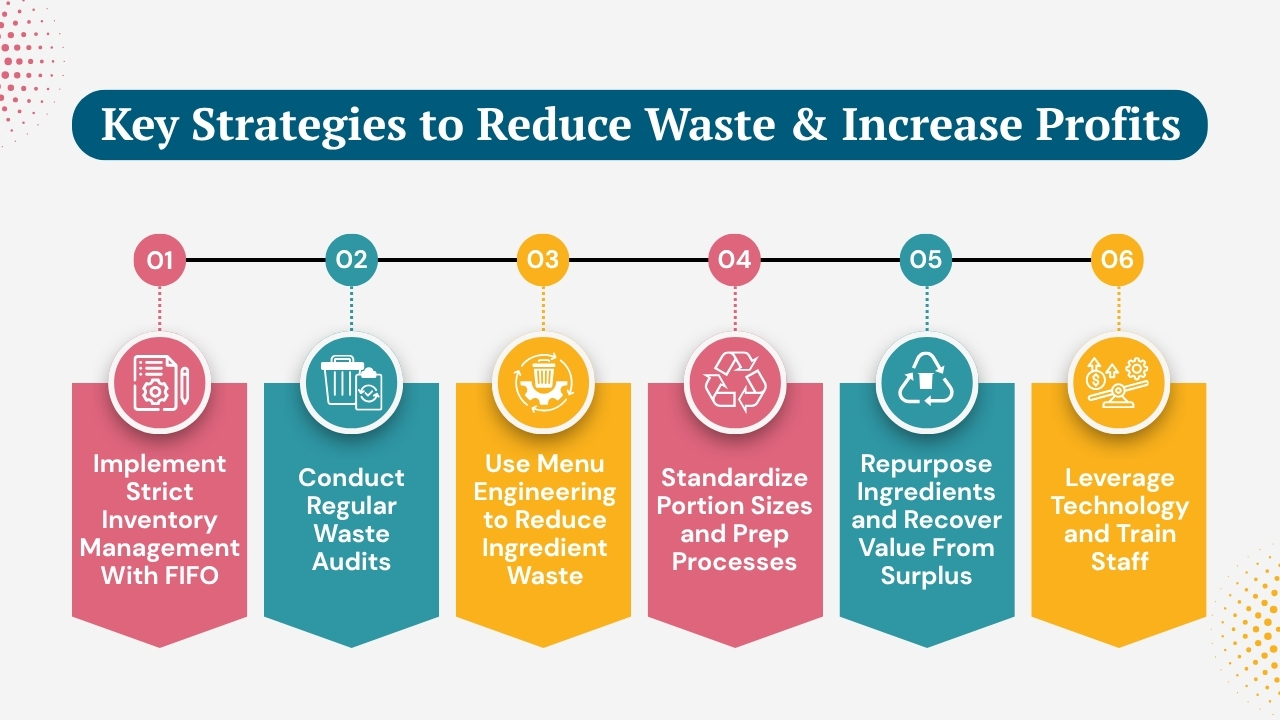
For reducing food waste restaurants require a clear system and not just random changes. Restaurants need to track the ingredients that are wasted, control how ingredients are ordered, and train teams to handle food carefully.
The best strategies for preventing food waste involve preventing food waste before it happens while also finding smart ways to reuse or recover from safe surplus food.
Restaurants can reduce food costs and protect profit margins by improving stock rotation, portion standards, menu decisions, demand forecasts, staff responsibility, and technology use.
These are practical steps that help restaurants to reduce spoilage, avoid over-preparation, make smarter purchasing decisions, and convert waste reduction into a consistent profitability improvement across daily operations and long-term performance goals.
Below are six practical strategies restaurants can use to reduce food waste and increase profitability.
1. Implement Strict Inventory Management With FIFO
Inventory management is the foundation of food waste control. Many restaurants waste food because they do not have a clear system for tracking what inventory is in stock, what inventory needs to be used first, and what inventory should not be reordered yet.
When inventory is poorly organized, older ingredients get moved to the back of shelves while newer products are used first. It leads to spoilage, expired stock, and unnecessary purchasing.
The FIFO method means “First-In, First-Out”, which is one of the simplest and most effective ways to reduce food spoilage. With FIFO, older inventory is always used before newer inventory.
When new stock arrives, staff should place it behind existing stock so older items are easier to access. This system helps restaurants use ingredients before they expire and avoids products from being forgotten in storage.
FIFO should be applied to dry storage, refrigerators, freezers, prep stations, and beverage inventory. Every item should be labeled with the date it was received or prepared.
Containers should be clearly marked, shelves should be organized, and managers should inspect storage areas regularly. A strong inventory process also includes checking expiry dates on ingredients, monitoring storage temperatures, and removing damaged or unsafe products quickly.
Good inventory management helps to avoid over-ordering. Restaurants should not order ingredient orders on real demand, current inventory, and sales trends rather than repeating old ordering habits.
Ingredient orders should be based on current food sales trends, upcoming demand, seasonal changes, menu requirements, and existing stock levels.
When restaurants order too many ingredients, then cash gets tied up in food that may never be sold. When they order too few ingredients, then they have a risk of stockouts and emergency purchases.
A balanced inventory system helps restaurants to maintain enough product to serve customers while reducing unnecessary waste.
Also Read: The Role of Data Analytics in Reducing Restaurant Waste
2. Conduct Regular Waste Audits
A restaurant cannot reduce food waste properly if they do not know the areas that are causing food waste. Many restaurant operators know that food waste is happening, but may not have clear details about the items that are being wasted, the quantity of food lost, and the reasons behind the food waste. This is why waste audits are so essential.
A waste audit involves a process of tracking food waste in detail. Restaurants should record the items wasted, quantity, reason, shift, station, and estimated cost.
Food waste may happen because of different reasons like spoiled ingredients, over-prepared food, incorrect orders, burned food, prep-stage waste, expired stock, customer plate waste, and unsold items by the end of the day.
For instance, if a restaurant throws away lettuce every weekend, then the issue may be over-ordering or poor demand forecasting. If fries are frequently wasted during slow afternoon hours, then the kitchen may be preparing too much in advance.
If chicken is being thrown away because of expired prep, the restaurant may require small batch preparation. If customers are leaving large amounts of food on plates, portion sizes may be too large.
Waste audits help managers shift from guessing to decision-making. Rather than asking staff to “waste less”, managers can exactly identify the reason behind the food waste and fix it.
The restaurant may discover that one menu item creates excessive prep waste, while one shift may over-portion ingredients, or one location has higher food spoilage than others.
Restaurants can track waste with paper logs, spreadsheets, POS reports, camera-based monitoring, or digital platforms. While restaurants have to be consistent with waste tracking. Because food waste needs to be recorded daily, not only during month-end reviews.
Regular waste tracking helps managers to identify waste patterns, reduce repeat mistakes, improve order accuracy, strengthen food handling, and fix problems before they become costly operational losses for the restaurant business quickly.
Also Read: Business Intelligence for Restaurants
3. Use Menu Engineering to Reduce Ingredient Waste
Menu design has a huge impact on food waste. A large menu may seem attractive to customers, but it often leads to operational problems. Because every extra menu item requires ingredients, storage space, food preparation time, staff training, and supplier coordination. If some food items sell slowly, then the ingredients used in those food items may expire before they are used.
Menu engineering helps restaurants to know which menu items are profitable, popular, wasteful, or unnecessary. While the goal is to develop a menu that sells well, uses ingredients efficiently, and supports strong food cost control.
A smaller, smarter menu can often perform better than a large menu item that has too many low performing items.
Restaurants should review menu items on the basis of sales volume, profit margin, and complexity in food preparation and waste levels. Food items that sell poorly and need unique ingredients must be reviewed carefully.
If a dish uses ingredients which are not used anywhere else on the menu, those ingredients may spoil quickly. On the other hand, if there are ingredients that can be used across multiple dishes improves inventory turnover and reduces waste risk.
For example, grilled chicken can be used in salads, wraps, bowls, sandwiches, and entrees. A sauce can be used as a dip, marinade, or topping.
Vegetables can be used in soups, sides, specials, and prep bases. When ingredients are shared across multiple menu items, restaurants can buy more efficiently and use stock faster.
Menu engineering also helps restaurants remove or improve menu items that create high levels of food waste. If a menu item produces too much prep waste, sells inconsistently, or depends on costly ingredients with a short shelf life, then the food menu may need to be changed.
Restaurants can also use limited-time offers or daily specials to move ingredients which need to be used soon. A well-engineered menu improves profitability by reducing complexity, increasing ingredient usage, and make food cost easier to control.
Also Read: Optimizing a Restaurant Menu with AI Powered Data Analytics
4. Standardize Portion Sizes and Prep Processes
Inconsistent portion sizes are one of the most common hidden causes of restaurant food waste. If one employee serves too much sauce, another adds extra protein, and another overfills side dishes, food cost then becomes unpredictable. Over-portioning may seem like good customer service, but it reduces profit and often increases plate waste.
Standardizing food portions help restaurants to control food expenses, maintain consistency, and reduce unnecessary waste. So it is essential that every menu item should have a clear recipe with exact ingredient quantities.
Staff should know how much protein, sauce, garnish, side dish, and topping should be used. This can be supported with portion scoops, ladles, scales, measuring cups, recipe cards, and plating guides.
Portion control does not mean reducing value for customers. This means giving customers the right amount consistently. A customer should receive the same quality and portion whether they visit on Monday afternoon or Saturday night. Being consistent with portion control helps to build trust and helps managers to calculate accurate food costs.
Prep processes should also be standardized. Over-preparation is a major cause of food waste especially in fast food restaurants, cafes, bakeries, and high volume kitchens.
Teams often prepare too much food because they want to avoid running out of food during busy hours. But if demand for food is lower than expected, prepared food may expire or food may lose quality before it can be sold.
Restaurants should use prep sheets based on sales history and demand forecasts. And prep levels should change by day of the week, season, weather, local events, and expected traffic.
Slow days should not have the same prep volume as peak days. Preparing food in a batch helps restaurants to reduce food waste because food is prepared in smaller amounts throughout the day rather than all at once.
When food portion sizes and prep processes are controlled, restaurants gain more predictable costs, better quality, less waste, and smoother kitchen operations.
Also Read: Cost-Effective AI Solution for Restaurants
5. Repurpose Ingredients and Recover Value From Surplus
Not all food waste happens due to poor management. Sometimes restaurants have ingredients that are still safe and usable but need to be moved quickly. Rather than wasting those ingredients, restaurants can repurpose ingredients creatively and recover value.
Repurposing ingredients involves using edible food in another way before it becomes waste. Vegetable scraps can be repurposed into flavorful stocks, soups, sauces, or broths instead of being thrown away.
Stale bread can become croutons, breadcrumbs, bread pudding, or stuffing. Overripe fruit can be used in smoothies, desserts, sauces, or breakfast specials. Cooked proteins can sometimes be used in soups, wraps, tacos, or staff meals if food safety rules allow it.
Daily specials are one of the best ways to use ingredients which need to move quickly. A restaurant can create a soup of the day, pasta special, chef’s bowl, sandwich special, or limited-time combo using surplus ingredients. This helps restaurants to reduce food waste while also creating a variety of food for their customers.
Restaurants can reduce food losses by using surplus food platforms and partnerships to sell unsold food at discounted prices rather than wasting the food items.
They can also be useful for bakeries, cafes, pizza shops, grab-and-go concepts, and restaurants with prepared items that may not sell before closing for the day.
Instead of taking a complete loss, restaurants can generate some revenue, attract new customers, and also reduce its impact on the environment.
Even food donation programs may also be a good option for restaurants based on local regulations and food safety requirements. Restaurants may also give meals to staff which is another useful strategy for safe, edible food which may not be sold but can still be consumed.
The main goal for restaurants is to plan ahead about how safe surplus will be reused, sold, donated, or repurposed before it becomes waste.
Restaurants should decide in advance about the food that can be repurposed, food which can be sold at a discount, food that can be donated, and about the food that can be discarded for safety reasons.
6. Leverage Technology and Train Staff
Technology also helps restaurants to reduce food waste easily, quickly, and more accurately. Though manually tracking food waste is useful, it can be limited when restaurants have high order volume, multiple staff shifts, or several locations.
Technology helps restaurant owners to connect inventory, POS data, sales trends, ordering patterns, waste logs, and demand forecasting.
Modern restaurant technology helps restaurant managers and owners to know about the ingredients being used instantly, know about the items that are moving slowly, know which menu items produce high waste, and when customer demand is likely to increase or decrease.
Inventory systems can send alerts when the inventory stock is about to expire. POS data can show the menu items that are selling and also about the menu items that are underperforming. Forecasting tools help managers to prepare the right amount of food on the basis of historical patterns.
For running multi-location restaurants, technology is highly effective. Restaurant owners and operators can compare waste levels by store location, identify underperforming store location, and find best practices from stores that are performing well.
If one location consistently has lower food waste and better profit margins, then managers can study the processes of well performing restaurants and use it across other locations.
However, only implementing technology alone is not enough, instead staff training is equally important. Staff must understand why understanding the reason behind food waste is crucial and how their daily actions affect profitability.
Staff should be trained on FIFO strategies, food portion control, prep levels, labeling, waste logging, storage standards, and order accuracy.
Managers should explain food waste in financial terms. When staff know that food waste directly reduces profit, then they are more likely to handle ingredients carefully and follow waste-control practices. A restaurant can also set food waste reduction goals, review their progress weekly, and reward teams that improve performance.
A strong waste reduction process begins with good leadership. Managers must inspect storage, review waste logs, correct portioning mistakes, and encourage accountability. When both technology and training work together then restaurants can reduce waste more effectively and protect profit every day.
Also Read: How Data Analytics Improve the Measurement of Employee Performance
Profitability Gains
1. Lower Food Costs
Reducing food waste directly helps restaurants to reduce their food costs and also protect profit margins. Because when less food is spoiled, over-prepared, or thrown away, then the restaurant does need to purchase replacement stock.
It helps restaurants to improve cash flow and keeps ingredient spending under control. Even if there are small reductions in daily waste then it can lead to meaningful monthly savings, especially for restaurants with high-volume sales or multiple locations.
Also Read: 10 Ways Data Analytics Solutions Reduce Costs Improve Profit
2. Improved Operational Efficiency
Better waste control also improves daily restaurant operations. When inventory is organized, tracked, and used correctly then managers can spend less time handling overstock, expired products, and last-minute reorders.
Kitchen teams can work more effectively because with organized inventory, they know exactly about the ingredients that are available, and know about the ingredients that need to be used first, and know how much food items should be prepared. It reduces confusion, saves labor time, and creates a smoother workflow from storage to service.
Also Read: How Livelytics Helps Retailers to Reduce Operational Costs
3. Increased Brand Reputation
Reducing food waste can also improve the public image of a restaurant. When restaurants partner with charities, food banks, or surplus food programs, it shows that the restaurant cares about the community and sustainability.
Donating usable surplus food helps restaurants to reduce food waste while also improving the position of restaurants in the community. Customers are more likely to support restaurants which act responsibly and show a commitment towards reducing unnecessary food waste.
Also Read: Boosting Brand Loyalty With Customer Sentiment Analysis
Steps for Action
1. Start a Waste Log
Restaurants must start by tracking what food is being wasted, and how much food is being thrown away, and why food waste is happening. While a simple waste log helps restaurants to identify the biggest reason behind food waste such as expired produce, over-prepped items, incorrect order, or uneaten food portions. Once restaurants know the waste patterns then the managers can take targeted actions instead of just guessing.
2. Train Staff to Treat Ingredients as Money
Employees should understand that each wasted ingredient affects the profitability of a restaurant. Staff training must focus on proper storage, FIFO rotation, accurate portioning, careful prep, and daily waste reporting. When staff consider food as a direct cost, they become more responsible towards handling, cooking, and serving food.
3. Optimize the Ordering Schedule
Restaurants should avoid ordering perishable items quite early or in excessive quantities. Ordering of the stock should be based on sales patterns, upcoming demand, storage capacity, and ingredient shelf life.
A better stock ordering schedule helps to reduce overstocking, prevents spoilage, and keeps inventory fresh while protecting cash flow.
Conclusion
Reducing food waste in restaurants is one of the most practical ways that helps restaurants to improve profits and build stronger restaurant operations. Each spoiled ingredient, over-prepped item, oversized portion, and unsold dish indicates money that could have supported better profit margins.
When restaurants control food waste, they lower food costs, improve inventory accuracy, reduce unnecessary purchasing, and make better use of the ingredients they already have.
The most effective way to reduce food waste begins with visibility. Restaurants need to track waste daily, identify the areas that are causing food waste, and understand why food is being lost.
From there, restaurants can improve rotating inventory, use FIFO, standardize portion sizes, train staff, simplify menu, forecast demand, and repurpose safe ingredients before they become waste. These steps helps teams to make smarter decisions and prevent small daily losses from becoming major financial problems.
Technology also plays an important role. With tools like Livelytics, restaurant operators can connect sales, inventory, labor, and operational data that helps to identify food waste patterns quickly and improve decision-making across all locations. Rather than waiting for month-end reports, managers can act earlier and protect profit in real time.
Food waste reduction is not only about sustainability rather it is about running a more profitable, efficient, and responsible restaurant. When every ingredient is used with a purpose and every team member understands the cost of waste, restaurants can reduce losses, improve profit margins, and create long-term operational success.
If you still have any query about how to reduce food waste in restaurants and improve profitability then you may book a free demo at Livelytics and we are more than happy to assist you.