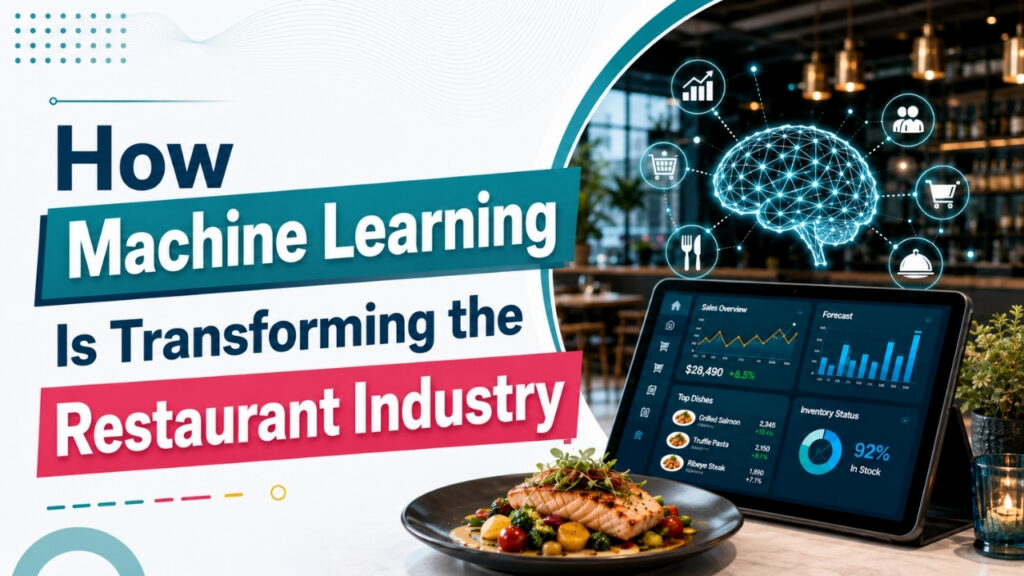

The restaurant industry is going through a major digital transformation, and Machine Learning in Restaurants has become the most crucial technology causing this change.
Due to the rise in many challenges in restaurants like increasing labor expenses, changing customer expectations, supply chain disruptions, and increasing competition, restaurant operations are using advanced technologies to improve efficiency in operations, profits, and customer satisfaction.
Among all these new technologies, Machine Learning is a specialized branch of Artificial Intelligence(AI) systems that enable restaurants to make smarter, faster, and more data-driven decisions.
Unlike traditional software systems which follow fixed rules, machine learning algorithms continuously analyze data, find customer demand patterns, and use this data to improve performance of operations over time.
Such a capability helps restaurants to predict customer demand, optimize inventory levels, personalize marketing campaigns, improve customer experiences, and smooth daily operations.
Whether quick-service chains, fine-dining establishments, businesses are mostly adopting restaurant technology empowered by machine learning to gain a competitive advantage.
Modern restaurants create large amounts of data through Point-of-Sale(POS) systems, online ordering platforms, reservation software, loyalty programs, delivery applications, and customer feedback channels.
Machine learning turns this raw data into insights that supports Restaurant Analytics, Customer Behavior Analytics, Predictive analytics for restaurants, and restaurant operations optimization.
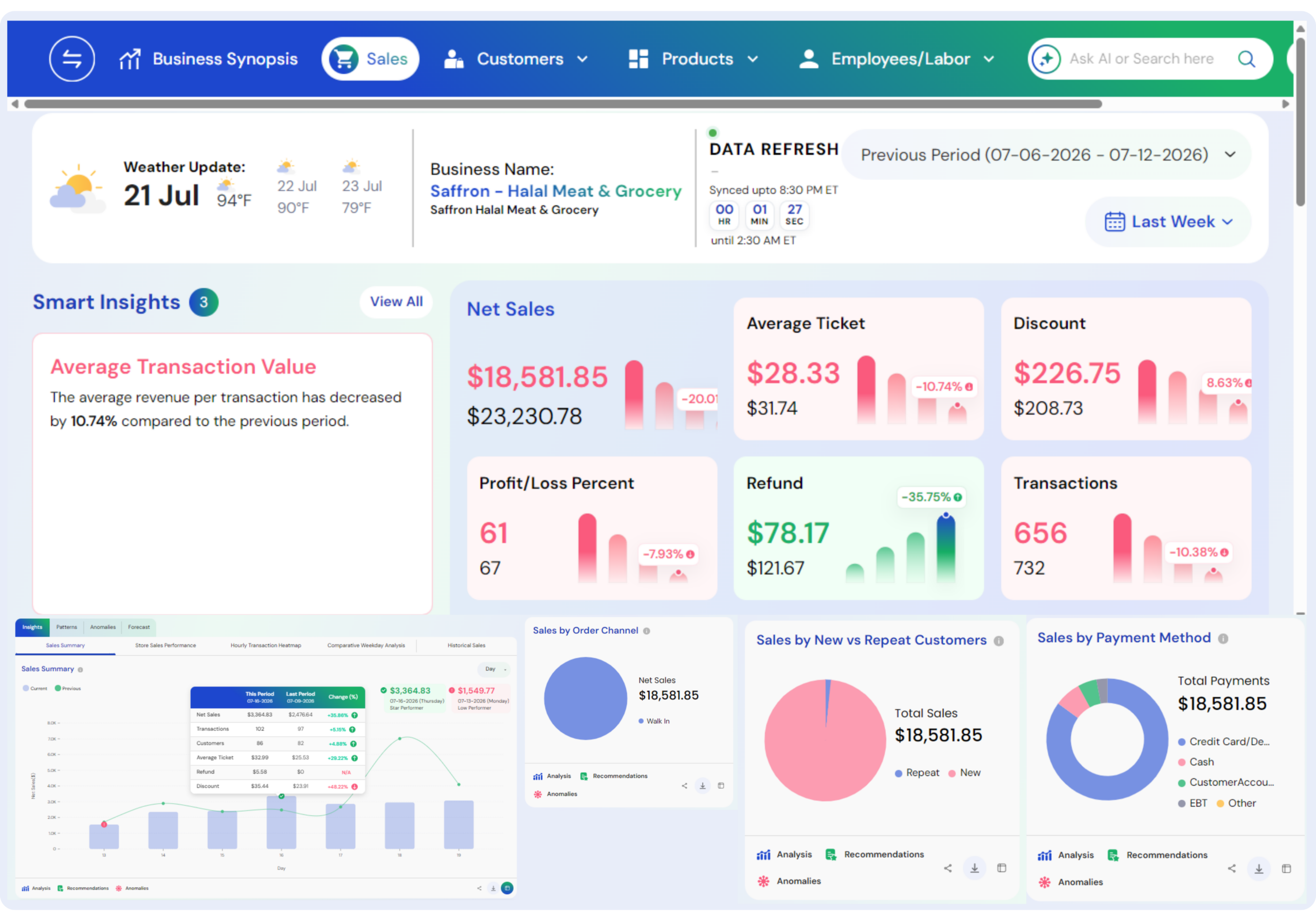
When machine learning is combined with advanced business intelligence solutions such as Livelytics, restaurants can gain deeper visibility into sales performance, menu profits, customer preferences, and operational efficiency.
Utilizing Restaurant Data Analytics and predictive insights, restaurant operators can make informed decisions which drive sustainable growth.
While this technology keeps evolving, Machine learning in the restaurant industry has become an essential tool for businesses who want to improve performance, reduce costs, improve guest experiences, and remain competitive in a highly data-driven market.
Also Read: Machine Learning for Business Analytics
Understanding Machine Learning in Restaurants
These are specialized branches of artificial intelligence. It enables computer systems to analyze data, identify sales patterns, make predictions, and continuously improve operational performance over time.
Unlike traditional software that follows predefined instructions, machine learning systems learn from real-data. It allows restaurants to adapt effectively to changing customer preferences, market conditions, and operational demands.
In the restaurant industry, machine learning helps to convert large volumes of operational and customer data into actionable insights.
By analyzing data from multiple data sources, restaurants can make better operational decisions, increase operational efficiency, reduce expenses, and offer more personalized customer experiences.
Due to such capabilities, machine learning is an essential tool for managing modern restaurants.
Machine learning can analyze a wide range of restaurant data, including:
- Sales transactions to identify purchasing patterns and revenue patterns.
- Customer purchasing behavior: It helps to support personalization and targeted promotions.
- Reservation trends: These systems help to forecast customer traffic and demand.
- Weather conditions to predict fluctuations in sales and menu preferences
- Seasonal variations that influence customer behavior and inventory needs
- Inventory usage to optimize purchasing and reduce waste
- Labor performance to improve workforce planning and scheduling
- Online reviews to understand customer sentiment and satisfaction
- Marketing campaign results : It helps to improve effectiveness of marketing campaigns and improve future strategies.
By processing this data, machine learning enables restaurants to identify opportunities, predict challenges, and make smarter, data-driven decisions.
Also Read: Business Intelligence for Restaurants
Why Machine Learning Is Becoming Essential
There are multiple trends prevailing in the restaurant industry which is causing the quick adoption of machine learning across the entire sector.
While businesses face high operational complexities and changing customer demands, machine learning offers the insights and tools for automating tools which helps restaurants to remain efficient, competitive, and profitable.
1. Rising Operating Costs
Restaurants regularly have high costs because of labor, ingredients, rent, utilities, and supply chain management. Hence, it is essential for restaurants to manage these expenses to maintain profits.
Machine learning helps restaurant operators to identify operational inefficiencies, predict demand, optimize purchasing decisions, and reduce food waste.
Analyzing this operational data enables restaurants to make smarter financial decisions and improve overall control of operational costs.
Also Read: The Blind Spots Costing Your Business More Than You Think
2. Labor Challenges
Shortage of staff and high employee turnover remain big challenges throughout the restaurant industry.
While machine learning enables management of workforce by improving accuracy of staff scheduling, predicting staff requirements, and identifying staff productivity patterns.
These insights help managers to allocate resources more effectively while maintaining staff quality of service and controlling labor expenses.
Also Read: How Can Data Analytics Improve Employee Performance
3. Growing Customer Expectations
Modern diners expect personalized customer experiences, convenient ordering options, quick service, and relevant food recommendations.
While machine learning analyzes both customer preferences and customer purchasing behavior to provide personalized promotions, food menu suggestions, and loyalty rewards.
This helps restaurants to improve customer satisfaction and build stronger long-term relationships with customers.
Also Read: Customer Analytics for Restaurants
4. Rapid Data Growth
Restaurants generate large amounts of data through POS systems, online ordering platforms, reservation software, loyalty programs, delivery services, and customer feedback channels.
If restaurants do not implement machine learning, all the essential information remains less utilized. While machine learning converts raw data into actionable insights.
These insights enable restaurants to make strategic planning, operational improvements, and data-driven decisions across the entire business.
Also Read: Two Way Data Analytics in Shaping Retail Business
The Role of Machine Learning in Modern Restaurant Management
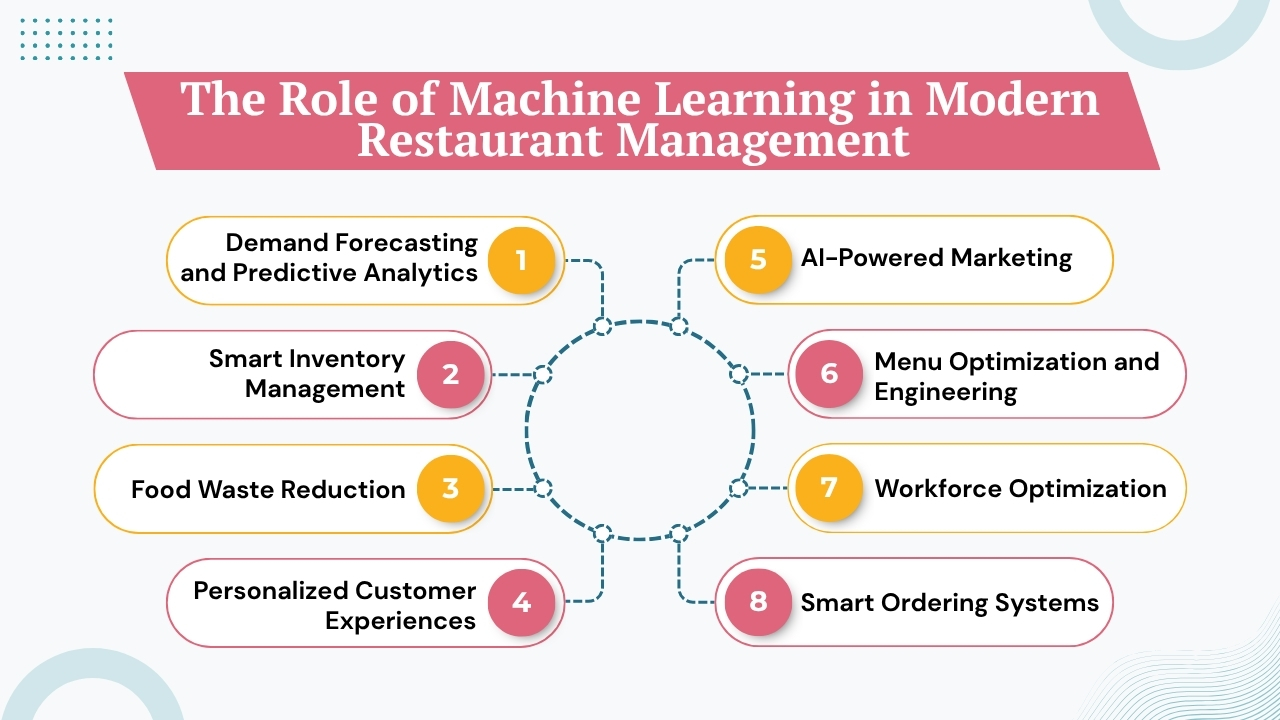
1. Demand Forecasting and Predictive Analytics
One of the crucial applications of machine learning is demand forecasting in restaurants. When machine learning models make right forecasts about customer demand, it enables restaurants to prepare more effectively for busy hours and prevent unwanted food waste.
These ML models combine both internal restaurant data with external factors such as weather, holidays, and local events which help to improve accuracy of demand forecasting unlike in traditional methods.
Machine learning systems analyze customer demand patterns across multiple data sources, including:
- Past sales data to identify recurring demand patterns.
- Seasonal patterns which are affecting customer behavior throughout the year.
- Local events and holidays which may increase or decrease restaurant traffic.
- Weather forecasts which affect dining preferences of customers and customer traffic.
- Promotional campaigns to track how their marketing efforts are influencing customer demand.
By processing all these variables, machine learning helps restaurants to make smarter operational decisions.
Key benefits include:
- It helps for better inventory planning and purchasing accuracy
- It causes reduced food waste and spoilage
- Helps in improved staffing and scheduling decisions
- Higher profitability through optimized operations
- Faster, more reliable customer service during peak periods
Restaurants that forecast demand accurately have more chances to handle changes in customer traffic and adapt quickly to changing market conditions.
Also Read: Restaurant Sales Forecasting How to Predict Future Revenue
2. Smart Inventory Management
Proper management of inventory is essential for managing restaurant operations property as it is a major challenge for many businesses.
Because if there is poor control over inventory then it can cause inventory overstocking, ingredient shortages, food spoilage, excessive food waste, and higher operational expenses.
These issues not just affect restaurant profits but can also affect customer satisfaction when essential menu items become unavailable.
Machine learning enables restaurants to improve management of inventory by analyzing past customer food consumption patterns, sales patterns, seasonal changes, and customer demand.
Using predictive analytics, restaurants can make informed decisions about purchasing stock and maintain the right stock levels instead of overstocking.
Advanced machine learning systems can:
- Forecast ingredient consumption : It enables forecasting ingredient consumption based on expected customer demand.
- Recommend purchase quantities : Machine learning recommends adequate purchase quantities which helps to maintain optimal inventory levels.
- Detects inventory anomalies: ML models detect inventory anomalies which indicate food waste, theft, or tracking mistakes.
- Reduce stockouts : It helps restaurants to reduce stockouts by predicting when ingredients require replenishment.
- Improve supplier planning through more accurate purchasing forecasts.
These capabilities enable restaurant operators to make inventory processes smooth, reduce food waste, and improve cash flow management.
Machine learning helps restaurants to maintain balance between supply and customer demand that help restaurants to operate more efficiently while also reducing unwanted expenses and maximizing profits.
Also Read: How Inventory Software for Restaurants Reduces Food Costs
3. Food Waste Reduction
Food waste is a major challenge for restaurants that affect both parties and sustainability efforts. Because excess inventory, inaccurate demand forecasting, and inefficient stock purchasing practices cause ingredients being discarded before it can be used.
Machine learning helps restaurants to resolve these problems by analyzing operational data and identifying patterns which are causing food waste.
It analyzes past sales, inventory usage, seasonal demand, and purchasing patterns. Machine learning systems can improve accuracy of demand forecasting and support more efficient management of inventory.
This enables restaurants to match food preparations and ingredient purchasing decisions with actual customer demand.
Machine learning can identify:
- Frequently wasted ingredients : It enables restaurants to consistently cause food loss.
- Overproduction patterns : It identifies overproduction patterns which cause unnecessary excessive food.
- Demand inconsistencies : It helps to identify any inconsistency in demand which affects inventory planning.
- Purchasing inefficiencies : It helps to identify inefficiency in inventory purchasing decisions which causes overstocking or food spoilage.
Reducing food waste has several advantages such as reducing operational expenses, improving inventory efficiency, and stronger sustainability performance.
Using these insights from machine learning, restaurants can reduce food waste, maximize use of resources, and support environmentally responsible business practices that protect profits.
Also Read: AI Solutions for Reducing Restaurants Wastes
4. Personalized Customer Experiences
Today’s customers expect dining experiences as per their own preferences and requirements. Machine learning enables restaurants to deliver such personalization by analyzing customer behavior and identifying patterns of customer’s past food purchase and dining habits.
Using data-driven insights, restaurants can develop more relevant and engaging interactions which strengthen customer relationships.
Machine learning systems evaluate various customer data points, including:
- Purchase history these machine learning systems help to understand past ordering preferences.
- Favorite menu items : machine learning systems identify favorite menu items and recommend similar products.
- Visit frequency: these systems identify visit frequency of customers by identifying loyal and occasional customers.
- Dietary preferences : these systems considering dietary preferences of customers suggest suitable menu options.
- Ordering habits to anticipate future purchases.
Using these insights, restaurants can provide:
- Personalized menu recommendations
- Customized promotions and discounts
- Offering loyalty rewards as per customer behavior
- Targeted marketing campaigns
Personalization improves the overall dining experience by making customer interactions more relevant and convenient for customers.
As a result, restaurants can improve customer satisfaction, encourage repeat visits, improve brand loyalty, and increase average order values through effective customer engagement strategies.
Also Read: How AI Revolutionizes Customer Experience in Restaurant Industry
5. AI-Powered Marketing
Restaurant marketing has become highly data-driven, and machine learning helps businesses to deliver more effective and personalized marketing strategies.
Machine learning analyzes customer data, purchasing patterns, and engagement trends, which helps restaurants to better understand their audience and improve campaign performance.
Important applications of machine learning in restaurant marketing include:
- Customer Segmentation: These models group customers based on their spending habits, customer visit frequency, product preferences that support targeted marketing efforts.
- Personalized Promotions: It involves offering personalized offers such as birthday rewards, loyalty incentives, re-engagement campaigns, and personalized discounts which increase customer engagement and customer retention.
- Sentiment Analysis: Such ML models analyze customer reviews, social media conversations, survey responses, and online ratings to understand common perceptions of customers and identify areas for improvement.
These insights help restaurants to improve their marketing strategies, improve customer relationships, and brand reputation.
By offering more valid messages and offers, machine learning increases effectiveness of marketing while improving the overall customer experience.
Also Read: Business Intelligence for Marketing
6. Menu Optimization and Engineering
Menu performance is essential for restaurant profits, customer satisfaction, and overall business success. While machine learning helps restaurant operators to make data-driven decisions by analyzing sales data, customer preferences, and profitability metrics.
Hence, rather than simply assuming, restaurants can use machine learning insights to continuously improve and optimize their menu offerings.
Important machine learning capabilities include:
- Identifying best-selling dishes: It identifies best-selling dishes which drive customer demand.
- Measuring item profitability: It measures profits of each item which helps restaurants to maximize revenue potential.
- Tracking customer preferences: It analyzes customer preferences and their food purchasing patterns.
- Detecting emerging food trends: It determines new food trends even before they become mainstream.
- Optimizing menu design: It helps to optimize menu design which helps restaurants to improve visibility and sales performance.
Machine learning helps restaurants adapt to changing consumer preferences which includes:
- Plant-based food options
- Health-conscious menu choices
- Sustainable ingredients
- International and global cuisines
With these insights, restaurants can make proactive menu adjustments, improve customer satisfaction, increase profits, and maintain a competitive advantage in a quickly changing market.
Also Read: Optimizing a Restaurant Menu With AI Powered Data Analytics
7. Workforce Optimization
Labor is one of the biggest expenses for restaurants due to which it is essential for managing the workforce effectively for gaining profits and maintaining service quality.
Machine learning helps restaurants to improve staffing by analyzing customer traffic patterns, sales patterns, seasonal patterns, and historical workflow data.
Using these insights enable managers to align staffing with predicted customer demand and improve operational efficiency.
Important benefits of machine learning in workforce optimization include:
- Reduced labor costs: These systems reduce labor expenses through more accurate staffing decisions.
- Improved scheduling accuracy: These systems improve scheduling accuracy based on predicted customer demand.
- Better shift coverage : These systems improve better shift coverage of staff during busy and non-busy hours.
- Enhanced employee productivity: These systems improve employee productivity by allocating resources effectively.
- Improved employee satisfaction: These systems improve employee satisfaction through balanced workloads and optimized schedules.
Machine learning also offers valuable performance insights by identifying productivity patterns, service patterns, and potential training needs.
Managers can use this data to support employee development, improve team performance, and improve team performance, and improve service quality.
When restaurants optimize workforce planning, restaurants can reduce expenses while delivering a more consistent and efficient customer experience.
Also Read: Benefits of Supply Chain Optimization for Business
8. Smart Ordering Systems
Machine learning is changing the way restaurants process orders. With smart digital solutions can improve convenience, speed, and accuracy of services.
When ML models analyze customer behavior, their purchase patterns, and operational data, these systems enable restaurants to smooth ordering workflows and also create more engaging experiences for guests.
Although customer expectations keep changing, smart ordering systems have become an important component of modern restaurant operations.
Important applications of machine learning in smart ordering systems include:
- Self-Service Kiosks: AI-based kiosks can recommend complementary food items, personalize menu displays, and also promote special offers on the basis of customer preferences, and their past purchases.
- Voice Ordering Systems: Voice-enabled technology allows customers to place orders with natural speech while also improving order accuracy, reducing wait times, improving convenience, and reducing human errors during the ordering process.
- Dynamic Menus: Machine learning can automatically adjust menu displays on the basis of weather conditions, time of day, inventory availability, and customer demand patterns.
Such smart ordering systems enable restaurants to improve operational efficiency while improving the overall customer experience.
By delivering faster service, personalized recommendations, and more accurate order processing, machine learning supports higher customer satisfaction, increased sales opportunities, and stronger customer loyalty.
Also Read: How Restaurant Business Intelligence Helps Owners Make Fast Decisions
The Role of Data Analytics and Livelytics
Machine learning is only as powerful as the data which supports it. For generating accurate predictions and insights, restaurants need access to reliable, organized, and detailed data.
This is where advanced analytics platforms such as Livelytics play a major role in enabling data-driven restaurant management.
Livelytics helps restaurants consolidate and analyze information from multiple business systems, including:
- POS systems
- Sales reports
- Customer transactions
- Inventory management platforms
- Operational performance metrics
By converting raw data into meaningful insights, Livelytics enables restaurant operators to:
- Track sales performance and revenue patterns
- Analyze customer behavior and purchasing patterns
- Track menu profits and product performance
- Improve operational efficiency across locations
- Track financial performance and important business metrics
- Support strategic planning and growth initiatives
When such tools are combined with machine learning capabilities, livelytics provides a strong foundation for predictive analytics and smart decision-making.
Restaurant leaders can use both real-time dashboards and actionable insights to identify opportunities, address challenges, and optimize menu performance.
Rather than just relying on intuition, restaurant operators can make informed decisions based on accurate data that helps to drive efficiency, profits, and long-term business success.
Also Read: The Role of Data Analytics In Reducing Restaurant Waste
Challenges of Machine Learning Adoption
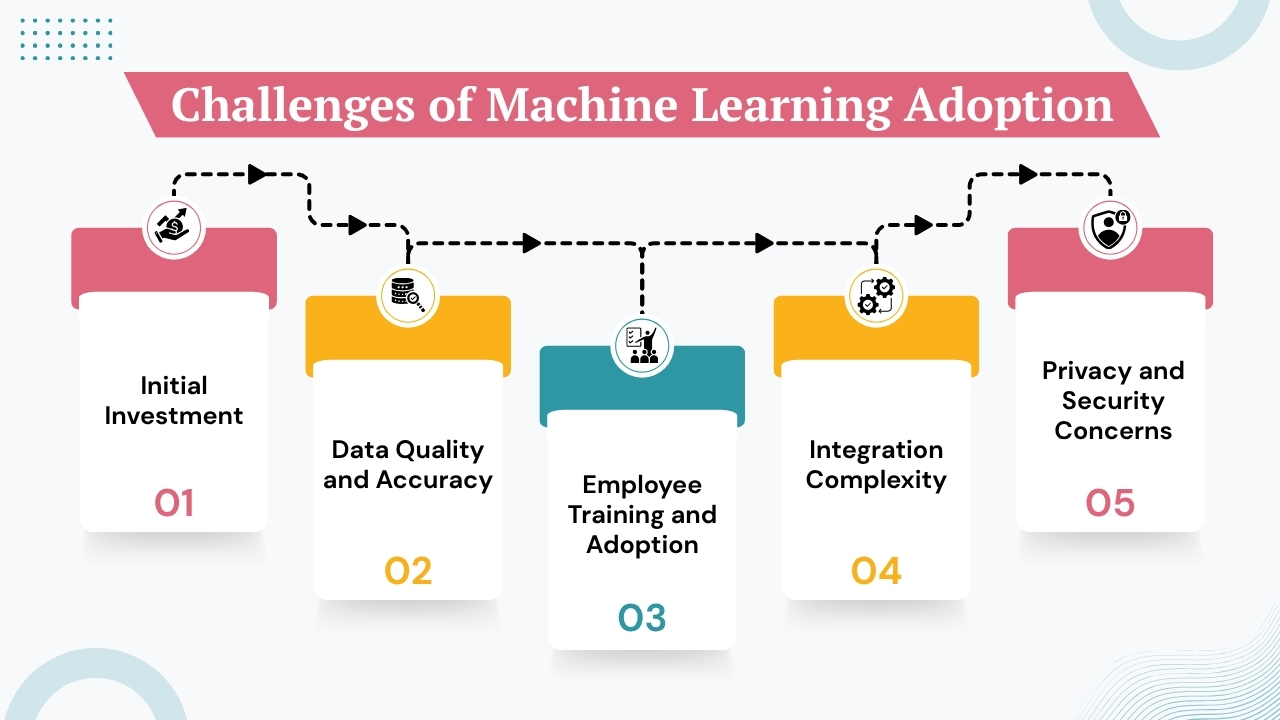
Though machine learning offers many benefits, successful implementation requires careful planning and investment.
Restaurant operators must address many challenges to understand the importance of machine learning technologies and ensure long-term success.
1. Initial Investment
For implementing machine learning solutions need upfront investment in software, hardware, data infrastructure, and system upgrades.
For small and medium-sized restaurants, these expenses can cause an important challenge to adoption.
2. Data Quality and Accuracy
Machine learning models rely on accurate, consistent, and reliable data to develop impactful insights.
If there are incomplete records, duplicate data, and inaccurate data collection can reduce accuracy of demand prediction and reduce the effectiveness of machine learning systems.
Also Read: Business Intelligence and Data Analytics Services
3. Employee Training and Adoption
Staff members and restaurant managers must be able to interpret machine learning tools effectively.
By providing regular proper training to staff ensures that employees are able to understand insights, and incorporate decisions based on these insights into their daily operations.
Also Read: How Data Analytics Improve the Measurement of Employee Performance
4. Integration Complexity
Many restaurants use multiple technology platforms such as POS systems, inventory software, scheduling tools, and customer management applications.
By integrating machine learning solutions with existing systems can be complex technically and may also require more staff and expertise.
5. Privacy and Security Concerns
Machine learning systems often depend on customer and operational data. Hence it has become essential for restaurants to implement strong security measures, protect sensitive details, and comply with existing data privacy regulations.
For maintaining customer trust needs responsible management of data and transparent security practices.
By addressing all these challenges strategically, restaurants can have maximum benefits of machine learning while reducing any form of implementation risks.
Conclusion
Machine learning is quickly changing the restaurant industry by helping businesses to operate more efficiently, make smarter decisions, and deliver better customer experiences.
Whether demand forecasting, inventory management, personalized marketing, workforce optimization, and intelligent ordering systems, machine learning tools enable restaurants to use data and implement in their daily operations which was not possible earlier.
By analyzing large volumes of operational and customer data, restaurants can identify current customer patterns, challenges, and respond more effectively to changing market conditions.
While there is high competition and customer expectations keep increasing, machine learning offers a major advantage for restaurants who want to improve profits, reduce expenses, and improve service quality.
Being able to automate routine tasks, improve staff allocation, and generate predictive insights enables businesses to focus more on strategic growth and also maintain operational excellence.
However, successful adoption of machine learning requires more than advanced technology. Restaurants must invest in quality data, employee training, system integration, and performance monitoring to maximize results.
When these technologies are supported by strong data analytics and smart intelligence tools, machine learning becomes even more powerful.
While the restaurant industry keeps evolving, machine learning will play a crucial role in shaping the future of restaurant operations.
Restaurants that adopt data-driven innovation today will be better placed to achieve sustainable growth, strengthen customer loyalty, and remain competitive in a highly digital market.
If you still have any query about how machine learning is transforming the restaurant industry then you may book a free demo at livelytics and we are more than happy to assist you.