For restaurants, managing food costs is one of the biggest challenges especially when ingredient prices, supplier charges, waste, and customer demand keep changing.
Without accurately tracking food costs, restaurants may either order more stock than required, lose ingredients because of spoilage, may miss to know about rise in supplier price, or fail to know why profit margins are reducing.
This is where inventory software for restaurants becomes a powerful tool.
Restaurant inventory management software helps restaurant owners and managers to track stock levels, track ingredient usage, reduce inventory waste, manage supplier invoices, and improve purchasing decisions.
Restaurants instead of depending on spreadsheets or manually counting stock, restaurants can use real-time data to know exactly about the ingredients that are in stock, or know about the ingredients which need to be ordered, and whether food costs are increasing. This data helps restaurants to make daily operations of restaurants more accurate, organized, and profitable.
One of the biggest benefits of restaurant inventory software is it allows restaurants to compare inventory usage to expected usage. This helps restaurants to identify over-portioning, theft, preparation problems, expired stock, and unnecessary purchases.
This inventory software helps restaurants for better menu pricing as it shows the actual cost of each recipe and ingredient. When restaurants understand their food cost percentage then they can make smarter inventory decisions which protects profit margins.
With platforms like Livelytics, restaurants can go beyond basic inventory tracking. Livelytics helps to connect inventory, POS, accounting, supplier, and operational data into clear dashboards and actional insights.
Using AI-powered analytics, restaurants can identify trends faster, predict demand more accurately, and reduce profit leaks before they become serious problems.
In today’s highly competitive restaurant industry, inventory software for restaurants, food cost control, restaurant inventory management, AI restaurant analytics, and real-time inventory tracking are no longer optional.
Inventory software are essential tools for reducing waste, improving efficiency, and building a more profitable restaurant business.
Also Read: AI for Restaurant Inventory
Why Restaurant Inventory Management Matters
Inventory is directly connected to food cost, cash flow, menu profitability, and customer experience. If a restaurant orders too much, money gets invested into stock that may spoil.
If it orders too little, proper menu items may become unavailable, which leads to disappointed customers and lost sales. If stock counts are inaccurate, managers cannot trust their purchasing decisions or financial reports.
Restaurant inventory management gives structure to this process. This helps teams to know about the inventory levels that are available, the quantity of inventory that has been used, and inventory that needs to be ordered, and the inventory that has been wasted.
Knowing the levels for restaurants is essential because restaurants with perishable ingredients, changing demand, seasonal menus, multiple suppliers, and high daily transaction volume.
For instance, a restaurant may believe its food cost problem is caused by supplier prices. But the real concern may be over-portioning, unrecorded waste, inaccurate recipes, theft, wrong POS entries, or incorrect receiving.
Without reliable inventory data, these problems stay hidden. Inventory software helps reveal the difference between expected usage and actual usage, that makes it easier to find where money is being lost.
Strong inventory management also improves daily operations. Chefs can plan prep more accurately, managers can avoid emergency purchases, accounting teams can reconcile invoices faster, and owners can see whether costs are moving in the right direction. In short, inventory control is not just a back-office task rather it protects profits.
Also Read: Why Restaurant Need a Food Inventory Management System
How Inventory Software Controls Food Costs
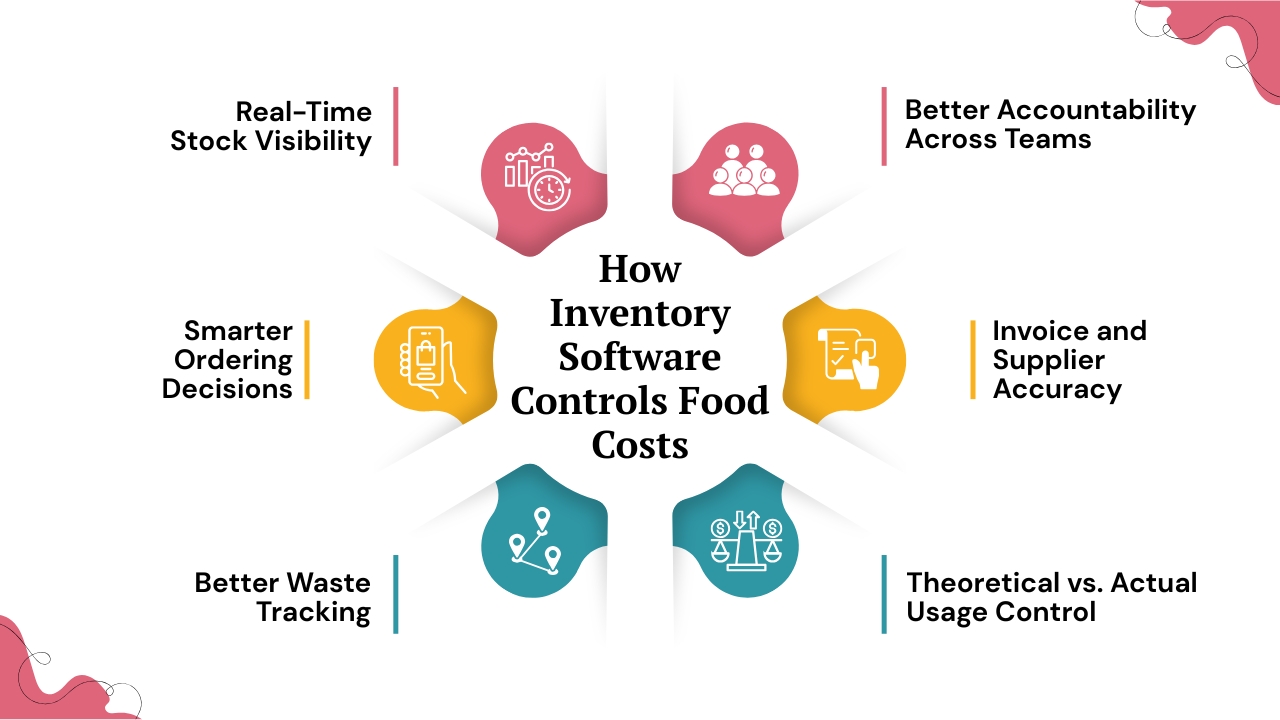
Restaurant inventory software helps to control food costs by giving restaurants a better visibility, stronger purchasing control, and more accurate cost tracking.
Instead of relying on manual counts, guesswork, or delayed reports, managers can use real-time data to make smarter decisions on a daily basis.
1. Real-Time Stock Visibility
Inventory software shows the inventory or stock levels that are available in storage areas, kitchens, bars, and multiple restaurant locations. Such software helps managers to instantly see the items that are running low, which items are overstocked, and about the products that are moving slowly.
This reduces unnecessary stock purchases and helps to prevent last-minute stock shortages.
Also Read: Real Time Analytics Why Does Your Business Needs it
2. Smarter Ordering Decisions
The software uses par levels, reorder points, sales trends, and usage history to recommend the stock that should be ordered. This helps restaurants to buy the right quantity of stock at the right time.
As a result, shelves are not overloaded with excess stock, and kitchens are less likely to run out of crucial ingredients.
Also Read: Improved Decisions Through Decision Intelligence How it Works
3. Better Waste Tracking
Tracking waste on a daily basis helps restaurants to identify the food that is being lost. For instance, certain items may expire often, staff may over-prep during slow periods, or one location may waste more than another.
Once such patterns are clear, then the managers can adjust prep levels, improve storage, and train staff more effectively.
Also Read: The Role of Data Analytics in Reducing Restaurant Waste
4. Theoretical vs. Actual Usage Control
Inventory software compares expected ingredient usage with actual usage. When the expected usage of inventory differs with actual inventory usage, then it may reveal problems like oversized portions, incorrect recipes, food waste, theft, receiving mistakes, or POS errors.
It helps restaurants to identify hidden cost losses quickly and take action before they reduce restaurant profits.
Also Read: Restaurant Demand Forecasting Reduce Restaurant Wastes and Increase Profits
5. Invoice and Supplier Accuracy
The software can match purchase orders, delivery receipts, and invoices. It helps to find incorrect prices, missing items, wrong quantities, duplicate charges, and missed credits before they affect profits.
6. Better Accountability Across Teams
When inventory data is accurate and easy to access, managers, kitchen staff, and purchasing teams become more accountable. Everyone works from the same information, making food cost control more consistent and reliable.
Also Read: AI for Retail Inventory Management
How Inventory Software Reduces Restaurant Food Costs
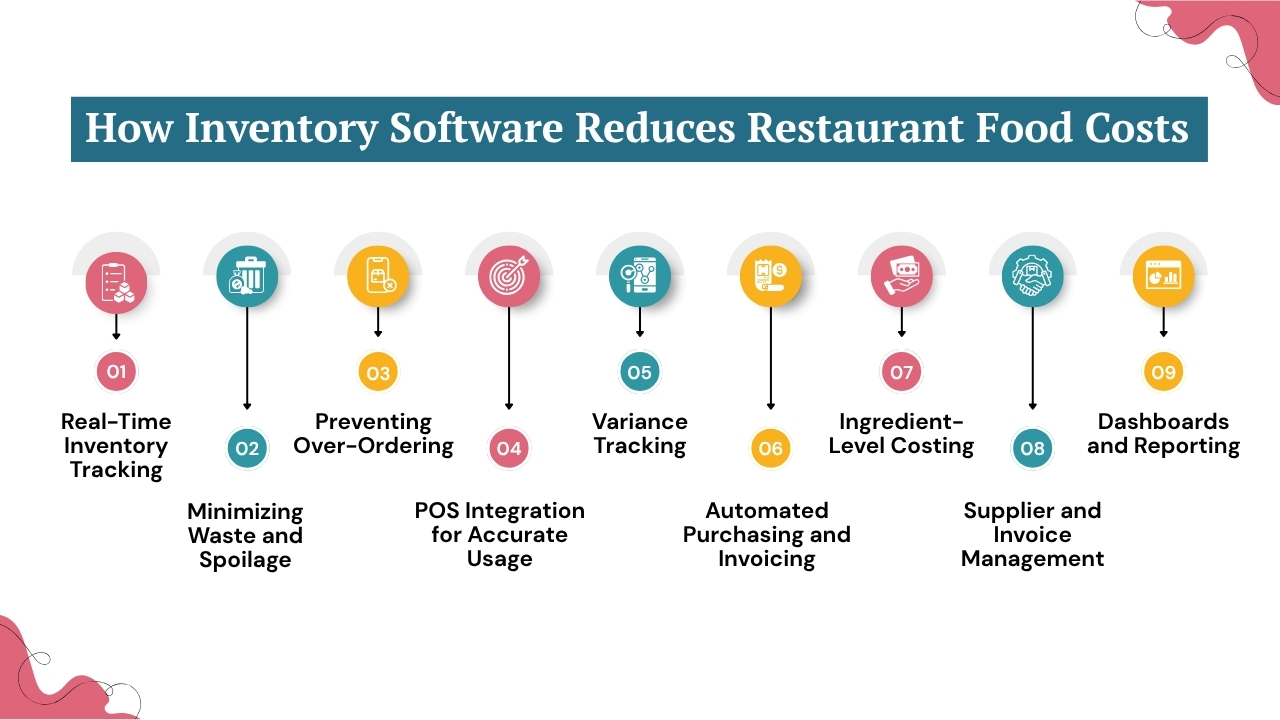
Inventory software helps restaurants reduce food costs by improving accuracy, visibility, and control across purchasing, stock usage, waste, and supplier pricing.
Many restaurants can lower food costs by 2-5% when inventory systems are used consistently because the software reduces guesswork and replaces manual tracking with real-time data.
1. Real-Time Inventory Tracking
Inventory software gives restaurant managers a clear, real-time view of stock levels across kitchens, storage rooms, bars, and multiple locations. Rather than depending on manual counts, spreadsheets, or delayed reports, managers can quickly see that ingredients are available, which items are running low, and which products are not being used fast enough.
It helps to prevent over-ordering, reduces emergency purchases, and lowers the risk of stockouts during busy service hours. With better visibility, restaurants can make faster and more accurate purchasing decisions.
Also Read: AI Unlocks Business Insights That Drive Required Results
2. Minimizing Waste and Spoilage
Inventory software helps restaurants reduce food waste by tracking how ingredients are used, how quickly products move, and when items are close to expiring.
It makes it easier for managers to identify slow-moving stock before it spoils. If certain ingredients are being wasted often, restaurants can reduce order quantities, adjust prep levels, improve storage practices, or create menu specials using those items.
By controlling food spoilage and unnecessary waste, restaurants can lower food costs, protect profit margins, and make better use of every ingredient they purchase.
Also Read: 10 ways restaurant data analytics solution reduce costs and improve profits
3. Preventing Over-Ordering
Inventory software helps restaurants to avoid over-ordering by using sales history, consumption patterns, par levels, and reorder points to guide their purchasing.
Rather than ordering extra stock based on guesswork, managers can see exactly what is needed and what it should be ordered. It keeps inventory levels balanced and prevents shelves from being filled with unused products.
Better ordering of stocks helps restaurants to improve cash flow because money is not tied up in excess stock. It also reduces stock spoilage risk and helps restaurants to control food costs more effectively.
4. POS Integration for Accurate Usage
When inventory software connects with the POS system, inventory updates automatically as menu items are sold. Each sale is connected to recipes, so the system can calculate how much of every ingredient should be used.
It gives managers a clearer view of ingredient movement, portion accuracy, and food cost performance. POS integration also reduces manual data entry and helps to identify gaps between expected and actual usage. With more accurate tracking, restaurants can control waste, improve ordering, and make better decisions based on real sales data.
Also Read: POS Reports vs Real-time Analytics
5. Variance Tracking
Variance tracking helps restaurants to compare expected ingredient usage with actual inventory results. Theoretical usage shows how much stock should have been based on recipes and sales, while actual usage shows what stock was really consumed.
When both theoretical usage and actual usage do not match, then the difference can reveal hidden problems such as over-portioning, food waste, theft, recipe errors, receiving mistakes, or POS issues.
When restaurants identify these gaps early, then managers can correct problems faster, improve food portion control, reduce losses, and protect restaurant profit margins.
Also Read: Restaurant Performance Metrics Every Restaurant Owner Should be Tracking
6. Automated Purchasing and Invoicing
Inventory software simplifies purchasing and invoicing by creating purchase orders automatically, scanning supplier invoices, and matching bills against deliveries.
It helps managers to confirm that ordered items, delivered quantities, and billed prices are all accurate. This reduces manual mistakes, duplicate entries, missing credits, and unnoticed price increases from suppliers.
When purchasing and invoice data remain accurate, restaurants can control costs more effectively and avoid paying for items which they did not receive. This creates stronger supplier accountability, improves accounting accuracy, and protects profit margins.
Also Read: Automating Data Analysis Using Artificial Intelligence
7. Ingredient-Level Costing
Ingredient-level costing helps restaurants understand the real cost of every menu item by tracking each ingredient used in a recipe. Managers can see how much each dish costs to prepare and whether it is priced accurately.
This makes it easier to adjust portions, update recipes, control food waste, and protect profit margins. This supports better menu engineering by showing which items are profitable and which ones need improvement. With accurate ingredient costing, restaurants can make smarter pricing and purchasing decisions.
Also Read: Cost-Effective AI Solution for Restaurants
8. Supplier and Invoice Management
Supplier and invoice management helps restaurants to control food costs by tracking vendor prices, order history, delivery accuracy, and invoice details in one place.
As supplier prices can change often, managers require a system that quickly shows price increases, inaccurate charges, missing credits, or duplicate invoices.
A good inventory system compares invoice prices with agreed rates, purchase orders, and previous deliveries. It helps restaurants to catch errors before payment, improve supplier accountability, and protect profit margins from unnoticed cost increases.
Also Read: Benefits of Supply Chain Optimization for Businesses
9. Dashboards and Reporting
Dashboards and reporting tools help restaurant managers understand inventory and food cost data quickly. Rather than reviewing spreadsheets or separate reports, managers can see important information in one place that includes food cost trends, waste levels, stock variance, supplier price changes, and menu performance.
Clear dashboards help restaurants to identify problems, compare locations, and track progress over time easily. Having accurate reports helps restaurants to make faster decisions, reduce hidden losses, improve inventory purchasing, and keep control over daily operations and profit margins.
Overall, inventory software provides the tools to restaurants to control waste, improve ordering, track costs accurately, and strengthen profit margins.
Livelytics supports interactive visualizations, real-time reports, customizable dashboards, drill-down reports, and charts that help businesses uncover detailed insights.
Also Read: Business Intelligence Dashboard for Data Collection
How Inventory Software Improves Efficiency
Inventory management software improves restaurant efficiency as it helps restaurants for real-time data to make daily inventory tracking faster, more accurate, and easier to manage.
1. Saves Time on Manual Tasks
Having access to inventory software helps managers to not spend many hours counting stock, update spreadsheets, checking invoices, or estimate order quantities. This software provides automated tools that help managers to complete all their tasks faster and with less mistakes.
Also Read: Two Way Data Analysis is Shaping Retail Business
2. Simplifies Stock Counts
Inventory software simplifies stock counts because it lets staff complete inventory counts using mobile devices rather than using paper sheets. This makes stock counting faster, reduces duplicate stock entries, and keeps inventory records updated in real time.
Also Read: AI for Retail Inventory Management
3. Automates Purchasing
The software can generate purchase orders based on par levels, reorder points, and low-stock alerts. This helps restaurants to order on time without depending on guesswork or last-minute decisions.
Also Read: Automating Data Analysis Using Artificial Intelligence
4. Improves Invoice Matching
Inventory software can compare invoices with purchase orders and deliveries. This helps restaurants to catch incorrect prices, missing items, duplicate charges, and supplier billing mistakes before payments are made.
5. Improves Team Communication
Kitchen teams, purchasing staff, accounting teams, and owners can all work from the same data. It reduces confusion, repeated work, and delays between departments.
6. Helps Managers Focus on Exceptions
Instead of checking every item manually, inventory software allows managers to focus on unusual waste, high-cost ingredients, supplier price changes, and inventory varices. This makes inventory control more strategic and improves overall restaurant operations.
How Inventory Software Supports Better Menu Decisions
Inventory software helps restaurants to make smarter menu decisions as it connects ingredient costs, recipe usage, sales performance, and profit margins.
1. Shows True Menu Item Costs
A dish may sell well but still provide low profit if the ingredient costs of that dish are very high. Inventory software helps managers to calculate the actual cost of each menu item which includes every ingredient used in the recipe.
Also Read: Optimizing a Restaurant Menu With AI Powered Data Analytics
2. Identifies High-Margin and Low-Margin Items
Some menu items may sell less but generate good profit margins. While other menu items may be popular among customers but quite expensive to produce. Having accurate cost and sales data helps managers to clearly see the items that support profits.
Also Read: Restaurant Profit Margin Analytics Tool to Boost Profits
3. Improves Menu Engineering
Having inventory data helps restaurants to promote high-margin dishes, adjust food recipes, reduce portion costs, remove slow moving food items, or update prices on the basis of actual food costs.
Also Read: How Data Analytics Can Help Restaurants Optimize Menus
4. Supports Better Pricing Decisions
When ingredient prices change, inventory software helps restaurants to review whether menu prices still protect profit margins. It helps restaurants to avoid underpricing profitable dishes or losing revenue on popular items.
Also Read: Benefits of Data Driven Decision Making
5. Adds AI-Powered Insights
Platforms like Livelytics can combine POS data, food cost data, customer behavior, and operational trends to know where menu changes can improve profits.
Also Read: How AI Unlocks Business Insights that Drive Required Results
Best Practices for Implementing Restaurant Inventory Software
1. Clean Your Inventory List
Before using inventory software, restaurants should organize their item list properly. Remove duplicate products, standardize units, create clear categories, and confirm supplier details. A messy inventory setup can lead to inaccurate reports and poor decisions.
2. Set Accurate Par Levels
Par levels and reorder points should be based on real usage, supplier lead times, delivery schedules, storage space, and shelf life. These levels should be reviewed regularly because customer demand and menu needs can change over time.
3. Train Staff Properly
Everyone involved in counting, receiving, wasting, transferring, or ordering should know how to use the system. Simple training helps teams follow the same process consistently and reduces mistakes.
Also Read: How Data Analytics Improve the Measurement of Employee Performance
4. Log Waste Daily
Daily waste tracking gives managers better data. Waiting until the end of the week can lead to forgotten details and missed problems.
5. Review Reports Weekly
Managers should review food cost trends, stock variance, supplier pricing, waste, and high-value ingredients every week.
6. Connect Your Systems
Integrating inventory with POS, accounting, and analytics tools creates stronger insights and better decision-making.
Why Livelytics Adds More Value to Restaurant Inventory Control
Livelytics adds more value to restaurant inventory control by helping owners see inventory as part of the full business picture. Inventory is connected to sales, labor, supplier pricing, customer demand, menu performance, accounting, and profitability. When restaurants only look at stock levels, they may miss the bigger reasons behind rising costs or shrinking margins.
Livelytics helps bring data from POS systems, accounting tools, CRM platforms, inventory software, and other business systems into one clear view. This allows restaurant owners to understand which ingredients are increasing in cost, which menu items are hurting margins, which locations are wasting more food, and which suppliers are affecting profitability.
With AI-powered analytics, Livelytics helps restaurants move from reactive management to proactive decision-making. Instead of waiting until profits drop, managers can spot risks earlier, solve operational problems faster, and make smarter decisions that protect food costs, improve efficiency, and support long-term growth.
Conclusion
Inventory software for restaurants reduces food costs because it gives managers better control over stock, purchasing, waste, supplier pricing, and menu profits.
Rather than manually counting, spreadsheets, or guesswork, restaurants can use real-time data to understand exactly the inventory that is being used, the inventory that is being wasted, and the inventory that needs to be ordered.
The biggest benefits of inventory software is visibility. When managers see inventory levels, ingredient usage, variance, waste patterns, and supplier price changes clearly then they can take faster action.
It helps restaurants to prevent over-ordering, reduce food spoilage, control portions, catch invoice errors, and identify hidden food cost losses before they damage overall profit margins.
Inventory software supports better decisions across the entire restaurant operation. This helps teams to order stock smartly, track recipe costs, improve menu pricing, compare location performance, and create more consistent inventory procedures.
When inventory software is connected with POS, accounting, and analytics tools, then the value becomes even more stronger.
For restaurants that want to protect margins and operate more efficiently, inventory software is no longer optional but instead is a helpful tool. This is a practical system for reducing food costs, improving accountability, and building a more profitable restaurant business.
If you still have any query about how inventory software for restaurants reduces food costs then you may book a free demo at Livelytics and we are more than happy to assist you.