In today’s quickly changing restaurant market, data analytics for restaurants is not optional. Restaurant data analytics has become an essential tool that supports growth, operational efficiency, and long-term success.
As of 2026, restaurants are generating even more data every day from point-of-sale(POS) systems, online orders, customer feedback, and delivery platforms.
But the real challenge is not with collecting data rather converting that data into actionable insights that improves decision-making abilities of businesses and improves profits.
Most restaurants are using restaurant data analytics tools that help them to understand customer behavior, better menus, manage inventory, and streamline operations.
Due to the rise in the use of AI-powered analytics, many restaurants can predict demand, identify patterns, and personalize customer experiences which was not possible before.
Whether you are running a small cafe or a multi-location chain, real-time data insights help to reduce waste, increase profits, and improve customer satisfaction.
In 2026, when restaurants implement data analytics, it will help restaurants to have a competitive advantage. Tracking different metrics like sales performance, table turnover rates, and customer preferences, helps restaurant owners to make smarter and faster decisions.
Additionally integrating data from various sources such as online ordering platforms, social media, and loyalty programs gives a complete view of business performance to restaurants.
This blog will walk you through everything you need to understand about restaurant analytics which includes essential tools, key metrics, advantages, and implementation strategies.
So if you are about to launch a restaurant data analytics in your platforms or want to upgrade your systems, then it is essential to understand data analytics in the restaurant industry which will help restaurants to stay ahead of competitors and offer excellent dining experiences in 2026 and beyond.
Also Read: How Restaurant Data Analytics Helps Increase Profit Margin
Why Data Analytics Matters More Than Ever in 2026
The restaurant industry in 2026 has become competitive and rapidly changing than before. Due to increase in the costs, digital ordering, and increasing customer expectations, making decisions only by guessing is not enough.
Data analytics for restaurants provides the insights which are essential for them to make smarter decisions, improve efficiency, and remain ahead of the competitors.
When these analytics tools convert their everyday data into actionable strategies, it helps restaurants to function more effectively and provide better customer experiences.
1. Data-Driven Decision Making
Today restaurant data analytics generate insights from every transaction and customer interaction. Instead of guessing, restaurant data analytics tools help businesses to make informed decisions with real data.
This helps restaurants to know the sales patterns, find best-selling items, and busy hours. It helps restaurants to make better choices about pricing, promotions, and menus.
Such a data-driven approach helps restaurants to act in real time when the market changes which ensures restaurants remain quick and competitive. Utilizing right insights helps businesses to reduce risks and improve their decisions which leads to consistent growth.
Also Read: Benefits of Data-Driven Decision Making
2. Improved Profit Margins
Due to the increase in food costs and operational expenses in 2026, profitability is a major concern for restaurants. Data analytics tools are essential that helps restaurants to improve profits by identifying the factors that lead to profits or losses.
Such insights help restaurants to highlight high-selling items and promote them effectively and remove underperforming dishes from their menu. These analytics help restaurants to reduce food waste by tracking food usage and predict customer demand accurately.
Additionally these insights help restaurants to have control over unwanted expenses that includes labor and supply costs. When restaurants focus on efficiency and cost optimization, restaurants are able to improve their revenue and achieve consistent growth.
Also Read: Restaurant Profit Margin Analytics Tool to Boost Profits
3. Enhanced Customer Experience
Customer expectations have changed in recent years. Hence, it has become essential for restaurants to provide personalized experiences. Restaurant analytics tools help businesses to understand behavior of their customer, customer preferences, and food ordering patterns.
Such information helps restaurants to provide targeted promotions, recommend popular items, and offer personalized loyalty programs. These analytics tools help restaurants to improve the speed of their services by identifying busy hours and optimize their staff availability. Also tracking customer feedback and reviews helps restaurants to quickly resolve their problems and improve overall customer satisfaction.
When restaurants implement a data-driven approach then every interaction with customers feels personalized and effortless that leads to stronger relationships with customers, increased customer loyalty, and higher customer retention rates. A data-driven approach ensures that every interaction feels customized and seamless that leads to stronger relationships, increased customer loyalty, and higher retention rates.
Also Read: How AI Revolutionizes Customer Experience in Restaurant Industry
4. Operational Efficiency
Operational efficiency is essential for running a restaurant successfully. Data analytics tools help restaurants to manage every area of the business successfully.
From staffing, inventory management, these insights help restaurants to streamline processes and reduce operational inefficiencies.
It helps restaurants to optimize staff schedules on the basis of customer demand, which ensures that the right number of employees are available at the right time.
Tracking inventory helps restaurants to avoid overstocking of inventory and inventory shortages which helps to reduce waste and improve cost control. These analytics help to improve kitchen workflows, reduce any errors, and speed up order processing.
When restaurants improve coordination across all operations, restaurants can offer faster service, maintain consistency, and operate more smoothly on a daily basis.
Also Read: How to Improve Restaurant Operations
Types of Data Restaurants Should Track
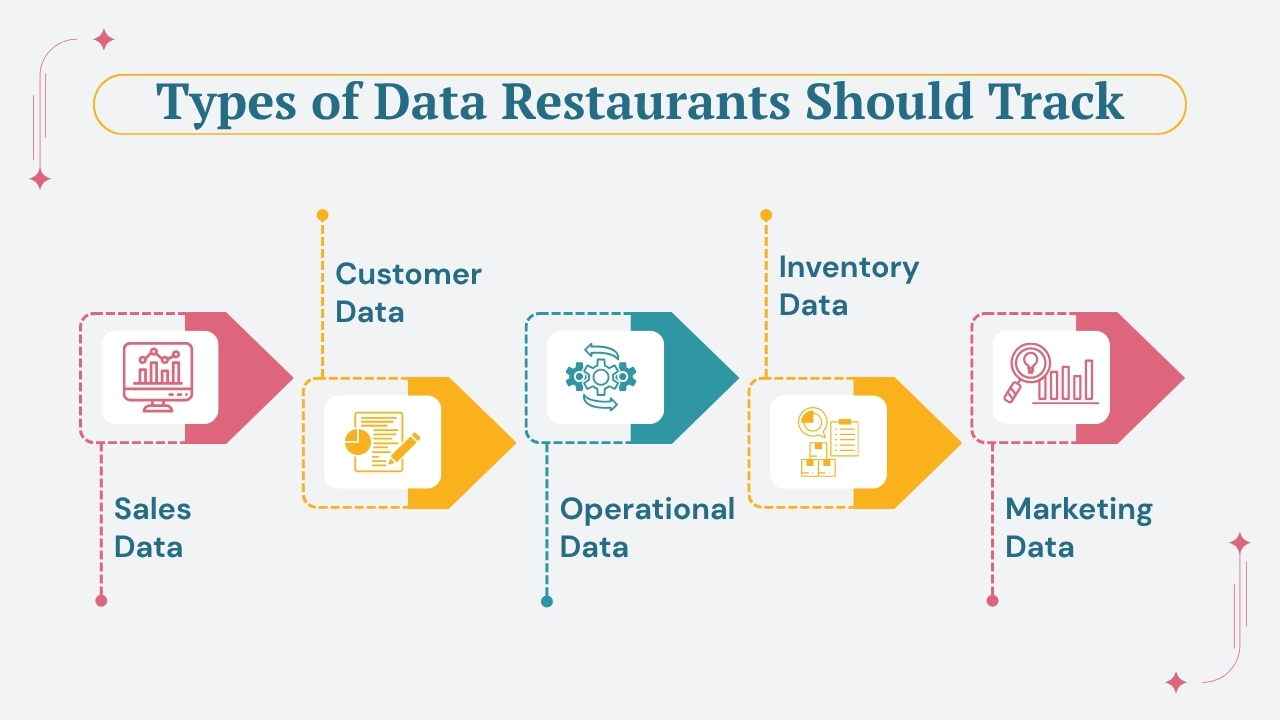
To fully utilize data analytics for restaurants, it is essential for them to understand the data that is actually important. Tracking the right data helps restaurants to make smarter decisions, improve efficiency, and increase profits.
In 2026, successful restaurants depend on several factors such as sales, customer, operational, inventory, and marketing data to remain ahead of competitors and grow consistently.
1. Sales Data
Sales data is the foundation of restaurant data analytics. It helps restaurants to get a complete understanding of business performance. This data helps restaurants to understand sales patterns, customer demand, and product performance.
Key Metrics:
- Total revenue
- Sales by day, week, and month
- Sales by menu item
- Peak hours and slow periods
Why It Matters:
Sales data reveals crucial patterns that help businesses to make smarter business decisions. This data reveals the fast selling food items, optimize pricing, predict customer demand, and identify busy hours.
These insights help restaurants to plan staffing more effectively, improve service speed, and operate efficiently that makes sales data crucial for growth.
Also Read: How to Increase Restaurant Sales Without Advertising
2. Customer Data
Understanding customer behavior is crucial for ensuring long-term success. Customer data analytics offers insights about the customer preferences, their purchasing habits, and engagement levels.
Key Metrics:
- Customer demographics
- Order history
- Visit frequency
- Average spend per customer
Why It Matters:
Customer data helps restaurants to offer personalized experiences to customers and also targeted marketing campaigns. Analyzing order history and customer preferences helps businesses to recommend popular items to their customers and offer personalized promotions.
By tracking customer visit frequency helps restaurants to find their loyal customers and also those customers who may not return back to restaurants.
Additionally, understanding the average spend of customers helps restaurants that helps to improve upselling and pricing strategies. It helps restaurants to build stronger relationships with customers, higher customer retention, and increased lifetime value.
Also Read: Customer Analytics for Restaurants
3. Operational Data
Operational efficiency is essential for restaurants to achieve high profits and improved customer satisfaction. This data helps restaurants to streamline processes and improve overall performance of restaurants.
Key Metrics:
- Table turnover rate
- Order preparation time
- Staff performance
- Wait times
Why It Matters:
Operational data helps restaurants to identify inefficiencies in operations and also improve workflows. For instance, tracking order preparation time helps to find delays in the kitchen, while tracking table turnover helps maximum seating capacity.
Staff performance metrics reveal that employees are productive and also offer consistent service. Wḥen restaurants reduce wait times, improve the customer experience and satisfaction levels. Optimizing daily operations helps restaurants to run smoothly and efficiently.
Also Read: Two Way Data Analytics in Shaping Retail Business
4. Inventory Data
Inventory management is essential for restaurants to control costs and reduce waste. Inventory data analytics helps restaurants to ensure that there is balance between supply and demand.
Key Metrics:
- Stock levels
- Food waste
- Ingredient usage
- Supplier performance
Why It Matters:
Having inventory data helps restaurants to avoid overstocking or stockouts of inventory which can cause losses. Tracking ingredient usage helps restaurants to predict customer demand accurately and reduce any unnecessary waste.
When restaurants track food waste it helps restaurants to reveal the areas where they can save money. Evaluating supplier performance ensures that there is consistent quality and timely delivery.
Implementing effective inventory management often leads to best control over expenses, improved efficiency, and reduced losses.
Also Read: AI for Retail Inventory Management
5. Marketing Data
Marketing analytics is crucial for measuring the effectiveness of campaigns and achieving maximum return on investment. Marketing data analytics helps restaurants to attract and retain customers effectively.
Key Metrics:
- Campaign performance
- Customer acquisition cost (CAC)
- Conversion rates
- ROI on promotions
Why It Matters:
Marketing data offers insights about strategies that deliver results and learn about strategies that require improvement. This helps restaurants to identify the most effective channels whether social media, email campaigns, or delivery platforms.
Tracking customer acquisition costs helps restaurants to ensure that marketing expenses are efficient and sustainable. While conversion rates reveal how good campaigns convert potential customers into actual sales.
Measuring return on investment helps to refine further marketing efforts and avoid any unwanted expenses. Ultimately marketing data ensures that every campaign leads to business growth.
Also Read: Benefits of Data-Driven Decision Making
Key Metrics Every Restaurant Should Monitor
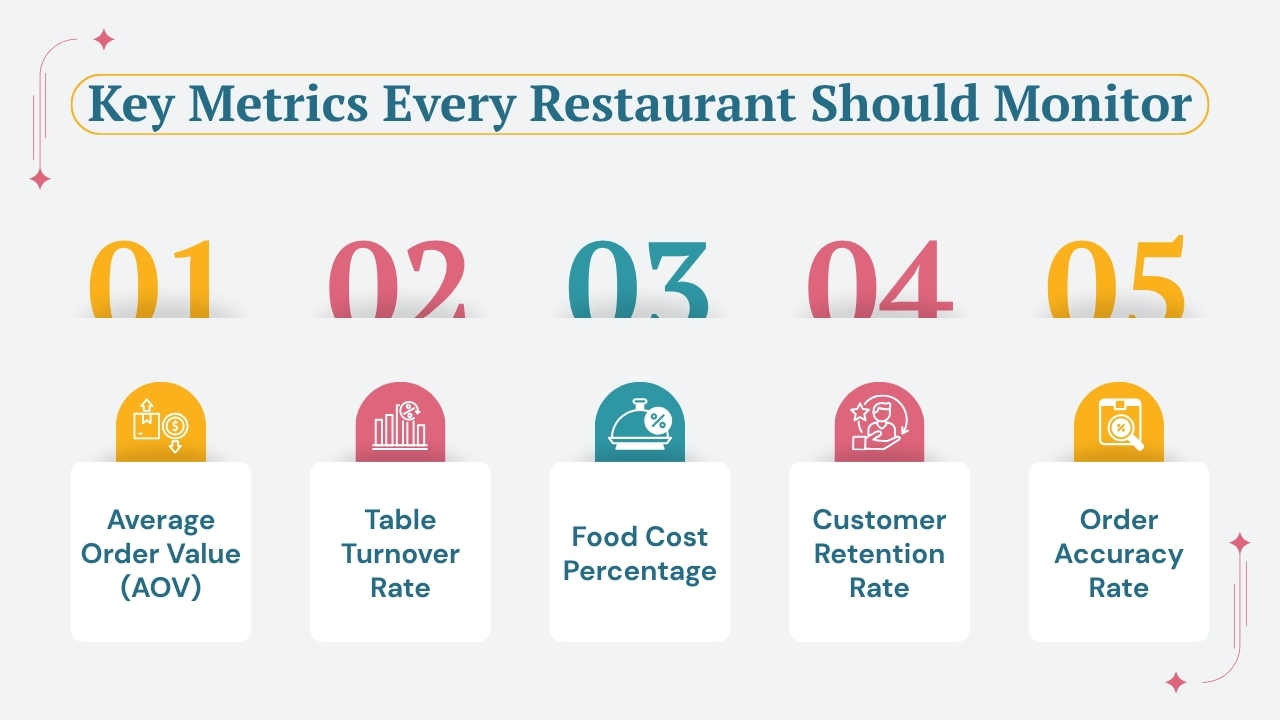
For successfully implementing data analytics for restaurants it is essential to focus on metrics that impact performance, profitability, and customer satisfaction.
Tracking the right KPIs helps restaurant restaurant managers to make informed decisions, better operations, and drive long-term growth.
Below are five essential metrics every restaurant should track in 2026.
1. Average Order Value (AOV)
Average Order Value(AOV) measures how much customers spend per order. It is essential to understand revenue per transaction to find the opportunities to increase sales without increasing customer volume.
For tracking Average order value, restaurants have to divide total revenue by the number of orders within a certain period. If higher the average order value, it shows that customers are spending more per visit to restaurants that directly improves revenue.
How to Improve AOV:
- Use upselling techniques, such as suggesting add-ons, drinks, or desserts
- Implement cross-selling strategies by pairing items together (e.g., meal combos)
- Offer combo deals and bundles that provide value while increasing total spend
- Optimize menu design and placement to highlight high-margin items
- Train staff to recommend popular or premium items effectively
By improving Average Order Value, restaurants can increase profitability without requiring to attract additional customers that makes it one of the most efficient growth strategies.
Also Read: Optimizing a Restaurant Value With AI Powered Data Analytics
2. Table Turnover Rate
The table turnover rate measures how quickly tables of a restaurant get occupied, how fast their services are made available for the next customers.
For dine-in restaurants it is essential to track table turnover rates because seating capacity directly impacts revenue.
When table turnover rates are high, it means more customers can be served at the same time that lead to high sales without requiring increased physical space.
Why It Matters:
- Higher turnover = more customers served = higher revenue
- Reduces waiting time and improves customer satisfaction
- Maximizes the use of available seating capacity
- Helps identify inefficiencies in service or kitchen operations
For increasing table turnover rates restaurants have to enable smooth service processes, reduce order preparation time, and better staff coordination.
It is essential for restaurants to provide fast service along with quality services to customers so that they feel they are served well.
When managed effectively, this metric helps restaurants to improve revenue and customer experience.
Also Read: Optimizing a Table Turnover Using Analytics
3. Food Cost Percentage
Food cost percentage measures the cost that restaurants spend on ingredients to the revenue that they generate from food selling. This is one of the crucial metrics for restaurants to control expenses and maintain profits.
Food cost percentage is calculated by dividing the cost of ingredients by total food sale and then multiplying the result by 100.
This metric helps restaurants to know how efficiently they are managing ingredient costs. A high food cost percentage indicates waste, over-portioning, inefficient purchasing while a very low food cost percentage may impact food quality.
Why It Matters:
- Helps control expenses and maintain profit margins
- Identifies waste and inefficiencies in inventory usage
- Supports better menu pricing strategies
- Encourages smarter purchasing and supplier management
It is essential for restaurants to track inventory closely, reduce food waste, standard portion sizes, and regularly review supplier pricing. Maintaining a balanced food cost percentage ensures that there are sustainable profits.
Also Read: How to Calculate Food Cost Percentage
4. Customer Retention Rate
The customer retention rate tracks the count of customers who may return to your restaurant after a certain period. In 2026, retaining old customers is more cost-effective than acquiring new customers . It is essential to track customer retention rate for ensuring long-term success.
If there are repeat customers then they may spend more, visit frequently, and are more likely to recommend your restaurants to others.
Why It Matters:
- Loyal customers generate consistent revenue
- Reduces marketing and customer acquisition costs
- Builds strong brand reputation and trust
- Increases lifetime customer value
For improving customer retention, restaurants can offer loyalty programs, personalized promotions, and good customer service.
Analyzing customer data helps restaurants to identify customer preferences and personalize their experiences that encourage repeat visiting. By focusing on customer retention helps restaurants to ensure that there is stable growth and a loyal customer base.
Also Read: Customer Analytics for Restaurants
5. Order Accuracy Rate
The order accuracy rate tracks the count of customer orders that are fulfilled accurately without any errors. This metric directly impacts customer satisfaction levels and operational efficiency.
Even if there are minor mistakes such as missing items or incorrect orders can often cause customer dissatisfaction, negative reviews, and lost customers.
Impact:
- Higher accuracy leads to better customer satisfaction
- Reduces complaints, refunds, and rework costs
- Improves brand reputation and trust
- Enhances overall service quality
For improving order accuracy, it is essential for restaurants to clearly communicate with staff using digital ordering systems and train employees well.
Technologies like POS integrations and kitchen display systems may also reduce errors. Maintaining a high order accuracy rate ensures that they offer a smooth and reliable dining experience to customers.
Also Read: Customer Analytics for Restaurants
Using Data to Optimize Your Menu
Menu engineering is an essential way for restaurants to use data analytics to improve restaurant performance and profits.
Analyzing this sales and cost data helps restaurants to make smarter decisions to know about the items which they need to promote, or remove from their menu.
Steps to Optimize Your Menu:
- Identify best-selling items to understand customer preferences
- Analyze profit margins to determine which dishes generate the most revenue
- Highlight high-margin dishes
- Adjust pricing based on demand, cost, and competition
Result:
By utilizing data-driven menu optimization often increases profits by focusing on strategies that work best. It helps restaurants to improve customer satisfaction by providing popular and high-quality items.
Additionally, when restaurants plan better inventory, it helps restaurants to reduce food waste and unnecessary costs which lead to efficient and consistent operations.
Also Read: Optimizing a Restaurant Menu With AI Powered Data Analytics
Enhancing Marketing Strategies with Analytics
Data-driven marketing helps restaurants to design effective campaigns which will be based on real customer insights instead of assumptions.
With the help of analytics, helps restaurants to understand their audience and send the right message at the right time to their customers.
Strategies:
- Segment customers based on behavior, preferences, and spending patterns
- Run targeted campaigns tailored to specific customer groups
- Track campaign performance using measurable metrics
- Optimize promotions based on real-time results and feedback
Result:
Utilizing analytics in marketing often causes higher return on investment, improved customer engagement, and better conversion rates.
These insights help restaurants to spend their budget on promotions that work, reduce unwanted expenses, and build stronger connections with their customers.
Also Read: Best Marketing Strategies for Restaurants
Real-Time Dashboards and Reporting
Modern analytics tools offer real-time insights which help restaurants to remain informed and make fast, data-driven decisions. Rather than depending on delayed reports, managers may have access to live data and respond quickly to changing restaurant conditions.
Key Dashboard Features:
- Sales trends to monitor revenue patterns and identify peak hours
- Performance metrics such as order volume, staff efficiency, and customer activity
- Alerts and notifications for critical updates like stock shortages or drops in sales
Real-time dashboards help restaurants to remain proactive, reduce risks, and ensure smoother, efficient operations every day.
Also Read: Real-Time Dashboard Drive Smart Business Decisions
How to Implement Data Analytics in Your Restaurant
Implementing data analytics in your restaurants need a clear approach to convert raw data into actionable insights that improve performance and profits.
Step 1: Choose the Right Tools
The first step of implementing Data Analytics in restaurants is to select a reliable POS system and analytics platforms that match with the needs of your restaurants.
Implementing the right tools helps restaurants to provide real-time reporting, easy integration, and user-friendly dashboards which helps restaurants to make informed decisions.
Also Read: How Data Analytics Helps Restaurant Optimize Menus
Step 2: Collect Data
It is essential that restaurants ensure all systems such as POS, inventory, and customer management systems are integrated which helps them to collect accurate data.
This data includes sales transactions, customer preferences, and operational metrics that give a clear understanding of your business.
Also Read: Automating Data Analysis Using Artificial Intelligence
Step 3: Analyze Data
Then use dashboards and reports to understand the patterns, performance of restaurants. When restaurants identify busy hours, best selling menu items, and customer behavior helps to understand the strategies that are working and the strategies that require improvement.
Step 4: Take Action
Then restaurants use these insights and better their menu, adjust prices, streamline operations, and improve marketing. When restaurants make data driven decisions often leads to higher efficiency and customer satisfaction.
Step 5: Monitor Results
It is essential for restaurants to continuously track restaurant performance and manage the impact of your changes. By regularly tracking these metrics helps restaurants to refine strategies and ensure long-term success of restaurants.
Conclusion
In 2026, data analytics for restaurants is no longer optional; instead it is a necessary tool which helps restaurants to stay competitive and profitable in a quickly changing industry.
Understanding customer behavior, optimizing operations, and reducing costs, data helps restaurants to make smarter, faster, and confident decisions.
Leveraging insights from sales, customer, operational, inventory, and marketing data, helps businesses to reveal hidden opportunities and address challenges actively.
Modern tools like POS systems, AI-powered analytics, and real-time dashboards help restaurants to collect and analyze data easily.
When these tools are utilized effectively, these tools helps to improve menu performance, improve customer experiences, and streamline everyday operations.
More importantly, it helps restaurants to shift from reactive decision-making to a proactive, data-driven approach.
While the competition continues increasing, restaurants who adopt analytics will have a competitive advantage. Consistently tracking important metrics, adapting essential strategies, and focusing on customer needs, helps businesses to achieve sustainable growth.
Ultimately, data analytics is essential for building an efficient, customer-focused, and future ready restaurant in 2026 and beyond.
If you still have any query with data analytics for restaurants in 2026 then you may book a free demo at Livelytics and we are more than happy to assist you.