Introduction
It’s a dream for every restaurant business owner to see tables turning faster, guests leaving happier, and the revenue graph climbing steadily.
But in reality, increasing your table turnover rate isn’t just about clearing plates quicker or handing out the bill sooner. It’s about understanding the tiny details that make a big difference.
Did you know, as per an expert, Restaurants with slow table turnover—particularly when customer wait times exceed 30 minutes can see a 20% drop in revenue per seat.
But have you ever wondered how some restaurants manage to serve more guests without making anyone feel rushed? The answer lies in how they use data. Modern restaurants are no longer dependent on guesswork for restaurant table turnover optimization; it’s driven by a smart analytics tool.
But now you might be wondering, how exactly does this tool work, what are the table turnover best practices hidden in your data, and how the choose the right analytics for your restaurant business? Let’s explore how restaurant table turnover optimization is evolving with analytics and why these insights are becoming essential for staying ahead.
Also Read: How AI is improving Table-Turnover Rate
What is the Table Turnover Rate in Restaurants?
Table turnover rate in restaurants refers to how many times a table is occupied by different guests during a specific period, usually a meal service or an entire day. Simply put, it tells you how often you’re able to seat new guests at the same table. For example, if a table is used by four different dining parties during dinner hours, its turnover rate is four for that period.
Table turnover rates in restaurants vary widely based on the type, service style, and target audience. Here’s what current industry data says:
- Family restaurants have an average table turnover rate of 3. This means that during dinner service (5 p.m. to 10 p.m.), tables will turn around every 1.5 hours.
- Fast food restaurants often have turnover rates ranging from 30 minutes to an hour, resulting in 12-24 spins per table in a 12-hour workday.
- Fine dining restaurants often have lower turnover rates, with only 1-2 turns every service, as customers expect a leisurely dining experience.
By tracking and analysing this rate, you can implement restaurant table turnover optimization strategies that improve efficiency, increase table turnover rate, and boost your overall revenue.
Also Read: How Restaurant Analytics and Reporting Drive Better Business Decision
Why Increase Table Turnover Rate in Restaurants?
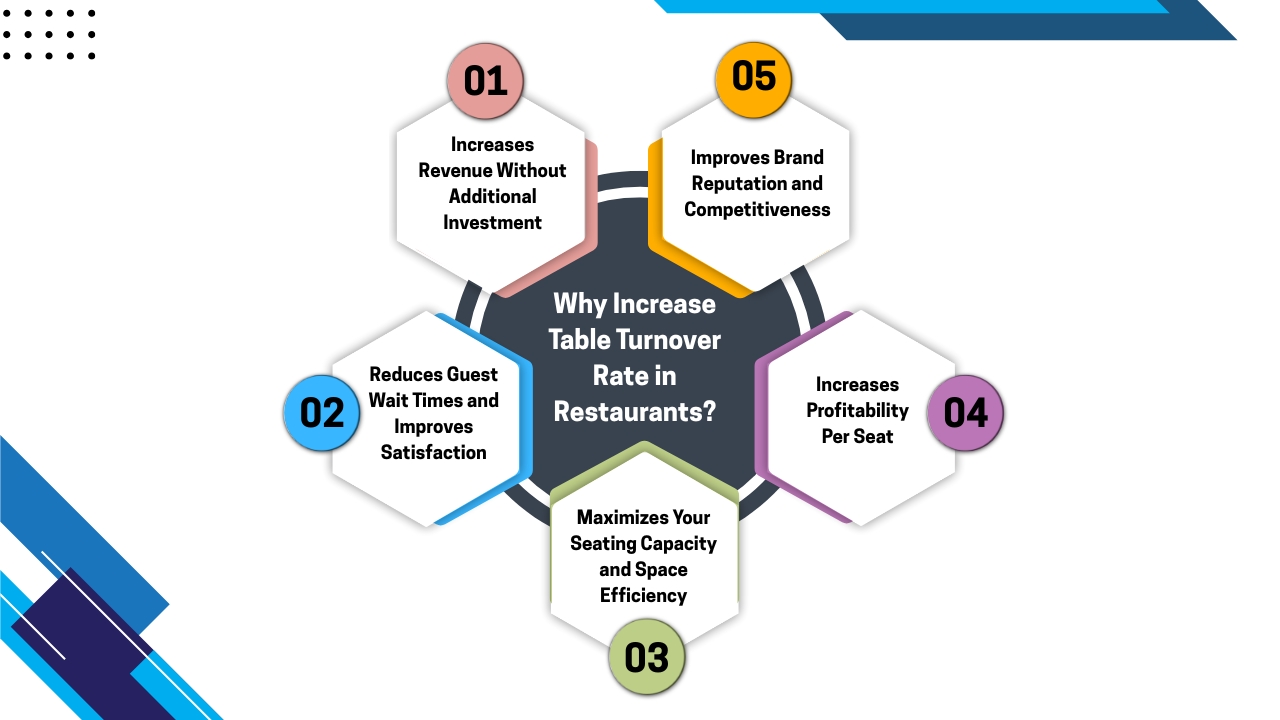
Here’s a deeper look at how optimizing table turnover benefits your restaurant:
1. Increases Revenue Without Additional Investment:
When you increase table turnover rate, you’re simply serving more guests using the same space, staff, and resources. For example, if your tables turn over just one extra time during dinner service, and your average table spend is $80, that’s an additional $800 per 10 tables each night. Over a month, this adds up significantly without any expansion costs or extra payroll.
Also Read: How AI is Boosting Restaurant Revenue and Profits
2. Reduces Guest Wait Times and Improves Satisfaction:
No one likes waiting 45 minutes for a table, especially during lunch breaks or weekend dinners. Restaurant table turnover optimization ensures guests are seated faster, orders are taken promptly, and service flows smoothly. This leads to happier guests, better reviews, and repeat business.
Also Read: How AI Revolutionizes Customer Experience in the Restaurant Industry
3. Maximizes Your Seating Capacity and Space Efficiency:
Your restaurant’s square footage is expensive real estate. By optimizing table turnover, you make the most of each seat, especially during peak hours. For instance, a fast casual restaurant with a turnover rate of 4–5 times per meal period can maximize sales per square foot compared to one turning tables only twice, increasing table turnover rate.
Also Read: Leveraging AI to Collect Customer Insights
4. Increases Profitability Per Seat:
Every seat in your restaurant carries a cost – rent, utilities, staff, and supplies. By optimizing turnover, you’re increasing the revenue generated by each seat, improving your overall profitability without increasing operational costs.
Also Read: How Business intelligence Dashboard Help Business
5. Improves Brand Reputation and Competitiveness:
Restaurants with long wait times and slow table turnover lose guests to competitors. But those who seat guests promptly, provide great service, and maintain quality build a reputation for reliability and guest-centric operations. This enhances your brand image and keeps you ahead in a crowded market.
Also Read: Boosting Brand Loyalty With Customer Sentiment Analytics
How the Right Restaurant Data Analytics Tool Can Increase Table Turnover Rate?
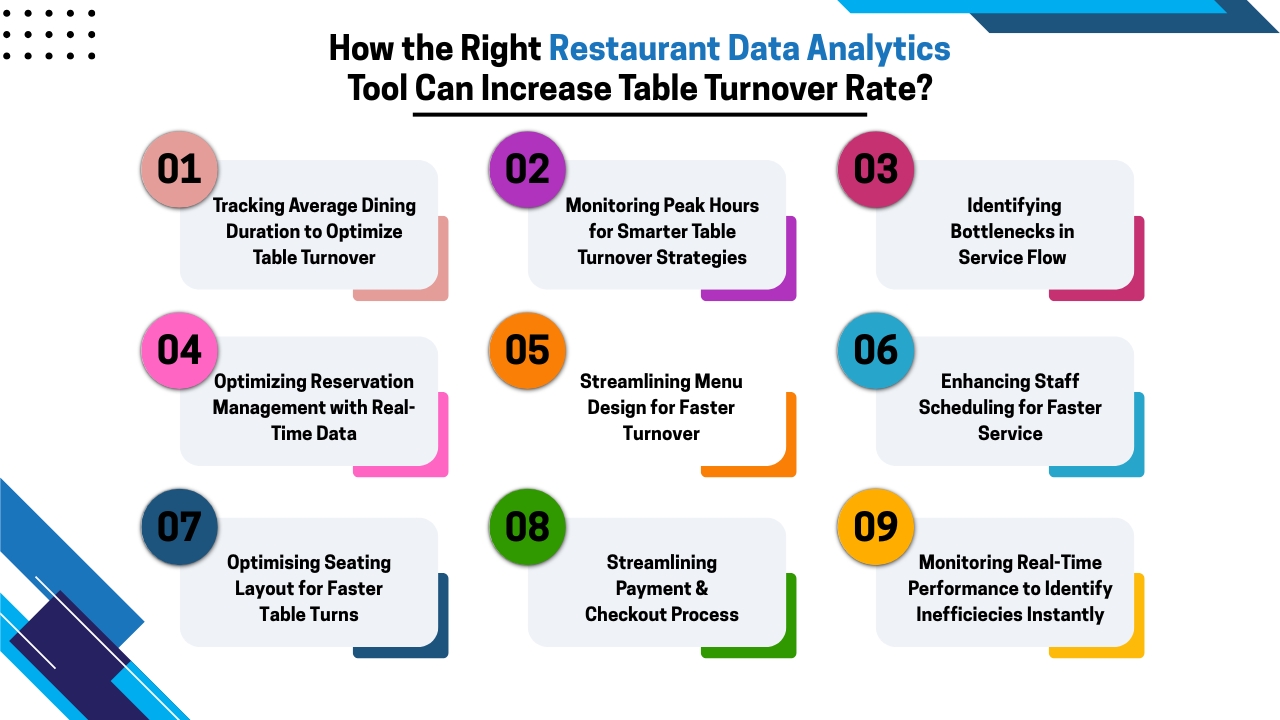
If you want to optimize table turnover using analytics, the right restaurant data analytics tools can make a world of difference. These tools don’t just show you numbers; they reveal powerful insights. By leveraging these insights, restaurants can implement table turnover best practices that increase efficiency without compromising guest experience.
In the next section, we’ll dive into 10 powerful ways these tools track data and help increase your restaurant’s table turnover rate effectively.
1. Tracking Average Dining Duration to Optimize Table Turnover:
One of the smartest ways to optimize table turnover using analytics is by tracking the average dining duration for each table.
The right restaurant data analytics tools record how long guests spend dining based on party size, time of day, and even what they order. For instance, you may discover that two-top tables during weekday lunches turn over in about 35 minutes, while larger dinner parties take 90 minutes or more.
Knowing these patterns helps you implement table turnover best practices like:
- Adjust reservation slots based on realistic dining durations to avoid overlaps and waiting for guests.
- Pace service efficiently, such as taking orders promptly for quick-turn tables during lunch hours.
- Plan seating strategies, like prioritizing smaller, faster-turning tables during peak hours to increase guest count.
- Train staff to monitor cues indicating guests are ready to leave and gently offer bill settlement or clear plates to maintain flow without making guests feel rushed.
- Optimize menu offerings for peak hours by promoting items that have faster prep and serving times to reduce table occupancy duration.
How Livelytics Takes It a Step Ahead
This is where Livelytics truly shines. It combines AI, ML, and predictive intelligence to show dining duration trends in real time and predicts how long each table will be occupied based on historical data, party size, and even seasonal dining behavior.
Imagine knowing that Table 4’s upcoming reservation will likely finish in 42 minutes, giving you confidence to slot another reservation right after, reducing empty table gaps. Livelytics also suggests actionable strategies based on these insights, like adjusting your lunch menu to promote quick-turn dishes or reallocating staff during peak times.
Also Read: AI for Restaurant Marketing
2. Monitoring Peak Hours for Smarter Table Turnover Strategies:
Another powerful way to optimize table turnover using analytics is by closely monitoring your restaurant’s peak hours. The best restaurant data analytics tools help you identify not just general busy times but also specific patterns like which days have higher lunch rushes or which evenings see longer dining durations.
What practices can restaurants implement with this data?
- Schedule staff efficiently to ensure enough hands are available during peak hours for quick service and table resets.
- Streamline kitchen workflows during these periods to reduce ticket times and avoid delays.
- Offer limited-time or pre-set menus during peak hours to shorten ordering and preparation time.
- Stagger reservations strategically to avoid sudden crowding and empty table gaps.
- Run targeted promotions to attract customers during slower hours, balancing out the traffic flow for the day.
How Livelytics Takes It a Step Ahead
Livelytics doesn’t just show you your peak hours; it predicts them with AI and ML-powered insights by analyzing historical data, seasonality, local events, and guest behaviors. For example, if Fridays usually see a spike at 7 pm, Livelytics will forecast expected guest count, suggest optimal staffing levels, and reservation slots.
What makes it stand out is its automated and predictive intelligence, which goes beyond static reports. Livelytics alerts managers ahead of time about upcoming busy periods and recommends actionable strategies, like adjusting menu items for faster prep or realigning staff shifts.
Also Read: Automating Data Analysis Using Artificial Intelligence
3. Identifying Bottlenecks in Service Flow:
Sometimes, slow table turnover isn’t about guests lingering too long; it’s about hidden bottlenecks in your service flow. It includes not having order consistency, following standard recipes, orders piling, guests waiting too long for their bills, or tables staying uncleaned after diners leave.
These small delays add up, affecting your table turnover rate and overall guest experience. The right restaurant data analytics tools can pinpoint exactly where delays are happening, whether it’s slow order taking, longer kitchen prep times, or delays in clearing tables after guests leave.
What practices can restaurants implement with this data?
- Redesign table service processes to remove unnecessary steps and speed up guest turnover naturally.
- Provide targeted staff training based on data showing where service lags occur most often.
- Improve kitchen prep efficiency by identifying dishes that consistently delay orders and reworking their preparation process.
- Enhance table-clearing protocols by assigning specific staff during peak times to reset tables faster.
- Adjust menu offerings if certain dishes frequently slow down the entire dining flow.
How Livelytics Takes It a Step Ahead
Here’s where Livelytics truly changes the game. It drills down to every stage of the guest journey, such as order placement, kitchen prep, food serving, and table clearing, highlighting exact bottlenecks in your flow.
Its AI and ML-powered analytics go further by recommending practical solutions, such as reallocating servers to busier sections, tweaking kitchen workflows, or even reworking table layouts for better service movement. Plus, Livelytics’ predictive intelligence foresees potential delays before they happen, helping managers proactively avoid slowdowns.
Also Read: What is Business Analytics as a Service
4. Optimizing Reservation Management with Real-Time Data:
Efficient reservation management is a powerful way to optimize table turnover using analytics. A good restaurant data analytics tool helps you manage reservations based on real-time data, ensuring your tables are always filled without overlaps or unnecessary gaps.
How does this work in practice?
- Track cancellations and no-shows instantly and reassign tables quickly to walk-in guests.
- Identify peak reservation slots to open waitlists proactively and keep tables occupied.
- Optimize seating plans by analysing table usage patterns, ensuring no table stays empty for too long.
- Adjust reservation slot durations based on historical dining time data to accommodate more guests efficiently.
- Manage to overbook intelligently, balancing it with expected no-show rates to maximize occupancy without hurting guest experience.
How Livelytics Takes It a Step Ahead
While typical reservation systems only handle bookings, Livelytics integrates reservations with real-time operational analytics. Its AI and ML-powered intelligence analyses:
- Historical no-show and cancellation rates
- Average dining times by meal period
- Current table statuses and turnover rates
Using this data, Livelytics suggests the best reservation times, smart overbooking limits, and when to activate your waitlist to keep your tables full and your operations running smoothly. Also, it can help you predict higher walk-in traffic and suggest holding specific tables for walk-ins to balance reservations and walk-in guests seamlessly.
Also Read: Real-Time Analytics Why Your Business Needs it
5. Streamlining Menu Design for Faster Turnover:
Your menu plays a significant role in how quickly guests order, dine, and leave, directly impacting your table turnover rate. Using restaurant data analytics tools, you can analyse which menu items take longer to prepare or consume and design your menu to optimise speed without compromising guest satisfaction.
How does this work in your favour?
- Identify high-prep-time dishes that slow down kitchen operations and turnover, and adjust or simplify them.
- Highlight quick-serve bestsellers during peak hours to reduce overall dining time.
- Track order patterns to design menus that encourage quicker decisions, avoiding guest confusion.
- Optimise menu layout based on item popularity and profitability data for faster ordering.
- Adjust portion sizes or presentation styles where appropriate to speed up serving and dining time.
How Livelytics Takes It a Step Ahead
Unlike basic POS sales reports, Livelytics uses its AI and ML-powered intelligence to:
- Analyse preparation and dining times for each dish
- Map guest ordering patterns by day, time, and table turnover impact
- Suggest menu engineering strategies, like combo offers or quick-serve recommendations during rush periods
What makes Livelytics unique is its predictive intelligence. For example, if it detects that your signature dish is popular but delays table turnover on Friday nights, it suggests reworking its prep method or promoting faster alternatives to maintain guest satisfaction and turnover goals.
Also Read: POS Reports Vs Real Time Analytics
6. Enhancing Staff Scheduling for Faster Service:
Your team’s efficiency directly affects your table turnover rate. If you’re understaffed during peak hours or overstaffed during slow periods, it impacts service speed, guest satisfaction, and operational costs.
But, following the table turnover best practices ensures your team is always ready to deliver quick, quality service, helping you increase table turnover rate while keeping guests happy and operations stress-free.
How can the right restaurant data analytics tool help?
- Analyse peak hours and guest flow patterns to schedule the right number of staff.
- Track individual staff performance data, identifying training needs for faster, smoother service.
- Predict demand surges or lulls to adjust shifts proactively.
- Optimise task allocation so that hosts, servers, bussers, and kitchen staff work in sync, reducing delays.
How Livelytics Takes It a Step Ahead
- Helps you predict busy periods based on past trends and market behavior.
- It recommends optimal staff numbers and role allocations for each shift.
- Analyse service time data to identify bottlenecks caused by staffing gaps or inefficiencies.
- Gives you real-time suggestions on where you are lacking, which server is performing better, which is not, and also how many staff you will be needing based on the current time slot and customers.
- Ask relevant questions, such as, for example, there is a huge event happening nearby, and you can ask how you can better plan the staff and manage their shifts, etc.
Also Read: Types of POS Systems for Restaurants
7. Optimising Seating Layout for Faster Table Turns:
Your restaurant’s seating layout impacts how quickly you can seat guests, serve them comfortably, and turn tables efficiently. A cramped or inefficient layout can slow down service, create bottlenecks, and reduce your table turnover rate.
These table turnover best practices help you use your space smartly to increase table turnover rate while keeping guests comfortable and staff efficient.
How can restaurant data analytics tools help?
- Analyse guest seating patterns and table usage rates to identify underutilised or problematic areas.
- Track service time differences across various seating zones to understand where delays happen.
- Recommend optimal table sizes and arrangements to fit more guests without compromising comfort.
- Identify peak group sizes to adjust layouts that suit most reservations and walk-ins efficiently.
- Measure server walking distances to reassign sections or reposition tables for faster service and table resets.
How Livelytics Takes It a Step Ahead
Unlike static floor plan tools, Livelytics uses its AI and ML-powered intelligence to:
- Analyse dining times based on table locations, sizes, and guest group types.
- Simulate different seating layouts to predict which arrangement increases turnover without affecting guest experience.
- Suggest strategic changes, like adding two-tops near the bar for quick diners or repositioning tables to reduce server travel time.
Because Livelytics is a restaurant data analytics tool built specifically for restaurants, it offers actionable insights beyond aesthetics, ensuring your layout supports operational flow, faster service, and maximum profitability.
Also Read: Two-Way Data Analytics in Shaping Retail Business
8. Streamlining Payment & Checkout Process
The final step of a guest’s dining journey, payment often causes unnecessary delays. Slow POS systems, long waits for card machines, or confusion over bill splitting can add precious minutes to table turnover time.
How can restaurant data analytics tools help?
- Track average checkout time per table to spot delays in final billing.
- Identify peak payment congestion times and suggest solutions to reduce wait.
- Analyse payment preferences (cash, card, digital wallets) to streamline options and staff training.
- Recommend POS integration improvements for faster transaction processing.
- Use customer feedback data to identify dissatisfaction points in the billing process.
When the checkout is smooth, tables become available faster, helping you increase your table turnover rate without rushing guests or hurting their experience.
How Livelytics Takes It a Step Ahead:
Livelytics integrates seamlessly with POS system to streamline the payments and blends ML to go beyond tracking checkout delays to reduce friction in real-time and provides predictive alerts when wait times exceed optimal thresholds, allowing proactive staff response.
Because Livelytics is tailored for restaurant businesses, its insights empower you to fine-tune even the smallest inefficiencies that make a big impact on your overall turnover rate.
9. Monitoring Real-Time Performance to Identify Inefficiencies Instantly:
Delays in service often go unnoticed until they start affecting guest satisfaction or table flow. With a smart restaurant analytics tool, you can spot inefficiencies as they happen, all in real-time.
How does real-time monitoring help increase table turnover rate?
- Tracks live table status, seated, ordering, eating, waiting for bill, or cleared.
- Flags delays in staff attending, order preparation, service times.
- Identifies bottlenecks in the kitchen or server-side processes instantly.
- Sends alerts for table idle time so staff can act quickly.
- Helps shift managers take immediate action to speed up turnaround.
When you’re working with real-time data, you can take proactive steps, reassign staff, assist a delayed server, or prioritize pending orders and ensure smooth, fast-paced operations.
How Livelytics Elevates It?
Livelytics offers live dashboards tailored for restaurant operations. Here’s how it gives you an edge:
- Tracks every table’s journey in real-time, from guest arrival to exit.
- Alerts you when service time crosses the standard threshold.
- Offers quick insights into which tables are lagging and why, be it delayed food, slow billing, or server issues.
- Helps floor managers make instant decisions to keep things moving smoothly.
This kind of real-time responsiveness, powered by AI and automation, is what makes Livelytics more than just a data tool. It becomes your on-ground ally in achieving faster, more consistent table turnover.
Try Your Free Livelytics Demo Today
Livelytics is a one-of-a-kind AI data platform curated specifically for restaurant businesses. Whether you run a cozy cafe, a busy dine-in, or a fast-paced delivery kitchen, it gives you all the insights you need to stay ahead in today’s competitive food industry.
Here’s why restaurant owners love it:
- It’s easily integrable with your existing systems, like POS, CRM, or reservation software.
- It has a simple learning curve, so your team won’t need weeks of training.
- Pricing stars from just $299/month, packed with all the powerful features your restaurant analytics tool should offer.
With Livelytics, you can:
- Increase table turnover through real-time insights and predictive recommendations.
- Automate repetitive tasks like report generation, sales tracking, or staff scheduling.
- Get personalized recommendations for menu, staffing, inventory, and operations.
- Enhance customer satisfaction through smarter, faster service decisions.
- Streamline your entire workflow, from back-of-house to front-of-house.
- Drive business growth with reliable, AI-powered forecasting.
And the best part?
You don’t have to commit right away. You can book a free trial and see how Livelytics works in real-life restaurant operations. Let the results speak for themselves, then decide how you want to move forward.
Try your free Livelytics demo today and turn your data into a competitive advantage.
Final Thoughts
Throughout this blog, we have explored how restaurant owners face challenges like underutilized tables, unpredictable wait times, inefficient staff scheduling, and missed revenue opportunities, often due to scattered or underused data.
Obviously, there are problems. But in this AI realm and data-driven environment, the right data analytics platform can change the game. It helps restaurants turn these bottlenecks into breakthroughs. From optimizing table turnover and predicting peak hours to automating mundane tasks and offering personalized guest experiences, it’s clear that actionable data makes a real difference.
So, make choose the right data analytics platform and take your restaurant business to new heights of success. Good Luck.