It’s Monday morning, and your operations manager is staring at three different spreadsheets trying to figure out why last week’s food cost spiked by 4%. Y
- our POS system shows one set of numbers,
- Your inventory spreadsheet shows another,
- And your accounting software tells a completely different story.
By the time your team manually reconciles everything, it’s Wednesday, and you’ve already placed orders based on gut feeling rather than actual data.
So, with legacy restaurant tools, you’re making strategic decisions based on last week’s information that is costing you thousands in missed opportunities, preventable waste, and reactive decision-making.
That’s why forward-thinking restaurant leaders are replacing legacy systems with restaurant business intelligence platforms. Instead of your team spending hours consolidating data, you get instant insights that drive better decisions across all locations.
Let’s keep on reading to know about why legacy restaurant tools are not enough, and how restaurant business intelligence tools can transform things for your restaurant business.
Also Read: Business Intelligence for Restaurants
What are the Legacy Restaurant Reporting Problems & Why Replace Restaurant Reporting Systems?

You might have invested in multiple systems, such as POS, inventory management, labor scheduling, online ordering, and accounting software. Each promised efficiency, but instead created a new problem. Let’s find out more about it and what it is costing your business.
1. Data Silos = Lost Revenue You Can’t See
Your sales data sits in your POS, inventory in spreadsheets, and labor in scheduling software. None of them talks to each other, so you can’t see the complete picture.
The real cost:
- Industry data shows 2-3% revenue leakage from untracked discounts, voids, and comps
- For a restaurant doing $2M annually: That’s $40,000-$60,000 disappearing without you knowing where
Also Read: How AI Helps In Boosting Restaurant Revenue and Profits
2. Delayed Data = Profit Margin Erosion
You get your food cost report on Friday, showing last week’s numbers. But the damage is already done.
The real cost:
- Average food cost variance: 1-2% when problems go undetected for a week
- On $50,000 weekly food purchases: That’s $500-$1,000 in unnecessary costs per week
- Annual impact: $26,000-$52,000 per location in preventable food cost overruns
Example: Your chicken supplier raises prices by 8% on Monday. You don’t see it until Friday’s report. You’ve already purchased $2,000 worth at the higher price without adjusting menu prices or portions. That’s $160 in lost margin, and it happens repeatedly without real-time restaurant business intelligence tools.
For a 5-location group: That’s $130,000-$260,000 annually just from delayed food cost visibility.
Also Read: Restaurant Profit Margin Analytics Tool for Boost Profits
3. No Forecasting = Massive Food Waste
Without predictive analytics, you’re ordering based on gut feeling or what we ordered last time.
The real cost:
- Industry average food waste: 4-10% of food purchases
- On $500,000 annual food costs: That’s $20,000-$50,000 literally thrown in the trash
- With better forecasting: Reduce waste by 30-50% = saving $6,000-$25,000 annually per location
One study showed that AI-driven waste reduction systems helped businesses cut food waste by 23–51%, and the cost of wasted food per meal dropped by up to 39%
Example: You over-order fresh seafood for weekend service because you don’t have demand forecasting. You throw away $400 worth of spoiled product. This happens 2-3 times per month = $9,600-$14,400 annual waste per location.
Also Read: AI Solution for Reducing Restaurant Waste
4. Poor Labor Scheduling = Burning Cash or Losing Sales
Without demand forecasting, you’re either overstaffed (wasting money) or understaffed (losing revenue). Labor (wages and benefits) accounted for a median 36.5% of sales for full-service restaurants in recent industry data.
The real cost of overstaffing:
- Just 2 extra hours per day at $15/hour = $30 daily
- Annual cost: $10,950 per location in unnecessary labor
The real cost of understaffing:
- Lost revenue from poor service: Studies show 30-40% of dissatisfied customers don’t return
- One lost regular customer spending $40/week = $2,080 annual lifetime value
Example: Your Friday dinner rush needs 5 servers, but you scheduled 3 based on last year’s data (not accounting for your new delivery partnership increasing orders). Table turns slow down, Google reviews drop, and you lose customers.
Also Read: How Data Analytics Improve the Measurement of Employee Performance
5. Hidden Menu Item Performance = Lost Profit Opportunity
Your legacy reports show total sales, but not which items drive profit vs. just revenue.
The real cost:
- Typical menu: 20% of items drive 80% of profit, but you don’t know which ones
- Low-margin items taking up menu space = lost opportunity to promote high-margin items
Example: Your salmon dish costs $12, sells for $28 (43% food cost). Your chicken dish costs $4, sells for $22 (18% food cost). Without restaurant BI platforms showing item-level profitability, you’re promoting the salmon special when the chicken generates a $18 margin vs. salmon’s $16.
On 100 daily dinner covers: Shifting 20% from salmon to chicken = $400 extra margin weekly = $20,800 annually per location.
Also Read: Optimizing Restaurant Menu With AI Powered Data Analytics
6. Multi-Location Blind Spots = Inconsistent Performance
Without centralized restaurant business intelligence solutions, each location operates differently, and you can’t see which locations are underperforming or why.
The real cost:
- Top-performing location: 8% net profit margin
- Bottom-performing location: 2% net profit margin
- On $1.5M revenue per location: That’s a $90,000 profit difference
Example: Your best location has a food cost of 28%. Your worst has 35%. Without the best restaurant business intelligence software showing you the variance and why, that 7% gap continues.
On $500,000 food purchases: That’s $35,000 in lost profit annually at just one underperforming location.
For a 6-location group with 2 underperformers: You’re leaving $70,000+ on the table every year.
Also Read: Customer Sentiment for Multi Location Businesses Challenges and Solution
Why Replace Restaurant Reporting Systems Now?
The operating environment has become dramatically more complex:
- More data sources: Delivery apps, online ordering, loyalty programs
- Thinner margins: Rising costs demand precision, not guesswork
- Faster competition: Data-driven operators are winning
- Multi-unit complexity: Growth amplifies every reporting inefficiency
The truth: Legacy systems were built for a simpler era. They can’t handle the volume and velocity of data that modern restaurants generate.
The 10 Top Benefits of BI in Restaurants That You Should Know About!

Modern restaurant business intelligence platforms don’t just fix the problems of legacy systems; they transform how you operate. Here’s what the best restaurant business intelligence software delivers that spreadsheets and disconnected systems simply can’t:
1. Real-Time Data Integration Across All Systems
Restaurant BI platforms automatically connect your POS, inventory, labor, accounting, delivery apps, and reservation systems into one unified dashboard. No manual data entry. No reconciliation. No delays.
For example, instead of waiting until Friday to see last week’s food cost, modern platforms pull live data from your POS and inventory systems. When your chicken supplier raises prices 6% on Monday morning, you know immediately, not after you’ve already lost $800 in margin by Friday.
Business intelligence for restaurant operations means seeing problems as they happen, not discovering them in hindsight.
Also Read: How Real-Time Dashboard Drive Smarter Business Decisions
2. AI-Powered Insights That Identify Problems Automatically
Restaurant business intelligence tools use AI to analyze patterns, spot anomalies, and alert you to issues before they become expensive problems. You don’t hunt for problems; the system finds them for you.
For example, AI-powered platforms like Livelytics can detect that your Location B is using 12% more cheese per pizza than Location A, even though recipes are identical. This variance has been costing you $280 weekly for three months = $3,640 in waste. Legacy systems would never catch this pattern.
How McDonald’s Uses BI & Predictive Analytics Throughout its 40k+ Restaurants Across the Globe?
McDonald’s uses advanced predictive analytics and business intelligence across its global operations, spanning 40,000+ restaurants worldwide serving 65 million daily customers, to forecast demand, optimize supply chains, and reduce risks.
By analyzing massive real-time POS and operational data, McDonald’s improves forecasting accuracy and inventory planning, helping ensure menu availability and operational consistency across tens of thousands of locations.
Also Read: AI to Collect Customer Insights
3. Predictive Forecasting That Cuts Waste and Optimizes Inventory
One of the biggest benefits of BI in restaurants is predictive analytics. Modern restaurant BI solutions forecast demand based on historical data, weather, events, holidays, and trends, so you order exactly what you need.
And, it helps you
- Reduce food waste by 20-35%.
- Eliminate stock-outs during peak periods.
- Optimize inventory carrying costs & reduce tied-up cash by 10-15%
For example, Predictive analytics show that next Saturday’s local concert will drive 35% higher traffic than typical. The system recommends specific inventory quantities for your top-selling items. You order precisely, serve every customer, and minimize waste.
Also Read: How Predictive Intelligence Transforms Retail
4. Labor Optimization Through Demand Forecasting
Best BI platforms for restaurants predict customer traffic patterns and recommend optimal staffing levels, hour by hour, day by day. You schedule the right people at the right times.
With the restaurant BI tool, businesses can:
- Reduce labor costs by 1.5-3% through optimized scheduling
- Improve service quality = retain customers
- Reduce overtime by 25-40% & save $3,000-$5,000 annually per location
For example, instead of scheduling 5 servers for Tuesday lunch just in case, demand forecasting predicts 65% typical traffic due to predicted rain. You schedule 3 servers, save $80 in labor that day, and still deliver excellent service. Over a year, these micro-optimizations add up to $8,000-$12,000 in savings.
Modern restaurant business intelligence platforms like Livelytics can even factor in local events, weather patterns, and historical trends to fine-tune labor scheduling down to 30-minute increments.
Maine Seafood Restaurant Saved $15600 with Optimized Inventory & Labor!
A seafood restaurant improved real-time inventory tracking and eliminated weekly wastage of 15 pounds of ribeye, saving approximately $15,600 annually on discarded meat. At the same time, operational analytics helped servers handle 25% more tables by optimizing floor flow, reducing labor costs without hurting service quality.
Also Read: How Can Data Analytics Improve the Employee Performance
5. Menu Engineering and Profitability Analysis
Restaurant business intelligence solutions show you exactly which menu items drive profit versus just revenue. You see food cost percentages, contribution margins, and sales velocity for every single item.
It helps you impact:
- Optimize menu mix to boost margins by 1-2%
- Identify and eliminate low-performers
- Data-driven pricing decisions = capture 3-5% more profit without losing customers
For example, our analysis reveals that your signature burger has a 36% food cost and generates an $8.50 contribution margin, while your chicken sandwich has 24% food cost and generates a $11 margin. You’re heavily promoting the burger. By shifting focus to the chicken (through specials, server suggestions, menu placement), you increase average check profitability by $2 per cover.
Platforms designed specifically for restaurants like Livelytics understand menu engineering principles and present this data in actionable formats, showing you not just what’s selling, but what’s actually making you money.
Also Read: How Data Analytics Can Help Restaurants to Optimize Menu
6. Multi-Location Performance and Benchmarking
The best restaurant business intelligence software gives you consolidated views across all locations while allowing drill-down into individual units. Compare performance, identify best practices, and replicate success.
It helps you:
- Bring underperforming locations up to top-performer standards
- Standardize operations across locations
- Make confident expansion decisions backed by data for higher ROI on new locations
For example, your Location A runs 29% food cost. Location C runs 34%. Restaurant BI platforms show you exactly why: Location C has portion control issues on two specific menu items and is ordering from a more expensive supplier for proteins. You fix both issues in two weeks, saving $1,800 monthly = $21,600 annually at that one location.
Also Read: Customer Sentiment Analysis for Multi Location Business Challenges And Solution
7. Mobile Access and Real-Time Alerts
Modern restaurant business intelligence tools offer mobile apps so you can check performance, receive alerts in real-time, and make proactive decisions from anywhere without being chained to a desktop, regardless of the number of locations you own.
For example, you’re at Location B when you receive a mobile alert: Location A just had an unusually high void percentage during lunch. You immediately call the manager and discover a POS training issue with a new server, catching it after 2 hours instead of discovering it days later in weekly reports.
This kind of proactive alerting is what separates modern restaurant business intelligence from legacy reporting that requires you to manually check everything.
Also Read: Two Way Data Analytics in Shaping Retail Business
8. Vendor and Supplier Performance Tracking
Restaurant BI platforms automatically track supplier pricing trends, delivery accuracy, and quality issues across all your vendors. You see which suppliers are reliable and which are costing you money.
The impact:
- Identify 3-5% price creep from suppliers
- Catch invoice errors and overcharges
- Negotiate better contracts with data-backed leverage = 2-4% cost reductions on major contracts.
For example, your beef supplier gradually increased prices by 4% over three months without notification. Legacy systems wouldn’t catch this gradual creep. Modern restaurant business intelligence platforms flag the trend immediately, showing you’re now paying $240 more per week than three months ago. You renegotiate or switch suppliers, saving $12,480 annually.
Platforms like Livelytics can even compare your supplier pricing against industry benchmarks, showing you when you’re paying above market rates for specific items.
Also Read: How to Choose the Right Restaurant Data Analytics Solution
9. Customer Behavior and Sales Pattern Analysis
Restaurant business intelligence solutions analyze customer purchasing patterns, peak times, average check sizes, and item popularity trends. You understand not just what sells, but when, why, and to whom.
It helps you provide:
- Optimized promotions
- Best cross-selling & upselling opportunities
- Bundling the right away
- AI-driven recommendations
For example, analysis reveals that your Tuesday lunch crowd has an average check 35% lower than on other weekdays. Digging deeper, you see they’re ordering fewer appetizers and drinks. You introduce a Tuesday Lunch Combo that bundles an appetizer with entrées at a slight discount. Average check increases by $4.50, and Tuesday lunch revenue grows 18%.
Best BI platforms for restaurants also show you which menu items are frequently ordered together, enabling strategic bundling and cross-selling opportunities that increase revenue per transaction.
Also Read: How AI Revolutionizes Customer Experience in Restaurant Industry
10. Compliance and Operational Consistency Monitoring
Modern restaurant business intelligence tools track operational compliance across locations, recipe adherence, portion sizes, opening/closing procedures, safety protocols, and brand standards. You ensure consistency without micromanaging.
Restaurant BI solutions flag these variances automatically. You standardize to 6 oz. across all locations, saving money at one location and improving guest satisfaction at another.
Modern platforms can even track temperature logs, cleaning schedules, and safety checklists, creating an audit trail that protects you during health inspections and reduces liability.
Also Read: How to Improve Restaurant Operations
Choosing the Right Restaurant Business Intelligence Platform is The Key!
Modern restaurant business intelligence tools offer powerful capabilities, but the real impact comes from choosing the right one for your restaurant operations.
Here’s what you should focus on:
- Understand your restaurant’s real needs
Before exploring any restaurant BI platforms, identify your biggest pain points. Is it a food cost variance? Labor inefficiency? Multi-location inconsistency? The right tool should directly solve your operational bottlenecks. - Align the platform with your budget
The best restaurant business intelligence software isn’t necessarily the most expensive. Look for solutions that clearly show ROI through waste reduction, labor optimization, and margin improvement. - Make sure it’s built for restaurants
Generic BI systems don’t understand menu engineering, contribution margins, recipe-level costing, or daypart analysis. Your restaurant business intelligence solutions should come with restaurant-specific features out of the box. - Look for AI & ML-powered capabilities
Modern business intelligence for a restaurant should include predictive forecasting, anomaly detection, automated alerts, and smart inventory recommendations, not just static reporting. - Ensure it’s easy to use
If managers need technical training to navigate dashboards, adoption will suffer. The platform should be easy-to-set-up, easy to use, intuitive, visual, and actionable. - Check mobile accessibility
Today’s operators aren’t tied to desks. Strong restaurant BI platforms offer mobile access so you can monitor KPIs, receive alerts, and make decisions from anywhere. - Verify seamless integrations
It should connect smoothly with your POS, inventory, labor, accounting, and delivery systems without manual uploads. - Review business testimonials & case studies
Look at real-world results. Strong reviews, case studies, and operator testimonials reveal whether the tool delivers measurable improvements. - Evaluate scalability for growth
If you plan to expand your restaurant business intelligence solutions should support multi-location benchmarking and performance comparison. - Prioritize data accuracy & reliability
Clean, automated data integration ensures you’re making decisions based on truth, not flawed reports.
The true benefits of BI in restaurants come when the platform fits your business model, simplifies decision-making, and consistently protects margins.
Also Read: Choosing the Right AI Data Platform for your Business
If you are looking for a one-of-a-kind restaurant BI tool, try Livelytics!
If you’re looking for a truly modern restaurant business intelligence solution, Livelytics stands out for one simple reason: it’s built specifically to help restaurants operate smarter, faster, and more profitably.
Here’s what makes it different:
- AI-Powered Restaurant Intelligence Tool
Livelytics isn’t just reporting software. It is an AI-driven platform designed specially for the restaurant business to analyze, predict, and optimize every layer of your restaurant operations. - Meet LivAI – Your AI Assistant
With LivAI as your AI powered assistant, you can easily ask questions, and based on your restaurant business data, you will get all the answers. No manual digging, just real-time insights. - 650+ Data Connectors
Effortlessly move data from any source to any destination. Whether it’s POS, accounting, inventory, labor systems, or delivery apps, Livelytics centralizes everything into one unified ecosystem. - End-to-End Integrated Platform
Instead of juggling multiple disconnected tools, Livelytics integrates and centralizes your operations so your team works smarter, not harder. - Automated Reporting & ML-Powered Recommendations
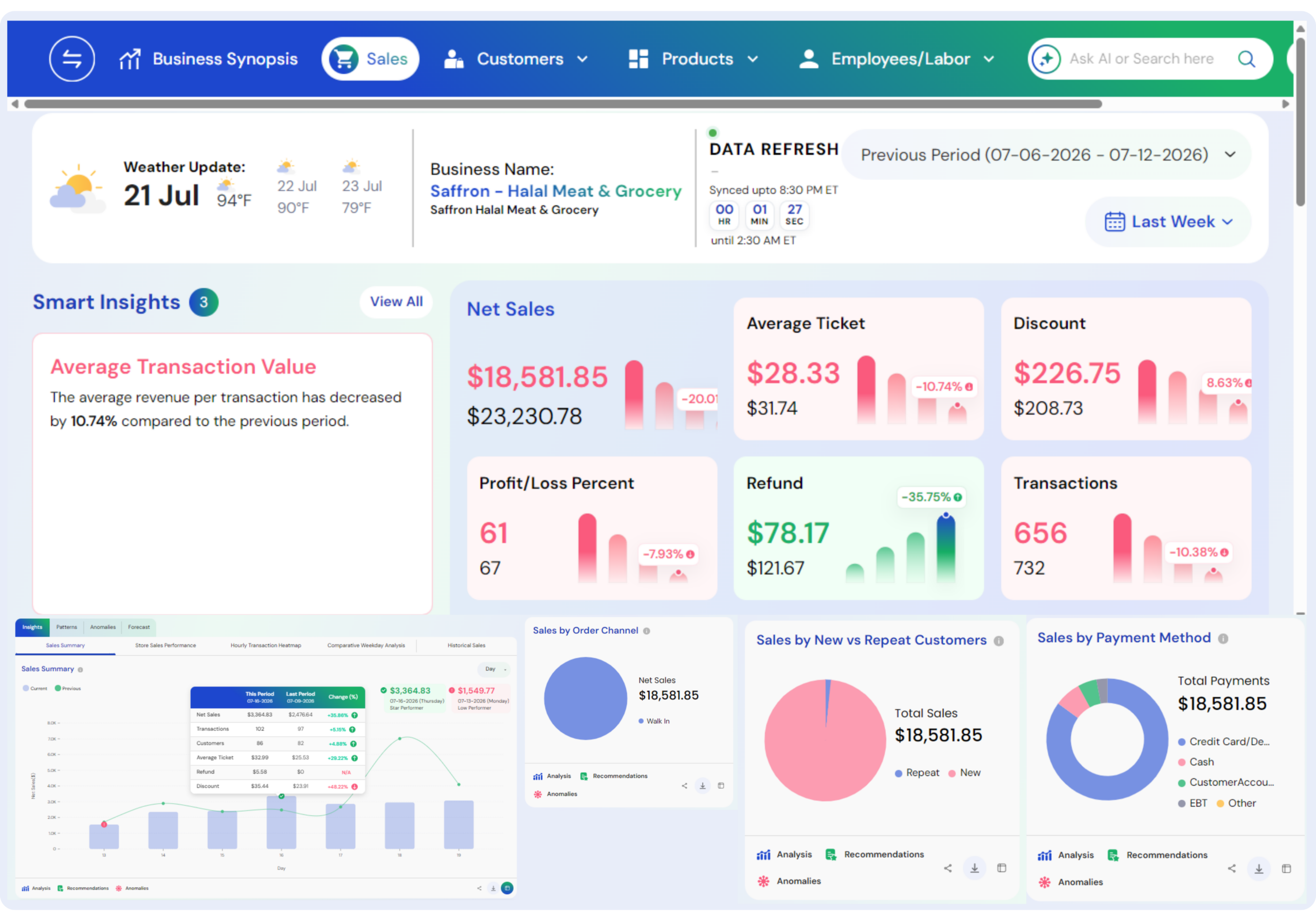
No more manual report pulling. The platform delivers automated insights and machine learning–driven recommendations that proactively reduce waste, optimize labor, and protect margins. - Actionable & Visually Appealing Insights
Clear dashboards, real-time alerts, and easy-to-understand KPIs make decision-making faster for owners, managers, and operators. - Easy to Set Up & Use
You don’t need a technical team. The system is intuitive, quick to implement, and built for real restaurant teams. - Cost-Effective & Flexible Subscription Model
Scale up or down as your business evolves. Whether you operate one location or multiple units, the pricing adapts to your growth. - Flexible, cost-effective pricing
Livelytics offers a scalable subscription model, so you only pay for what you need and can adjust as your restaurant grows.
And, you know the best part? You don’t have to commit right away. You can book a free Livelytics demo and see how it fits into your business processes, experience it firsthand.
Set it up, personalize it to your operations, explore the insights, and then decide.
Conclusion
At the end of the day, restaurants don’t lose money because owners don’t care. They lose money because they don’t see the problem early enough.
That’s the real gap legacy reporting creates. By the time the numbers show up in a spreadsheet, the margin is already gone.
Strong restaurant business intelligence changes that. The right restaurant BI platforms help you see food cost shifts, labor inefficiencies, menu gaps, and supplier price creep in real time, so you can fix them immediately, not next week. That’s how modern operators protect margins and grow confidently.
If you’re seriously evaluating restaurant business intelligence solutions, don’t just read about them. See how they work inside your own numbers. Book a free Livelytics demo, test it with your data, and then decide if it earns a place in your operations.