The restaurant industry is functioning in a highly competitive and data-driven environment where the margins are low and have to be guided by real-time insights and not intuition.
Due to constant rise in food costs, labor shortages, changing customer expectations, and the increasing impact of online ordering and delivery platforms, it has become crucial for restaurant operators to make data-driven decisions for survival.
Today, restaurants generate large amounts of data from POS systems, inventory tools, labor management software, loyalty programs, and customer feedback channels.
The real challenge which restaurant operators face today is not to collect data, instead the real challenge they face today is to convert that data into clear, actionable restaurant analytics which allows them to improve decisions across operations, marketing, labor, and profitability consistently.
While the restaurant operators consider using restaurant data analytics, they often face a crucial question which is whether restaurants depend on off-the-shelf restaurant analytics software or should invest in custom restaurant analytics built specifically for their business.
Both off-the-shelf and custom restaurant analytics can reveal patterns in the restaurant but they differ in terms of flexibility, scalability, insights, and long-term value.
Off-the-shelf restaurant analytics solutions provide pre-built dashboards, standardized KPIs, and quick implementation. It is an excellent analytics approach for independent restaurants or small groups who require quick access to sales reports, labor metrics, and basic performance tracking.
However, off-the-shelf analytics tools target an average restaurant as it can restrict customization and avoid deeper insights into customer behavior, operational efficiency, and long-term growth patterns.
In contrast, custom restaurant analytics platforms are designed around your specific workflows, data sources, and strategic goals.
Custom analytics combines POS data, customer analytics inventory, and labor insights into a single system which often goes beyond reporting to provide predictive insights, customer retention analytics, and real-time operational intelligence.
Understanding the difference between custom and off-the-shelf restaurant analytics will help restaurant operators to choose the right analytics tool essential for sustainable growth.
This blog compares both custom and off-the-shelf analytics tools which will help restaurant owners to choose the analytics strategy which is suitable for their needs today and supports where they want to take the business next.
Also Read: A Complete Guide to Restaurant Business Analytics for 2026
Understanding Off-the-Shelf Restaurant Analytics
Off-the-shelf restaurant analytics are pre-built analytics platforms which are designed to serve a wide range of restaurant types, like independent eateries to small multi-location restaurant groups.
It has a consistent framework so they can be implemented quickly across locations, offering ready-made dashboards with minimal setup and limited customization.
Off-the-shelf analytics can automatically integrate with popular POS systems and generate reports fast, thereby reducing the time and complexity required to get started.
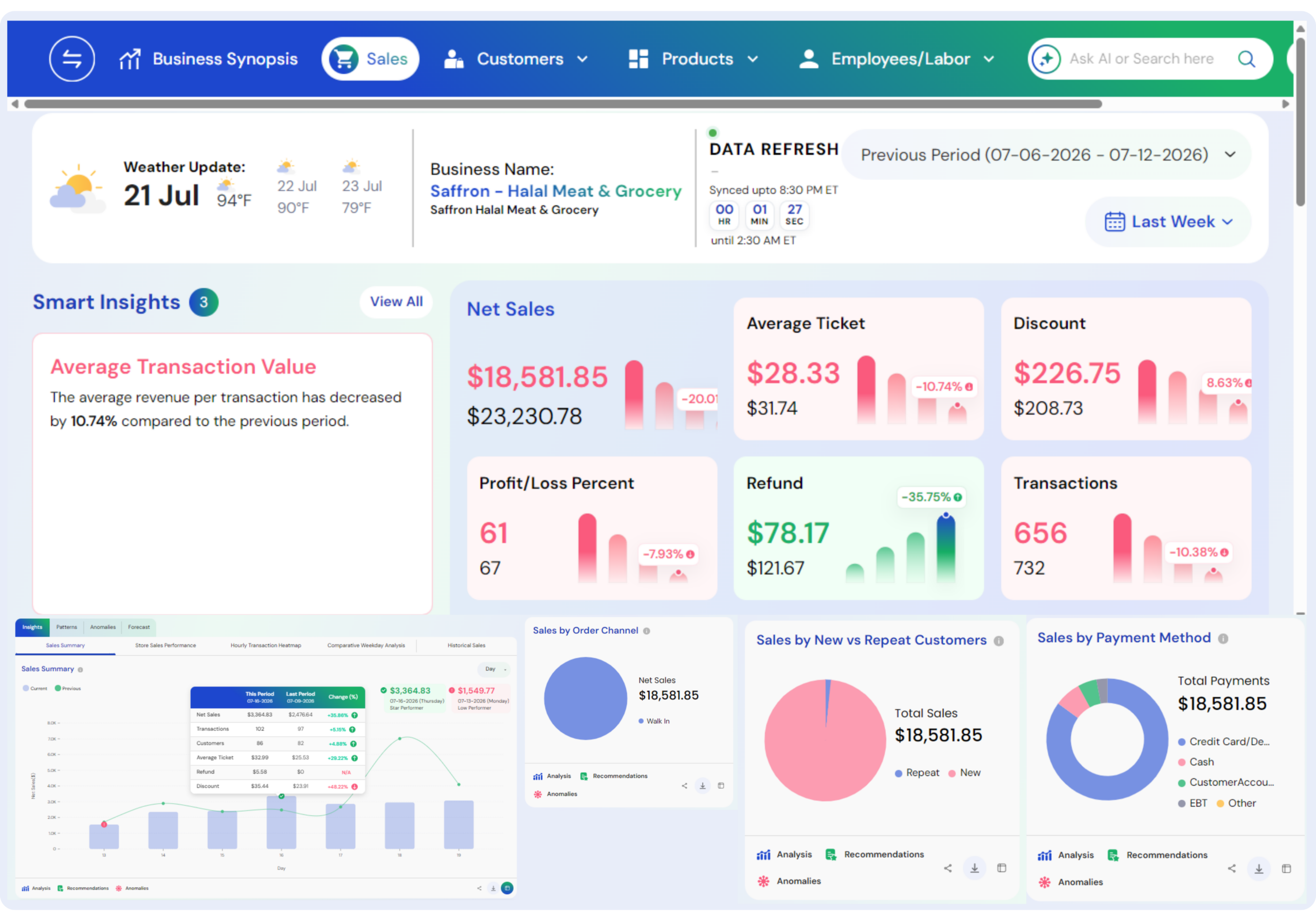
Such tools are marketed as “plug-and-play” restaurant analytics solutions, because they can connect quickly and offer ready-made dashboards which present sales, labor, and operational metrics in visually simple format with less technical work.
Off-the-shelf tools are an attractive option for operators because there is low effort and fast results. It includes POS integrations for automatic data capture, sales, and revenue dashboards, and basic labor and inventory reports to track costs.
Most platforms also include predefined KPIs like average check size, labor and food cost percentages, and sales by time of day through fixed charts which remain consistent for every user.
It typically uses monthly subscriptions or per-location pricing, which makes costs predictable and easier for operators to budget consistently.
With a standardized system, the provider gets to oversee updates, security patches, and ongoing maintenance, which removes the need for internal technical teams to manage the analytics.
These tools are popular because they are affordable and can be quickly implemented which helps restaurant operators to become more data-driven without having to develop a complex custom analytics system.
Also Read: Customer Analytics for Restaurants
Advantages of Off-the-Shelf Restaurant Analytics
1. Fast Implementation and Quick Results
Due to quick setup and immediate dashboards, off-the-shelf analytics helps restaurant operators to gain quick visibility about performance and start making data-informed decisions instantly.
Within days restaurants get to plug in their POS system, sync sales history, and access dashboards that give them quick insights regarding peak hours, top selling categories, and overall performance without long implementation delays.
For restaurants that are new to data analytics, instant dashboards may replace guesswork and manual reporting with real-time insights helping teams to make faster, confident decisions across daily operations.
Also Read: Business Intelligence Dashboard for Data Collection
2. Lower Upfront Cost
Off-the-shelf analytics has a subscription pricing model which makes it a budget friendly analytics option early on allowing restaurants access reporting and dashboards without large upfront costs.
As the platform is already built and hosted, there are no upfront development expenses and operational work of managing data pipelines, storage.
This is why off-the-shelf analytics is an attractive option for independent restaurants, small restaurant groups, and new businesses who want to know the value of data-driven decisions before investing in a larger, custom-built system.
Also Read: Cost Effective AI Solution for Restaurants
3. Industry-Standard Metrics (Built-In KPIs)
As the common restaurant KPIs are preconfigured, teams can adopt analytics quickly because the metrics are ready to use and do not require setting definitions, formulas, or dashboard structures from scratch.
While the KPIs are already built in, restaurants can start tracking trends immediately and focus on improving operations instead of spending time defining metrics and setting up reports.
By using familiar industry KPIs helps teams understand results faster, align around shared standards, and build consistent dashboards around reviewing data and improving performance.
Also Read: How to Setup Key Performance Indicators KPIs for Your Businesses
4. Minimal Technical Maintenance
As the vendor handles the underlying technology, restaurants can focus on operations while still getting access to reliable dashboards without requiring internal teams for patching, monitoring, or system upkeep.
This allows teams to remain focused on service, staffing, food quality, and guest experience while still relying on consistent reporting essential to guide improvements and catch issues early.
Also Read: How Can Data Analytics Improve the Measurement of Employee Performance
Limitations of Off-the-Shelf Restaurant Analytics
While off-the-shelf analytics may seem to be a convenient option in the beginning but may feel restrictive as restaurants expand, add channels, and need deeper, more customized insights to support smarter decisions.
1. Generic Insights That Lack Context
Off-the-shelf restaurant analytics tools highlight outcomes like a drop in sales on Tuesday but often lack the context required the actual cause behind the outcomes like staffing changes, promo performance, weather.
Without context, operators can’t easily know whether the sales drop happened due to staffing issues, weaker promotions, bad weather, customer churn, or changing local competition.
Also Read: AI to Collect Customer Insights
2. Limited Customization
As requirements of the restaurant evolve, prebuilt tools can feel limited because they often restrict custom KPIs, avoid adding new data dimensions, which make cross-system analysis difficult.
As a result, restaurants must adapt their decisions to fit the tool, instead of using analytics designed around their true workflows, goals, and day-to-day operating realities.
Also Read: Business Intelligence for Marketing
3. Weak Customer Behavior Analytics
Many off-the-shelf restaurant analytics solutions treat customers as anonymous transactions. This makes it difficult to analyze repeat behavior patterns, changes in visit frequency, churn signals, or promotion response by customer segment.
These gaps reduce the value of the tool for customer retention analytics as one of the most important drivers of long-term restaurant growth.
Also Read: Customer Sentiment Analysis for Multi Location Business
4. Scaling Becomes Expensive and Fragmented
As restaurants expand into multiple locations, brands, or channels, then off-the-shelf analytics may become expensive, fragmented, and harder to manage across the organization.
Many vendors charge price per location or integration which can increase costs, fragment reporting across dashboards, and make it difficult to manage multi-brand , multi-unit in a single unified view.
So analytics that start as a simple, low-cost analytics solution can become expensive and restrictive once you add more locations, integrations, and the deeper insights required to manage growth.
Also Read: Cost Effective AI Solution for Restaurants
What Is Custom Restaurant Analytics?
Custom restaurant analytics refers to analytics systems which are built specifically for an individual restaurant or restaurant group, rather than designed for the “average” operator.
Unlike off-the-shelf tools that have fixed KPIs, custom restaurant analytics is built around real operations and decision-making requirements, so dashboards, metrics, and logic match with the way the team actually runs the business.
Custom restaurant analytics aligns with daily workflows, so it captures kitchen flow, labor planning, promotions, and location performance so KPIs reflect real operations rather than generic templates designed for the average restaurant.
Custom analytics also adapts to your menu structure. With custom analytics, it helps to measure profitability and customer response with the exact detail which your concept requires rather than seeing not only what sells, but what truly drives margins and repeat visits.
Custom restaurant analytics also track the customer journey across visits, channels, and locations to reveal repeat patterns, spending behavior, churn signals, and which promotions truly improve retention and profitability.
These insights strengthen retention analytics and enable personalized, high-impact decisions across marketing, service, and loyalty strategies.
As custom analytics is designed for growth, it can expand with new locations, brands, and revenue streams while integrating new data sources smoothly and maintaining consistent reporting across the organization.
Most custom restaurant analytics platforms unify data engineering, advanced reporting, and AI-driven insights into one intelligence layer which goes beyond static helping restaurants forecast outcomes, spot risks early, and act faster for sustainable growth.
Also Read: Predictive Analytics in Restaurants a Game Changer
Benefits of Custom Restaurant Analytics

1. Insights Designed Around Your Business
Custom restaurant analytics delivers insights which are directly aligned with how your restaurant actually operates. Rather than depending on generic dashboards, it provides answers which matter to your specific business model.
For instance, it can reveal the menu items that drive long-term customer retention, and not just one-time sales, about the locations that have hidden labor inefficiencies which are not obvious in high-level reports.
Custom analytics can also identify the customer segments that respond best to upsells or promotions and highlight where margins are leaking even when overall revenue appears stable.
Because these insights are built around your workflows and goals, as they are actionable, relevant and far more valuable than standardized reports.
Also Read: Business Intelligence for Marketing
2. Unified Restaurant Data Analytics
One of the strongest benefits of custom restaurant analytics is its ability to combine data from multiple systems into a unified single source of truth.
Custom platforms can integrate POS systems, inventory and supplier data, labor and payroll information, loyalty and CRM systems, online ordering platforms, and customer reviews or feedback.
By combining all of this data together, operators gain an integrated view of performance rather than a fragmented view.
This unified approach allows restaurants to see how decisions in one sector like staffing or promotions directly impact sales, margins, and customer behavior in measurable ways.
Also Read: Business Intelligence and Data Analytics Services
3. Predictive and Proactive Analytics
Unlike off-the-shelf tools that focus mainly on historical reporting, custom restaurant analytics supports predictive and proactive decision-making. Advanced models can forecast demand, detect early signs of customer churn, optimize labor scheduling, and predict inventory waste before it happens.
This shifts analytics from a reactive to a strategic approach. Instead of responding to problems after they affect revenue, operators can anticipate challenges and take corrective action in advance.
Also Read: How Predictive Intelligence Transforms Retail
4. Scales With Growth
Custom analytics architectures are designed to grow alongside the business. New locations, brands, or data sources can be added without rewriting core logic or rebuilding dashboards.
Such scalability makes custom analytics tools an excellent option for multi-location chains, franchises, and high-growth restaurant groups who require consistent, reliable insights while the complexity increases.
Challenges of Custom Restaurant Analytics

1. Higher Initial Investment
Custom restaurant analytics offers powerful, business-specific insights that have higher upfront cost as compared to off-the-shelf software.
Developing a custom solution requires data modeling to define how information should be structured, engineering to build pipelines and dashboards, infrastructure setup to store and process data securely, and continuous optimization to keep performance and reporting accurate as systems evolve.
Unlike subscription-based systems which can be used instantly, custom analytics usually requires planning, and implementation effort. For smaller restaurants, these investments may feel high unless they have clear, measurable outcomes which they want to achieve.
Also Read: Choosing the Right AI Data Platform for Your Business
2. Strategic Planning Is Essential
Custom analytics succeeds only when the strategy is clear. It is essential for restaurants to define what they want through analytics to improve things like labor efficiency, customer retention, location performance, marketing ROI, or demand forecasting.
Also stakeholders will be required to agree on KPIs and the way metrics should be calculated, because if there are non consistent definitions can reduce trust in the data.
When there is no proper alignment, a custom analytics system can become just a nice dashboard which no one checks, and wastes time and budget. While strong planning ensures analytics become operational and not just informational.
Also Read: Real-Time Analytics Why Does Your Business Needs it
3. Ongoing Ownership and Maintenance
With custom restaurant analytics, the restaurant may feel like they own the whole system. This ownership gives control but it also requires constant responsibility from operators.
As the operations expand, the business needs to manage updates, adjust logic when menu structures or pricing change, and evolve insights.
Data sources may change, POS systems may update, and new channels like delivery platforms or loyalty tools may require integration. A custom system has to be regularly maintained to remain accurate and useful.
For growing brands, custom analytics can prove to be a strength rather than a burden as businesses own the analytics which means the business can adapt quickly, have competitive advantage, and build intelligence which evolves along with growth.
Also Read: How Restaurant Business Intelligence Helps Owners to Make Faster Decision
Off-the-Shelf vs Custom Restaurant Analytics: A Clear Comparison
Choosing between both analytics options is a strategic decision which directly impacts cost control, operational efficiency, and long-term competitiveness.
While both approaches deliver value, they serve different business needs. Below is a precise breakdown which will help restaurant owners to decide which option fits their operations best.
1. Off-the-Shelf Restaurant Analytics (SaaS Products)
Best For
- Independent restaurants
- Small to medium-sized restaurant groups
- Startups or new concepts requiring quick deployment
- Operators with limited technical resources
Key Advantages
- Lower Upfront Cost: Off-the-shelf restaurant analytics tools usually operate on a subscription model. So there are no large development costs, making them budget-friendly at the beginning.
- Fast Implementation: Setup of off-the-shelf restaurant analytics is usually quick. Some POS systems can be connected within days. Dashboards and reports are available almost immediately offering instant visibility into performance.
- Pre-Built Reports and Dashboards: Pre-built dashboards offer instant access to operators to see daily sales trends, labor performance, and cost breakdowns without any custom setup or manual report building. It helps operators gain insights without having to design metrics or dashboards from scratch.
- Vendor-Managed Updates and Security: Provider handles software maintenance, updates, and security patches so restaurants do not require in-house technical expertise to manage the off-the-shelf systems.
Limitations
- Limited Customization: Off-the-shelf tools restrict customization, so building unique KPIs, role-based workflows, and advanced logic can be either difficult or not possible. As a result, restaurants have to fit their operations into the preset dashboards of vendors instead of tracking metrics which actually drives performance.
- Ongoing Subscription Costs: Off-the-shelf tools can add monthly or per-location fees with time especially when the business expands.
- Workflow Constraints: Off-the-shelf platforms are designed for the average restaurant and are not an option for unique or complex operations.
These platforms are designed for the average restaurant and not for unique or complex operations.
Off-the-shelf restaurant analytics is an ideal option when speed, simplicity, and affordability are the primary goals.
Also Read: The Importance of Customer Analytics in Retail
2. Custom Restaurant Analytics (Tailored Software)
Best For
- Large restaurant enterprises
- Multi-location chains and franchises
- Restaurants with proprietary workflows
- High-growth brands requiring advanced analytics
Key Advantages
- Tailored to Business Logic: Custom restaurant analytics is designed around specific workflows, menu structures, and customer journeys. Reports and dashboards provide answers to business-specific queries rather than generic queries.
- Deep Data Integration: Custom analytics integrates POS, labor, CRM, loyalty, online ordering, and external data into a single unified system which creates a single source of truth across the organization.
- Advanced Analytics and Predictive Insights: Custom analytics offers demand forecasting, churn prediction, labor optimization, and margin analysis which enables proactive decision-making rather than reactive reporting.
- Higher Security and Data Ownership: Data in Custom Analytics is owned and controlled by the restaurant so security policies can be customized to enterprise standards.
- Scalability: Custom analytics tools are designed to grow with the business without any major restructuring.
Limitations
- High Initial Investment: Custom analytics requires spending on development, data engineering and infrastructure.
- Longer Development Timeline: Custom systems require a longer development timeline because planning, building, testing, and refinement must happen before they deliver full value and reliable decision-ready insights.
- Ongoing Maintenance Responsibility: With a custom analytics system, the restaurant is responsible for ongoing maintenance by handling updates, improvements, data quality monitoring, and continuous evolution as the business changes.
Custom restaurant analytics is best when precision, control, and long-term advantage is required more than quick deployment.
Also Read: How AI Revolutionizes Customer Experience in the Restaurant Industry
3. Key Decision Factors to Consider
Budget
- Off-the-shelf: There are lower initial costs but long-term subscription expenses are high.
- Custom: There are higher upfront costs but usually lower long-term total cost of ownership.
Operational Uniqueness
- Standard operations benefit from off-the-shelf tools.
- Complex or proprietary processes require custom analytics.
Speed vs Depth
- Off-the-shelf tools deliver immediate insights.
- Custom analytics delivers deeper, more strategic intelligence over time.
Growth Plans
- Small or stable operations benefit from SaaS simplicity.
- Rapidly growing chains need scalable, flexible analytics.
Also Read: How Businesses Are Adopting AI in Decision Making
4. Final Perspective
There is no universal better analytics option rather only a better fit for your priorities.
- Choose off-the-shelf restaurant analytics if your priority is speed, affordability, and ease of use matter most right now.
- Choose custom restaurant analytics if your priority is long-term control, advanced insights, and competitive differentiation are crucial/.
Ultimately, the decision comes down to whether your restaurant requires immediate visibility or long-term intelligence.
Cost Comparison: Off-the-Shelf vs Custom Restaurant Analytics
1. Initial Cost
- Off-the-shelf analytics usually begins with low initial cost as the product is already built and packaged.
- Custom analytics costs more upfront due to discovery, data modeling, dashboards, and integrations customized to your operations.
2. Monthly Fees
- Off-the-shelf tools charge a fixed subscription often per location or per integration.
- Custom analytics have variable ongoing costs based on hosting, maintenance, and updates but you control what you pay for and what you don’t pay.
3. Customization
- Off-the-shelf platforms usually restrict custom KPIs, complex workflows, and advanced business rules.
- Custom analytics can reflect your real processes like menu engineering, promo attribution, staffing logic, delivery versus dine-in splits, and more.
4. Scalability
- Off-the-shelf often scales by charging more locations and adding tiers.
- Custom analytics can scale with built-in architecture, allowing you to expand locations, brands, and channels without per-seat transactions.
5. Long-Term ROI
- Off-the-shelf ROI is usually moderate because you get standard insights similar to competitors.
- Custom ROI can be higher because you build decision systems that improve margins, labor efficiency, waste control, and marketing performance over time.
6. Competitive Advantage
- Off-the-shelf gives convenience and not differentiation.
- Custom analytics become a strategic asset due to unique metrics, faster decisions, and operating habits competitors can’t copy.
7. Key Insight
- Off-the-shelf optimizes for speed and convenience.
- Custom analytics optimizes for leverage and differentiation.
Conclusion
Choosing between custom and off-the-shelf analytics depends on your restaurant goals, growth phase, and operational complexity.
Off-the-shelf solutions are an ideal option for restaurants who require quick implementation, predictable costs, and access to standard performance metrics without requiring high technical involvement.
It provides immediate visibility into sales, labor, and food costs, which makes off-the-shelf analytics tools an excellent option for small teams or single-location operators who look for simplicity and speed.
However, as operations expand across multiple locations, brands, delivery platforms, and promotional channels then off-the-shelf tools may begin to feel restricted.
Restaurants may find themselves adjusting their decisions to fit the tool rather than designing analytics around their actual workflows. This is where custom analytics creates long-term strategic value.
By aligning dashboards with actual processes, building customized KPIs, and integrating multiple data sources, custom systems turn analytics into a competitive advantage rather than just a reporting tool.
The real difference is not just cost, rather it is leverage. Off-the-shelf analytics helps you monitor performance.
Custom analytics helps you engineer performance by converting raw data into specific, repeatable actions like optimizing staffing, pricing, inventory, and marketing with precision rather than guesswork. One tool offers convenience while the other builds differentiation.
Ultimately, the better option is the one that aligns with your goal. If you want clarity and speed, off-the-shelf works well. If you want scalable growth, smarter decisions, and a lasting competitive advantage, custom analytics become a stronger investment.
If you still have any query about the differences between custom and Off-the-Shelf Restaurant analytics, then you may book a free demo at livelytics and we are more than happy to assist you.