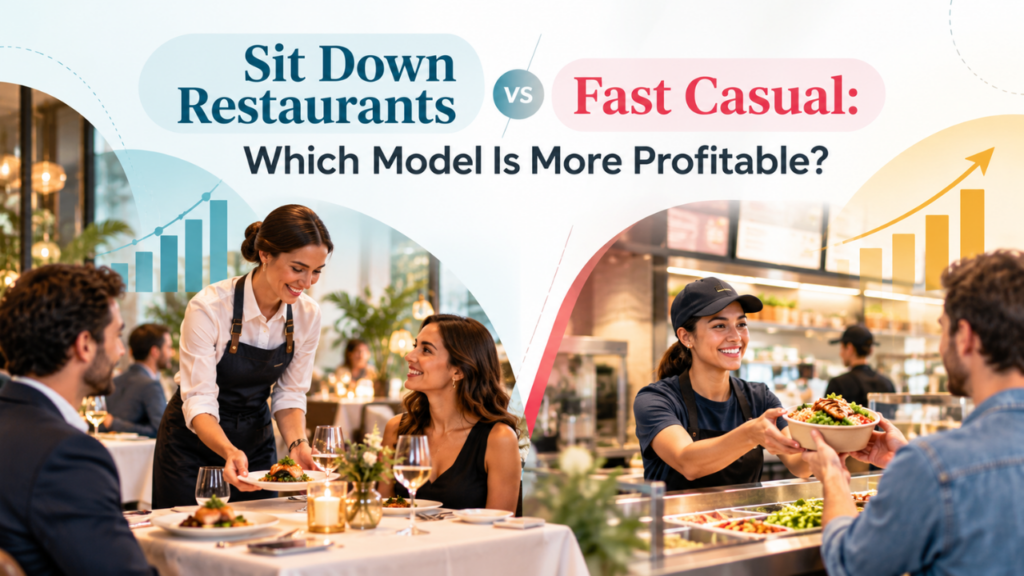

While entering the restaurant industry choosing whether to implement sit down restaurants vs fast casual is an important decision for business owners.
Because both restaurant business models provide opportunities for restaurateurs to generate revenue, attract customers, and build a well-known brand.
However, both the models differ in operating costs, service styles, menu pricing, and overall profits. Sit-down restaurants usually offer full-service dining, where customers receive table service and enjoy a traditional dining experience.
On the contrary, fast-casual restaurants provide quick service, convenient ordering, fresh food, and a relaxed ambience to their customers. Understanding differences between both restaurant business models lets business owners determine the restaurant concept that suits well as per your goals and target audience.
When evaluating restaurant profitability, restaurant owners should consider startup costs, labor expenses, food costs, and overhead expenses.
Sit-down restaurants may generate higher average bills through premium food menus, beverages, and personalized service, but such restaurants require more staff and large dining spaces.
While fast-casual businesses may benefit from faster table turnover, smooth operations, and lower service requirements. However, achieving success in both restaurant models is based on customer demand, pricing, and efficient inventory management.
Other important factors to consider while choosing the restaurant model include customer experience, sales volume, location selection, and profit margins.
Neither Sit-Down Restaurants or Fast Casual restaurants ensure higher returns, because profits are based on execution, competition, and local market conditions.
Comparing all these factors helps aspiring restaurateurs to identify the model that gives the strongest aspects for sustainable growth, operational efficiency, and long-term financial success.
Also Read: POS Analytics Vs Traditional Restaurant Reporting
Sit-Down vs Fast-Casual: Startup Costs, Revenue, and Profit Potential
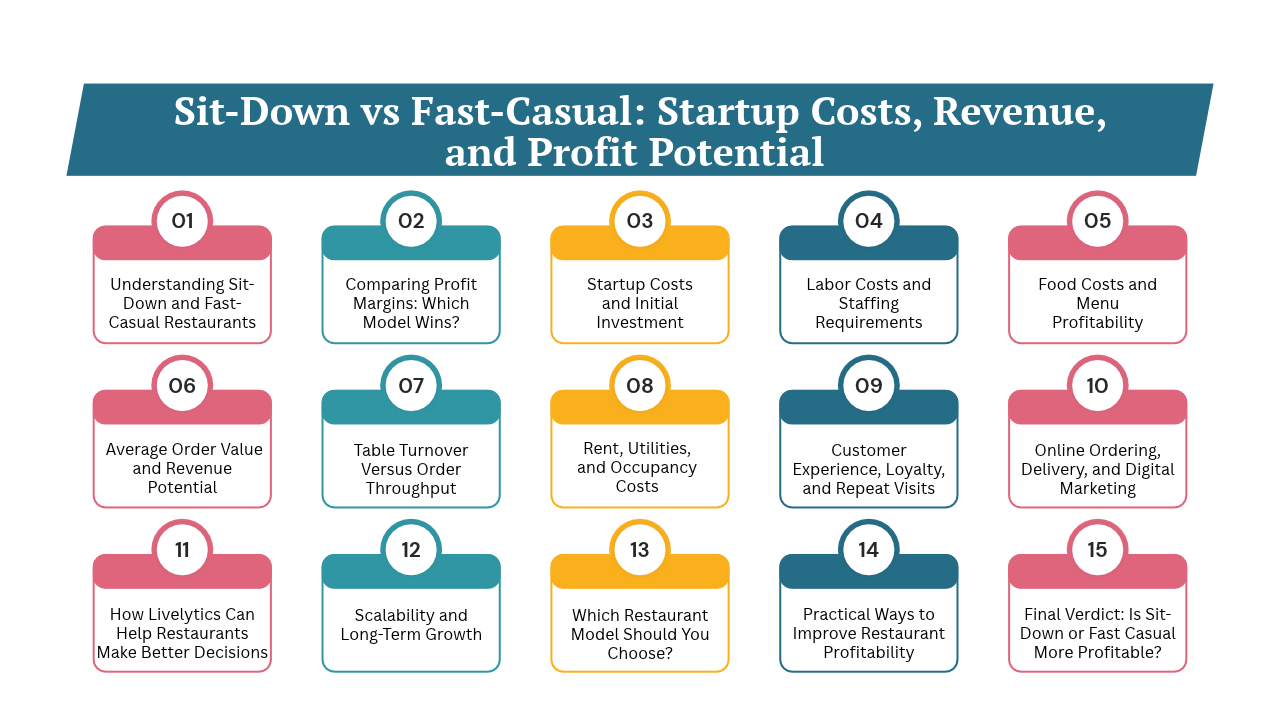
1. Understanding Sit-Down and Fast-Casual Restaurants
Aspiring restaurant owners before comparing profits must understand the way both Sit-Down and Fast-Casual restaurants operate.
What Is a Sit-Down Restaurant?
A sit-down restaurant, also known as a full-service restaurant provides table services and a complete dining experience to customers. In a sit-down restaurant, hosts get the customer seated, receive menus, place orders with servers, and ordered meals are delivered to the table.
It includes casual dining restaurants, family restaurants, upscale eateries, and some specialty dining concepts. While revenue is earned from food, beverages, desserts, and additional services.
Sit-down restaurants help to build customer loyalty as such restaurants provide personalized service, comfortable surroundings, special occasions, and carefully prepared meals. However, sit-down restaurants may require more staff members, dining space, equipment, and coordination.
What Is a Fast-Casual Restaurant?
Fast-casual restaurants offer quick-service dining where the major focus is on food quality, customization, and providing a comfortable ambience. In such restaurants customers order at a counter, kiosk, or digitally, and then either collect their meals delivered to their tables.
It includes salad bars, sandwich shops, grain bowl concepts, and restaurants specializing in customizable meals.
Fast-casual restaurants have smaller dining spaces, streamlined menus, and less front-office staff. So, setting up such restaurants helps to reduce expenses while increasing order throughput during busy hours.
However, aspiring owners must not assume fast-casual restaurants are inexpensive to operate. Because running fast-casual restaurants needs premium ingredients, high delivery commissions, costly locations, and inefficient staffing that can still impact profit margins.
Also Read: Optimizing Table-Turnover Using Analytics
2. Comparing Profit Margins: Which Model Wins?
Comparing profit margins helps restaurants to measure the remaining revenue after relevant costs have been deducted. Calculating net profit margin is essential because it covers operating costs and other costs rather than just food sales.
Industry estimates profit margins can be different by source, location, accounting method, and restaurant category. The 2026 guide estimates net profit margins of fast casual restaurants to be around 6%-12% and casual-dining profit margins to be around 3%-9%.
All these figures are just estimates and do not guarantee results. Aspiring restaurant owners must consider these estimates for financial planning.
In general, fast-casual restaurants can achieve stronger margins because such restaurants require less service staff, run with simple food menus, and process more food orders in less time.
Sit-down restaurants must cover additional expenses associated with table service, larger spaces, and an excellent hospitality experience.
However, an efficiently run sit-down restaurant can be highly profitable. If there are strong sales of beverages, premium pricing, consistent reservations, and good use of spaces can help to balance its higher expenses.
The best way to compare both sit down restaurants and fast casual restaurants is not just all about the model that has the higher profit margins but which restaurant type generates revenue to keep its total expenses under control.
Also Read: Restaurant Profit Margin Analytics Tool to Boost Profits
3. Startup Costs and Initial Investment
Startup costs and initial investment can affect profits long before a restaurant provides services to its first customer. If more capital is required to open a restaurant, then more sales and cash flow may be required to recover that investment.
Sit-Down Restaurants
Sit-down restaurants often require substantial upfront spending on:
- Dining furniture, seating, lighting, and interior design.
- Commercial kitchen equipment and food preparation areas.
- Ventilation, refrigeration, storage, and dishwashing systems.
- Point-of-sale equipment and reservation management.
- Tableware, glassware, linens, and service supplies.
- Initial inventory, hiring, training, permits, and working capital.
While running a sit-down restaurant involves large dining space or good interior which may require more investment. It is essential for restaurant owners to have a budget for the duration before the business earns regular sales.
Fast-Casual Restaurants
Fast-casual restaurants may open with less customers and simple dining setup. Initial startup expenses for fast-casual restaurants may include counter-service equipment, digital ordering systems, small seating, kitchen equipment, and streamlined food preparation stations.
Having a simplified restaurant concept may need less furniture, tableware, and front-office infrastructure.
However, actual expenses depend on menu, location, equipment, franchise fees, lease conditions, and whether the premises previously operated as a restaurant.
If aspiring restaurant owners are thinking about which type of model is better, then fast casual restaurants have an advantage if the goal is to limit initial capital requirements. Sit-down dining may need a larger investment as it can support premium pricing and enough customer demand.
Also Read: Why Founders Should Stop Reading Reports and Start Asking AI Questions
4. Labor Costs and Staffing Requirements
Labor and Staffing expenses is one of the major differences between Sit Down restaurants and Fast casual restaurants.
Sit-down restaurants require hosts, servers, bussers, cooks, kitchen supervisors, dishwashers, and managers. While larger restaurants may require bartenders, sommeliers, and event staff.
All these staff members give a good experience to customers, but they also increase payroll expenses, scheduling complexity, training requirements, and the cost of staff turnover.
On the contrary, fast-casual restaurants usually run with fewer front-office staff employees. In such restaurants customers place orders independently, collect their meals from the counter, and use digital payment systems. Having standardized recipes and food preparation procedures can also make staff training easier.
However, the requirement of less staff does not mean understaffing. A fast-casual restaurant still requires sufficient staff members to prepare orders accurately, and prevent long queues.
Fast casual often has the advantage because they offer simpler services. While sit-down restaurants can benefit by matching staffing to reservations, actual customer traffic.
Also Read: How Data Analytics Improve the Measurement of Employee Performance
5. Food Costs and Menu Profitability
One of the major factors to compare both sit-down restaurants and fast-casual restaurants is food cost. Because it determines the amount of revenue a restaurant retains.
Sit-down restaurants may serve larger menus with appetizers, main courses, desserts, specialty dishes, and beverages. Such a variety of food menus attract different customers and encourage them to spend more. However, these restaurants also require more inventory, may have high chances of food spoilage, and making purchasing decisions harder.
Fast-casual restaurants focus on fewer core ingredients used across several menu items. For instance, a sandwich restaurant may use the same vegetables, sauces, proteins, and bread. Such processes can simplify ingredient purchasing, food preparation, and inventory management.
Both formats can improve food profitability by:
- Calculating the expenses of ingredient of every menu item
- Standardizing food portion sizes and recipes
- Tracking regularly food waste and spoilage
- Tracking ingredient price changes
- Removing low-demand items
- Negotiating with suppliers
- Reviewing profit contribution margins
But owners must know that a popular dish is not always the most profitable dish. Because if ingredients are costly or its preparation takes too much time then it may cause less profit than a lower-priced food menu.
Fast casual may benefit from standardized menus, but sit-down restaurants can improve their food margins through thoughtful menu engineering, seasonal purchasing.
Also Read: Cost-Effective AI Solution for Restaurants
6. Average Order Value and Revenue Potential
Before starting a restaurant, one of the major aspects for restaurant owners to compare is average order value and revenue potential. Where Sit-down restaurants generate higher average order value because customers order multiple food items, beverages, desserts, and premium dishes.
However, fast-casual restaurants can manage lower transaction values by serving more customers throughout the day.
For example, a sit-down restaurant charging $35 per customer and serving 100 customers daily can generate $3,500 in daily sales. A fast-casual restaurant charging $16 per customer and serving 220 customers can generate $3,520 daily. Over 30 operating days, their illustrative monthly sales would be $105,000 and $105,600, respectively.
These estimates are just hypothetical but it does not represent industry averages. These reports indicate that both models can achieve the same revenue and profits by implementing different approaches.
However, revenue is not the same as profit. Labor costs, food costs, rent, utilities, and other operating costs ultimately help owners to determine the restaurant model that is more profitable.
Also Read: How AI Helps in Boosting Restaurant Revenue and Profits
7. Table Turnover Versus Order Throughput
Restaurant capacity influences the amount of revenue that a business can generate from its available space.
Sit-down restaurants must balance larger dining spaces with the need to serve more customers. For instance, a table occupied for two hours cannot be used for serving other customers during that period.
However, longer visits may support more beverage orders, desserts, and stronger customer relationships.
On the contrary, fast-casual restaurants aim to process orders more quickly. Having a smooth ordering system and efficient kitchen workflow can allow to complete more transactions during lunch and dinner peak hours.
For better utilization of space, sit-down operators must manage reservations, improve coordination between kitchen staff and their timing, reduce unwanted delays, and prepare themselves for busy hours.
Fast-casual restaurant owners must focus on managing queues, digital ordering, kitchen workflow, order accuracy, and pickup coordination.
While the goal of restaurants must not be to maintain speed, rather restaurants should increase throughput without compromising food quality, safety, or customer satisfaction.
Also Read: How AI is Improving Table-Turnover Rate in Restaurants
8. Rent, Utilities, and Occupancy Costs
The physical layout of each restaurant model can affect its ongoing expenses.
Sit-down restaurants may require more space for tables, walkways, waiting spaces, restrooms, and service stations. Larger spaces means higher rent, utility bills, cleaning expenses, and maintenance costs.
Fast-casual restaurants may operate in smaller spaces particularly when most orders are takeaway or delivery. Less customer traffic reduces occupancy expenses and makes it easier to verify more locations.
However, the location of the restaurant is also essential more than its size. A fast-casual restaurant in a premium shopping district may pay more rent than a sit-down restaurant in a less expensive neighborhood.
Owners should compare occupancy expenses against realistic sales. A smaller restaurant in a low customer traffic location may be less profitable than a large restaurant with strong customer demand.
Before signing a lease, they must estimate expected revenue, rent, utilities, maintenance, insurance, and any service charges. They must also consider if the selected premises can support the kitchen, storage, customer flow, and equipment required by the concept.
Also Read: Choosing the Right AI Data Platform for Your Business
9. Customer Experience, Loyalty, and Repeat Visits
Sit-down restaurants can differentiate themselves by offering attentive services, ambiance, special menus, celebrations, and personalized hospitality.
All these features can encourage customers to return for birthdays, business dinners, family meals, and social occasions.
Fast-casual restaurants usually offer convenience, consistency, customization, speed, and value. Customers may visit frequently because the experience fits well into work breaks, busy schedules, and everyday routines.
Both models need a clear reason for customers to return.
Sit-down restaurants can improve loyalty by training servers, maintaining consistent food quality, handling complaints professionally, and creating memorable experiences.
Fast-casual businesses can focus on offering correct orders, convenient pickup, easy digital payments, loyalty rewards, and reliable food preparation times.
Customer feedback is highly valuable. Reviews, surveys, and complaint trends can reveal if the customers are unhappy with waiting times, food portion sizes, prices, cleanliness, or service.
A repeat customer may be more essential than a one-time visitor acquired through a costly promotion. Restaurants should therefore measure customer retention and customer spending over time and not just the number of new members attracted each week.
Also Read: How AI Revolutionizes Customer Experience in Restaurant Industry
10. Online Ordering, Delivery, and Digital Marketing
Both sit down restaurants and fast casual restaurants support online ordering, but profits must be measured carefully.
Fast-casual concepts suit takeaway and delivery orders as it involves many food items packaged for transport. Online ordering may increase convenience for customers beyond a restaurant’s reach.
Sit-down restaurants can also generate additional revenue through takeaway menus, catering, family meal packages, and delivery-friendly dishes.
However, some dine-in dishes may not maintain their quality during delivery while additional packaging costs can reduce profits. If there are third-party delivery commissions, discounts, refunds, and packaging costs can again reduce the profits generated by an order. Higher delivery sales does not indicate higher profits.
Restaurant owners should track the performance of each channel separately, including:
- Average order value.
- Food and packaging costs.
- Delivery and platform fees.
- Discounts and promotional spending.
- Order accuracy and refunds.
- Repeat purchase rates.
- Contribution margin per order.
Restaurants can also attract customers through their website, local search visibility, social media content, and email marketing without depending only on third-party platforms. The main objective should be to identify the channels that produce profitable sales instead of simply increasing order volume.
Also Read: Restaurant Technologies Tools Every Modern Restaurant Needs
11. How Livelytics Can Help Restaurants Make Better Decisions
As restaurant businesses grow, it becomes harder for restaurateurs to understand performance using separate reports and spreadsheets. Because sales, labor, inventory, customer feedback, and financial information may be spread across different systems.
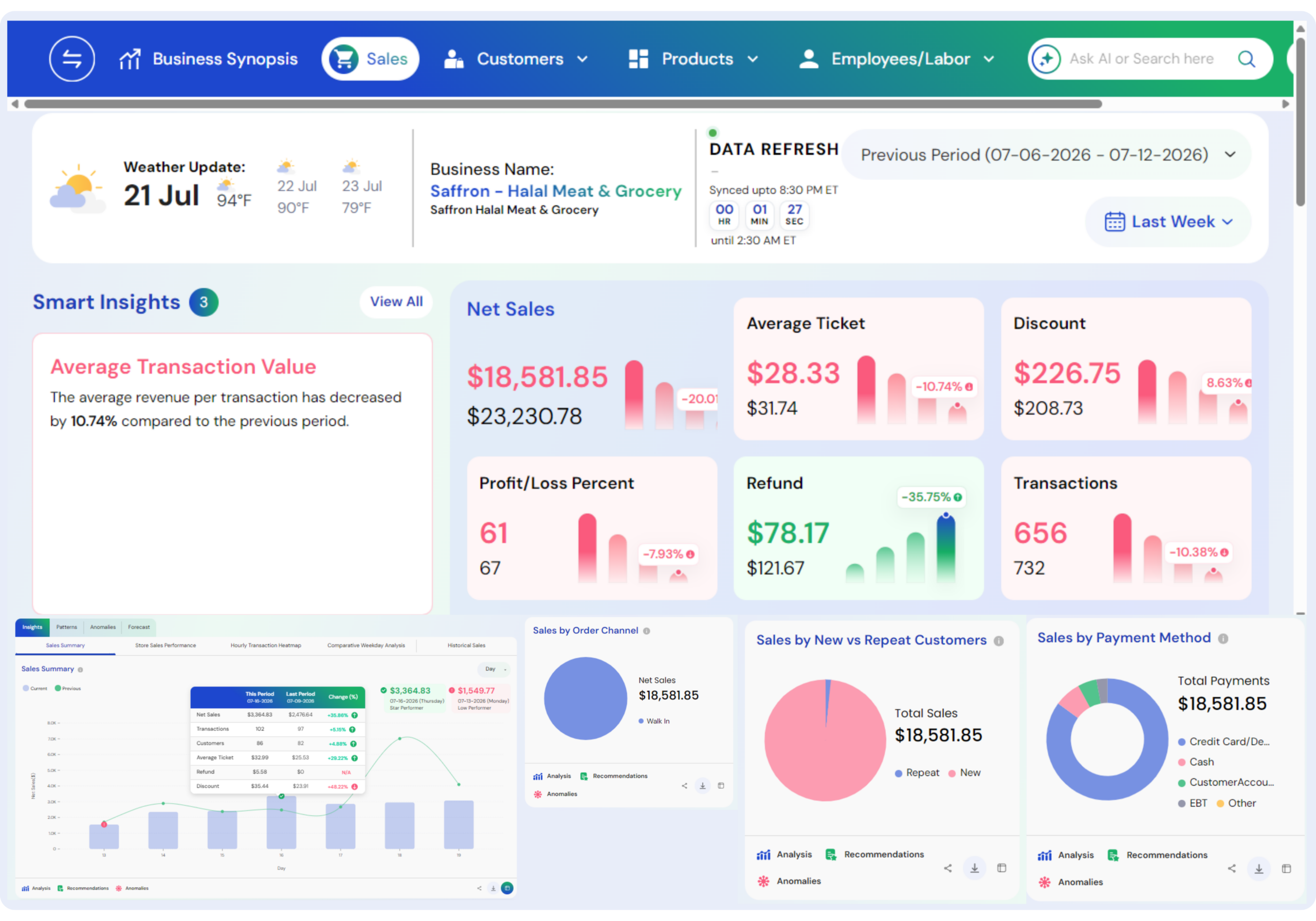
Livelytics is an AI-powered analytics and operational intelligence platform that integrates business data on a centralized platform to help restaurant owners to understand performance, identify problems, and focus on actions.
Its restaurant-based capabilities include sales and profit margin visibility, labor analysis, operational insights, customer experience intelligence, and comparisons across locations.
For sit-down restaurants, connected performance information can help managers investigate questions such as:
- Are longer waiting times associated with lower customer satisfaction?
- Which shifts have labor costs that are high relative to sales?
- Are certain menu items generating strong revenue but weak margins?
- Which locations experience declining guest feedback or repeat visits?
For fast-casual restaurants, following the same approach can help to identify slow order periods, unexpected food cost increases, staffing inefficiencies, differences in performances between locations.
For instance, if a restaurant experiences a decline in profits, managers can evaluate whether the cause is lower sales, rising ingredient expenses, or excessive labor hours.
Although data analytics in restaurants does not improve profits. While the main value comes from using reliable data to make changes, assigning responsibility, and checking whether those changes provide results.
Such analysis can be useful for multi-location restaurant operators who require a consistent way to compare performance and determine whether management attention is valuable.
Also Read: Benefits of Data-Driven Decision Making
12. Scalability and Long-Term Growth
Faster-casual restaurants may be easier to expand due to small spaces, consistent menus, and streamlined service procedures can make operations easier to manage across multiple locations.
Once a restaurant concept has been established, the restaurant operator may be able to grow into additional locations more efficiently.
However, rapid growth of restaurants has its own risks. New locations require capital, strong managers, reliable suppliers, consistent training, and sufficient local demand. A restaurant model that works well in one neighborhood may not succeed in another.
Sit-down restaurants can also be expanded successfully especially if the brand has a unique dining experience, strong customer loyalty, effective management, and standardized operating procedures.
While the main challenge is to maintain service quality and consistency across different locations. A restaurant concept that depends highly on a specific chef or an owner’s daily involvement may be harder to expand.
Before expanding the restaurant model, restaurant owners should have clear operating procedures, measure location-level profits, document successful marketing strategies, and confirm that the original business generates sustainable cash flow.
Also Read: Business Intelligence for Marketing
13. Which Restaurant Model Should You Choose?
Choosing the best restaurant model is based on your business goals, available capital, skills, location, and target market.
Choose fast casual if you want to:
- Start with a potentially smaller footprint.
- Serve customers quickly during busy periods.
- Build a streamlined, repeatable menu.
- Reduce the need for extensive table-service staffing.
- Develop a concept that may be easier to replicate.
Choose a sit-down restaurant if you want to:
- Build a hospitality-focused brand.
- Generate higher average checks through courses and beverages.
- Serve celebrations, group meals, and special occasions.
- Create a distinctive atmosphere and personalized service.
- Develop a concept that supports premium pricing.
Neither model ensures success. For instance, a poorly located fast-casual restaurant with high food costs can lose revenue, while a sit-down restaurant with stronger customer demand, efficient staffing, and disciplined purchasing can outperform expectations.
Before making a decision, they must prepare a financial forecast which includes startup investment, sales assumptions, food expenses, payroll, rent, utilities, marketing, technology, insurance, taxes, and working capital.
Then they must test multiple scenarios which include lower-than expected sales and higher operating expenses. It helps to understand how much financial pressure each model can withstand.
Also Read: Artificial Intelligence Vs Machine Learning
14. Practical Ways to Improve Restaurant Profitability
Irrespective of restaurant format, restaurant owners can improve financial performance by focusing on a few important activities.
- Review menu performance. They must review menu performance by calculating the cost and contribution margin of individual dishes. Promote food items as per customer demand which will increase revenue.
- Control food waste. Use purchasing forecasts, standardized recipes, portion controls, and inventory checks to reduce unnecessary losses.
- Match staffing to demand. Review sales and labor by shift so schedules reflect actual customer traffic.
- Monitor key financial metrics. Track food cost percentage, labor cost percentage, prime cost, average order value, occupancy costs, and net profit margin.
- Improve customer retention. Use feedback and loyalty initiatives to encourage repeat visits and identify service problems early.
- Evaluate each sales channel. Measure dine-in, takeaway, delivery, catering, and promotional orders separately to understand which activities generate the strongest contribution.
- Use analytics consistently. Combine sales, operational, and customer information to identify problems, take action, and measure results.
Small improvements across several expenses can make an impactful difference because restaurant margins are less.
Also Read: The ROI of Restaurant Business Intelligence
15. Final Verdict: Is Sit-Down or Fast Casual More Profitable?
In 2026, fast-casual restaurants often have space benefits when profits are based on lower service complexity, faster order processing, smaller premises, and standardized food operations.
Industry estimates place fast-casual margins above traditional casual dining, although outcomes can differ based on concept and market.
Sit-down restaurants can still be highly profitable even when they attract enough customers, generate strong average checks, manage labor efficiently, and deliver an experience that supports repeat business and premium pricing.
The most important difference between sit-down restaurants and fast casual restaurants is revenue and profit. For instance, a busy dining room does not ensure profits, because a restaurant with a smaller average check can perform well if its expenses are under control and processes orders efficiently.
Restaurant owners should compare the total expenses of operating each model, evaluate realistic demand, and track performance at the menu, shift, channel, and location levels.
Tools like Livelytics can support this process by integrating operational and financial data, helping restaurant teams to identify performance gaps and make more informed decisions.
Ultimately, the most profitable restaurant model is the one that fits your market, serves customers consistently, and turns sales into sustainable profit.
Strong planning, disciplined execution, and continuous financial monitoring matter more than choosing a format based on industry averages alone.
Conclusion
Choosing between sit-down restaurants and fast-casual restaurants is based on your business goals, investment capacity, target customers, and operational priorities.
Sit-down restaurants can generate higher average spending through full-service dining, premium menu options, and personalized customer experiences.
However, it often requires higher labor costs, large dining spaces, and more complex operations. Fast-casual restaurants may benefit from faster service, smooth staffing, and efficient customer turnover which makes them attractive to entrepreneurs looking for less complex operations.
Ultimately, neither restaurant model ensures higher profits. Success is based on controlling food expenses, managing labor expenses, setting competitive menu prices, reducing food waste, and maintaining consistent food quality.
Location, customer demand, competition, and marketing strategies also influence revenue and profit margins. Restaurant owners should analyze startup expenses, and operating expenses, before making an investment.
Technology and data-driven decision-making can further support better financial performance. Platforms like Livelytics can help restaurant businesses to explore industry insights and make more informed operational decisions.
Comparing financial projections, tracking key performance indicators, and adapting to changing customer preferences, entrepreneurs can identify the model that is best suitable for their resources.
Through careful planning and effective management, both sit-down and fast-casual restaurants can achieve sustainable growth and long-term profits.
If you still have any query about sit down restaurants versus fast casual restaurants then you may book a free demo at Livelytics and we are more than happy to assist you.