The restaurant industry is going through a major digital transformation, with restaurant automation becoming essential for operational success.
As restaurants face high pressure because of labor shortages, increasing operational costs, changing consumer expectations, and intense market competition, restaurants are increasingly adopting advanced restaurant technology to improve efficiency, smooth workflows, and create super dining experiences for customers.
Whether automated ordering systems, self-service kiosks, AI-powered inventory management, and restaurant analytics, automation is changing all aspects of restaurant operations.
Today’s diners expect quick services, convenient payment options, and smooth digital experiences. For restaurants to meet all these demands of customers consistently can be difficult by only relying on manual processes.
Implementing restaurant automation solutions, helps restaurants to reduce customer wait times, improve order accuracy, reduce human mistakes, and optimize use of resources.
This allows employees to focus more on customer engagement and hospitality rather than on repetitive administrative tasks.
Automating different operational tasks plays a crucial role in improving operational efficiency behind the scenes.
Many technologies such as kitchen display systems, automated inventory tracking, employee scheduling software, and contactless payment systems help restaurants to reduce food waste, improve productivity, control labor expenses, and maintain service consistency.
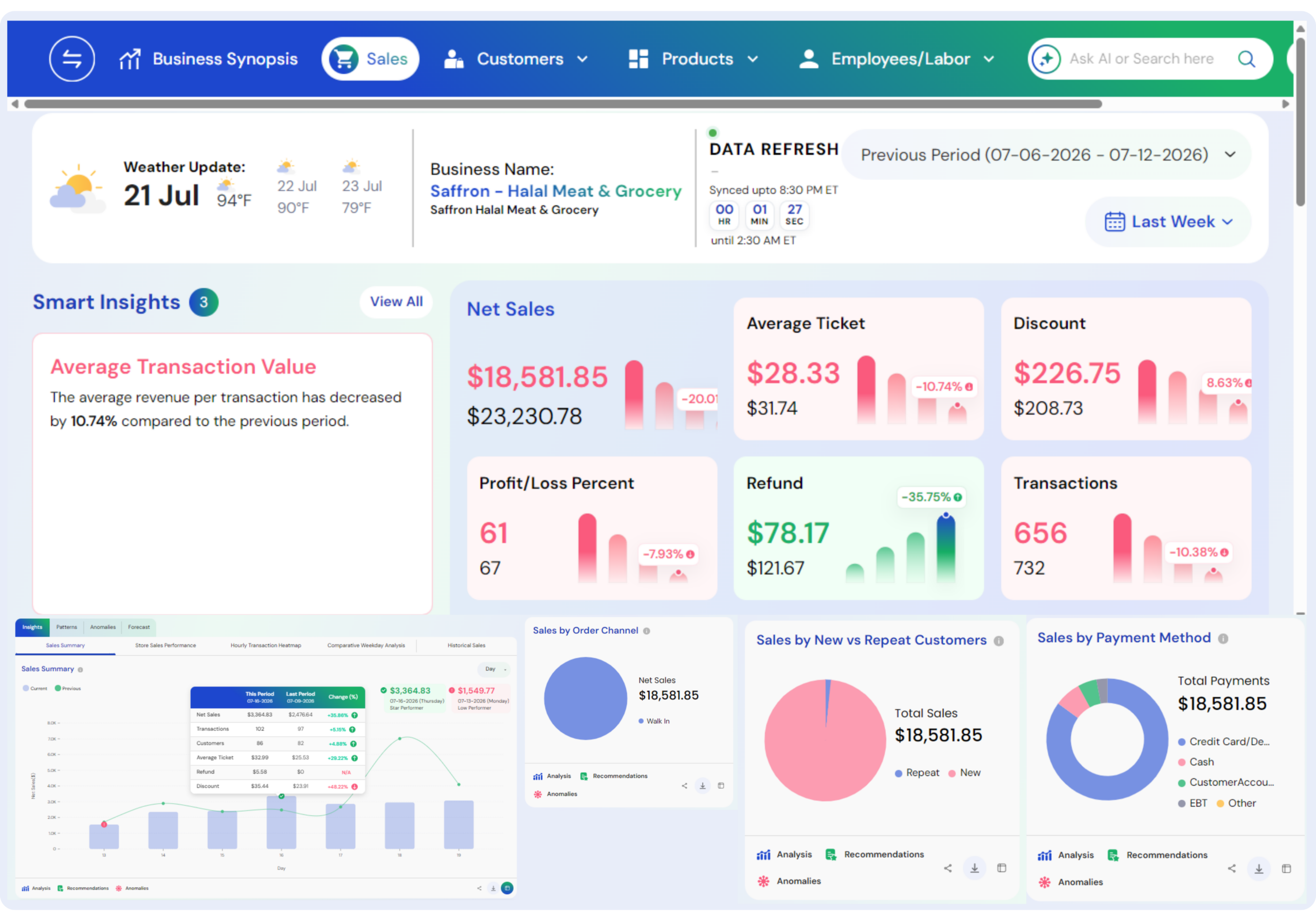
Additionally, new advancements in artificial intelligence(AI) and data analytics helps restaurant operators to make smarter decisions based on real-time insights about sales performance, customer behavior, labor utilization, and inventory levels.
As automation solutions become more affordable and available, restaurants of all sizes are using them not to just reduce expenses but also to increase profits, support business expansion, and long-term business success.
Through this blog, we will walk you through the role of automation in restaurants. Further we will explore the technologies driving innovation, the benefits and challenges of adoptions. While platforms like Livelytics help to convert restaurant data into actionable business intelligence.
Also Read: Automating Data Analysis Using Artificial Intelligence
Understanding Restaurant Automation
Restaurant automation involves the process of using technology and software to streamline restaurant operations while reducing manual effort.
Such solutions help restaurants to improve operational efficiency, reduce human errors, save time, and offer a more consistent customer experience.
Automation supports different restaurant operations like managing orders, tracking inventory, payment processing, scheduling, kitchen operations, and customer communication.
By collecting and analyzing real-time data, automation systems allow restaurant managers to make informed decisions, optimize resources, and improve overall performance.
Common examples of restaurant automation include:
- Self-ordering kiosks
- QR code ordering systems
- Online ordering platforms
- Automated inventory management tools
- Kitchen Display Systems (KDS)
- Contactless payment solutions
- Employee scheduling software
- Customer loyalty programs
- AI-powered demand forecasting
- Business intelligence dashboards
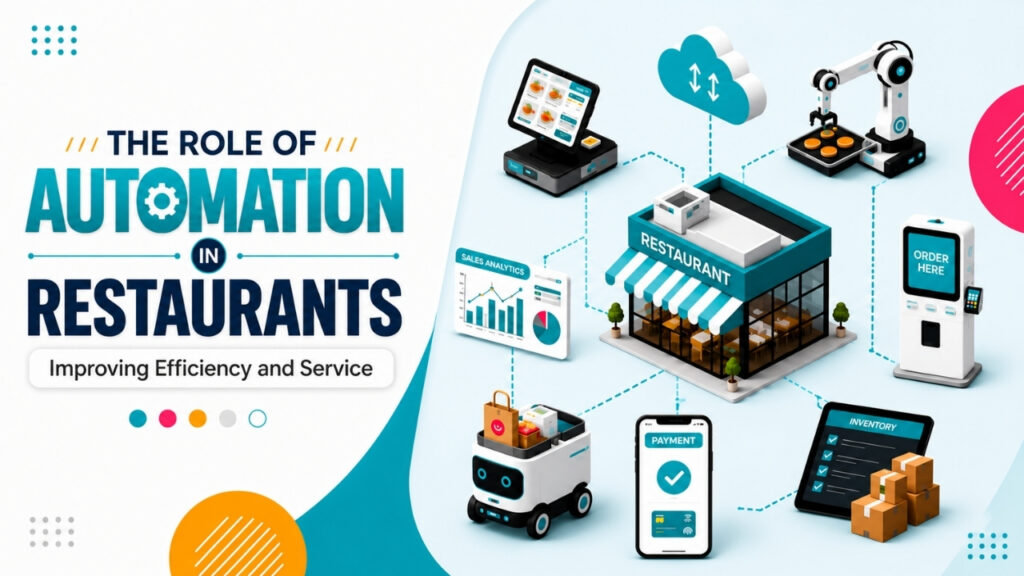
Together all these technologies create a connected restaurant ecosystem that improves visibility, productivity and decision-making.
Also Read: Business Intelligence for Restaurants
Why Automation Is Becoming Essential
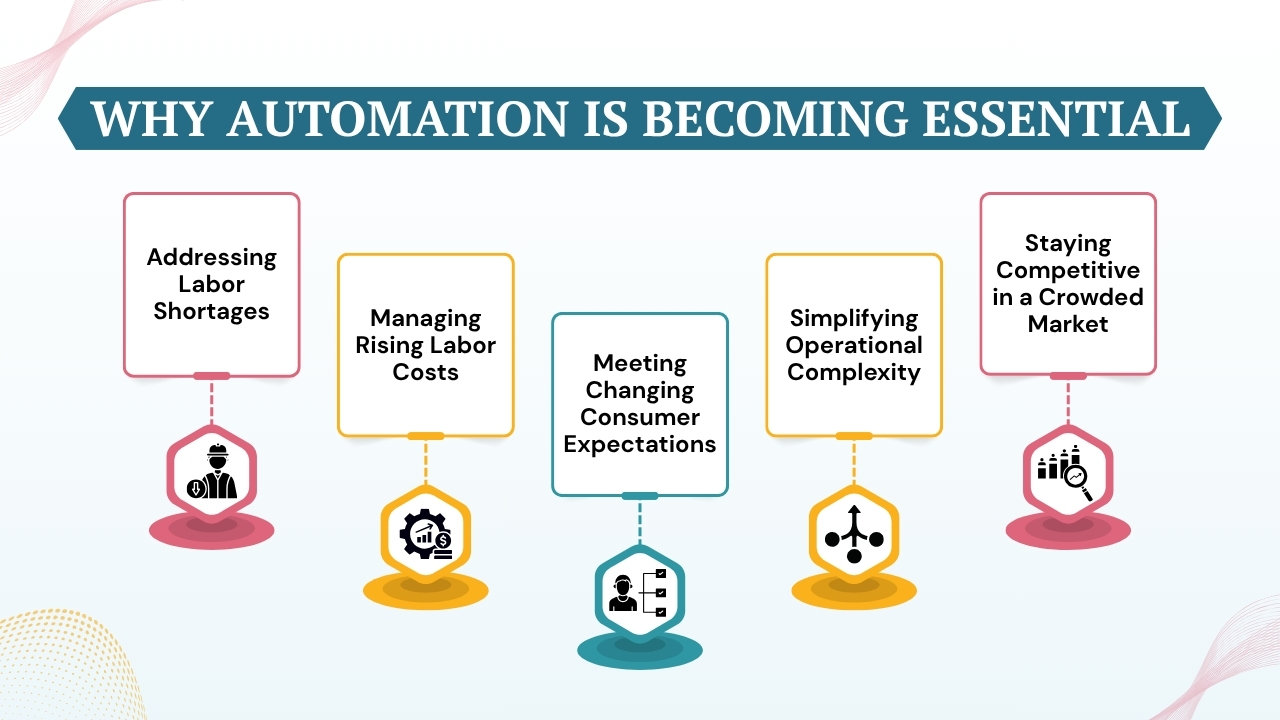
The restaurant industry is experiencing many changes which is speeding the adoption of automation technologies among restaurants. As there are high operational challenges, automation has become a necessity rather than a luxury.
Below are five important reasons why restaurant automation is gaining momentum.
1. Addressing Labor Shortages
Many restaurants face many difficulties to hire and retain qualified employees. While there are high employee turnover rates and shortage of staff can affect both service quality and operational efficiency.
Automation helps restaurants to resolve all these challenges by effectively handling tasks such as order taking, scheduling, tracking inventory, and payment processing.
Such automation gives staff more time to focus on customer service and other essential responsibilities that improves productivity and satisfied employees.
Also Read: How Can Data Analytics Improve the Measurement of Employee Performance
2. Managing Rising Labor Costs
Labor expenses are one of the highest operational expenses for restaurants. If minimum wages, employee benefits, and training costs can highly affect profits.
Automation helps businesses to improve utilization of workforce by reducing the amount of manual work needed for completing routine tasks. As a result, restaurants can improve efficiency while maintaining high service standards and controlling operational expenses.
Also Read: Ways Restaurant Data Analytics Solutions Reduce Costs Improve Profit
3. Meeting Changing Consumer Expectations
Today’s customers expect quick, convenient, personalized, and smooth digital experiences. Features like online ordering, mobile payments, self-service kiosks, and contactless transactions have become standard expectations for customers.
Automation enables restaurants to provide modern conveniences while also improving order accuracy and reducing wait times which improves the overall customer experience.
Also Read: Customer Analytics for Restaurants
4. Simplifying Operational Complexity
Restaurants manage many interconnected processes. These processes include inventory management, food preparation, staffing, customer service, accounting, and reporting.
Though coordinating all these processes manually can be time consuming and prone to errors. While automation makes these workflows smooth by integrating systems and providing visibility into operations in real time that makes managing operations both efficient and data-driven.
5. Staying Competitive in a Crowded Market
Competition in the restaurant industry keeps increasing. While restaurants which use automation can operate more efficiently by making rapid decisions, reducing expenses, and offering superior experiences to customers.
When restaurants adopt innovative technologies, businesses have a competitive advantage that helps to attract customers, improve profits, and support long-term growth.
Also Read: How AI Unlocks Business Insights that Drive Required Results
Transforming Restaurant Management with Automation and Data-Driven Insights
1. Automated Ordering Systems
Automated ordering systems are the mostly adopted restaurant automation technology. These systems smoothly manage the ordering processing by letting customers place orders digitally through kiosks, mobile apps, or online platforms.
These systems help restaurants to improve order accuracy, reduce wait times, improve customer experience, and help restaurants to operate more efficiently.
a.) Self-Service Kiosks
Self-service kiosks are becoming more popular in modern restaurants. These kiosks allow customers to browse menus, customize orders, and complete payments independently.
As such kiosks do not need much support from staff for taking orders, these systems help restaurants to make restaurant operations smooth by creating a faster, convenient dining experience.
Many kiosks also have features like smart recommendations which suggest food upgrades, add-ons, and complementary menu items which help restaurants to increase sales.
Benefits of self-service kiosks include:
- These kiosks reduce wait times
- It improves order accuracy
- It causes higher average order values
- It reduces workload on cashier
- It improves customer convenience and satisfaction
b.) Mobile Ordering
Mobile ordering applications allow customers to browse menus, customize menus, and place orders directly from their smartphones even before arriving at the restaurant.
Such applications provide a smooth and convenient ordering experience which helps restaurants to manage customer demand more efficiently.
By enabling advance ordering, mobile apps reduce customer wait times, improve service speed, and support smoother operations during busy hours.
Advantages of mobile ordering include:
- It enables faster service and shorter wait times
- It improves customer convenience
- It enables better order management and accuracy
- Increased customer satisfaction
- Higher order volumes during peak business hours
c.) QR Code Ordering
QR code ordering systems have become a popular restaurant automation solution which offers customers a more convenient and contactless dining experience.
Customers just have to simply scan a QR code with their mobile phones which allows guests to instantly access digital menus, place orders, make payments, and request assistance whenever needed.
Such technology enables smooth table service while reducing the workload on restaurant staff and improving operational efficiency.
Customers can use QR code ordering to:
- It enables customers to access digital menus instantly
- It allows them to place orders directly from their tables
- It allows them to make electronic payments securely
- It request staff assistance whenever required
- It enables a faster and more convenient dining experience.
d.) Voice Ordering Technology
This technology uses advanced speech recognition and artificial intelligence which allow customers to place orders through natural speech.
Such systems simplify the ordering processing, improve efficiency, and offer a smooth ordering experience across restaurants, drive-thrus, and delivery services.
While AI technology keeps evolving, voice ordering is becoming increasingly accurate and accessible that helps businesses to deliver faster and more convenient service.
Benefits of voice ordering technology include:
- It improves order accuracy
- It reduces wait times
- It supports greater customer convenience
- It causes fewer manual input errors
- Improves accessibility for diverse customer needs
Also Read: Artificial Intelligence in Restaurants
2. Kitchen Automation and Food Preparation
Automating kitchen duties and food preparation helps restaurants to maintain speed, consistency, and food quality by making food preparation processes smooth.
With advanced equipment and digital tools, restaurants can improve operational efficiency, reduce mistakes, optimize workflows, and deliver a more reliable dining experience.
a.) Kitchen Display Systems (KDS)
Such systems replace traditional paper with digital screens that display orders in real time. These systems improve communication between front office staff and kitchen staff which helps teams to manage orders more efficiently.
Whenever a food is ordered, updated, or modified, kitchen staff can receive instant notifications that ensures smoother operations and faster service.
Benefits of Kitchen Display Systems include:
- It enables real-time order tracking
- It improves communication between staff
- It enables faster food preparation times
- It reduces order mistakes
- Better workflow organization
b.) Automated Food Preparation Equipment
Many restaurants use automated food preparation equipment which helps them to handle repetitive cooking tasks more efficiently.
Such technologies help to maintain consistency, improve food quality, and reduce the need for manually completing tasks required in the kitchen.
Common examples include:
- Automated fryers
- Smart ovens
- Beverage dispensing systems
- Robotic food preparation equipment
- Automated portion control systems
These tools improve productivity, reduce preparation errors, and support faster kitchen operations.
c.) Smart Cooking Technologies
Smart cooking technologies use connected equipment which automatically adjusts temperatures, cooking times, and preparation settings to ensure optimal results.
These systems help restaurants to maintain consistency while improving overall kitchen performance.
Advantages include:
- These equipment ensures consistent food quality
- It reduces food waste
- Improves safety compliance
- It reduces need for training requirements
- It improves kitchen efficiency
Also Read: Two Way Data Analytics is Shaping Retail Business
3. Inventory Management Automation
Automation of inventory management enables restaurants to monitor stock levels in real time and improve inventory control.
By using automated tracking and predictive analytics, businesses can reduce food waste and improve stock purchasing.
Key benefits include:
- It reduces stock shortages
- It prevents overstocking of inventory
- It helps to reduce food waste
- Fewer ordering mistakes
- It improves revenue management
a.) Real-Time Inventory Monitoring
Monitoring inventory in real-time involves automatically updating stock levels on the basis of sales data and usage of inventory data.
This offers restaurants with the right inventory data that help managers to make informed purchasing decisions and maintain optimal stock levels.
Benefits include:
- It ensures accurate inventory counts
- It improves purchasing decisions
- It helps to reduce food waste
- It ensures better cost control
- It enables increased operational visibility
b.) Automated Purchasing
Automated purchasing systems help restaurants to maintain optimal stock levels by instantly generating purchase orders when stock levels go below predefined limits.
This reduces the need for manually tracking ingredients and ensures that ingredients are reordered on time.
Benefits include:
- Automated purchasing prevents shortage of stocks
- It reduces emergency purchases
- It ensures consistent inventory levels
- It improves relationships with suppliers
- More efficient procurement processes
c.) Demand Forecasting
AI-based demand forecasting helps restaurants to predict the need of inventory in the future by analyzing past and real-time data.
Such tools help to identify customer patterns and trends that enable businesses to make more accurate purchasing and staffing decisions that reduce food waste.
Forecasting tools analyze:
- These tools analyze past sales data
- Analyze seasonal trends
- Weather conditions
- Local events
- Customer purchasing behavior
Such insights support better planning of inventory and operational efficiency.
Also Read: AI for Restaurant Inventory
4. Employee Management Automation
Automation of employee management helps restaurants to make workforce tasks smooth while controlling labor expenses.
When restaurants automate scheduling, time tracking, attendance monitoring, and performance management, it helps restaurants to improve productivity, reduce administrative workload, improve staff coordination, and ensure more efficient daily operations.
a.) Automated Scheduling
Automated scheduling software helps restaurants to create efficient employee schedules on the basis of operational needs and availability of workforce.
Using data-driven insights, these systems help to reduce manual planning and ensure appropriate staffing levels during busy and slow hours.
Scheduling factors include:
- Sales forecasts
- Employee availability
- Labor budgets
- Skill requirements
- Peak demand periods
Such automation of scheduling reduces administrative workload, reduces scheduling conflicts, and improves workforce efficiency.
b.) Time Tracking Systems
These automated time tracking systems help restaurants to accurately record work hours of employees which reduces workload of manually checking working hours of the staff and admin work.
These tools improve accuracy of payroll, support labor compliance, and provide restaurant managers with more visibility into staff attendance and their productivity.
Common features include:
- Digital clock-ins and clock-outs
- Attendance monitoring
- Overtime tracking
- Payroll integration
- Compliance reporting
Such capabilities make management of the workforce smooth for restaurants and reduce payroll-related mistakes.
c.) Staff Performance Monitoring
Tools that monitor staff performance using automated tools to track KPIs and provide insights into the productivity and effectiveness of employees.
These systems help managers to identify strengths, address performance challenges of each employee. These insights help restaurants to make informed decisions about training and workforce management.
Important metrics monitored include:
- Order completion times
- Sales performance
- Customer satisfaction scores
- Attendance records
- Employee productivity trends
Such insights support improved training programs, better accountability, and improved overall team performance.
Also Read: Leveraging AI to Collect Customer Insights
5. Payment Processing Automation
Automating payment processing simplifies transactions for both customers and restaurant operators.
By making payment workflows smooth, these systems improve checkout speed, convenience, reduce manual mistakes, and provide a smooth dining experience while improving operational efficiency.
a.) Contactless Payments
Contactless payment solutions have become popular as today’s customers look for faster, safer, and more convenient ways to complete transactions.
Offering tap-to-pay cards, mobile wallets, and digital payment apps, allows restaurants to make the checkout process smooth and improve the overall customer experience.
Benefits include:
- It enables faster transactions
- Improves customer convenience
- Improves payment security
- It reduces need for cash handling
- It ensures shorter checkout times
b.) Integrated Payment Systems
Integrated payment systems connect payment processing with other essential restaurant technologies which creates a smooth flow of information across the business.
By connecting transactions with operational systems, restaurants can reduce manual work, improve accuracy, and gain better visibility into financial performance.
Integrated systems connect with:
- Point-of-sale (POS) platforms
- Accounting software
- Inventory management systems
- Customer loyalty programs
- Reporting and analytics tool
Such integration removes chances of duplicate data entry and improves reporting accuracy.
c.) Automated Reconciliation
Automated reconciliation makes financial management smooth by automatically aligning payment transactions with sales data and accounting data.
It reduces need for manual bookkeeping, errors, and ensures that financial records remain accurate and up to date.
Advantages include:
- Reduced accounting workload
- Improved financial accuracy
- Faster reporting processes
- Better financial visibility
- More efficient transaction management
These benefits help restaurants maintain stronger financial control and make informed business decisions.
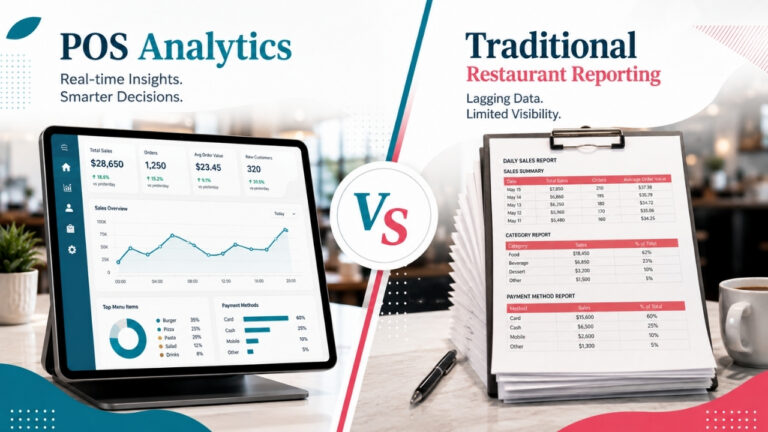
Also Read: POS Reports Vs Real-time Analytics
6. Customer Experience Automation
Automating customer experience helps restaurants to meet changing guest expectations through personalized, convenient, and efficient transactions.
Using technology, restaurants can improve customer satisfaction, improve loyalty, and provide smooth experiences while maintaining operational efficiency.
a.) Loyalty Programs
Automated loyalty programs help restaurants to develop stronger customer relationships by tracking purchase activity and also rewarding repeat visits.
Such systems help restaurants to easily manage rewards, deliver personalized offers, and encourage long-term customer engagement.
Benefits include:
- Such loyalty programs increases customer retention
- It increases higher customer lifetime value
- This ensures more frequent restaurant visits
- Stronger brand loyalty
- Improves customer engagement
These loyalty programs help restaurants to build lasting relationships with customers while increasing repeat business and revenue growth.
b.) Personalized Marketing
Personalized marketing involves using customer data and customer behavior to offer targeted promotions and relevant offers.
When restaurants personalize communications as per individual preferences, restaurants can increase engagement with customers, repeat visits, and improve the effectiveness of marketing campaigns.
Examples include:
- Birthday promotions
- Personalized discounts
- Product recommendations
- Re-engagement campaigns
- Customized loyalty offers
These strategies help restaurants to establish stronger customer relationships and higher marketing performance.
c.) Automated Customer Communication
Automated customer communication tools help restaurants to offer timely updates and also send personalized messages instead of increasing workload on staff.
These systems improve customer engagement by ensuring guests receive essential information throughout their dining.
Restaurants can automate:
- Reservation confirmations
- Order status updates
- Feedback requests
- Promotional messages
- Loyalty program notifications
When restaurants automate communication with customers, then restaurants can improve customer satisfaction, strengthen relationships with customers, and maintain consistent engagement while improving operational efficiency.
Also Read: Customer Sentiment Analysis for Multi-Location Business
Benefits of Restaurant Automation
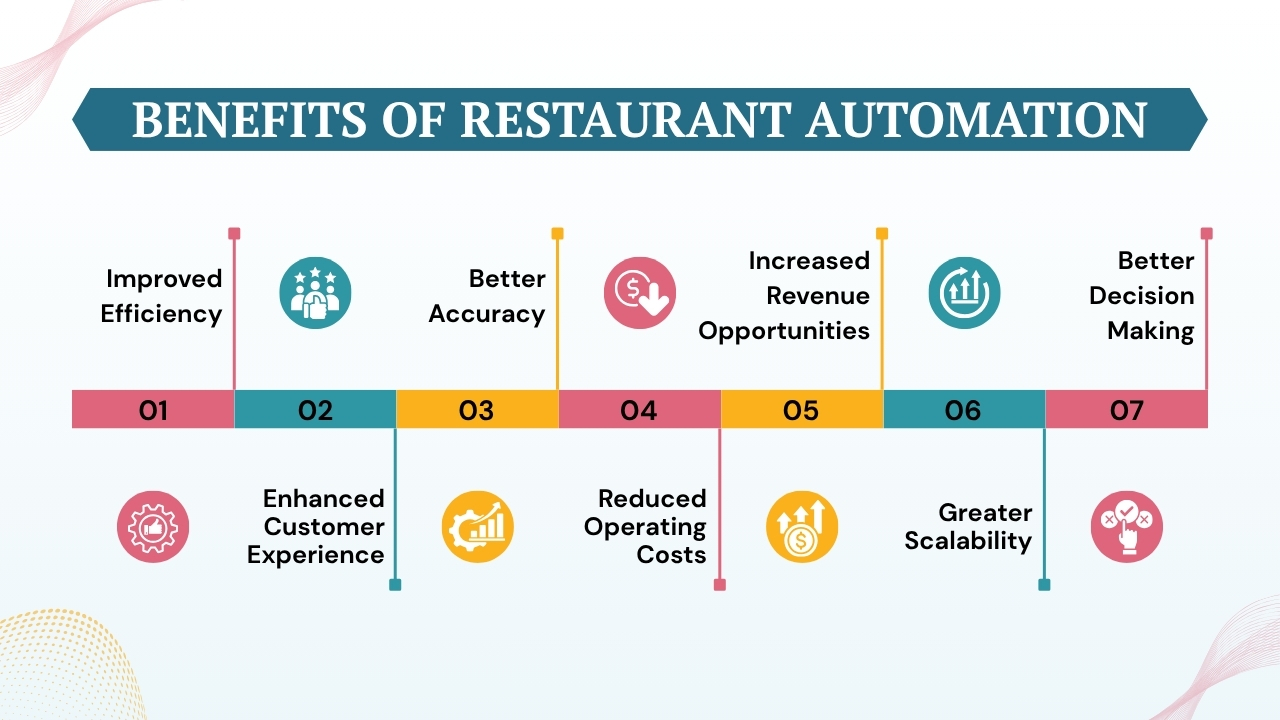
When restaurant automation is implemented strategically, it offers benefits that improve both operational performance and customer satisfaction.
Below are seven key benefits of adopting automation technologies.
1. Improved Efficiency
Automation enables restaurants to smoothly manage repetitive tasks like order processing, inventory tracking, and payment handling.
As these systems reduce manual efforts of staff, restaurants can complete tasks quickly, improve workflow efficiency, and allow employees to focus on higher-value responsibilities.
Also Read: Improved Decision Through Decision Intelligence
2. Enhanced Customer Experience
Modern automation tools can provide quick service, personalized recommendations, and convenient ordering options.
Many features like self-service kiosks, mobile ordering, and contactless payments enable it to provide a smoother and satisfying dining experience for customers.
Also Read: How AI Revolutionizes Customer Experience in Restaurant Industry
3. Better Accuracy
Any type of human mistakes can cause inaccurate orders, inventory discrepancies, and staff scheduling issues.
While automated systems improve accuracy by reducing need for manually entering data. It ensures consistent execution of operational processes.
4. Reduced Operating Costs
Automation helps restaurants to improve better use of labor, reduce food waste, and improve management of inventory.
By reducing all these inefficiencies can help restaurants to reduce operational expenses and well allocate their resources as per the requirement.
5. Increased Revenue Opportunities
Many automation solutions include intelligent upselling and cross-selling features which encourage customers to purchase additional items.
Faster service and improved customer retention also contribute to increased sales and profitability.
Also Read: Restaurant Profit Margin Analytics Tool to Boost Profits
6. Greater Scalability
While restaurants grow, managing multiple locations, and increasing workloads becomes more challenging.
While automation allows businesses to scale operations efficiently without significantly increasing administrative complications and staffing requirements.
Also Read: How Businesses Are Adopting AI in Decision Making
7. Better Decision Making
Integrated analytics and reporting tools offer real-time insights into sales performance, labor expenses, customer behavior, and inventory patterns.
Such data-driven insights help restaurant operators to make informed decisions, identify growth opportunities, and continuously improve business performance.
Together, these benefits make automation a valuable investment for restaurants seeking long-term efficiency, profitability, and competitive advantage.
Conclusion
Automation is quickly changing the restaurant industry which helps businesses to improve operational efficiency, reduce operational expenses, and offer better customer experiences.
Whether automated ordering systems, kitchen display technologies, inventory management, workforce scheduling, and payment processing, automation enables restaurants to make daily operations smooth while maintaining consistent and accurate operations.
These technologies not just reduce the burden of repetitive tasks and also allow employees to focus on providing good hospitality and personalized service to the customers.
As customer expectations keep changing, restaurant automation has become a valuable tool for meeting customer demands for speed, convenience, and smooth digital experiences.
Additionally, advanced technologies like artificial intelligence, predictive analytics, and business intelligence platforms allow restaurant operators to make data-driven decisions which improve profits and operational performance.
However, successful automation requires thoughtful implementation. Restaurants must address many challenges like investment expenses, staff training, system integration, and data security that ensures that technology improves instead of replacing impactful human interactions.
The most effective automation strategies need a good balance between technological efficiency and personalized customer service. For going beyond, automation will continue to play a crucial role in the future of the restaurant industry.
Businesses that adopt innovative solutions and use data-driven insights from platforms like Livelytics will be better placed to improve operations, adapt to changing market conditions, and achieve sustainable growth.
When restaurants combine automation with good hospitality, restaurants can create a stronger foundation for long-term success in a highly competitive market.
If you still have a query about the role of automation in restaurants improving efficiency and service then you may book a free demo at livelytics and we are more than happy to assist you.