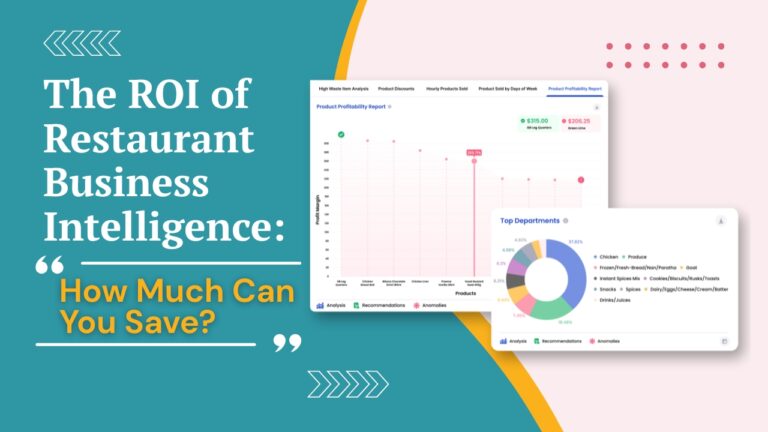
Running a multi-location restaurant isn’t just about serving great food anymore. It’s about keeping every outlet aligned on pricing, inventory, staff performance, customer experience, and profitability without relying on endless spreadsheets, delayed reports, or gut-based decisions.
When you’re managing five, ten, or even fifty locations, small inconsistencies quickly turn into lost margins, unhappy customers, and operational blind spots.
This is where Restaurant Business Intelligence changes the game. Instead of guessing or waiting for end-of-month reports, Restaurant Business Intelligence tools bring all your data from different locations into one place.
Because for growing brands, the goal isn’t just more data; it’s clarity.
Let’s keep on reading to know about Restaurant Business Intelligence, how it’s shaping the modern restaurant businesses, and the guide to manage it all with ease.
Also Read: Customer Sentiment Analysis for Multi-location Business
What is Restaurant Business Intelligence?
Restaurant Business Intelligence is a simple way to understand how your restaurant is performing using data you already have. It collects information from sales, inventory, staff, and customers and shows it clearly in one place.
With Restaurant Business Intelligence tools, operators can quickly see what’s working, what’s not, and where action is needed without spreadsheets or guesswork. Data analytics in restaurants helps compare locations, control costs, and make better day-to-day decisions using clear insights from Restaurant Data Analytics Solutions.
Let’s understand with a simple example:
You run three restaurant locations. Your Restaurant Business Intelligence dashboard shows that one outlet’s profit is lower than the others, even though sales are similar. Using data analytics in restaurants, you see that food costs are higher at that location due to over-ordering. You adjust the ordering quantities, reduce waste, and profits improve without changing prices or the menu.
Also Read: Business Intelligence For Restaurants
How Multi-Location Restaurants Use BI Tools to Improve Performance?
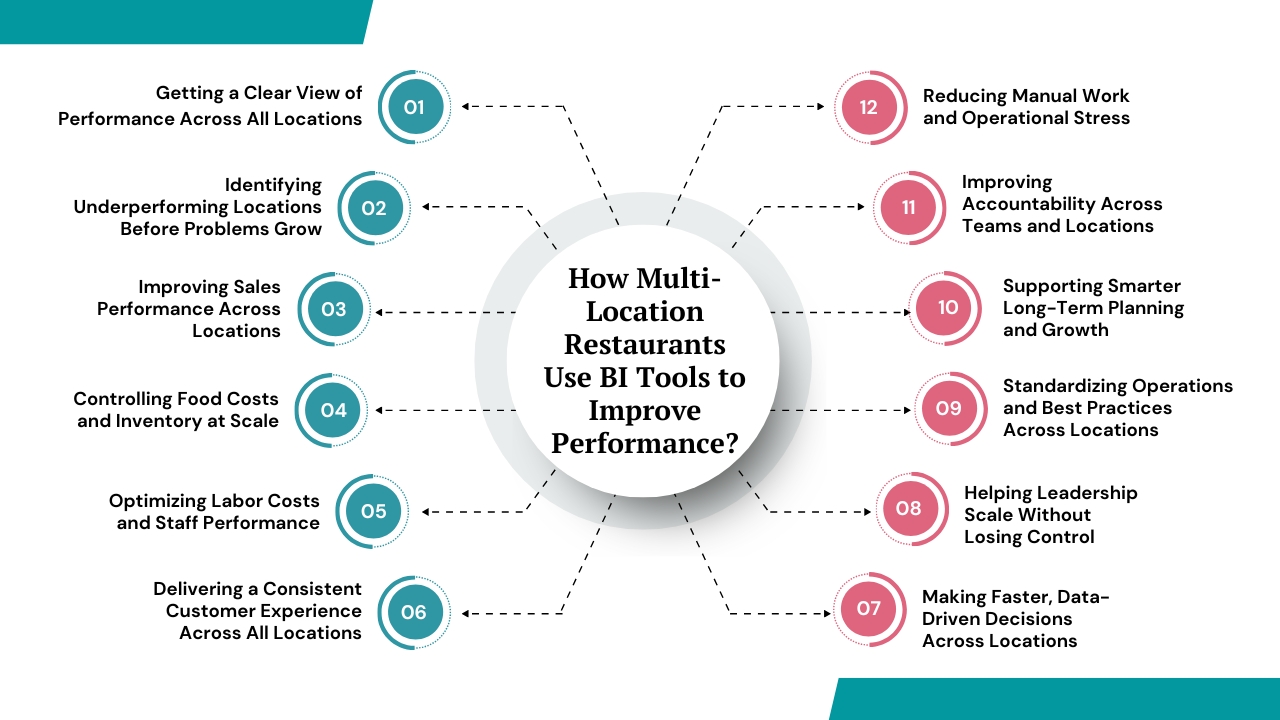
1. Getting a Clear View of Performance Across All Locations
When you’re running multiple restaurant locations, visibility is everything. Without a centralized view, operators often rely on manager updates, spreadsheets, or delayed reports, which makes it hard to see the real performance picture. Restaurant business intelligence tools bring all location data into one dashboard, so leadership always knows what’s happening across the business.
How BI helps multi-location restaurants
- Combines sales, revenue, margins, and order data from all outlets
- Shows location-wise performance in real time, not days later
- Makes it easy to compare outlets using data analytics in restaurants
- Helps leadership focus on insights instead of manual reporting
Let’s understand it with a simple example,
You manage six restaurant locations. Your restaurant business intelligence dashboard shows that two outlets consistently generate higher margins than the others.
By reviewing their data, like average order value and peak-hour performance, you identify what’s driving better results. You then apply the same pricing and operational strategy across other locations to improve overall performance.
How does Domino’s run thousands of locations using data and get 50% global sales through digital solutions?
Domino’s is a great example of data analytics in restaurants done right. They connected data from stores, supply chain, and digital orders to create one real-time view of performance across locations.
Why this matters
For multi-location restaurants, having one version of the truth helps maintain consistency, improve delivery speed, and support growth without chaos.
What improved
- Integrated 85,000+ data sources
- Managed 17TB of standardized data
- Over 50% of global sales now come from digital channels
Also Read: How to Setup KPIs for Your Business
2. Identifying Underperforming Locations Before Problems Grow
In multi-location restaurants, performance issues don’t always look obvious. Sales may appear stable, but profits can quietly drop due to higher costs or inefficiencies at just one or two outlets. Restaurant Business Intelligence helps operators spot these early warning signs before they impact the entire business.
How BI helps multi-location restaurants
- Tracks food costs, labor costs, and profit margins for each location separately
- Compares location performance to quickly spot gaps and inconsistencies
- Flags unusual trends, like rising costs or lower margins, using data analytics in restaurants
- Allows operators to dig deeper into problem areas with Restaurant Data Analytics Solutions
- Enables faster, data-backed decisions instead of guesswork
Simple example
You run four restaurant locations. All four are generating similar sales, so everything seems fine at first. However, your Restaurant Business Intelligence dashboard shows that one location has lower profits. When you look closer using data analytics in restaurants, you see that this outlet is ordering more ingredients than it needs, leading to higher waste.
After adjusting ordering quantities and improving portion control at that location, food costs come down, and profits improve without changing the menu or customer experience.
Also Read: Why One Burger Chain Location is Always Slower
3 Improving Sales Performance Across Locations
Multi-location restaurants often see uneven sales performance. Some outlets consistently perform better, while others struggle, even with the same menu and pricing. Restaurant Business Intelligence helps identify what’s driving higher sales at top-performing locations and replicate those strategies across others.
How BI helps multi-location restaurants
- Tracks sales trends and revenue by location and time period
- Identifies best-selling menu items across outlets
- Compares average order value and peak-hour performance
- Uses data analytics in restaurants to understand what drives higher sales
Let’s understand with a simple example: your Restaurant Business Intelligence dashboard shows that one location consistently has a higher average order value. Using restaurant data analytics solutions, you discover that customers at this outlet frequently add sides and beverages. You apply the same upselling approach at other locations, which leads to higher sales without increasing footfall.
Also Read: How Livelytics Can Helps Restaurants Boost Revenue
4. Controlling Food Costs and Inventory at Scale
Managing inventory across multiple locations is one of the biggest challenges for restaurant operators. Small inefficiencies at each outlet can quickly add up. Restaurant Business Intelligence helps maintain control by showing exactly how inventory and food costs behave across locations.
How BI helps multi-location restaurants
- Monitors food cost percentages by location
- Tracks inventory usage and wastage patterns
- Identifies over-ordering or stock shortages early
- Supports smarter inventory planning using Restaurant Data Analytics Solutions
Let’s understand with a simple example
You notice through data analytics in restaurants that one location frequently runs out of key ingredients, while another has excess stock that goes to waste. Using Restaurant Business Intelligence, you adjust ordering patterns for both outlets, reduce waste, and ensure consistent availability, improving margins and customer satisfaction.
Also Read: How to Calculate Food Cost Percentage
5. Optimizing Labor Costs and Staff Performance
Labor is one of the biggest expenses for multi-location restaurants, and it’s rarely consistent across outlets. Some locations may be over-staffed during slow hours, while others struggle during peak times.
Restaurant Business Intelligence brings it all into one place, understands who is doing well, who is struggling, and makes decisions to manage the staff, customer experience, retention, and ensure consistency across the different locations.
How BI helps multi-location restaurants
- Tracks labor cost percentage by location and shift
- Compares staffing levels with sales performance
- Identifies overstaffing and understaffing patterns
- Uses data analytics in restaurants to align schedules with demand
Let’s understand with a simple example
Your restaurant business intelligence dashboard shows that one outlet has higher labor costs but similar sales compared to others. Using restaurant data analytics solutions, you see that this location is over-staffed during weekday afternoons. You adjust schedules to match footfall, reduce labor costs, and maintain the same service level.
How Starbucks uses BI to run stores smarter & improve store productivity by 15%?
Starbucks operates thousands of locations, so even small inefficiencies can scale into big losses. By using restaurant business intelligence and data analytics, Starbucks analyzes store-level sales, customer behavior, and time-based demand to optimize operations.
Why this matters
BI helps Starbucks decide what to sell, where to sell it, and when, ensuring consistency and profitability across locations.
What improved
- 15% increase in store-level productivity
- Better inventory forecasting, reducing stock-outs during peak hours
- Faster rollout of successful menu items across locations
Also Read: How Data Analytics Helps to Improve the Measurement of Employee Performance
6 Delivering a Consistent Customer Experience Across All Locations
For multi-location restaurants, consistency matters as much as growth. One poor experience at a single outlet can affect the brand as a whole. Restaurant Business Intelligence helps ensure every location delivers the same quality of service and experience.
How BI helps multi-location restaurants
- Tracks customer ratings, reviews, and feedback by location
- Identifies recurring complaints or service issues
- Compares customer experience scores across outlets
- Uses restaurant data analytics solutions to standardize performance
Let’s understand with a simple example
Using data analytics in restaurants, you notice that one location receives lower ratings due to slow service during dinner hours. And when you checked the data, it showed that this particular location is understaffed during peak times. After adjusting staffing for those hours, customer ratings improve and match other locations.
Also Read: How AI Revolutionizes Customer Experience in the Restaurant Industry
7. Making Faster, Data-Driven Decisions Across Locations
In multi-location restaurants, timing matters. A delayed decision, whether it’s about pricing, staffing, or inventory, can quickly impact revenue and customer experience. Restaurant Business Intelligence helps operators move faster by replacing delayed reports with real-time insights.
How BI helps multi-location restaurants
- Provides real-time dashboards showing sales, costs, and performance by location
- Flags sudden changes like sales drops, cost spikes, or operational issues
- Reduces reliance on manual reports and follow-ups with location managers
- Uses data analytics in restaurants to support confident, data-backed decisions
Let’s understand with a simple example
Your restaurant business intelligence dashboard shows a sudden drop in orders at one location during peak hours. Instead of waiting for end-of-day reports, you investigate immediately and discover a payment system issue. The problem was fixed the same day, preventing further revenue loss and customer complaints.
Also Read: Benefits of Data-Driven Decision Making
8. Helping Leadership Scale Without Losing Control
As restaurant brands expand, staying connected to day-to-day performance becomes harder. Leadership teams can’t monitor every outlet manually, but they still need visibility and control. Restaurant Business Intelligence ensures growth doesn’t come at the cost of oversight.
How BI helps multi-location restaurants
- Gives leadership a single, high-level view of all locations
- Allows regional and area managers to monitor KPIs easily
- Ensures consistent reporting and performance benchmarks
- Uses restaurant data analytics solutions to support structured, scalable growth
Let’s understand with a simple example
As your brand grows from five to ten locations, your Restaurant Business Intelligence platform keeps all performance data centralized. Leadership can quickly review how each outlet is doing, identify which locations need support, and scale operations confidently without adding complexity or extra manual work.
How Yum! Brands use BI across brands & achieved solid leadership control.
Yum! Brands (parent company of KFC, Pizza Hut, and Taco Bell) relies heavily on Restaurant Business Intelligence to track performance across thousands of outlets worldwide. Their BI systems connect sales, supply chain, and customer data into one unified view.
Why this matters
When BI works at scale, it gives leadership control without slowing down local teams.
What improved
- 10%+ improvement in operational efficiency
- Lower supply chain costs through better forecasting
- Faster decision-making across regions and brands
Also Read: How Restaurant Business Intelligence Helps Owners Make Faster Decisions
9. Standardizing Operations and Best Practices Across Locations
As restaurants grow, consistency becomes harder to maintain. Different locations may follow slightly different processes, which can affect food quality, service speed, and costs. Restaurant Business Intelligence helps standardize operations by showing what works best and where gaps exist.
How BI helps multi-location restaurants
- Compares operational metrics across locations
- Identifies best-performing outlets and processes
- Highlights inconsistencies in execution or performance
- Uses data analytics in restaurants to roll out proven best practices
Let’s understand with a simple example
Your restaurant business intelligence dashboard shows that locations following a specific prep and service process consistently achieve faster table turnover and higher customer ratings. You standardize that process across all outlets, improving consistency and overall performance.
How McDonald’s used BI to speed up operations and serve 20% more customers?
When you’re running thousands of outlets, even small delays add up. McDonald’s used Restaurant Business Intelligence dashboards to compare performance across locations and understand where service slowed down, by time of day, store layout, and staffing patterns.
Why this matters
By seeing the same performance data across locations, managers could quickly copy what top-performing outlets were doing and fix issues before customers felt the impact.
What improved
- 6% faster service times
- 20% more customers served per hour
Also Read: How to Improve Restaurant Operations
10. Supporting Smarter Long-Term Planning and Growth
Beyond daily operations, multi-location restaurants need data to plan for the future. Whether it’s expanding to new locations, updating menus, or adjusting pricing, Restaurant Business Intelligence provides the insights needed for confident long-term decisions.
How BI helps multi-location restaurants
- Tracks long-term sales, cost, and performance trends
- Identifies high-performing locations and growth opportunities
- Supports forecasting using Restaurant Data Analytics Solutions
- Helps leadership plan expansion with less risk
Let’s understand with a simple example
Using data analytics in restaurants, you see that certain locations consistently perform well during lunch hours in specific areas. You use these insights to plan your next location in a similar market, increasing the chances of success.
Also Read: How Data Analytics Help Restaurant Grow
11. Improving Accountability Across Teams and Locations
In multi-location restaurants, accountability can get blurry. When performance drops, it’s often unclear where the issue started or who needs to act. Restaurant Business Intelligence creates transparency by tying performance data to each location and function.
How BI helps multi-location restaurants
- Assigns clear performance metrics to each location
- Makes results visible to leadership and regional managers
- Reduces dependency on subjective updates or excuses
- Uses data analytics in restaurants to support fair, data-backed accountability
Let’s understand with a simple example
Your restaurant business intelligence dashboard shows one location consistently missing margin targets. Instead of guessing, you review the data with the location manager and identify exact cost issues. Clear data helps teams take ownership and fix problems faster.
Also Read: Retail Pricing Strategy AI for Right Prices and Maximum Revenue
12. Reducing Manual Work and Operational Stress
Managing multiple locations often means hours spent on reports, follow-ups, and data checks. This manual work slows teams down and increases the risk of errors. Restaurant Business Intelligence automates reporting and simplifies performance tracking.
How BI helps multi-location restaurants
- Automates daily, weekly, and monthly performance reports
- Reduces reliance on spreadsheets and manual data entry
- Gives teams instant access to insights using Restaurant Data Analytics Solutions
- Frees up time for strategy and on-ground improvements
Simple example
Earlier, your team spent hours every week collecting sales and cost reports from each restaurant location. With Restaurant Business Intelligence in place, all location data flows automatically into one dashboard. Managers can instantly see sales, costs, and performance for every outlet, allowing leadership to review numbers in minutes and spend more time improving operations instead of chasing reports.
Streamline Your Multi-Location Restaurant Business with Livelytics!
Running a multi-location restaurant business becomes much easier when data starts working for you instead of against you. This is where Livelytics fits in naturally. Livelytics is an AI-powered business intelligence & analytics platform for restaurants that transforms fragmented data into clarity, foresight, and action, helping operators move beyond static dashboards to real, decision-ready insights.
Built for operators and leadership teams alike, Livelytics helps multi-location restaurants achieve operational excellence while improving performance across every critical area of the business.
How Livelytics helps multi-location restaurant businesses:
- Operational excellence: Streamlines daily operations with AI-driven recommendations that reduce inefficiencies, improve workflows, and support faster decision-making
- Menu management: Uncovers top-performing dishes, slow movers, and menu gaps in real time, helping teams refine menus based on actual demand
- Inventory optimization: Identifies over-ordering, waste, and stock imbalances to control food costs and improve margins across locations
- Customer experience: Uses real-time insights to improve service speed, consistency, and overall guest satisfaction
- Marketing optimization: Helps refine pricing, promotions, and campaigns using clear data on customer behavior and sales trends
With LivAI, Livelytics’ AI assistant, teams get instant answers to key performance questions, what’s selling, what’s slowing down, and where action is needed without digging through reports. Its end-to-end integrated platform connects seamlessly with existing systems, bringing everything into one centralized dashboard so teams work smarter, not harder.
Ready to see how this works for your business?
You can book a free Livelytics demo to understand how the platform fits into your existing processes and helps streamline operations, optimize performance, and scale your multi-location restaurant business, smarter, faster, and more profitably.
Wrap Up!
Running a multi-location restaurant today isn’t just about adding more outlets; it’s about staying in control as you grow. The difference between restaurants that struggle and those that scale smoothly often comes down to how well they use their data.
Managing multiple restaurant locations becomes much easier when data brings clarity instead of confusion. When teams can see what’s working, where gaps exist, and what needs attention, decisions naturally become faster and more consistent. That’s the real shift Restaurant Business Intelligence brings, moving operations from reactive to informed, without adding complexity.
If you are looking for one such tool, check out Livelytics. It turns everyday data into clear, actionable insight across operations, menus, inventory, and customer experience.
Curious about how this kind of intelligence could fit into your own restaurant workflows? Well, book a free Livelytics demo to see how it works in real scenarios and supports smarter decision-making across multi-location businesses.