For years, business intelligence has been reduced to dashboards creating charts, track KPIs and waiting for the right insights to appear.
But in today’s fast-moving market, business intelligence(BI) can’t just display data, rather it needs to interpret them, connect the context, and guide smarter decisions.
Leaders don’t struggle because they lack reports rather they struggle because they lack actionable insights. When revenue drops, costs rise, or customer behavior shifts, then a static dashboard shows the outcome but rarely shows the cause or advises the best next step.
In 2026, the role of analytics is changing from reporting to decision intelligence. Modern BI should unify data across sales, marketing, operations, finance, and customer experience to reveal the root causes and not just react to final outcomes.
That requires smarter capabilities like AI-powered analytics, predictive analytics, anomaly detection, and contextual recommendations that will have the greatest impact in the moment.
The goal is not more dashboards instead it’s decision clarity, modern BI should deliver clear insights that identify patterns, why it changed, and exactly what to do next to improve performance.
This is especially crucial in operational businesses like restaurants and multi-location brands, so intelligence that reveals warnings early and recommends immediate adjustments can protect margins before small problems become expensive ones.
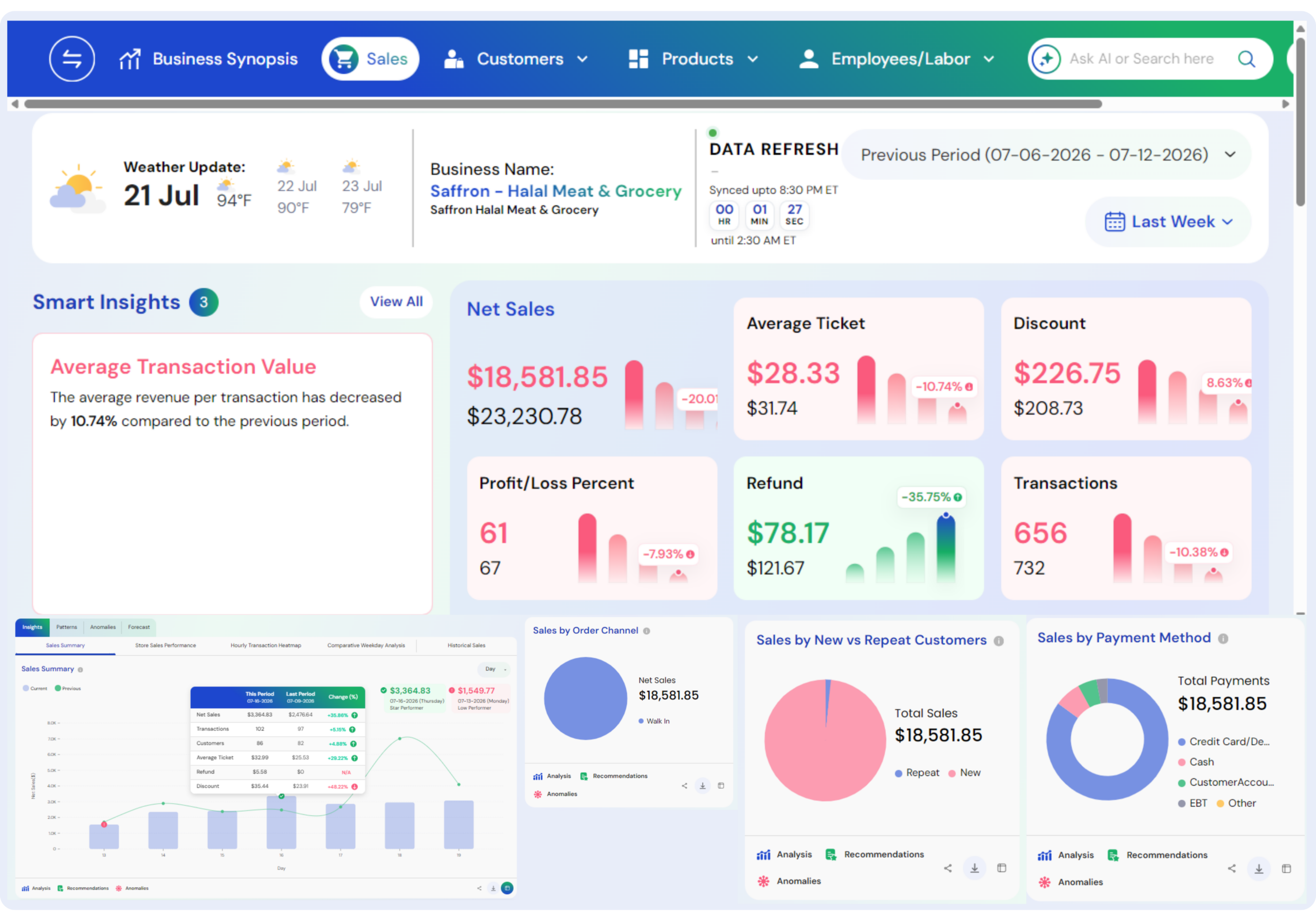
Platforms like Livelytics turn raw data into practical intelligence highlighting cost leaks, demand shifts, labor inefficiencies, and growth opportunities without requiring a full-time analyst.
Also Read: Business Intelligence for Marketing
The Original Purpose of Business Intelligence
Business Intelligence(BI) emerged to solve a major challenge where organizations had plenty of data but leaders lacked fast, practical access to it for decision-making.
In most organizations, crucial information is often found inside disconnected systems such as sales tools, accounting software, and spreadsheets managed by different teams.
Because the data is scattered across tools and teams, leaders often get a fragmented picture slowing decisions and making it harder to trace performance changes back to the real driver.
Leaders used to have questions about performance, profits, and growth, but getting answers was slow, manual, and often unreliable. BI emerged to solve a major challenge that is organizations had plenty of data, but leaders lacked fast, and practical access to it for decision-making.
Early BI systems focused on three core functions. First BI systems extract data from multiple systems and centralized into one place through which organizations get to view performance across different departments.
Second, they standardize data into reports aligning important metrics like revenue, costs, conversion, churn, and customer activity which will help teams to measure performance the same way.
Third, by presenting summaries through charts, tables, and dashboards, it turns complex datasets into visuals which even non-technical teams could understand quickly.
At the time, the shift was a game-changer because businesses could pull on-demand reports instantly rather than waiting for weeks and collecting data manually.
Leadership teams gained more transparency into what was happening across the organization. Analysts were able to explore trends over time, compare segments, identify gaps, and highlight opportunities.
Business intelligence made reporting scalable and repeatable, reducing dependence on individual spreadsheets and helping companies make decisions with greater confidence.
However, the environment BI was originally built for is no longer the environment businesses operate in today. Today, data is abundant and overwhelming, and performance no longer changes slowly, it shifts daily or even hourly.
Customers move across channels, competitors react quickly, and operations are increasingly complex. Static dashboards and monthly reporting cycles move too slowly to support the pace of modern, real-time decision-making.
While traditional BI succeeded at making data visible, today’s businesses need more than visibility. They need systems that can interpret data, provide context, and support faster, smarter actions.
Also Read: Decision Intelligence Vs Business Intelligence
Why Traditional BI Falls Short Today

While traditional Business Intelligence systems once delivered immense value, they are no longer equipped to handle the speed, complexity, and expectations of modern business.
The core issue is not that dashboards are useless rather it’s that dashboards alone are no longer sufficient. As data volumes grow and decisions become more time-sensitive, traditional BI struggles to turn information into timely, confident action.
1. Showing Data Is Not the Same as Explaining It
Most BI dashboards are designed to summarize outcomes, so they show what changed but hardly cover the reasons behind the change.
Traditional BI can highlight an 8% revenue drop, a 3% churn increase, or a labor-cost spike, but it rarely provides the context needed to turn those signals into clear action.
Once a metric changes, the burden of interpretation falls entirely on people. Teams must manually investigate whether churn is seasonal or operational, whether marketing campaigns were adjusted, whether staffing levels changed, or whether pricing and promotions influenced behavior.
This process is slow and often fragmented, requiring multiple dashboards, spreadsheets, and meetings just to assemble a complete story.
More importantly, this manual interpretation introduces bias as different stakeholders may draw conflicting conclusions from partial data or personal assumptions.
In fast-moving environments, BI can turn into a debate tool that shows numbers without direction, and the resulting delays can cost revenue, opportunities, and timely risk mitigation.
Also Read: Business Intelligence Dashboard for Data Collection
2. Cognitive Overload Is a Real Business Risk
As BI tools evolved, many platforms attempted to solve insight gaps by adding more features like more KPIs, more filters, more dimensions. While flexibility is valuable, it has created a new problem which is cognitive overload.
Modern dashboards often include many metrics across multiple views, segmented by department, location, channel, or time period.
Leaders are expected to interpret all of this information, identify what matters most, and decide where to act. Instead of gaining clarity, they often get overwhelmed, unable to confidently choose the next move.
When everything is visible, nothing feels urgent. Critical signals often get buried under routine metrics, so teams spend more time explaining charts in meetings than acting to solve the underlying problems.
Instead of empowering decisions, BI can become overwhelming leaving teams less confident and not more.
Also Read: How AI Unlocks Business Insights That Drive Required Results
3. Static Reporting Can’t Match Real-Time Business
Traditional BI systems are built around scheduled reporting cycles like hourly, daily, or weekly updates. That approach worked when business conditions changed slowly.
In today’s environment, customer behavior, fraud risk, and operational issues can change within hours, so if insights arrive only after a dashboard refresh, when the best chance to respond may already be gone.
In modern businesses, insight delayed is insight denied. Static reporting turns BI into showing what already happened rather than what is unfolding now. To stay competitive, organizations need intelligence that keeps pace with the business itself and not reports that arrive after the moment has passed.
Also Read: Real-Time Analytics Why Does Your Business Needs It
What It Means for Business Intelligence to “Think”
When we say Business Intelligence needs to think, then we are not suggesting that machines should replace human judgement or strategic decision-making.
Rather than thinking BI is about augmenting human intelligence by taking over the difficult analytical work that slows teams down. It allows people to focus on decisions and not data interpretation.
Traditional BI systems are passive. They wait for users to ask questions, apply filters, and interpret charts.
Thinking BI flips this model by actively analyzing data in the background and showing what matters most without requiring constant manual effort. It does not merely report changes rather it interprets them and highlights what they mean for the business.
A thinking BI system can detect patterns automatically, recognizing trends and relationships that might take humans days or even weeks to uncover.It can identify early warning signals, performance shifts, or emerging opportunities before they become visible in standard reports.
This is especially valuable in complex environments where thousands of variables interact at once. It also identifies anomalies without depending on rigid, manual thresholds.
Rather than triggering endless threshold-based alerts, thinking BI adapts to normal patterns and highlights only the deviations that truly matter, reducing noise and keeping attention on real problems.
Context is another crucial difference. Thinking BI systems understand relationships across datasets, connecting sales, operations, marketing, finance, and customer behavior into a single narrative.
Instead of forcing teams to jump between dashboards, the system explains how different factors influence each other.
Equally important, thinking BI can explain changes in plain language. Rather than leaving interpretations to meetings and debates, it summarizes what happened, why it happened, and who or what is impacted. This clarity shortens the path from insight to action.
Ultimately, thinking BI goes a step further by recommending next actions. These recommendations are not rigid commands, they are data-driven suggestions grounded in past outcomes and real-time conditions.
In this way, BI evolves from a reporting tool into an active decision-support system helping teams move faster, act with confidence, and consistently make better choices.
Also Read: Business Intelligence and Data Analytics Service
From Dashboards to Decision Intelligence
In traditional Business Intelligence, the workflow has always followed the same pattern of building dashboards, looking at charts, interpreting the numbers, and then deciding what to do.
This approach assumes that if the right visuals exist, insight will naturally follow. In reality, it often works the other way around. Teams spend significant time navigating dashboards, adjusting filters, and debating interpretations before any action is taken.
Thinking BI reverses this model by putting insight before visualization. Instead of starting with charts, it begins by detecting meaningful changes in the data.
The system identifies the changes, and the warnings that are unusual or important, and then explains the drivers and business impact.
Once the insights are clear then comes visuals which are used to support understanding instead forcing users to search for meaning. In this approach, visualization becomes a supporting tool.
This shift drastically changes time-to-decision. Teams no longer have to search for problems or opportunities rather the system brings them forward with context and clarity. Instead of asking, “What should I look at?” leaders can focus on “What should I do next?”
Also Read: Improved Decisions Through Decision Intelligence
Context Is the Missing Layer
One of the biggest weaknesses of traditional BI is the lack of context. Metrics are often displayed in isolation, even though real business performance is shaped by several interconnected factors. A thinking BI system understands that numbers rarely reveal the full story on their own.
For instance, a dip in sales may not be cause for concern if overall traffic also declined because of seasonality or external events. A spike in labor costs might be justified during peak demand periods or special promotions.
Lower margins can be deliberate when discounts are used to drive volume or customer acquisition. Without the right context, these changes can look like underperformance when they are actually the expected result of a calculated strategy.
Instead of leaving teams to guess, thinking BI connects the signals together and delivers a clear, evidence-backed narrative about what changed, what influenced it, and what means next.
This reduces false warnings and prevents teams from reacting to normal behavior as if it were a crisis.
Platforms like Livelytics emphasize contextual intelligence, especially in operational environments where performance can change daily.
Rather than simply showing that labor costs increased or margins tightened, Livelytics breaks down what is actually causing the change by connecting the underlying drivers like demand shifts, staffing decisions, or promotional activity so actions are based on insight and not assumptions.
When BI prioritizes insight and context first, organizations shift from reacting to numbers to making confident, informed decisions grounded in how the business is actually performing.
The Role of AI in Thinking Business Intelligence
Artificial Intelligence turns BI from a passive scoreboard into an active decision partner by continuously analyzing warnings, learning patterns, and revealing the “why” behind performance in real time.
Without artificial intelligence, Business Intelligence remains reactive and manual dependent on humans to identify patterns, interpret changes, and decide where to act.
With Artificial Intelligence, Business Intelligence becomes continuous, proactive, and scalable, capable of analyzing complexity at a speed no team could match on its own.
1. Pattern Recognition at Scale
Modern businesses generate high volumes of data across time periods, locations, customer segments, channels, and operational systems.
AI models can analyze millions of data points simultaneously and do so continuously, not just during scheduled reporting windows. This allows BI systems to uncover insights that would otherwise remain hidden.
AI-driven pattern recognition enables early detection of emerging trends before they show in dashboards. AI helps uncover the hidden connections between actions and outcomes, revealing how choices in staffing, pricing, and day-to-day operations combine to shape the metrics you see.
AI exposes inefficiencies by showing hidden inefficiencies, revealing cost leaks, underperforming segments, and challenges that seem normal alone, but become clear risks when viewed together.
For complex multi-location operations, AI is essential as no analyst team can monitor every variable in real time, so AI continuously scans performance and reveals what needs attention immediately and not weeks later.
Also Read: Retail Pricing Strategy
2. Anomaly Detection Without Guesswork
Traditional BI systems depend heavily on static limits, trigger alerts like notifying teams when sales drop below a fixed number or costs exceed a predefined limit.
Though simple, this approach has flaws because business behavior is rarely static. Because what seems normal on one day, location, or season may be abnormal on another day.
AI-driven BI learns each business’s true “normal” using history, seasonality, and live signals. That adaptive baseline catches real anomalies early, reduces false alerts, and keeps teams focused on action.
Instead of reacting to every fluctuation, teams get a list of interruptions that truly needs attention so teams can focus on the few shifts that indicate real risk or a clear opportunity to improve.
By removing guesswork from anomaly detection, AI helps BI systems become more trusted, more actionable, and far more effective in supporting fast, confident decision-making.
Why “Thinking BI” Matters Even More in Operational Businesses
Operational businesses like restaurants, retail stores, hospitality brands, and service-based organizations operate in such environments where decisions must be made quickly without affecting profits.
Because conditions change constantly, operators must manage moving targets like daily demand shifts, staffing constraints, unpredictable costs, and big performance differences across locations.
That’s why modern BI has to be forward-looking, detecting change as it starts and guiding quick adjustments while there is still time to influence the outcome.
These industries usually operate with low margins, so even small inefficiencies can erode profits. Often labor is the highest controllable expense still staffing is also the hardest to optimize without affecting service quality.
Additionally rapid demand changes are caused by weather, local events, seasonality, or promotions, and it becomes clear why static dashboards can’t keep up with what operators need at the moment. A chart might show that costs increased or dropped but it rarely explains why.
This is where Thinking BI becomes essential. Rather than forcing operators to interpret raw metrics on their own, Thinking BI focuses on connecting data points and delivering context.
Platforms like Livelytics are an exception because they go beyond displaying Key Performance Indicators and actively explain performance changes. The goal is not just visibility rather it’s understanding.
Instead of showing that labor costs went up, Thinking BI examines related factors like sales volume, staffing levels, scheduling decisions, and hourly demand patterns.
It can reveal, for instance, that labor rose not because of inefficiency, but because managers intentionally staffed heavier shifts to support a promotion or anticipated traffic surge.
Without the full context, teams can overcorrect, treating a normal shift as a failure and reducing labor in ways that reduce service quality and hurt the customer experience.
Thinking BI also helps uncover why one location outperforms another. Instead of unclear comparisons, it highlights operational drivers like foot traffic timing, staff mix, product demand, or local conditions.
A store may be winning not because it has better pricing, but because it aligns staffing more closely with peak demand or executes promotions more effectively. These insights allow best practices to be identified and replicated across locations.
Another crucial advantage is early risk detection. Thinking BI shows patterns before they convert into real problems.
A gradual dip in weekday traffic, rising overtime hours, or declining conversion during certain time blocks can be flagged early, while corrective action is still easy and inexpensive. This proactive approach prevents small issues from turning into crises.
Ultimately, this transforms BI into a daily operational guide instead of a backward-looking reporting tool. Operators no longer spend time asking what happened or on assumptions.
Rather they receive clear explanations that support faster, more confident decisions. In fast-moving operations, the ability to act on clear insight instead of chasing lagging metrics often determines whether a business merely survives or reliably pulls ahead of the competition.
Also Read: Predictive Intelligence In Restaurants
From Retrospective to Proactive Intelligence
Traditional BI is built to explain the past. It helps teams answer questions like What happened last week? Where did we miss targets? And Which metrics dropped?
While that visibility is useful, it often arrives too late like once after revenue is lost, costs have already increased, or customer experience has declined.
In fast-moving environments, this approach creates reactive decision-making, where teams spend more time determining outcomes than preventing them.
Thinking BI shifts the focus from reporting to anticipation. Rather than only summarizing historical performance, it continuously monitors patterns and signals that suggest what may happen next.
It asks more operational questions: Where are risks emerging right now? Which locations or categories are trending off-course? And what should we address today to protect performance tomorrow?
By comparing current behavior against historical norms, seasonality, and real business conditions, it can indicate early warnings before they become obvious in weekly dashboards.
This shift matters because competitive markets reward speed and accuracy. When teams can spot margin erosion early, detect staffing inefficiencies before overtime spikes, or respond to demand changes as they form, they operate with control rather than urgency.
Proactive intelligence keeps teams ahead by guiding smarter decisions in real time rather than summarizing outcomes after the week is already gone.
Also Read: Predictive Intelligence in Retail
From Insight to Action:
Business Intelligence has already moved beyond static reporting into context-aware insight and now the next leap is turning that understanding into clear, timely recommendations teams can act on.
Tḥis is the shift from explanation to execution because BI that does not just clarify the past, but actively recommends the next best move while there is still time to change the outcome.
Instead of leaving teams to interpret charts on their own, these systems analyze performance patterns, compare them against historical behavior, and convert those findings into practical, action-oriented suggestions which help close the gap between insight and execution.
For instance, rather than simply showing traffic fluctuations, modern BI can recommend staffing adjustments aligned with hourly demand patterns helping managers avoid both overstaffing and service challenges.
Margin analysis can go beyond identifying underperforming items to suggesting menu, product mix, or pricing changes that protect profits without sacrificing customer satisfaction.
On the marketing side, BI can detect shifts in conversion trends and recommend reallocating spend, adjusting offers, or timing campaigns more effectively.
When anomalies appear like rising labor costs, declining throughput, or inconsistent location performance, the system can show likely operational fixes rather than forcing teams to diagnose the issue from the beginning.
This recommendation-driven approach is especially valuable for operational leaders who make many decisions each day. It simplifies decision-making, shortens the time from insight to action, and keeps every response anchored in evidence and not instinct.
Platforms like Livelytics are designed to help operators see performance, but to guide them toward confident action. The goal is not just to help operators see performance, but to guide them toward confident action.
By turning insights into clear, prioritized recommendations, BI becomes an active partner in daily decisions-making helping teams move faster, act smarter, and continuously improve outcomes without waiting for problems to become obvious.
Conclusion
Data alone does not create value rather understanding does. As businesses look ahead, the true measure of Business Intelligence will no longer be how many dashboards it can generate or how much data it can display.
Rather, success will be defined by how effectively BI helps people make better decisions, faster, in the moments that matter most. In an environment where conditions change daily and margins leave no chance for error, clarity and context become strategic advantages.
Modern organizations are having a lot of data but under-supported in interpretation. Dashboards show trends, but they rarely explain intent, casualty, or urgency.
Without the right context, teams are left to interpret numbers through assumptions, intuition, or incomplete perspectives. This slows decision-making and increases risk.
To stay competitive, BI must evolve from a passive reporting function into an active system that thinks alongside the business.
Thinking BI connects data across systems, evaluates patterns against real operating conditions, and converts signals into meaning. It helps teams understand not just what changed, but why it changed and what to do next.
This shift empowers operators, managers, and executives to act with confidence rather than reacting under pressure. Decisions become proactive, aligned, and grounded in reality rather than hindsight.
Organizations that embrace this evolution using intelligent platforms like Livelytics gain more than visibility. They gain the ability to shape outcomes, anticipate risks, and continuously improve performance.
Over time, this leads to stronger execution, reduced volatility, and more resilient operations. In a world where competition is relentless and expectations are rising, the businesses that win will be those that don’t just see their data clearly but truly understand it.
If you still have any query with why business intelligence needs to think and not just show then you might book a free demo at Livelytics and we are more than happy to assist you.