Due to the rise in several challenges like high operational expenses, labor expenses, changing customer demands, and intense competition, the restaurant industry is quickly adopting digital technologies to improve efficiency, service quality, and support business growth.
For staying profitable and offering exceptional dining experiences, restaurants are adopting restaurant technology that improves efficiency, and makes workflows smooth, and supports sustainable growth.
Many technologies like artificial intelligence(AI), automation, data analytics, online ordering systems, and contactless payments are rapidly becoming essential tools for modern restaurant operations.
Today’s diners expect services to be convenient, fast, accurate and personalized. As a result, restaurants are investing in innovative solutions such as self-service kiosks, mobile ordering, digital loyalty programs, smart inventory management, and cloud-based restaurant management systems.
Such technologies help to reduce tasks being done manually, improve accuracy of taking orders, optimize use of labor, and create smooth customer experiences across multiple channels.
One of the biggest advancements in the industry is the ability to use restaurant analytics and real-time business intelligence.
Data-driven insights help restaurant owners to monitor performance, identify sales patterns, understand customer behaviors, and make informed decisions that improve profits.
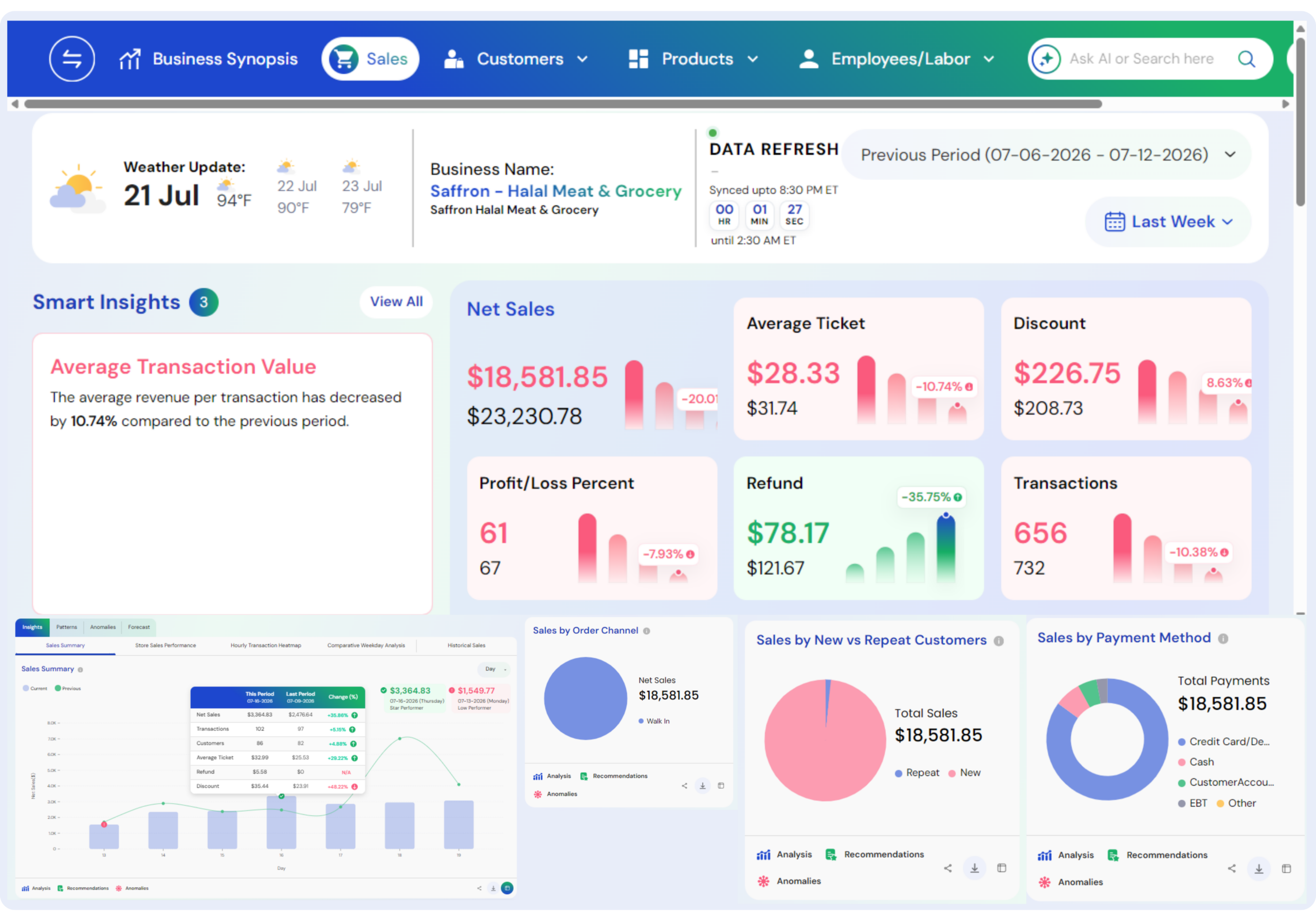
Platforms like Livelytics help restaurants to convert operational data into actionable insights through intuitive dashboards and reporting tools.
As it offers visibility into crucial metrics, Livelytics help restaurant operators to improve operations, increase operational efficiency, and increase business growth.
While technology continues to change the restaurant market, restaurants that adopt digital innovation will have a crucial competitive advantage over others.
Understanding the latest restaurant technology trends is essential for improving operational performance, improving customer satisfaction, and for building a successful future in a highly technology driven industry.
Also Read: Artificial Intelligence in Restaurants
Why Technology Matters More Than Ever
The restaurant industry is facing many challenges like increasing operational expenses, shortage of labor, changing customer expectations, and intense competition.
Today’s customers expect quick service, convenient ordering, personalized experiences, and smooth payment operations.
Hence, technology has become essential for improving operational efficiency, customer satisfaction, and supporting business growth.
Important factors driving technology adoption include:
- Labor shortages and high employee turnover.
- Increasing food and operational expenses.
- Increasing customer demand for online ordering and contactless payments.
- Competition from restaurant brands with digital presence.
- Growing demand for online ordering and contactless payments
- High pressure to improve profitability and operational efficiency
Modern restaurant technology helps businesses:
- Automate repetitive tasks and reduce any manual workload on staff
- Improve inventory management and control expenses
- Improve workflows and resource allocation
- Gain real-time insights through data analytics
- Provide better customer experiences
Restaurants that consider technology as a strategic investment rather than an operational tool have better chances to adapt to industry changes, strengthen customer loyalty, and achieve sustainable long-term success.
Also Read: How AI Unlocks Business Insights That Drive Required Results
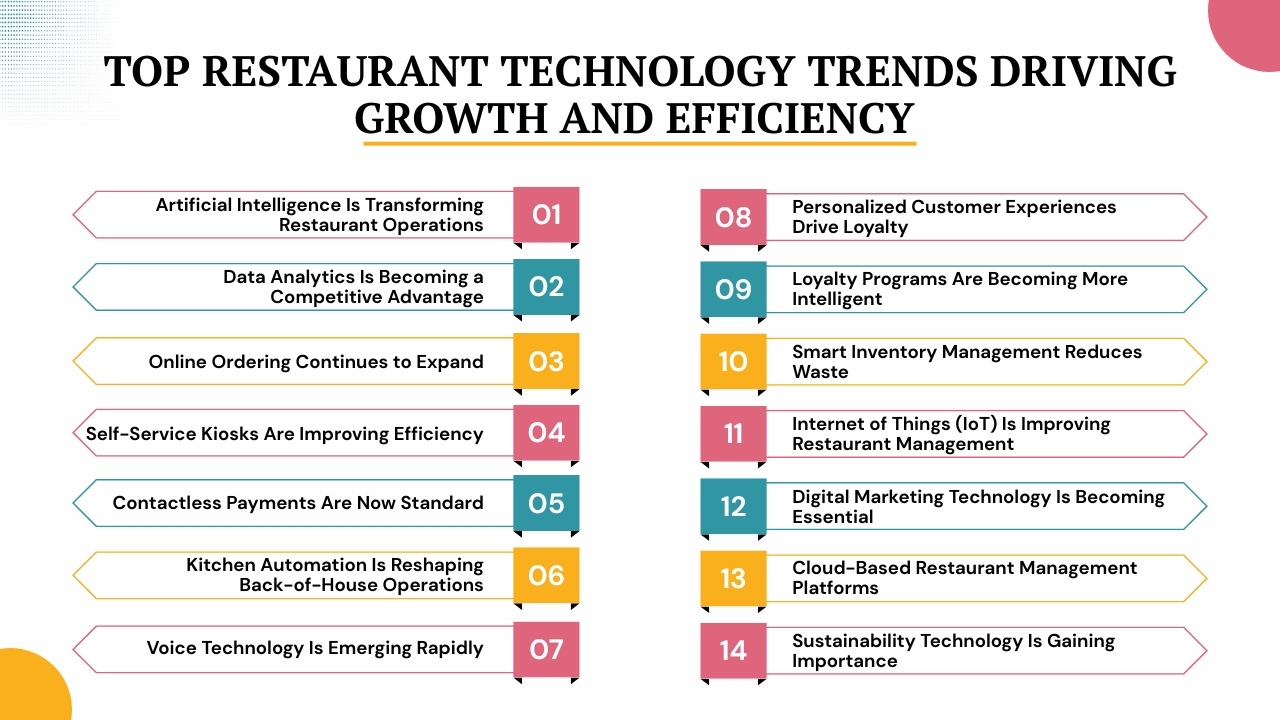
Top Restaurant Technology Trends Driving Growth and Efficiency
1. Artificial Intelligence Is Transforming Restaurant Operations
Artificial Intelligence(AI) is rapidly changing the way restaurants operate. AI systems help businesses to improve efficiency, reduce expenses, and improve customer experiences.
AI tools analyze large volumes of operational and customer data and provide insights. It helps to identify patterns, automate routine tasks, and provide actionable insights which supports decision-making.
As restaurants face high pressure to improve resources and profits. It has become a valuable tool for driving operational success.
Important applications of AI in restaurants include:
- Smart Menu Recommendations: AI tools analyze preferences of customers and their purchasing history to recommend complementary items, premium food upgrades, provide seasonal special offers, and personalized promotions. These suggestions increase average order value while improving customer satisfaction.
- Demand Forecasting: AI tools use past sales data, weather conditions, local events, and seasonal patterns. Then uses these data to predict future demand of customers. With the right demand forecasts restaurants can improve staffing, their schedules, and inventory purchases.
- Dynamic Pricing: Some restaurants use AI-based pricing strategies to adjust menu prices based on changing customer demand which helps to attain maximum revenue during busy hours while remaining competitive.
Implementing AI technologies in restaurants helps them to make operations smooth, improve engagement with customers, and make data-driven decisions which support long-term profits and business growth.
Also Read: Business Intelligence for Restaurants
2. Data Analytics Is Becoming a Competitive Advantage
Large amounts of restaurant data is generated every day from sales transactions, customer interactions, inventory usage, and labor performance.
However, most businesses face difficulty to convert this data into impactful insights. Modern restaurant analytics platforms help restaurant operators to turn raw data into actionable business intelligence.
Such insights enable smarter decisions which improves efficiency, profits, and customer satisfaction.
Important metrics restaurants can track include:
- Sales performance and revenue patterns
- Menu profits and performance of each food menu
- Customer behavior and their purchasing patterns
- Labor efficiency and staffing expenses
- Usage of inventory and food waste
- Peak operating hours and demand patterns
- Customer retention and loyalty metrics
Platforms like Livelytics offer real-time dashboards and reporting tools that help restaurant owners to track these important metrics easily.
Using modern analytics tools, restaurants can identify best-selling items, remove underperforming food items, optimize labor schedules, reduce food waste, improve marketing effectiveness, and increase customer lifetime value.
In this competitive market, data has become a valuable asset which drives restaurant success.
Also Read: How Does Data Analytics Help Restaurants Grow
3. Online Ordering Continues to Expand
Online ordering has changed the way customers interact with restaurants that make conveniences of customers the topmost priority.
Today, consumers most often place orders through restaurant websites, mobile apps, delivery platforms, and even social media channels.
As the number of digital orders keeps increasing, restaurants are investing in direct ordering systems which provide greater control and long-term business benefits.
Important advantages of direct online ordering include:
- Higher Profit Margins: Online ordering takes direct orders which helps to reduce depending on third-party delivery services and associated commission fees.
- Better Customer Data: Through online ordering restaurants have access to important details like customer preferences, their food ordering habits, and purchasing order, supporting targeted marketing, and loyalty initiatives.
- Greater Brand Control: Direct channels allow restaurants to manage the customer experience from ordering to fulfillment of the order.
Many successful restaurants are building integrated online ordering systems that connect smoothly with POS systems, inventory management software, and customer databases.
Such an integration improves operational efficiency, improves customer experiences, and supports more informed business decisions.
Also Read:How AI is Boosting Restaurant Revenue and Profits
4. Self-Service Kiosks Are Improving Efficiency
Self-service kiosks have become popular in quick-service and fast-casual restaurants. This allows customers to place orders by themselves, through which such kiosks make the ordering process smooth by improving operational efficiency.
This reduces workload on staff, improves customer convenience, and creates a faster, more accurate ordering experience.
Important benefits of self-service kiosks include:
- Faster Ordering: Such kiosks allow customers to browse menus and place orders quickly without waiting for any assistance from the staff.
- Reduced Wait Times: Kiosks help to reduce queues and improve service speed during busy hours.
- Improved Order Accuracy: Using these kiosks customers can place their own orders instantly which reduces chances of any type of order taking mistakes happening due to communication.
- Lower Labor Requirements: By implementing self kiosks staff members can prioritize food preparation and customer service instead of order taking.
- Increased Upselling Opportunities: Self service kiosks can instantly suggest any add-ons, menu upgrades, and promotional items.
This allows customers to have more control over personalizing menus that helps to personalize orders easily.
Many restaurants report higher average order values as customers are more likely to explore additional menu options and food menu recommendations without any stress.
Also Read: Self-Service Data Platform
5. Contactless Payments Are Now Standard
As today consumers highly prioritize quick orders, convenience, and secured payment transactions, so contactless payments have become essential in modern restaurants.
Customers now expect flexibility in payment options that allow them to complete transactions quickly and securely without handling cash or inserting cards.
By offering multiple digital payment methods, restaurants can improve the customer by making the checkout process smooth.
Popular contactless payment options include:
- Mobile Wallets: It includes payments made through mobile phones and wearable devices.
- QR Code Payments: In these payments just have to simply scan a code to pay directly from their mobile devices.
- NFC-Enabled Cards: These are tap-to-pay cards which allow for fast and secure transactions.
- Digital Payment Apps: These are convenient payment solutions that simplify the checkout experience.
Key benefits of contactless payments include:
- Faster transaction processing
- Reduced queues during peak hours
- Improved customer convenience
- Enhanced payment security
Restaurants that support different contactless payment methods offer smoother dining experiences, reduce checkout friction, and meet the high expectations of today’s digitally connected customers.
Also Read: POS Reports Vs Real-time Analytics
6. Kitchen Automation Is Reshaping Back-of-House Operations
Kitchen automation is essential for maintaining efficiency in kitchen operations by maintaining a restaurant’s speed, consistency, and overall profits.
While labor expenses keep affecting the restaurant industry, many restaurants are increasingly adopting automation technologies to make back-office operations and maintain high-quality standards.
Such solutions help to reduce manual workloads, improve restaurant productivity, and ensure consistent food preparation across locations.
Important benefits of kitchen automation include:
- Improved Food Preparation Consistency: Automated systems help to maintain uniform cooking standards throughout and food portion control.
- Reduced Labor Dependency: Automation reduces the need for staff because it handles repetitive tasks that allows employees to focus on other crucial activities.
- Minimized Human Error: Technology reduces any chances of human mistakes by reducing any mistakes in food preparation and order management.
- Increased Production Speed: Automated processes enable kitchens to serve customers more efficiently.
Examples of kitchen automation technologies include:
- Automated Cooking Equipment which includes smart ovens, fryers, and grills.
- Kitchen Display Systems (KDS) : such systems replace paper tickets with digital workflows.
- Automated Food Preparation Systems that assist with assembly, portioning, and ingredient preparation.
Such smart innovation equipment and systems helps restaurants to improve operational efficiency while maintaining food quality and consistency.
Also Read: AI for Restaurant Inventory
7. Voice Technology Is Emerging Rapidly
Voice technology is becoming essential in the restaurant industry as businesses look for rapid and more convenient ways to serve customers.
Due to advancements in artificial intelligence and natural language processing, voice-enabled ordering systems can understand customer requests, process orders accurately.
Such systems can understand customer requests, process orders more accurately, and improve overall service efficiency.
As consumers are becoming more comfortable interacting with voice assistants, restaurants are adopting this technology across multiple ordering channels.
Customers can now place orders through:
- Smart Speakers: which lets customers make hands-free ordering at home.
- Mobile Voice Assistants : These mobile voice assistants are integrated into smartphones which lets customers order through natural speed.
- AI-Powered Phone Systems: such systems automates call handling and order-taking.
- Drive-Thru Voice Ordering Platforms : such platforms makes the services quick and reduces customer wait times.
Important benefits of voice technology include:
- Faster service and order processing
- Reduced order-taking errors
- Lower staffing requirements
- Improved accessibility and convenience
As voice recognition technology keeps evolving, voice ordering is becoming a major customer interaction channel that helps restaurants to improve efficiency while delivering a smooth customer experience.
Also Read: Artificial Intelligence Vs Machine Learning
8. Personalized Customer Experiences Drive Loyalty
In today’s highly competitive restaurant industry, customers expect more than just quality food. Customers want personalized experiences as per their preferences and behaviors.
Modern restaurant technology enables businesses to gather and analyze customer data, which allows them to deliver personalized interactions which increase customer engagement and strengthen customer loyalty.
By understanding individual preferences, restaurants can create more impactful experiences which encourage repeat visits and higher spending.
Personalization strategies may include:
- Customized Menu Recommendations : such menu recommendations are based on previous orders and customer preferences.
- Birthday and Special Occasion Offers: offering birthday or special occasion offers make customers feel valued.
- Loyalty Rewards Programs: Offering loyalty rewards to customers based on their purchasing habits.
- Targeted Promotions : offering targeted promotions which are designed for specific customer segments.
- Personalized Email Campaigns : these campaigns feature relevant offers and updates.
Also Read: AI Revolutionizes Customer Experience in Restaurant Industry
9. Loyalty Programs Are Becoming More Intelligent
Modern loyalty programs have gone beyond traditional cards and basic reward systems.
Today, restaurants use advanced technology to create personalized customer engagement strategies that encourage repeat business and improve long-term relationships.
By collecting and analyzing customer data, loyalty programs help restaurants to understand behavioral patterns of customers and deliver more valid rewards and promotions.
Modern loyalty systems can track:
- Purchase History: which helps them to identify favorite menu items of customers.
- Visit Frequency: monitoring visit frequency helps restaurants to recognize the most loyal customers.
- Preferred Menu Choice: Tracking preferred menu choices helps restaurants for offering personalized recommendations.
- Spending Habits: Tracking spending habits of customers helps to create targeted incentives and rewards.
Using these insights, restaurants can develop highly customized loyalty campaigns which individual customers can correlate to.
Key benefits include:
- Increased repeat visits and customer engagement
- Higher customer retention rates
- Greater customer lifetime value
- Stronger brand loyalty and advocacy
When customers receive offers as per their preferences, then they remain loyal to your restaurant, make frequent purchases, and build stronger connections with the brand.
Also Read: How AI Revolutionizes Customer Experience in Restaurant Industry
10. Smart Inventory Management Reduces Waste
Food waste is one of the biggest challenges that affect restaurant profits. Because poor control over managing inventory causes overstocking, food spoilage, food shortages, and unnecessary expenses.
To resolve all these problems, many restaurants are adopting smart inventory management software that gives more visibility into stock levels and purchasing trends.
These systems help restaurant operators to make informed decisions which reduces food waste, and improves overall operational efficiency.
Modern inventory management solutions can:
- Track Stock Levels in Real Time: Such management solutions track stock levels in real time which helps to prevent shortages and overordering.
- Monitor Ingredient Usage : such solutions help to track ingredient waste and analyze consumption patterns.
- Predict Future Demand : such management solutions use past sales and seasonal patterns to predict future demand.
- Automate Reordering: Such solutions enable automated reordering which ensures optimal inventory levels.
Key benefits include:
- Lower food waste and spoilage
- Reduced inventory and purchasing costs
- Improved cash flow management
- Better purchasing and forecasting decisions
Restaurant owners gain deeper insights into profits, menu performance, and operational efficiency. This enables restaurants to make smarter strategies that support long-term growth and control expenses.
Also Read: AI for Retail Inventory Management
11. Internet of Things (IoT) Is Improving Restaurant Management
This technology is transforming restaurant management by connecting equipment, appliances, and tracking systems through the internet.
It helps restaurant operators to gather real-time data, improve visibility into operations, and respond quickly to concerns before they affect business performance.
By using IoT-enabled devices, restaurants can improve efficiency, reduce expenses, and maintain higher standards of food safety and equipment reliability.
Restaurants commonly use IoT sensors to monitor:
- Refrigeration Temperatures : which ensures food is stored safely.
- Energy Consumption: which helps to identify opportunities for cost savings.
- Equipment Performance to detect operational issues early.
- Food Safety Compliance to maintain regulatory standards.
Key benefits of IoT technology include:
- Reduced equipment downtime
- Lower energy and maintenance costs
- Improved food safety and quality control
- Predictive maintenance that prevents costly breakdowns
By tracking real-time and automated alerts, IoT solutions help restaurants to identify problems before they become disruptions, which results in smoother operations, improves efficiency, and better overall business performance.
Also Read: How to Improve Restaurant Operations
12. Digital Marketing Technology Is Becoming Essential
In today’s highly competitive restaurant industry, attracting new customers and retaining existing customers needs more than traditional advertising.
This technology enables restaurants to reach their target audience effectively, which builds stronger relationships with customers, and maximize marketing performance.
By using data and automation, restaurants can develop personalized campaigns which drive engagement with customers and increase revenue.
Important digital marketing tools include:
- Email Marketing Automation: automating email marketing is essential for sending personalized promotions and updates to the customers.
- Social Media Management Platforms: These platforms help to schedule content and engage with customers.
- Customer Segmentation Tools: These tools allow customers to target certain segments of audiences based on customer preferences and behavior.
- Reputation Management Software : This software helps to track and improve perception of the brand online.
- Review Monitoring Solutions: These solutions track customer feedback across multiple platforms.
Data-driven marketing helps restaurants to deliver the right message to the right customer at the right time.
Also Read: Is Email Marketing for Restaurants Still A Good Choice
13. Cloud-Based Restaurant Management Platforms
Cloud technology has revolutionized restaurant operations by providing businesses with more flexibility, accessibility, and scalability.
Unlike traditional on-premise systems, cloud-based restaurant management platforms store data online that allow restaurant owners and managers to access essential business details from virtually anywhere. This enables rapid decisions and improved oversight across daily operations.
Important benefits of cloud-based restaurant management systems include:
- Remote Access to Business Data : It offers remote access to business data from any devices connected on the internet.
- Real-Time Reporting : It gives instant visibility into sales, inventory, and operational performance.
- Multi-Location Management: This lets you oversee multiple restaurants from a single centralized platform and manage multiple locations.
- Automatic Software Updates ensure access to the latest features and security improvements.
- Enhanced Scalability that supports business growth without major investments on infrastructure.
These platforms track restaurant owners to track performance, track important metrics, and respond quickly to operational challenges.
Such flexibility and convenience of cloud-based solutions are essential for growing restaurant brands who are seeking to maintain consistency, improve efficiency, and make smooth management across multiple locations.
Also Read: Best Restaurant Business Intelligence Platform for Growing Business
14. Sustainability Technology Is Gaining Importance
Environment sustainability has become essential for both restaurants and consumers. Today’s customers highly prefer businesses that show responsibility towards the environment and actively work to reduce any impact on the environment.
As a result, many restaurants are adopting sustainability-focused technologies which help to reduce waste, conserve resources, and support environment friendly operations that improve profits.
Technology helps restaurants achieve sustainability goals through:
- Food Waste Tracking Systems : such systems help to identify waste trends and reduce unwanted food disposal.
- Energy Management Systems : such systems help to track and improve energy consumption.
- Smart Inventory Controls : prevents overordering and reduces food spoilage.
- Sustainable Supply-Chain Monitoring that improves transparency and supports responsible sourcing practices.
Key benefits of sustainability technology include:
- Reduced food waste and disposal costs
- Reduces energy consumption and utility expenses
- Improved operational efficiency
- Improves brand reputation among environmentally conscious consumers
Many sustainability initiatives deliver both environmental and financial benefits. By reducing food waste, conserving energy, and optimizing resource use, restaurants can highly improve profit margins while showing a commitment to responsible business practices and long-term sustainability.
Conclusion
Implementing technology is no longer optional for restaurants as it has become essential driving efficiency, profits, and long-term success.
Whether artificial intelligence, automation, cloud-based management systems, digital marketing tools, and smart inventory management, modern technologies are changing the way restaurants operate and serve their customers.
Such innovations help businesses to reduce costs, improve productivity, customer experiences, and adapt to changing market demands.
While customer expectations are high and competition becomes more intense, restaurants that adopt digital transformation will have higher chances to flourish in the future.
However, adopting technology successfully goes beyond just implementing new tools. Restaurant owners must choose solutions which align with their operational goals, integrate smoothly with existing systems, and provide value to businesses.
Platforms like Livelytics play a crucial role in transformation by offering actionable insights through advanced analytics and real-time reporting.
Using data-driven decisions and investing in the right technologies help restaurants to optimize performance, increase customer loyalty, and build a sustainable competitive advantage in a technology-driven industry.
If you are trying to know about technology in the restaurant industry then you may book a free demo at Livelytics and we are more than happy to assist you.