You know that feeling when one of your stores is crushing it, and another location down the street is… not?
Same brand. Same products. Same training materials. Yet somehow, Store A is exceeding targets while Store B is quietly underperforming month after month.
And, most businesses know this gap exists. But when it comes to actually fixing it? That’s where things get murky.
The usual approach includes checking our reports and making decisions based on recommendations based on gut feel, and hoping things improve. Sometimes it works. Often, it doesn’t. It depends.
The truth is, store-to-store performance gaps aren’t usually caused by one obvious problem. They’re the result of dozens of small variables.
So how do leading multi-location businesses actually solve this?
The answer is making the most out of data, and that’s exactly what we’re going to break down in this guide. Companies with strong data cultures make decisions up to 5× faster, a powerful edge versus intuition-based planning.
Let’s get started.
Also Read: Customer Sentiment for Multi Location Business
What are store-to-store performance gaps, & what are some of the common performance gaps?

Store-to-store performance gaps refer to the measurable differences in results between multiple locations of the same business, even though they operate under the same brand, pricing strategy, and core processes.
And, before you can fix a problem, you need to understand what’s causing it. And store-to-store performance gaps are rarely about one single issue.
Here are the most common culprits:
1. Operational Inefficiencies That Hide in Plain Sight
Small differences in how stores execute daily operations can create significant performance gaps. These aren’t major failures; they’re tiny process variations that happen behind the scenes, often unnoticed by management.
Your top store has optimized its opening procedures to get products on shelves 30 minutes faster each morning. That’s 30 extra minutes of peak selling time, every single day. Multiply that across a month, and you’re looking at significant revenue differences, all from a process tweak that never made it into official training.
Also Read: How Livelytics Help Retailer to Reduce Operational Cost
2. Inventory Misalignment With Local Demand
Not all locations serve the same customer base, yet many businesses stock them identically. When inventory doesn’t match local preferences and buying patterns, stores end up with the wrong products at the wrong time.
Your corporate buying team ordered the same mix for all locations, but Store B is in a neighborhood with different demographics. They’re overstocked on products that don’t move and are constantly running out of what customers actually want. The result? Lost sales and frustrated shoppers who eventually go elsewhere.
Also Read: AI For Restaurant Inventory
3. Inconsistent Execution of Proven Strategies
A great strategy only works when it’s executed properly. The gap between corporate planning and store-level execution is where many performance issues live. Two stores can receive identical instructions but deliver completely different results.
Store A runs promotions exactly as designed, with proper signage, staff training, and timing. Store B gets the same promotional materials but executes them half-heartedly or too late. Same strategy, completely different results.
Also Read: Retail Pricing Strategy
4. Staffing Patterns That Don’t Match Traffic
Labor is one of your highest costs, and how you schedule it directly impacts both customer experience and profitability. Stores that align staffing with actual customer traffic perform better on both metrics.
One store’s schedules are based on actual customer flow data. Another schedule based on how we’ve always done it. During rushes, customers wait too long. During slow periods, labor costs eat into margins.
Also Read: How Data Analytics Improve the Measurement of Employee Performance
5. The Compounding Effect of Small Differences
Here’s what makes this tricky: none of these issues alone might tank a store’s performance. But when you stack them together, a store that’s 3% less efficient in operations, 5% off on inventory mix, 4% weaker in promotion execution, and 6% misaligned on staffing ends up 15-20% behind in overall performance.
And here’s the real challenge: most of this is invisible. You have the data, sales numbers, inventory logs, schedules, and customer counts. But it’s all in different places, looked at separately, and reviewed when it’s already too late to fix anything.
6. Customer Experience Inconsistencies
The experience a customer has in your store directly determines whether they come back. Service quality, store cleanliness, checkout speed, and product knowledge can vary wildly between locations, even when teams receive the same training.
Even with the same training, when both stores didn’t perform consistently, it adds up. A customer who has a great experience at one location expects the same at another. When they don’t get it, they start questioning the entire brand.
Also Read: How AI Revolutionizes Customer Experience in the Restaurant Industry
How Data Fixes Store-to-Store Performance Gaps?

Traditional management relies on intuition, periodic store visits, and monthly reports that show what already happened. Data-driven management identifies problems as they’re happening and tells you exactly what to fix.
1. From Symptoms to Root Causes
Monthly reports show you that Store B is underperforming. That’s the symptom. But why is it underperforming? Data helps you dig deeper.
When you analyze sales patterns by hour, day, and product category across all locations, you start seeing the real story. Maybe Store B’s morning sales are strong, but afternoon performance drops significantly compared to top stores.
Now you have something specific to investigate: what’s different about their afternoon operations?
Layer in additional data points:
- Staffing schedules reveal they’re understaffed during peak afternoon hours
- Inventory logs show they’re running out of key products by midday
- Customer traffic patterns indicate the highest footfall when they have the fewest staff
Suddenly, you’re not just looking at underperformance, you’re looking at specific, fixable problems.
Also Read: What is Ad-Hoc Analysis
2. Identifying What Top Performers Do Differently
Your best stores aren’t just lucky. They’re doing specific things that drive results. Data helps you identify exactly what those things are, so you can replicate them.
And, data helps you find it. You can compare operational metrics across your top 20% and bottom 20% of stores:
- Inventory turnover rates
- Average transaction times
- Staff productivity metrics
- Promotion conversion rates
- Customer traffic patterns
The patterns that emerge tell you what separates good from great. Maybe your top stores process morning restocking 40% faster. They may maintain higher staff-to-customer ratios during peak hours. Maybe they’re better at cross-selling specific product combinations. Once you know what works, you can standardize it.
Also Read: AI For Retail Inventory
3. Real-Time Visibility Into Performance
Waiting until month-end to review performance means you’ve already lost 30 days of opportunity. Real-time data lets you spot issues and course-correct immediately.
When you can see daily performance metrics across all locations, patterns become obvious. Store C’s sales dropped 15% this week compared to last week. You can investigate today, not in next month’s review meeting.
Ask the right questions:
- Was it a staffing issue?
- A stock-out on popular items?
- A local event that affected traffic?
- A competitor promotion?
The faster you identify it, the faster you can fix it.
Also Read: Real-Time Analytics Why Does Your Business Needs It
4. Turning Insights Into Action
Data without action is just noise. The goal is to turn insights into specific, executable changes that improve performance.
Actionable steps based on data:
- When data shows top stores maintain certain inventory levels, create reorder triggers for underperforming stores
- When it reveals optimal staffing patterns, adjust schedules accordingly
- When it identifies successful promotional tactics, document and distribute them as best practices
- When it highlights training gaps, develop targeted coaching programs
The key is making data accessible to the people who can act on it: store managers, regional directors, and operations teams. They need to see relevant metrics, understand what they mean, and know exactly what to do next.
How Walmart is Transforming Inventory Management With Retailers Using Data and AI?
Walmart faced a massive challenge managing inventory across over 10,500 stores worldwide with millions of SKUs while reducing stockouts and overstock situations.
They implemented AI-powered demand forecasting using machine learning models that analyze historical sales, weather data, seasonal trends, and real-time POS data.
And, the results? It was extraordinary. It leads to:
- 16% reduction in stockouts,
- 10% improvement in inventory turnover,
- 10% reduction in logistics costs.
Beyond inventory, Walmart also automated supplier negotiations, helping them negotiate with 68% of suppliers approached and gained 1.5% in cost savings.
Also Read: How AI Unlocks Business Insights
5. Benchmarking Performance Across Locations
Data allows you to create clear benchmarks that show each store where they stand and what’s achievable.
Instead of vague goals like improving sales, you can set specific targets based on what similar stores are already accomplishing:
- Stores in similar market sizes with comparable demographics
- Locations with similar foot traffic patterns
- Stores facing similar competitive pressures
- New locations compared to established ones at the same stage
This makes goals realistic and motivating. Store managers can see that the target isn’t arbitrary; it’s what their peers are already achieving.
Also Read: How to Setup KPIs for Your Business
6. Predicting Problems Before They Escalate
Data doesn’t just show you what’s happening now; it can predict what’s likely to happen next.
By analyzing historical patterns, you can identify warning signs:
- Gradual declines in specific product categories signal changing customer preferences
- Seasonal inventory gaps based on previous years’ stock-out patterns
- Staffing shortages during predictable high-traffic periods
- Customer traffic trends that indicate growing or declining market demand
Catching these patterns early means you can adjust before small issues become major performance gaps.
Also Read: How Predictive Intelligence Transforms Retail
7. Measuring the Impact of Changes
When you implement a fix, how do you know if it actually worked? Data gives you proof.
Track performance before and after making changes:
- Did adjusting staff schedules improve conversion rates during peak hours?
- Did reordering inventory based on local demand reduce stock-outs and increase sales?
- Did implementing a new promotion strategy boost average transaction value?
- Did additional training improve customer satisfaction scores?
This feedback loop helps you double down on what works and quickly abandon what doesn’t.
Also Read: 9 Step Process Question Mining
8. Creating Accountability With Transparency
When performance data is visible across the organization, it creates natural accountability.
Store managers can see:
- How their location ranks against others
- Which specific metrics need improvement
- Progress toward goals over time
- Recognition when they achieve top performance
Regional managers can identify which stores need support and which managers deserve recognition. Everyone operates from the same facts, eliminating excuses and focusing conversations on solutions.
Also Read: What is Self-Service Data Platform
9. Reducing Bias in Decision-Making
Gut feelings and personal impressions can mislead even experienced managers. Data removes subjective bias from performance evaluations.
Common biases that data helps eliminate:
- Assuming a store is doing well because the manager is likable or communicative
- Overlooking struggling stores in less visible locations
- Attributing success or failure to factors that aren’t actually driving results
- Making decisions based on recent events rather than long-term trends
When decisions are based on objective metrics rather than impressions, you solve the right problems and recognize the right people. Performance becomes measurable, fair, and focused on what actually moves the business forward.
How H & M Optimized Store Layouts for Better Experience & Higher Conversions?
H&M needed to increase store-level conversions without relying on constant human trials and guesswork about product placement. They implemented agentic AI to test layout designs based on foot traffic and purchase data.
Each store’s AI system now tracks how customers move, what they buy, and how long they stay in different sections. Store managers receive daily layout updates optimized for conversion, leading to improved conversion rates through data-driven product placements.
Also Read: Benefits of Data-Driven Decision Making
10. Building a Culture of Continuous Improvement
Data transforms your organization from reactive to proactive. Instead of fixing problems after they occur, teams actively look for ways to improve.
This cultural shift happens when:
- Store managers regularly review their metrics and experiment with improvements
- Teams celebrate data-backed wins and learn from measurable failures
- Performance conversations focus on specific numbers rather than vague feedback
- Everyone understands that small, consistent improvements compound into major results
When performance becomes measurable and visible, improvement becomes part of daily operations, not something that happens only during annual reviews or crises.
Meet Livelytics: Your AI-Powered Solution to Performance Gaps
Understanding the problem is one thing. Having the right tools to fix it is another.
That’s where Livelytics changes the game.
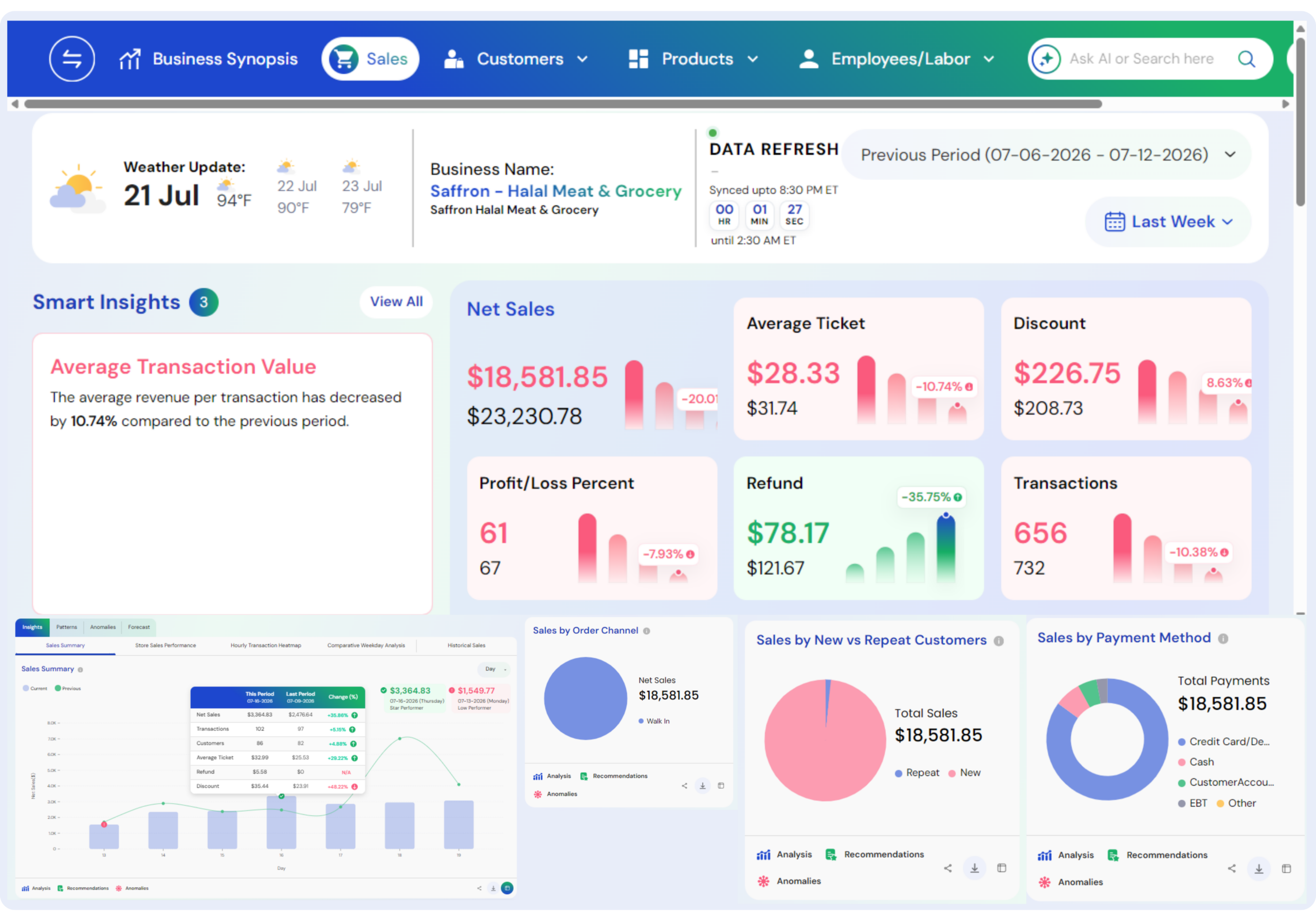
Livelytics is an AI-powered platform that is changing how businesses manage data and fix performance gaps. Instead of spending hours building reports or trying to connect the dots across multiple dashboards, Livelytics does the heavy lifting for you. It collects data from all your sources, analyzes it in real-time, and delivers clear, actionable insights that help you make smarter decisions faster.
By 2027, it’s predicted that 75% of business decisions will be powered by AI-driven analytics.
How Livelytics Solves Store-to-Store Performance Gaps?
1. Unified Data in One Place
Livelytics integrates seamlessly with your existing systems, POS, inventory management, customer databases, staffing tools, and more. No more logging into five different platforms to understand what’s happening across your stores. Everything you need is in one central hub.
2. Real-Time Performance Monitoring
See exactly how each store is performing right now, not last week or last month. Livelytics gives you real-time visibility into sales, inventory levels, customer traffic, staffing efficiency, and more. When a store starts underperforming, you know immediately and can take action before it becomes a bigger problem.
3. ML-Powered Recommendations
This is where Livelytics truly stands out. The platform doesn’t just show you data, it tells you what to do next. Using machine learning, Livelytics analyzes patterns across your stores and provides specific, actionable recommendations.
- Which products to reorder and when, based on demand patterns
- Optimal staffing levels for each store during different dayparts
- Promotion strategies that are working in top stores should be replicated
- Inventory adjustments needed to match local customer preferences
- Operational improvements that will have the biggest impact on performance
You’re not left wondering what the numbers mean or what actions to take. Livelytics guides you step-by-step.
Also Read: Artificial Intelligence Vs Machine Learning
4. Blended Functionality Across Your Business
Livelytics brings together pricing, inventory, and customer management in one platform. This means you can:
- Adjust pricing strategies based on real-time demand and competition
- Manage inventory across all locations with automated reorder triggers
- Understand customer behavior and preferences to drive better experiences
- Track performance metrics that actually matter to your business goals
5. Connected Decision-Making Across Your Organization
When everyone, from store managers to regional directors to corporate leadership, operates from the same data, decisions become faster, smarter, and more aligned. Livelytics makes data accessible to the people who need it, when they need it, in formats they can actually use.
- Store managers see what they need to improve today.
- Regional teams identify which stores need support.
- Leadership understands which strategies are working and where to invest resources.
Everyone moves in the same direction, backed by the same insights.
Also Read: Two Way Data Analytics In Shaping Retail Business
6. From Data to Action
The real power of Livelytics isn’t just in collecting data; it’s in turning that data into results. By extracting value from your own business data and applying AI-driven insights, you can:
- Close performance gaps between your best and worst stores
- Replicate success across all locations
- Catch problems before they impact your bottom line
- Make confident decisions based on facts, not guesswork
- Improve operations continuously, not just during quarterly reviews
Livelytics transforms how you run your multi-location business, from reactive problem-solving to proactive performance optimization.
Ready to See Livelytics in Action?
If you’re tired of watching performance gaps persist across your stores and want to see how Livelytics can turn your scattered data into clear, actionable insights, we’d love to show you. Book a free demo, and we’ll walk you through exactly how the platform works for businesses like yours. No sales pitch, just a real look at how it solves the problems you’re dealing with every day.
Final Thoughts
Store-to-store performance gaps aren’t a sign that something is wrong with your business. They’re a sign that there’s untapped potential hiding in plain sight. Every underperforming store already has access to the same brand power, systems, and resources as your top performers. The difference lies in visibility, clarity, and execution.
The businesses that win at scale aren’t the ones with perfect strategies. They’re the ones that learn faster, adapt quicker, and turn insights into action before gaps have time to grow.
If you’re curious about what your data could reveal and how much smoother decision-making could feel with the right insights in place, you might find it useful to explore how Livelytics works in a real-world setup. A quick demo can give you a clear picture, without pressure, of whether it fits the way your business operates today.