Food waste is one of the highest profit leaks in the restaurant industry. Every spoiled ingredient, oversized food portion, expired food product, or unsold prepared food items reflects the money which the restaurants already spent on purchasing, storage, preparation, labor, and service.
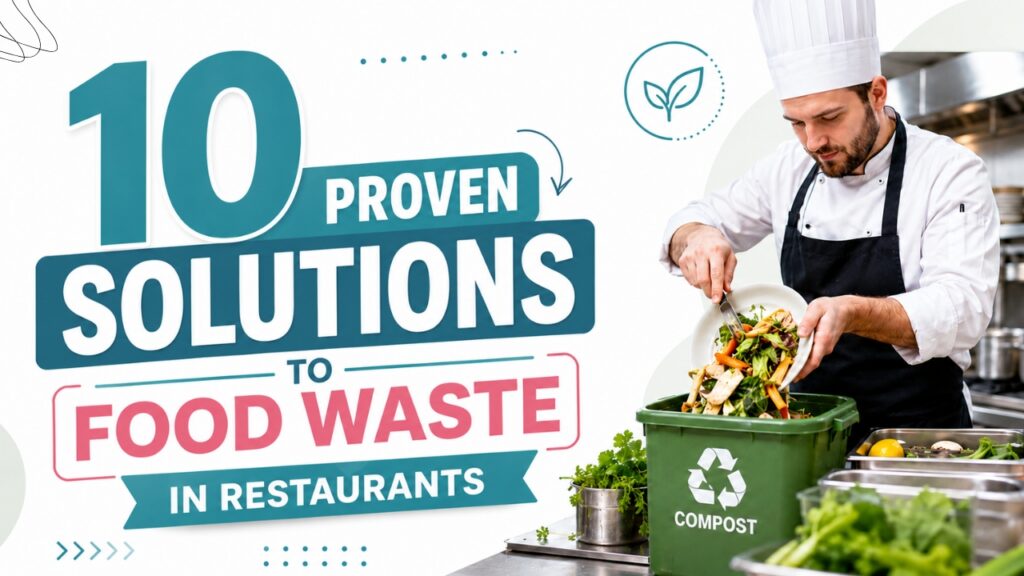
That is why it is essential for restaurants to know the 10 proven solutions to food waste in restaurants which helps to improve sustainability and profitability.
For many restaurants, food waste does not happen due to the carelessness of staff or team members. Rather food waste happens because of poor restaurant inventory management, weak demand forecasting, over-ordering, inconsistent food portion sizes, poor stock rotation, menu complexity, and low visibility into daily operations.
If there is a few pounds of wasted produce or extra prepared food may seem small for one shift but over weeks and months, this can lead to increased food costs, reduced profit margins, and affect cash flow.
But the good fact is that restaurant food waste reduction is possible when restaurant operators use the right systems. When restaurants regularly track food waste, improve demand forecasting, use FIFO methods, set accurate par levels, train staff well, repurpose surplus ingredients, and review menu performance, restaurants can make smarter decisions before food becomes waste.
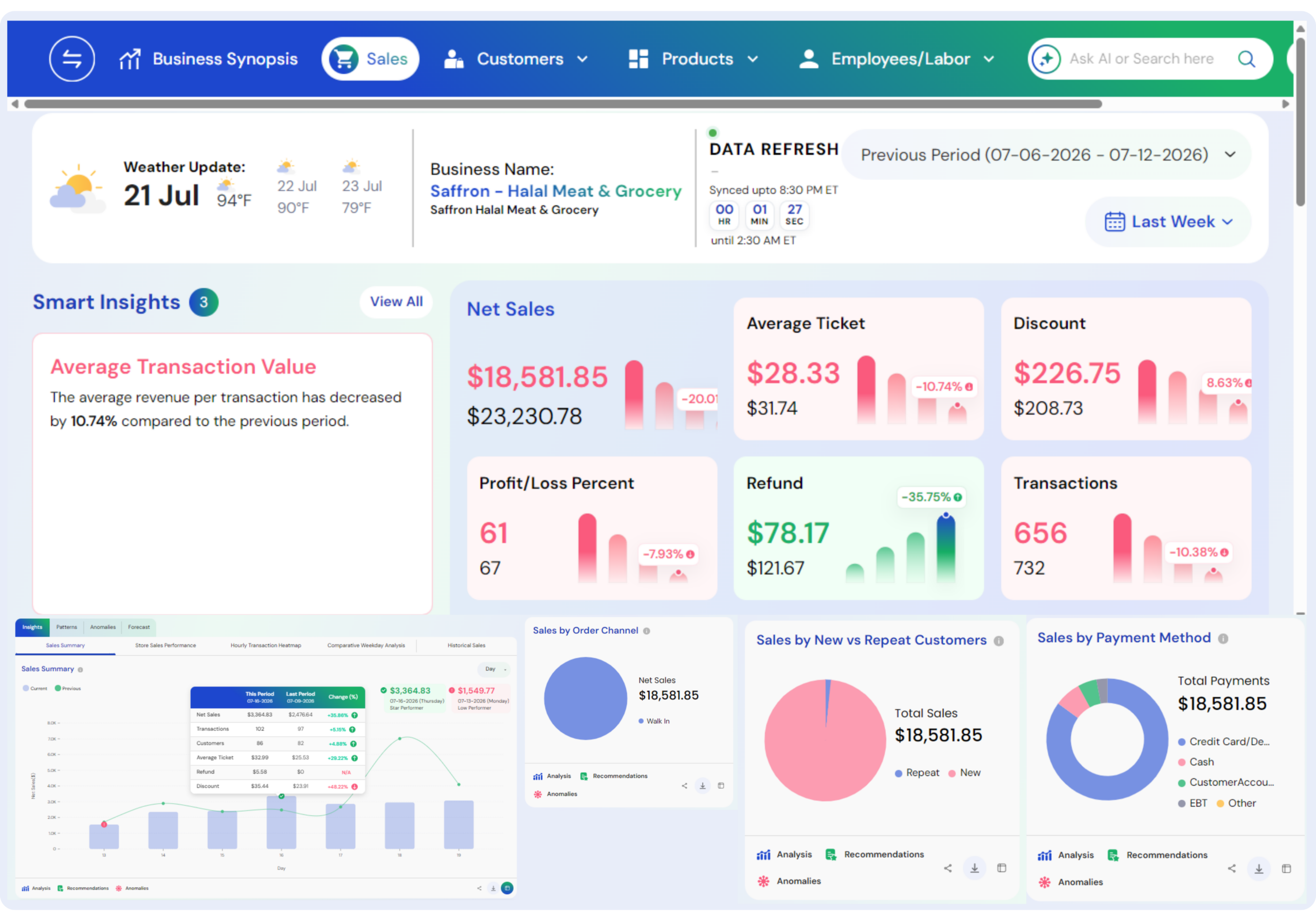
Technology also plays a crucial role in preventing food waste. With tools like Livelytics, restaurants can convert scattered operational data into clear insights through real-time dashboards, forecasting, anomaly detection, store performance tracking, and food cost variability.
Instead of waiting for month-end reports to reflect a problem with such tools, restaurant owners and managers can identify waste patterns early and take instant action.
This blog will walk you through 10 proven solutions to reduce food waste in restaurants, control restaurant food costs, improve inventory accuracy, and build a more profitable operation.
Whether you are running a single restaurant or running multiple locations, these smart food waste reduction strategies help restaurants to reduce food waste, protect profit margins, and establish a smarter and more sustainable kitchen.
Also Read: AI Solutions for Reducing Restaurant Waste
10 Smart Ways to Control Restaurant Food Waste
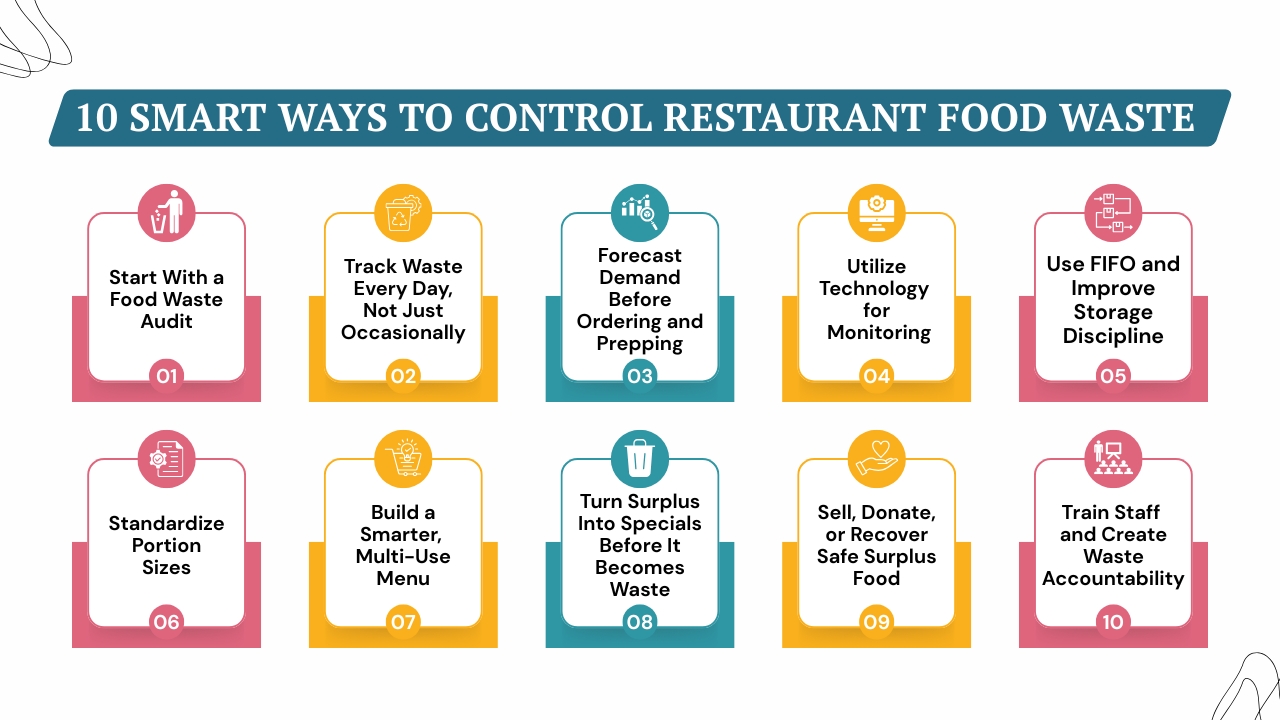
1. Start With a Food Waste Audit
The first step towards reducing food waste is understanding the quantity of food that is being wasted. Because many restaurants feel that they already know the reason why the food is wasted, but they only focus on obvious reasons like expired produce, leftover preparation, or spoiled ingredients.
A food waste audit gives restaurants clear visibility into food waste and reasons behind it. For at least one full week, track every item which is thrown away or wasted.
Record food items that were wasted, the quantity of food that was wasted, and know why this food waste happened, which shift does the food waste happened, and the estimated cost. It helps managers to identify patterns rather than making decisions based on guesswork.
Track food waste in categories such as:
- Pre-consumer waste
- Plate waste
- Spoiled inventory
- Overproduction
- Prep mistakes
- Supplier damage
- Expired ingredients
- Returned or refired food
By the end of the week, review the biggest food waste causes. Restaurants can minimize food waste by improving food storage practices, controlling food portion sizes, and avoiding excessive food preparation during low-demand hours which helps restaurants to improve efficiency, reduce costs, and maintain better kitchen operations daily.
While conducting a waste audit helps restaurants to identify hidden operational inefficiencies, and convert them into practical solutions for reducing waste, which improves operations and saves money.
Also Read: How to Reduce Food Wastes in Restaurants and Improve Profitability
2. Track Waste Every Day, Not Just Occasionally
Conducting a waste audit can provide useful insights to restaurants but only with regular daily tracking of food waste is essential for restaurants to reduce food waste over time.
As restaurant operations keep changing constantly because of customer demand, weather conditions, holidays, seasonal trends, and delivery volume. So it is essential for restaurants to monitor food waste every day to identify problems before they turn into costly expenses.
A simple waste tracking system lets managers identify waste patterns and make faster operational decisions. The purpose is not to blame staff, rather to improve kitchen efficiency and reduce unnecessary losses.
A daily waste log should include:
- Item wasted
- Quantity wasted
- Reason for waste
- Kitchen station
- Shift timing
- Employee or manager initials
- Estimated food cost
- Corrective action taken
Tracking this information daily helps restaurants to identify repetitive issues. For instance:
- Excess grilled chicken waste may indicate over-prepping during slower afternoon hours.
- Spoiled vegetables may suggest poor storage practices or incorrect ordering quantities.
- Frequent plate waste may show that portion sizes are too large for customers.
Restaurants can only reduce food waste successfully when they consistently track, record, and analyze waste patterns to identify operational problems and improve kitchen efficiency.
Daily food waste monitoring helps restaurants identify problems like spoiled stock, excess food preparation, unused ingredients, and uneaten customer meals which increase operational costs.
With Livelytics, restaurants can simplify this waste monitoring process using real-time dashboards, connected restaurant data, and automated reporting tools which help operators to track waste patterns more efficiently.
Also Read: Restaurant Demand Forecasting Reducing Restaurant Wastes and Increase Profits
3. Forecast Demand Before Ordering and Prepping
Poor demand forecasting is also one of the main reasons causing food waste in restaurants. Most of the managers in the restaurants keep ordering inventory through guessing, past habits, or due to concerns about food shortages instead of relying on accurate demand forecasting and real-time data.
However, customer demand keeps changing constantly which makes accurate demand forecasting essential for restaurants to reduce food waste and control food costs.
Restaurants should analyze multiple factors before ordering inventory or preparing food. A strong demand forecasting process helps kitchens to prepare the right amount of food quantities, reducing overproduction, reducing waste, and ensuring food ingredients are used efficiently without generating unnecessary surplus food.
Important forecasting factors include:
- Historical sales data
- Day-of-week customer patterns
- Weather conditions
- Local events and festivals
- Seasonal demand changes
- Marketing promotions
- Delivery platform activity
- Holiday traffic
- Menu item popularity
- Reservation volume
- Previous waste records
Demand Forecasting should guide both purchasing and kitchen prep decisions. For instance:
- Slower lunch expectations may require reduced prep quantities.
- Nearby events may increase customer traffic and require additional inventory.
Restaurants that use data-driven demand forecasting can reduce over Utilize Technology for Monitoring production of food, avoid food spoilage, and improve efficiency of the inventory.
While effective demand forecasting helps teams to maintain good food quality while reducing unnecessary kitchen waste.
Livelytics helps restaurants to improve demand forecasting through predictive insights, automated reporting, anomaly detection, and proactive alerts. Using real-time restaurant data, helps restaurant operators to make smarter inventory and prep decisions before food waste affects profitability.
Also Read: Restaurant Sales Forecasting How to Predict Future Revenue
4. Utilize Technology for Monitoring
Technology also plays a big role in helping restaurants to monitor, measure, and reduce food waste effectively. Because just using paper logs or manual estimates to track food waste often fail to capture operational patterns which often leads to missed insights and delayed corrective actions.
Modern digital tools let restaurants to shift from reactive management to real-time decision-making.
Restaurant analytics platforms such as Livelytics integrate data from multiple sources like POS systems, inventory management tools, invoices, and operational reports.
It creates a unified view of restaurant performance that helps managers to understand exactly where food waste is occurring and what is causing the food waste. For restaurants instead of waiting for month-end reports can take corrective actions immediately when issues are visible.
Technology enables restaurants to monitor key areas including:
- Inventory usage and stock levels
- Food cost percentage fluctuations
- Spoilage and expired ingredient tracking
- Overproduction by shift or station
- High-waste menu items
- Supplier pricing or delivery inconsistencies
- Theoretical vs. actual food cost variance
- Waste patterns across multiple locations
For instance, if an outlet is consistently wasting more vegetables than other outlets, managers can review or check their storage practices, inventory ordering accuracy, or food preparation practices.
Similarly, sudden increase in food cost can generate alerts which allows managers to quickly find and address operational inefficiencies before they impact overall profits of the restaurants.
Restaurants using technology for monitoring helps restaurants build a more transparent and accurate system. It is a data-driven approach that reduces food waste, improves consistency across different locations, and ultimately improves profit margins while improving operational efficiency.
Also Read: Choosing the Right AI Data Platform for Your Business
5. Use FIFO and Improve Storage Discipline
FIFO or First In, First Out, is a simple but essential inventory method where older stock is used before newer stock. Although this strategy is easy to understand, many restaurants struggle to implement it consistently because busy service periods often cause disorganized coolers, freezers, and dry storage areas.
When storage practices are not properly maintained, food waste can increase rapidly and often goes unnoticed until it significantly affects costs and inventory levels.
Poor stock rotation creates multiple problems like expired ingredients, unnecessary duplicate ordering, and hidden losses that are difficult to trace. For instance, newly delivered produce may be placed in front of older stock causing the older items to spoil before they are used.
To make FIFO effective, restaurants must build strong storage systems that support daily execution. This includes:
- Clear and consistent labeling systems
- Prep dates on all stored items
- Use-by or expiration dates
- Well-organized shelving layouts
- Easy visibility of older stock
- Regular daily storage inspections
- Clear staff accountability for rotation
Each label should clearly include the item name, date received, prep date, expiration date, and staff initials when applicable.
Storage areas must remain clean, structured, and easy to navigate so that employees can quietly identify the items that should be used first. Managers should also include regular inspections of walk-in coolers and dry storage areas into both opening and closing procedures to ensure that there is proper organization and prevent food waste.
High Speed Training emphasizes FIFO as a practical and effective method for reducing spoilage, improving stock rotation, and maintaining better control over kitchen inventory and operations.
When FIFO is properly followed, restaurants strengthen food safety, reduce waste, and ensure better consistency in kitchen operations and overall inventory management.
Also Read: AI for Restaurant Inventory
6. Standardize Portion Sizes
Inconsistent food portion sizes can be a frequently overlooked reason for food waste in restaurants. It often leads to higher costs, uneven dishes, and reduced operational efficiency.
When staff serve different quantities of protein, sauces, or toppings than the actual requirement of standard recipe then it causes fluctuating food causes and unwanted ingredient usage.
Over-portioning of food not just increases expenses but also causes larger plate waste if the customers cannot finish their meals.
Standardized food portions ensure that every guest receives the same quantity and quality of food regardless of who is working in the kitchen. Such consistency helps restaurants to protect profits while also improving the overall dining experience.
To maintain accurate portion control, restaurants should implement:
- Recipe cards for every menu item
- Digital or manual weighing scales
- Portion scoops and ladles
- Measuring cups for liquids and sauces
- Pre-portioned ingredient containers
- Visual plating guides for consistency
- Regular kitchen training and refreshers
For instance, if a pasta dish requires six ounces of sauce but staff consistently use eight ounces of sauce then the restaurant unintentionally increases food costs across every order. With time, this small difference becomes a high financial loss.
Standardized food portion control is widely considered as an effective strategy for reducing waste, ensuring consistency in dishes, and maintaining better control over food costs.
Inaccurate portioning combined with poor recipe management is widely recognized as an important factor that causes increased food waste in restaurant operations.
Food portion control is not about reducing quality or customer satisfaction. Rather, it ensures consistency, protects profit margins, and reduces unnecessary waste while maintaining a reliable guest experience across all orders.
Also Read: How Inventory Software for Restaurants Reduces Food Costs
7. Build a Smarter, Multi-Use Menu
A large and complex menu often leads to higher food waste as it requires a lot of ingredients, more storage space, and more preparation work.
When certain ingredients are used in only one or two dishes and those dishes do not sell consistently, the leftover stock is more likely to spoil before it can be reused. This creates unnecessary cost and inefficiency in the kitchen.
A smarter approach for restaurants is to design a menu based on cross-utilization, where ingredients are shared across multiple dishes. It reduces pressure around inventory and improves ingredient turnover.
Examples of cross-utilization include:
- Roasted chicken used in salads, wraps, bowls, and sandwiches
- Vegetables used in soups, sides, sauces, and daily specials
- Rice incorporated into bowls, fried rice, staff meals, and promotions
- Fresh herbs used in garnishes, marinades, drinks, and sauces
Menu engineering should prioritize analyzing top-selling items, profitable dishes, and low-waste recipes to optimize efficiency, reduce costs, and improve overall restaurant performance.
Some menu items may look attractive but can create hidden inefficiencies because of high ingredient trimming losses, complex preparation steps, or consistently low demand.
Oversized menus are known to increase inventory waste because they demand a wider range of ingredients and slow down turnover efficiency of overall stock.
Simplifying menus and designing dishes around common ingredients is widely recommended as an effective way to improve cost control and reduce food waste.
Livelytics can support menu optimization by analyzing food cost patterns, menu profitability, COGS movement, sales mix, and waste patterns across different locations. This helps restaurants to design menus which are both profitable and lead to efficient operations.
Also Read: How to Create an Effective Restaurant Daily Sales Report
8. Turn Surplus Into Specials Before It Becomes Waste
Restaurants do not always need to discard surplus food, especially when the food is safe, and is suitable for use. With effective planning and creativity, restaurants can turn excess ingredients into profitable menu items instead of becoming waste.
The key is to find surplus food early and take timely action quickly to prevent it from spoiling or becoming unusable.
When restaurants manage surplus food is managed accurately, surplus ingredients can be repurposed into a variety of menu offerings that attract customers while reducing overall food costs.
Common ways to use surplus include:
- Daily specials based on available ingredients
- Limited-time promotional dishes
- Soups and stews using mixed ingredients
- Sauces and gravies from leftover produce
- Staff or family meals
- Combo meals or value offers
- Meal kits for delivery or takeaway
- Desserts using overripe fruit
- Garnishes and toppings
- Stocks and broths from trimmings
For instance, if there is excessive cooked chicken it can be converted into a lunch special or sandwich filling. If there are vegetable scraps or trimmings, they can be repurposed to make tasty flavorful dishes that help restaurants to reduce food waste while maximizing ingredient use in the kitchen.
Further overripe fruits can be blended into smoothies, sauces, or desserts. Even leftover rice can be repurposed into fried rice or bowl-based dishes.
Restaurants can minimize food waste by creating specials with surplus ingredients and regularly updating menus to better utilize existing stock and improve efficiency.
Timing also plays a crucial role in effective repurposing which ensures that surplus ingredients are used while they are still fresh and suitable for safe, high-quality menu preparation.
It is essential for restaurants to identify the food surplus early and not when it is close to expiry.Livelytics helps managers to identify margin risks, monitor ingredient usage changes, and receive real-time alerts on unusual waste patterns so they can respond quickly and minimize losses.
Also Read: Restaurant Demand Forecasting Reduce Waste and Increase Profits
9. Sell, Donate, or Recover Safe Surplus Food
Even with strong demand forecasting and inventory control, there will be some quantity of surplus food which is unavoidable in restaurant operations. Unexpected decrease in food demand, order cancellations, or over-preparations can leave kitchens with excess food which is still safe to consume.
Instead of considering surplus food as waste, restaurants should have a recovery plan that helps them to maximize profits and minimize loss.
Safe surplus food can be redirected in several responsible and practical ways:
- Sold through surplus food platforms or apps
- Donated to local charities or food banks
- Used for staff meals to reduce internal costs
- Offered as discounted end-of-day bundles or specials
- Repurposed into next-day menu items, following food safety guidelines
Also selling surplus food through recovery platforms can help restaurants to reduce food waste, recover costs, and generate additional revenue from food that would otherwise be discarded.
Restaurants can also donate and redistribute safe surplus food which are some of the effective strategies for reducing food waste.
Restaurants should implement clear operational guidelines to ensure that surplus food recovery processes remain safe, organized, and consistent across all kitchen and service operations.
Employees should clearly understand which surplus food items are safe for reuse, donation, or resale and which surplus food must be discarded for safety reasons.
Procedures should define:
- Which items can be donated or sold
- Proper cooling and storage requirements
- Maximum holding times before reuse
- Items that must always be discarded
- Approval authority for surplus decisions
It ensures food safety is never compromised while still reducing unnecessary waste. A well-designed surplus recovery system helps restaurants to reduce impact on the environment, improve sustainability, and recover value from food which otherwise would be lost.
Also Read: Big Data Analytics for Restaurants Turning Data Into Profit
10. Train Staff and Create Waste Accountability
Reducing food waste is not just a management responsibility, rather it is an integral part of everyday restaurant culture. When staff understand that food waste directly impacts profitability, then they are more likely to follow procedures carefully and make more impactful operational decisions.
Without proper staff training and accountability, even the best systems for forecasting, storage, and food portion control can fail.
Employees should be trained to view food waste as a financial loss rather than just discarded food. Over-prepping, ignoring FIFO rules, inconsistent food portioning, improper stock storage, and poor handling of ingredients all contribute to avoidable costs.
Essential training areas include:
- Accurate waste logging and reporting
- FIFO (First In, First Out) implementation
- Standardized portion control techniques
- Proper storage and labeling practices
- Recipe adherence and consistency
- Safe repurposing of surplus ingredients
- Receiving and inventory checks
- Prep planning based on demand
- Plate waste awareness and reduction
- Reporting supplier or quality issues
Managers should also actively communicate waste performance with their teams. Positive results, like reduction in waste percentages, should be shared to recognize good staff performance, and reinforce positive operational habits across the team.
When certain locations or shifts consistently generate higher waste, managers should provide focused coaching and operational guidance to help eliminate inefficiencies and improve performance.
Considering waste as a financial loss and providing continuous staff training encourages stronger operational discipline, better inventory management, and more effective long-term waste reduction practices.
Livelytics supports accountability by offering real-time performance tracking, store comparisons, automated scoring, margin risk alerts, and food cost analysis. It makes waste management transparent, measurable, and actionable across all restaurant locations.
Also Read: How Can Data Analytics Improve the Measurement of Employee Performance
How Livelytics Helps Restaurants Reduce Food Waste
Many restaurants already have useful data, but it remains fragmented across POS systems, inventory tools, labor platforms, accounting software, supplier invoices, and spreadsheets. The problem with restaurants is not always lack of data rather connected visibility.
Livelytics helps restaurants bring fragmented data into one intelligence layer. It gives operators clearer visibility into stores, shifts, transactions, food cost, labor cost, profitability, COGS movement, menu mix, and operational variance.
For food waste reduction, Livelytics can help restaurants:
- Spot unusual waste patterns
- Detect food cost spikes
- Track ingredient variance
- Monitor COGS movement
- Compare waste across locations
- Identify underperforming menu item
- Forecast demand more accurately
- Send proactive alerts
- Support smarter ordering
- Improve accountability across teams
This matters because food waste is easier to prevent when managers see the warning signs early. A weekly report helps identify past issues, while a real-time dashboard enables restaurants to detect and resolve problems before they become more serious.
Conclusion
Food waste in restaurants is not caused due to a single issue rather due to a lot of forecasting errors, inconsistent operations, poor storage practices, and lack of accountability.
The ten solutions for preventing food waste include daily waste tracking, demand forecasting, implementing FIFO discipline, portion control, menu engineering, surplus food recovery, and staff training that works best when implemented together.
When restaurants start to track food waste consistently, then they gain visibility into hidden losses which were earlier overlooked. This data becomes the foundation for better decisions in ordering, food preparation planning, and menu design.
Similarly improving storage practices and implementing FIFO reduces food spoilage, while standardized food portioning ensures consistency and protects profit margins.
Designing smarter menus and surplus food utilization further reduce unnecessary purchasing and ingredient waste.
However, using only technology and systems alone are not enough for reducing food waste. Long-term success for reducing food waste depends on staff awareness and accountability.
When teams understand that waste directly affects profitability, then they become active participants for reducing food waste.
Digital tools like Livelytics can strengthen these efforts by providing real-time insights, forecasting support, and performance tracking across locations, making waste management more transparent and actionable.
Ultimately, reducing food waste is both an operational improvement and a cultural shift. Restaurants that commit to these practices not only save money but also improve efficiency, sustainability, and overall business performance in the long run.
If you still have any query about 10 proven solutions to food waste in restaurants then you may book a free demo at Livelytics and we are more than happy to assist you.