Four Everyday Operator Use Cases That Reveal the Power of Livelytics
How real-time data intelligence helps restaurants run smoother shifts, stronger regions, and more profitable systems
Walk into any restaurant — especially a high-volume QSR — and you’ll find the same thing: hardworking teams doing their best inside an unpredictable, high-velocity environment.
Shifts can turn on a dime.
A misplaced prep cycle.
A late delivery.
A sudden spike in mobile orders.
A fry station that slows down at exactly the wrong time.
Operators are constantly juggling a thousand moving parts, usually with fragmented information coming from a dozen systems that don’t talk to each other.
This is where Livelytics changes the game.
By unifying data across the entire operation and turning it into real-time, actionable intelligence, Livelytics helps both in-store teams and the C-Suite anticipate issues before they become costly. Instead of guessing, operators finally get clarity.
Below are four everyday use cases that show how powerful that clarity can be.
Four Everyday Use Cases

Use Case 1: Running a Smoother Shift (In-Store Ops):
“I need to know what’s going wrong before I hear it from a guest.”
Picture a typical Tuesday lunch rush.
Digital orders surge earlier than expected. The kitchen slows down. Tickets pile up. The GM looks across the line — something is off, but no one can pinpoint what. A prep item is running low. A grill position is lagging. Guests start pacing at pickup.
This is firefighting mode, and every operator knows it well.
How Livelytics helps:
Livelytics shows the GM:
- Real-time throughput trends
- Staffing mismatch for the daypart
- Prep levels slipping into unsafe territory
- A specific station consistently slowing the line
- Ingredient-level anomalies affecting food cost
Instead of reacting after things go wrong, the GM sees the risk as it forms — and fixes it.
The impact:
- Faster and more predictable shifts
- Lower stress for the team
- Shorter wait times
- Better guest satisfaction
- A more consistent operation
This is the difference between working blind and working with intelligence.
Use Case 2: Enterprise Operational Truth (C-Suite Ops)
 “Why do two stores with the same equipment perform so differently?”
On paper, these stores should perform the same. In reality, invisible behaviors and micro-patterns drive uneven performance.
How Livelytics helps
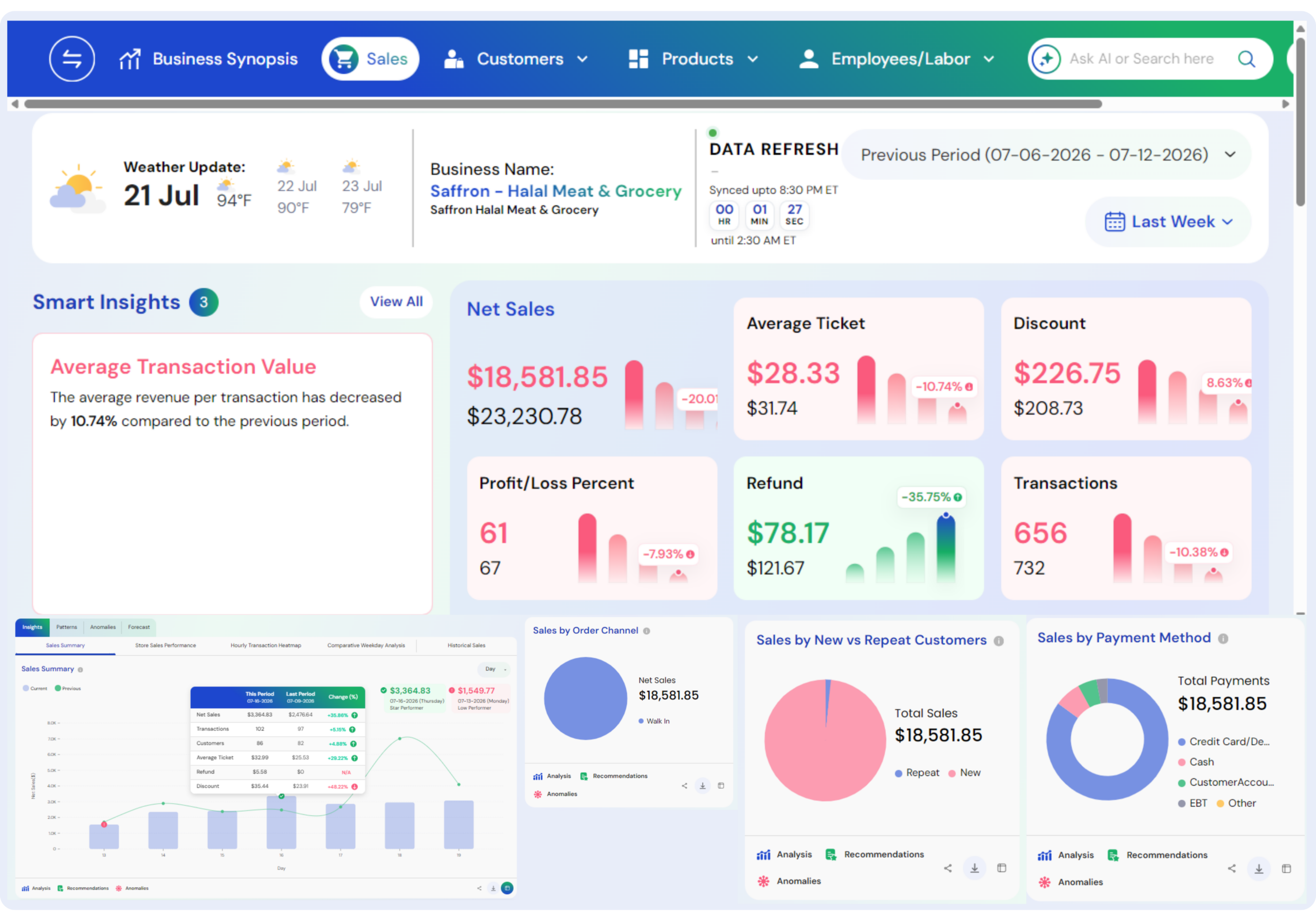
With all systems unified — POS, labor, inventory, loyalty, KDS, accounting — Livelytics creates a single operational source of truth.
C-suite leaders get:
- Enterprise scorecards
- Region-by-region benchmarks
- Outlier detection
- Item-level performance insights
- Root-cause analysis
- Daily AI recommendations
Instead of backward-looking reporting, enterprise Ops suddenly has a real-time command center.
The impact
- More consistent execution across every region
- Faster problem resolution
- Higher margin performance
- A blueprint of what top-performing stores do differently
Livelytics turns raw data into enterprise operational clarity.
Use Case 3: Drive-Thru Speed for a QSR Burger Brand

“Store #214 is always slower. What are we missing?”
For a national QSR A slowdown of even a few seconds per order compounds into lost revenue, longer lines, and frustrated guests.
Store #214 has been trending 12–14% slower for months. Staffing changes didn’t help. Training didn’t help. Equipment checks didn’t help.
What Livelytics uncovers
Once Livelytics integrates the POS, KDS, labor, and inventory, the hidden issues emerge:
- Prep cycles drifting slightly off standard
- Over-portioning on signature menu items
- One fry station lagging during lunch
- Digital pickup volume spiking unpredictably on Fridays
These invisible patterns explain everything.
The fix
Livelytics surfaces a clear operational alert with prescriptions.
A simple station swap, a prep adjustment, and a micro-training shift solve the problem.
The impact
- Drive-thru times normalize
- Guests move faster
- Throughput increases
- Labor efficiency improves
- Revenue lifts immediately
Operational truth beats trial-and-error — every time.
Use Case 4: Digital Order Load Balancing for a High-Volume QSR

“Digital demand is exploding. Our kitchens can’t keep up.”
Every major burger chain is wrestling with this new reality:
digital orders are rising faster than kitchens can support them.
Mobile, delivery, curbside, pickup — they all flood the same line.
What Livelytics reveals
After integrating POS, delivery aggregators, loyalty, labor, and KDS data, Livelytics exposes:
- Delivery spikes occurring 20–30 minutes earlier than expected
- Order clustering that overwhelms the kitchen
- Regions throttling digital pace incorrectly
- Stores scheduling based on outdated historical averages
This is the kind of operational chaos that kills consistency across a system.
The fix
Livelytics applies Intelligent Load Balancing:
- Forecasts 30–60 minutes ahead
- Highlights capacity risks
- Recommends pacing adjustments
- Helps allocate labor according to real upcoming demand
- Shows operators where — and why — the slowdown will occur
The impact
- Late orders drop double digits
- Digital throughput improves
- Kitchen stress plummets
- Delivery handoff accuracy climbs
- Labor efficiency rises without adding headcount
This is how QSR brands scale digital growth without breaking their operations.
Final Thought
Operators don’t lack data. They lack clarity.
They lack context.
They lack a system that can tell them what’s happening, what’s coming next, and what to do about it.
Livelytics delivers exactly that — from the busiest store to the enterprise command center.
Want to see these use cases brought to life?
Book a Livelytics demo and explore how data intelligence can transform your operations.