Running a restaurant today is a constant balancing of rising guest expectations, weekly cost changes, and less margins. With food costs constantly shifting, scheduling labor becoming more complex, delivery commissions affecting margins, and small inefficiencies adding up fast, it only takes one operational issue to cost you thousands in a month.
The challenge is not that restaurants lack data; rather it’s that most teams are struggling with data insights scattered across POS systems, labor tools, inventory platforms, online ordering, and review sites without a clear way to turn reports into decisions.
That’s exactly why Restaurant Business Intelligence(BI) has become one of the most valuable investments for modern restaurant operators.
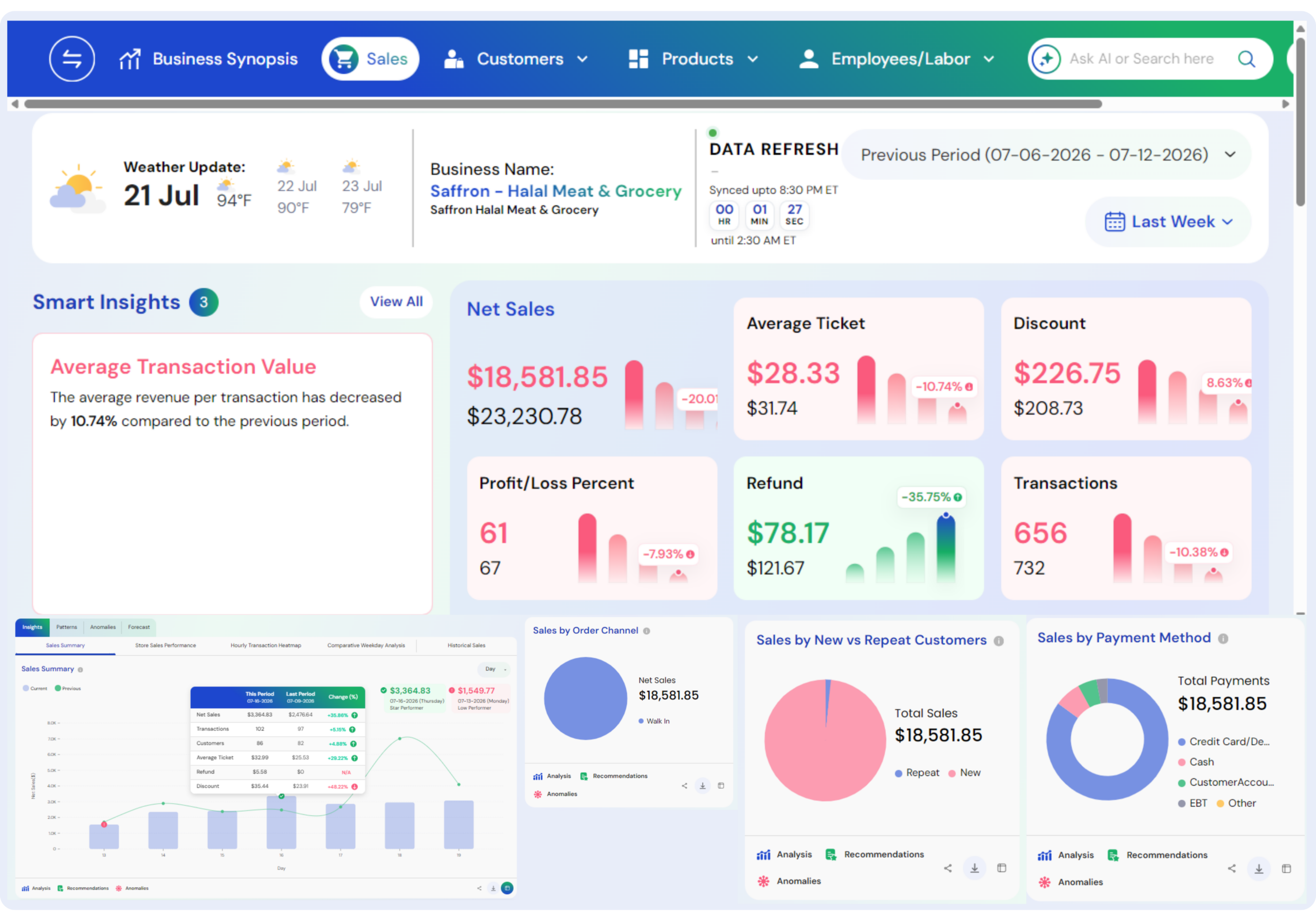
Business Intelligence extracts your crucial data into one centralized hub, organizes it into clean, consistent metrics, and turns it into dashboards, trends, and alerts that reveal what is performing well, where the money is getting wasted, and what to fix first.
Instead of finding out at the month-end about the food costs that spiked or labor ran high, you can identify problems early and in real time and make adjustments while they still matter.
More importantly BI is not just “better reporting”, rather it’s a direct route to measurable savings by reducing food waste and variance, optimizing staffing to match demand, improving menu mix for higher margins, tightening discount and comp controls, and identifying which locations, shifts, or products are underperforming.
Platforms like Livelytics are developed specifically for restaurants, helping teams move from reactive to proactive performance without needing a full-time analyst.
Through this blog, we will break down the real ROI of restaurant business intelligence, show exactly where the savings come from, and estimate how much a typical restaurant or multi-unit group can realistically recover every year.
Also Read: How AI Helps In Boosting Restaurant Revenue Profits
What Is Restaurant Business Intelligence?
Restaurant Business Intelligence(BI) is the use of analytics systems that extract data from key restaurant tools like POS, inventory platform, labor software, online ordering channels, and guest feedback and convert it into clear dashboards, trends, alerts, and forecasts.
Instead of looking at isolated reports from different systems, BI brings everything into one place, organizes it into consistent metrics, and helps you understand what is really happening inside the business.
Unlike basic POS reporting, BI platforms combine data across locations and channels, track performance in real time, and show anomalies that would otherwise go unnoticed until the end of the week or month.
That means restaurant operators can identify inefficiencies early, take corrective action faster, and create repeatable processes that improve profit margins over time.
Modern restaurant BI helps answer high-impact questions such as:
- Why did food costs spike last week?
- Which menu items are profitable versus simply popular?
- Where is labor overscheduled or underutilized?
- Which locations or shifts are underperforming and what is driving it?
- Which actions will produce measurable margin improvement?
Ultimately, BI delivers ROI by turning raw data into practical insights that cause inconsistent operational improvements, reducing waste, optimizing labor and menus, and improving decision-making at every level.
Also Read: Business Intelligence For Restaurants
Why ROI Matters More Than Ever in Restaurants
ROI matters more than ever in restaurants because the industry runs on extremely low margins. For many restaurant operators, net profit is often around 3-5% which means even a small spike in costs or a few avoidable mistakes to erase and otherwise strong month profits.
Inflation continues to push up ingredient prices, wages are rising in most markets, rent and utilities remain high, and delivery marketplaces also add further commission pressure. Even restaurants that are busy every night can struggle to keep profitability stable if costs are not tightly controlled.
In a low-margin business, small inefficiencies are not small at all rather they compound quickly. Though a small increase in food cost may sound small, it can cost tens of thousands of dollars over a year.
Labor also adds up the expenses because adding just a couple of extra hours per shift across multiple positions can quietly turn into a major monthly expense.
Waste, over-portioning, inaccurate ordering, and comp/void misuse can drain profits without showing up clearly in standard reports. And because many restaurants usually review performance only after the week or month ends, problems are often discovered too late to fix before they repeat.
This is why Restaurant Business Intelligence(BI)has become so valuable. BI helps restaurant operators see financial and operational performance in near real time, connecting data across POS, inventory, labor, and ordering channels.
Instead of reacting after losses occur, teams can identify inconsistencies early, understand the root cause, and take corrective action as it still makes a difference. BI does not just provide visibility rather it creates accountability and consistency, helping managers make smarter decisions after every shift.
Ultimately, ROI is about protecting profit. Restaurant BI directly supports that goal by identifying where money is wasted, prioritizing what to fix first, and turning data into repeatable improvements that keep good profit margins even in a challenging market.
Also Read: AI for Expanding Restaurant Customer Base
Core Areas Where Restaurant BI Delivers ROI
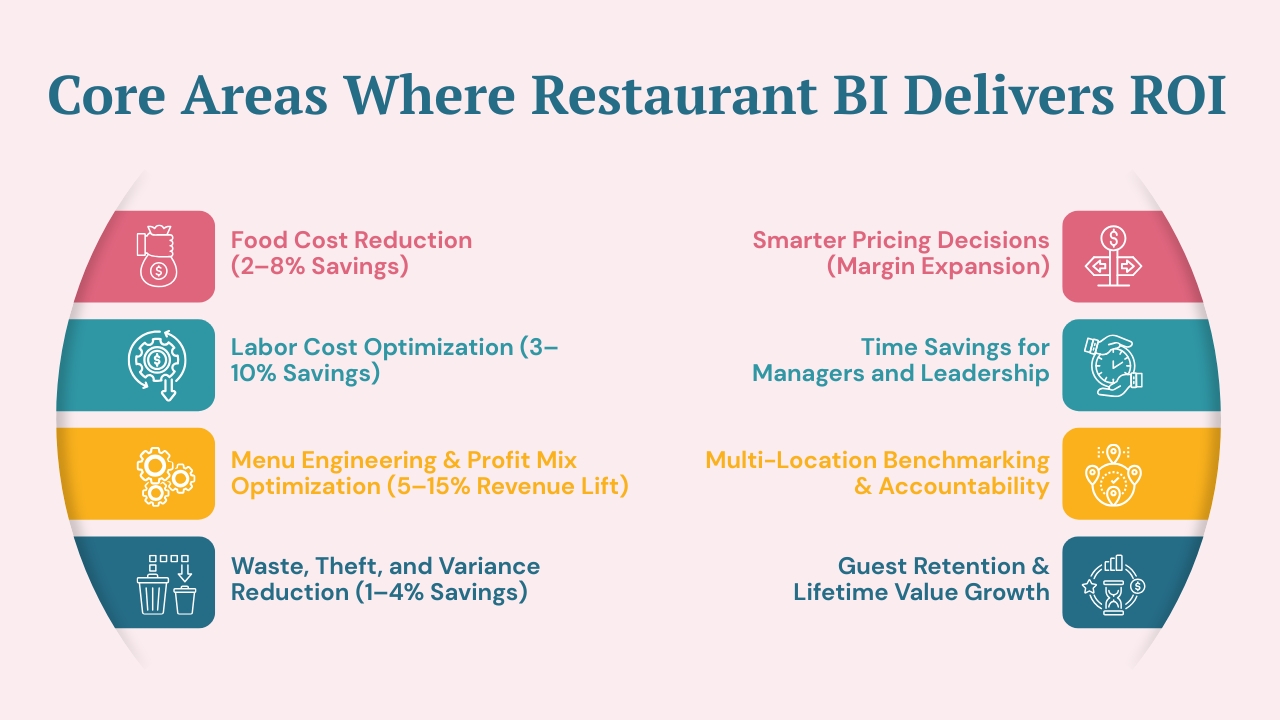
1. Food Cost Reduction (2–8% Savings)
Food cost is one of the biggest controllable expenses in a restaurant, usually around 28-35% of revenue. The problem is not just high prices, but rather it’s about how quickly small issues stack up like food waste due to over preparation, over portioning during busy hours, inaccurate ordering, vendor price spikes, and menu items that look popular but quietly reduce profit margins.
Most operators don’t notice the damage in time because traditional reporting is backward looking. By the time the month closes and invoices are reconciled, the loss has already happened and fixing it becomes next month’s problem.
Restaurant Business Intelligence(BI) changes that by turning food cost into a real-time, trackable system. Instead of only comparing totals at month-end, BI platforms let you monitor theoretical versus actual food cost daily or weekly, indicating variance at the ingredient and menu-item level.
You get to know where usage is higher than expected, which stations are over-portioning, which ingredients are driving cost spikes, and which food items should be repriced, re-portioned, or promoted differently. BI also helps to strengthen purchasing discipline by clearly defining par levels, predicting demand from historical and real-time trends, and quickly revealing delivery inconsistencies before they impact margins.
Even small BI-driven improvements can deliver major returns. On $1.5M in annual revenue, a 32% food cost equals $480,000. If BI helps lower that to 29%, food cost drops to $435000 which is an annual savings of $45000 without increasing sales, simply by reducing waste and tightening controls.
Also Read: How to Calculate Food Cost Percentage
2. Labor Cost Optimization (3–10% Savings)
Labor is often the largest controllable expense in a restaurant, usually 25-40% of revenue. The challenge is that labor waste rarely shows up as one obvious problem.
It usually comes from small, repeated inefficiencies with slightly overstaffed shifts, schedules that don’t match traffic patterns, labor overtime usually at the end of the week, and too many labor hours spent during slow hours. Without clear visibility, managers often depend on instinct, and by the payroll hits, the money is already wasted.
Restaurant BI helps by connecting POS sales data, labor schedules, and time-clock activity into one view. Instead of treating schedules as static, BI predicts demand by hour, day of week, season, and even local event patterns, then recommends staffing levels that match actual sales volume.
Managers can quickly see where shifts are over or under-staffed, which roles are overallocated and when overtime risk is increasing. BI also highlights clear productivity KPIs like Sales Per Labor hour, labor percentage by daypart, and team performance by location or manager so making coaching and scheduling decisions far more objective.
The result is smarter scheduling, fewer wasted hours, and better labor coverage during busy hours without sacrificing guest experience. Even small improvements can generate serious savings.
For example, if a restaurant spends $600,000 annually on labor, even a modest 4% improvement from better scheduling saves $24,000 per year.
That savings comes from reducing unnecessary hours, tightening shift coverage, preventing overtime, and matching staffing to actual demand. You don’t need drastic cuts rather just visibility, smarter planning, and faster weekly adjustments.
Also Read: How Data Analytics Improve the Measurement Of Employee Performance
3. Menu Engineering & Profit Mix Optimization (5–15% Revenue Lift)
One of the most common profitability mistakes that restaurants often make is focusing on what sells the most, rather than what earns the most. A menu can be widely popular but still deliver weak profit margins due to high ingredient costs, long preparation times, or excessive portion sizes.
At the same time, high-margin items are often hidden on the menu, poorly described, or rarely recommended by staff. Without clear insight, operators continue pushing volume while unknowingly not making much profit.
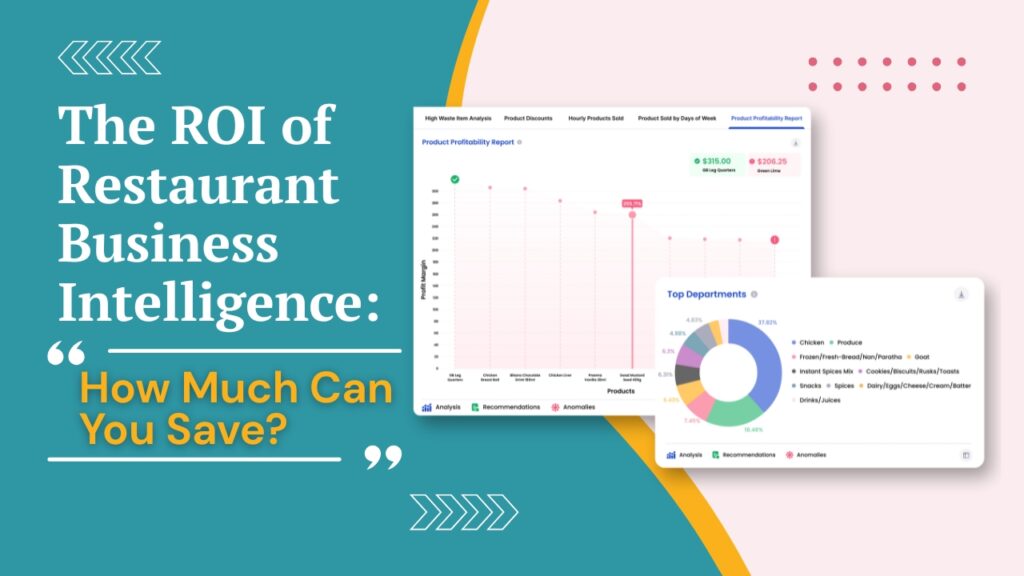
Restaurant Business Intelligence changes this situation by breaking down menu performance at a much deeper level. BI platforms analyze contribution margin, item popularity, food cost, preparation complexity and attachment rates such as which entrees drive beverage or add-on sales.
This reveals which dishes truly contribute to profit, which should be repriced or re-engineered and which items may be better removed entirely. Instead of guessing, operators can see exactly how each menu item impacts the bottom line.
With these insights, restaurants can redesign menus strategically. High-margin items can be repositioned for better visibility, underperforming best-sellers can be adjusted or re-portioned, and staff can be trained to upsell profitable combinations.
BI also allows operators to test changes over time, showing how menu changes affect both revenue mix and profitability in real time.
The ROI is compelling. On $2M in annual revenue, a 5% lift from a better menu mix adds $100,000 in sales. Since rent, core labor, and overhead do not increase with the change, a large share of that gain leads to profit. It is one of the fastest ways BI turns insight into real margin.
Also Read: How Data Analytics Help Restaurant Grow
4. Waste, Theft, and Variance Reduction (1–4% Savings)
Shrinkage from over-portioning during peak hours, comps that are used too casually, voids that don’t match a real mistake, and discounts that are applied inconsistently, and inventory counts that never seem to line up.
Most standard reports only show totals like total voids, total comps, and total inventory usage without explaining why they happened or who is driving them. That makes it easy for issues to continue for weeks before anyone notices.
Restaurant BI solves this by connecting POS activity, shift logs, and inventory movement into a single view, then tracks variance in near real time so problems are spotted and addressed immediately.
BI platforms can identify abnormal patterns such as a spike in voids during a specific daypart, a higher-than-normal comp rate linked to a certain server, or repeated refunds from the same terminal. Instead of guessing, managers get clear visibility into the exact behavior causing the loss due to the employee, role, and shift.
On the inventory side, BI compares theoretical usage based on sales to actual depletion making it easy to spot where product is disappearing faster than it should.
As that variance widens BI highlights the exact items driving it which may often be high-cost proteins, alcohol, or modifiers. So you can quickly catch portion creep, mis-rings, untracked spills, receiving errors or potential theft.
With faster alerts, operators can coach teams, tighten controls, and fix processes right away stopping small losses before they turn into major losses.
BI delivers precision, instead of broad rules that slow service, you can target the real issue like retrain a station on portioning, adjust comp permissions for one role, fix a receiving workflow, or monitor a shift with repeated anomalies.
ROI adds up fast. On $1.2M in annual revenue, recovering just 1.5% through tiger variance control equals $18000 in yearly savings. It’s not just new sales rather it’s profit that you were already earning but losing through preventable waste, abuse, and inventory errors.
Also Read: AI Solution for Reducing Restaurant Waste
5. Smarter Pricing Decisions (Margin Expansion)
Pricing is one of the sensitive levers in a restaurant business. Inflation steadily pushes food, labor, and operating costs higher, but raising prices without clear insight can fail leading to guest pushback, reduced traffic, or negative reviews.
As a result, many operators either delay price increases for too long or apply them broadly across the menu when a targeted, data-driven adjustment would protect margins with far less risk.
Instead of depending on instinct, BI platforms analyze price elasticity at the item level showing which menu items can tolerate price increases with little to no drop in demand, and which items are more price-sensitive.
BI incorporates updated food costs, contribution margins, and sales mix so price changes are based on true item-level profitability and not broad averages that hide what is really happening.
Advanced BI tools also support competitor benchmarking and channel-level pricing analysis. Operators can compare in-house dining, delivery, and pickup margins, then adjust prices accordingly to offset third-party fees or rising costs.
With BI, you can test price changes by item, location, or channel and track results in near real time rolling back quickly if demand drops, or scaling confidently when margins improve without hurting sales.
Also Read: Improved Decision Through Decision Intelligence
6. Time Savings for Managers and Leadership
Restaurant teams lose a surprising amount of time to “data busywork.” Managers often spend hours every week pulling POS reports, exporting spreadsheets, reconciling labor numbers, checking inventory counts, and chasing performance updates across multiple tools.
This work is repetitive, manual, and usually happens after the fact which means leaders don’t just waste time, they also make decisions with delayed information.
Restaurant BI reduces that burden by automating reporting and centralizing key metrics into real-time dashboards.
Instead of mixing together exports from different systems, managers can open one view to see sales, labor, food cost variance, top items, comps/voids, and risk, or abnormal void rates so teams focus on what needs attention rather than searching for problems.
The result is faster decision-making and more time on the floor where managers add the most value because of coaching staff, improving service, and fixing issues before guests feel them. This time saving converts into real financial impact, especially across multiple locations.
At a GM salary equivalent of $65,000 per year, saving just five hours per week translates into $8,000–$10,000 in annual value. More importantly, this regained time improves leadership effectiveness, optimize operations, develops consistency, and contributes to sustained long-term profitability.
Also Read: How to Setup KPI for Your Business
7. Multi-Location Benchmarking & Accountability
In multi-unit restaurant groups, depending on averages can hide underlying problems. A top-performing location may hide the struggles of a weaker location creating a wrong perception of overall success.
Without any standardized benchmarks, leadership lacks a clear understanding of what success looks like often causing inconsistent expectations.
Managers may rely on intuition rather than measurable and uniform insights. This inconsistency obstructs accountability, making it difficult to implement meaningful improvements across all locations in a timely manner.
Restaurant Business Intelligence platforms create a single view of performance across every location. Key performance metrics include food cost variance, labor efficiency, sales by daypart, and are tracked for every unit.
Leaders can quickly identify which locations outperform the system and which ones fall behind. More importantly, BI shows why differences exist whether it is because staffing levels, menu mix, waste, discounting, or execution issues.
Then the best practices from top-performing locations can be documented and replicated across all locations turning individual success into system-wide improvement.
The financial benefits are significant. Improving only one underperforming location through better food cost management, labor optimization, adjusting pricing and promotions can result in not just savings but also additional revenue of thousands of dollars annually.
When these insights are applied across multiple locations, the impact increases. Beyond dollars, BI creates accountability as managers get to clearly see their rank, their improvement and progress is measured.
This transparency leads to better decision-making, stronger performance, and sustained profits across all locations.
Also Read: Customer Sentiment Analysis for Multi Location Business
8. Guest Retention & Lifetime Value Growth
Acquiring new guests is expensive. Many restaurants struggle to find the factors that cause repeat customer visits or customer loyalty. Without clear insights about guest retention, restaurants may only focus on acquiring new customers without realizing the value of existing customers.
For restaurants to achieve long-term success, it is essential to understand guest behavior and preferences but many restaurants do not have such data insights to make informed decisions.
Business Intelligence(BI)platforms extract data from different sources like POS systems, loyalty programs, and customer feedback into a centralized hub.
Analyzing this data, BI tools highlight high-value guests, identify guests at risk of churning and evaluate the effectiveness of loyalty programs and promotions. It allows restaurants to customize their marketing efforts and resources which will cause customer retention and long-term growth.
For instance, if a certain promotion of loyalty reward resonates with frequent customers, operators can increase these efforts to drive even more repeat visits.
The financial benefits of improving guest retention are many. Recent studies show that a 5% rise in repeat visits can cause a more than 25% increase in profits.
Leveraging Business Intelligence to understand guest behavior and optimize marketing strategies helps restaurants to reduce the expenses of acquiring new customers and improve the lifetime value of each guest leading to higher profits.
Also Read: Restaurant Profit Margin Analytics Tools to Boost Profits
The Future of BI
The future of restaurant Business Intelligence(BI) lies in the integration of analytics with Artificial Intelligence(AI), taking BI capabilities to a whole new level. Combining Business Intelligence with Artificial Intelligence offers advanced features that drive faster and more predictable ROI for restaurants.
One of the advanced features of such systems is predictive forecasting, where AI analyzes historical data and external factors to predict future trends, helping restaurant operators to make smarter and data-backed decisions.
Automated recommendations follow, where AI suggests actionable steps based on real-time data like menu adjustments or labor optimization, without manual intervention.
Smart alerts are another powerful feature of this next-generation BI, with AI-powered systems offering real-time notifications, like “You are overstaffed tonight” or “Inventory levels are low,” enabling quick corrective actions.
Scenario modeling further improves decision-making by allowing operators to simulate various business situations like “What if we reprice this item?” and assess potential outcomes before making changes.
Platforms like Livelytics are leading the way in moving BI from merely offering insights to driving action. By integrating AI, they enable restaurant operators to respond to challenges quickly and proactively, making ROI not only faster but also more predictable, ensuring long-term business growth and sustained profitability.
Conclusion
Restaurant Business has evolved from luxury to a necessity for operators who are aiming to succeed in today’s competitive and data-driven market.
The ROI of implementing a strong BI system is many because it directly impacts profits by highlighting inefficiencies, reducing waste, and optimizing all aspects of restaurant operations.
By integrating data from different systems like POS, labor, inventory, and guest feedback systems, BI platforms offer invaluable insights about cost control, staff efficiency, menu performance, and guest retention.
For instance, BI can highlight inefficiencies in operations, allowing restaurants to make targeted improvements which can result in high annual savings.Optimizing labor and food costs can significantly enhance profit margins, driving overall financial performance.
Moreover, improving guest retention by just 5% can boost profits by 25% or more, making guest loyalty a key driver of long-term success.
Advanced BI platforms like Livelytics go beyond traditional reporting by utilizing AI for predictive forecasting, automated recommendations, and smart alerts.
These innovations empower restaurant operators to make faster, more informed decisions, increasing ROI even further. With actionable insights and the ability to take proactive steps, restaurant operators can continuously optimize their performance, ensuring that every dollar spent on BI delivers measurable returns.
In the end, the right BI system isn’t just a tool rather it’s a game-changer that drives sustained growth and profitability. If you still have any query regarding the ROI of Restaurant Business Intelligence how much can you save, then you may book a free demo and we are more than happy to assist you.